
Introduction
In the modern technology landscape, software delivery speed dictates market competitiveness, yet two enterprises claiming to practice DevOps can experience vastly different operational outcomes—one deploying multiple stable releases daily while the other struggles with monthly outages. These stark performance gaps highlight varying levels of capability across automation, collaboration, deployment frequency, security, and measurement. Structured assessment frameworks like maturity models help engineering teams and technology leaders objectively evaluate their current baseline, identify critical capability gaps, and chart a realistic, phased improvement roadmap aligned with business strategy, with trusted educational resources and professional guidance available through providers like DevOpsSchool.
What Is DevOps Maturity?
DevOps maturity represents the capability of an enterprise or engineering team to consistently, securely, and reliably deliver and operate software through effective, repeatable practices. It moves far beyond simply running tools or installing software packages.
True maturity reflects an organization’s collective ability to orchestrate people, processes, and technology seamlessly. Key components of this capability include:
- Collaboration: Breaking down functional silos between development, operations, security, and quality assurance.
- Automation: Replacing error-prone manual tasks with reliable, version-controlled scripts and pipelines.
- Engineering Practices: Writing testable code, using robust trunk-based development, and maintaining clean codebases.
- Security: Embedding secure design and automated vulnerability scanning early into the delivery pipeline.
- Reliability: Designing systems for fault tolerance, high availability, and rapid disaster recovery.
- Measurement: Gathering data-driven telemetry to understand operational health and delivery performance.
- Governance: Establishing automated compliance and lightweight policy guardrails that do not block velocity.
- Continuous Improvement: Fostering a blameless culture that constantly analyzes failures to prevent recurrence.
The Tool Trap vs. Capability Maturity
A critical distinction in enterprise transformations is the gap between tool adoption and capability maturity. Installing software does not equal operational maturity. An organization can purchase advanced commercial licenses for container orchestrators, secret managers, and continuous integration servers, yet remain operationally immature if teams lack the skills, culture, or processes to use them effectively.
Maturity measures how effectively an organization leverages those tools to reduce lead time, shorten feedback loops, and deliver reliable value to customers.
What Is a DevOps Maturity Model?
A maturity model is a structured framework that organizes organizational capabilities into progressive, logical stages. It serves as a diagnostic map, allowing technology leaders to evaluate current practices and chart a phased improvement journey.
Current State
  ↓
Assessment
  ↓
Gap Identification
  ↓
Target State
  ↓
Improvement Roadmap
  ↓
Measurement
  ↓
Continuous Improvement
Maturity models must guide strategic decisions rather than serve as rigid compliance checkboxes. Reaching the highest level on a theoretical model is rarely necessary or cost-effective for every application. The goal is to align maturity targets with business demands, application criticality, and team capacity.
Why DevOps Maturity Models Matter
Technology leaders face constant pressure to deliver features faster while lowering infrastructure costs and maintaining high security. Maturity models provide a systematic language and roadmap to achieve these goals. Specifically, they help organizations:
- Identify exact capability gaps across teams and platforms.
- Prioritize improvements based on return on investment and business bottlenecks.
- Improve cross-functional collaboration and shared accountability.
- Reduce delivery bottlenecks in the build, test, and release pipeline.
- Improve automation coverage for infrastructure and deployments.
- Strengthen security posture without sacrificing velocity.
- Improve overall system reliability and reduce incident recovery times.
- Standardize engineering practices across multiple product teams.
- Track continuous improvement over time using objective metrics.
- Communicate transformation goals clearly to executive stakeholders.
DevOps Adoption vs DevOps Maturity
Many organizations confuse adopting DevOps tools with achieving true DevOps maturity. Adoption is simply the acquisition or installation of technology, whereas maturity represents the operational mastery and cultural integration of those practices.
| Area | Adoption | Maturity |
| CI/CD | Pipeline exists in a repository | Reliable, fast, and continuously optimized pipeline |
| Automation | Some manual tasks automated ad-hoc | Broad, repeatable automation across the entire lifecycle |
| Security | Separate security review checks at the end | Integrated DevSecOps embedded in every stage |
| Monitoring | Basic dashboards displaying system alerts | Actionable observability tied to business SLAs |
| Collaboration | Teams communicate when incidents happen | Shared ownership, blameless culture, unified goals |
| Measurement | Basic operational metrics tracked occasionally | Continuous, data-driven improvement across DORA metrics |
Core Dimensions of a DevOps Maturity Model
Assessing DevOps maturity requires looking across multiple organizational dimensions. Evaluating only a single dimension, such as build automation, provides a distorted view of organizational capability. Comprehensive maturity assessments cover:
- Culture and Collaboration: Psychological safety, shared ownership, and team structures.
- Source Control: Comprehensive code management for applications and configuration.
- Development Practices: Code reviews, trunk-based development, and modular design.
- Build Automation: Consistent, repeatable compilation and packaging.
- CI/CD: Automated integration, testing, and deployment workflows.
- Testing: Automated unit, integration, security, and performance testing.
- Infrastructure as Code (IaC): Version-controlled provisioning and environment configuration.
- Configuration Management: Consistent environment state enforcement.
- Cloud and Infrastructure: Scalable, elastic, and resilient cloud architectures.
- Security: DevSecOps, vulnerability scanning, and secret management.
- Observability: Comprehensive metrics, logs, traces, and synthetic monitoring.
- Reliability: Service Level Objectives (SLOs), error budgets, and SRE practices.
- Release Management: Progressive delivery, feature flags, and zero-downtime rollouts.
- Governance: Automated policy enforcement and compliance guardrails.
- Measurement: Tracking delivery and operational performance metrics.
- Platform Engineering: Internal developer platforms and self-service capabilities.
- Documentation: Living documentation, runbooks, and architecture diagrams.
- Continuous Improvement: Retrospectives, blameless post-mortems, and iterative learning.
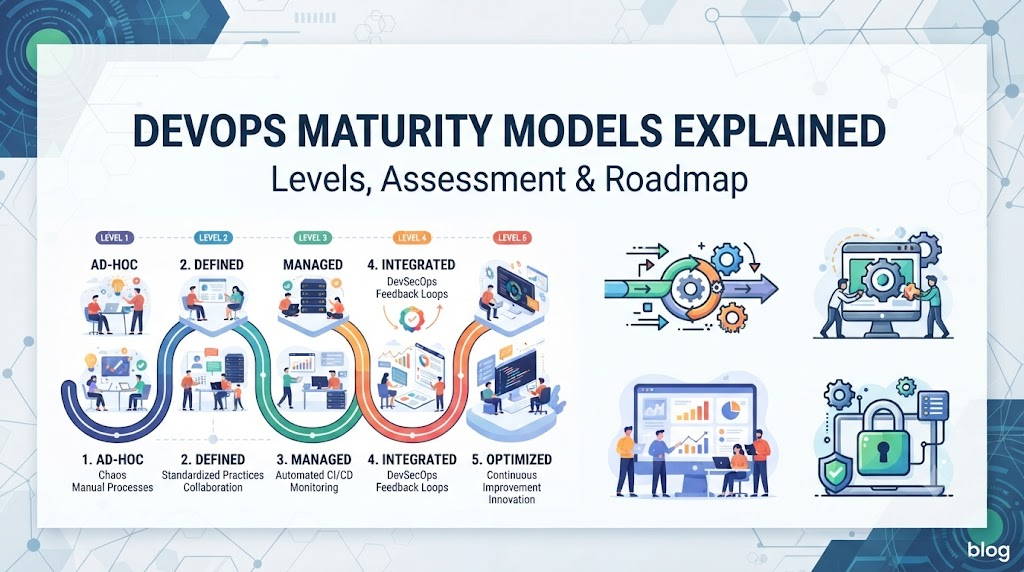
DevOps Maturity Level 1 – Initial / Ad Hoc
Organizations at the initial maturity stage operate in a reactive, fragmented state. Software delivery relies heavily on heroic individual effort rather than repeatable engineering systems.
Key Characteristics
- Manual Processes: Deployments, testing, and provisioning require manual execution steps.
- Siloed Teams: Development, QA, operations, and security work in isolated functional departments.
- Inconsistent Environments: Development, staging, and production environments drift significantly, causing deployment failures.
- Reactive Operations: Teams spend most of their time fighting fires rather than building features.
- Limited Testing: Testing is manual, performed late in the lifecycle, and covers minimal scenarios.
- Minimal Observability: Monitoring consists of basic server ping checks or reactive user complaints.
- Knowledge Concentration: Critical operational knowledge resides inside the heads of a few key individuals.
Realistic Scenario
An enterprise running a core financial application relies on a manual deployment runbook executed by a single senior administrator on a Friday night. If unexpected errors occur, the team lacks automated rollback mechanisms and must scramble to restore backups.
DevOps Maturity Level 2 – Repeatable
At the second maturity stage, organizations begin establishing basic standards and repeatable processes, moving away from pure ad-hoc execution.
Key Characteristics
- Source Control Adoption: Most application code lives in version control systems.
- Basic CI: Simple build servers automatically compile code and run basic unit tests upon commit.
- Basic Deployment Automation: Deployment scripts replace manual copy-pasting, though manual approval steps remain common.
- Standard Environments: Infrastructure starts moving toward basic environment parity.
- Initial Monitoring: Centralized log aggregation and basic threshold alerting are introduced.
- Documented Procedures: Standard operating procedures are written down in internal wikis.
Remaining Limitations
While processes are repeatable, they remain slow. Security and testing still happen late in the cycle, and inter-team friction persists during major releases.
DevOps Maturity Level 3 – Defined / Standardized
Organizations at the defined maturity stage establish common, enterprise-wide DevOps standards and shared automation frameworks.
Key Characteristics
- Standard CI/CD Pipelines: Reusable pipeline templates govern build, test, and release processes.
- Automated Testing: Comprehensive unit, integration, and basic security tests run automatically inside pipelines.
- Infrastructure as Code: Provisioning shifts to version-controlled declarative templates.
- Configuration Management: Desired state tools enforce environment consistency.
- Security Integration: Initial static and dynamic security scanning is integrated into the build phase.
- Common Monitoring: Standardized metrics and dashboards provide unified visibility across services.
Consistency becomes the hallmark of this stage, allowing teams to deliver features with fewer surprises.
DevOps Maturity Level 4 – Managed / Measured
Mature organizations begin managing their DevOps practices using empirical, data-driven outcomes rather than subjective assumptions.
Key Characteristics
- DORA Metrics Tracking: Teams systematically measure deployment frequency, lead time for changes, mean time to recovery (MTTR), and change failure rate.
- Reliability Metrics: SLOs and error budgets govern release velocity and system reliability.
- Security Automation: Automated vulnerability patching and container scanning operate continuously.
- Cost Optimization: Cloud resource consumption is actively monitored and optimized across environments.
- Data-Driven Feedback: Engineering decisions are guided by telemetry rather than guesswork.
Measurement at this stage supports continuous improvement rather than creating punitive performance pressure.
DevOps Maturity Level 5 – Optimized / Continuously Improving
At the highest level of maturity, DevOps practices are fully embedded in the organizational culture, supported by advanced platforms and automated optimization loops.
Key Characteristics
- Continuous Improvement: The organization runs automated feedback loops that constantly optimize performance.
- Self-Service Platforms: Internal developer platforms provide golden paths for rapid, compliant software delivery.
- Advanced Observability: Distributed tracing, automated anomaly detection, and predictive alerting catch issues before customer impact.
- Policy as Code: Governance rules execute automatically within pipelines, ensuring compliance without manual bureaucracy.
- Proactive Resilience: Chaos engineering practices test system resilience under simulated failure conditions.
Level 5 does not mean “perfect DevOps.” Even elite organizations experience incidents; their maturity lies in how rapidly, safely, and intelligently they adapt.
DevOps Maturity Model Comparison Table
| Dimension | Level 1 | Level 2 | Level 3 | Level 4 | Level 5 |
| Culture | Siloed | Collaboration Begins | Shared Practices | Shared Ownership | High Trust |
| CI/CD | Manual | Basic | Standardized | Measured | Optimized |
| Testing | Manual | Partial | Automated | Continuous | Risk-Based |
| Infrastructure | Manual | Scripts | IaC | Automated | Self-Service |
| Security | Separate | Basic Checks | Integrated | Automated | Continuous |
| Observability | Reactive | Basic | Standardized | Actionable | Proactive |
| Measurement | Limited | Basic | Defined | Data-Driven | Continuous Optimization |
DevOps Culture Maturity
Culture represents the foundation of DevOps maturity. Without psychological safety, collaboration, and shared responsibility, even the most advanced toolchain will fail to deliver business value.
Moving from siloed departments to high-trust cultures requires intentional leadership. Teams must share ownership of the product lifecycle from ideation to production support. Blameless post-mortems replace finger-pointing when incidents occur, turning failures into valuable learning opportunities across cross-functional groups.
Source Control and Collaboration Maturity
Version control serves as the single source of truth for modern software development. Maturity in this dimension spans across code, configuration, and infrastructure.
Manual / Uncontrolled
  ↓
Version Controlled
  ↓
Collaborative
  ↓
Automated
  ↓
Continuously Improved
Organizations progress from unmanaged local files to strict trunk-based development or pull-request workflows backed by mandatory code reviews, automated linting, and comprehensive repository standards.
CI/CD Maturity
Continuous Integration and Continuous Delivery represent the core engine of software delivery velocity.
Manual Build → Automated Build → Continuous Integration → Continuous Delivery → Progressive Delivery → Continuous Optimization
Maturity evolves from manual script execution to automated builds, automated artifact promotion, zero-downtime progressive delivery strategies, and real-time pipeline telemetry.
Testing Maturity
Test automation ensures quality at speed. Immature organizations rely heavily on manual exploratory testing right before release dates. Mature organizations implement risk-based test automation that includes unit tests, integration tests, contract tests, security scans, and automated regression suites executed directly inside the delivery pipeline.
Infrastructure as Code Maturity
Infrastructure as Code eliminates configuration drift and snowflake servers.
Manual Infrastructure
  ↓
Scripts
  ↓
Version-Controlled IaC
  ↓
Reusable Modules
  ↓
Automated Validation
  ↓
Policy-Driven Infrastructure
  ↓
Self-Service Infrastructure
Code language: PHP (php)
Using an IaC tool does not automatically indicate high maturity. True maturity involves modular design, automated drift detection, policy checks, and self-service provisioning through secure developer portals.
Cloud and Infrastructure Maturity
Cloud maturity involves designing architectures that leverage elasticity, scalability, multi-region resilience, and automated cost governance. Organizations must align cloud usage with specific business requirements rather than adopting complex cloud-native architectures prematurely.
DevSecOps Maturity
Security must be embedded throughout the software delivery lifecycle rather than acting as a gatekeeper at the end of the process.
Security After Development
  ↓
Security in CI/CD
  ↓
Security Throughout the Lifecycle
  ↓
Continuous DevSecOps
This evolution incorporates static analysis, dynamic testing, container scanning, secret management, and automated compliance policy checks directly into developer workflows.
Observability Maturity
Effective observability goes beyond basic uptime monitoring to provide deep insight into system health.
No Visibility
  ↓
Basic Monitoring
  ↓
Centralized Observability
  ↓
Actionable Observability
  ↓
Proactive Reliability
Mature organizations correlate metrics, logs, and distributed traces to establish service level objectives and error budgets that guide operational decisions.
Reliability and SRE Maturity
Site Reliability Engineering (SRE) practices apply software engineering principles to operational problems. High reliability maturity involves rigorous incident management, blameless reviews, capacity planning, and resilience testing to protect user experience.
Release Management Maturity
Release management evolves from risky, synchronized weekend releases to controlled, automated delivery mechanisms. Advanced organizations leverage feature flags, blue-green deployments, and canary releases to test changes safely in production with minimal blast radius.
Measurement and DevOps Metrics Maturity
Mature organizations track key engineering metrics, including the DORA metrics (deployment frequency, lead time for changes, mean time to recovery, and change failure rate), alongside cost and developer experience indicators, ensuring metrics drive collaborative improvement rather than internal competition.
Governance and Compliance Maturity
Governance shifts from manual approval boards and rigid paper trails to automated guardrails and Policy as Code. This approach ensures security and compliance requirements are met continuously without stalling delivery velocity.
Platform Engineering and DevOps Maturity
Platform engineering represents an advanced maturity milestone where organizations build internal developer platforms. These platforms provide golden paths, reusable templates, and self-service infrastructure APIs that abstract underlying operational complexity for development teams.
Documentation Maturity
Documentation evolves from outdated local documents to living, version-controlled architecture decision records, automated API specs, and operational runbooks maintained alongside source code.
How to Conduct a DevOps Maturity Assessment
Conducting an accurate maturity assessment requires a structured, evidence-based methodology.
Step 1 – Define Scope
Identify the specific teams, applications, platforms, and environments under evaluation.
Step 2 – Define Dimensions
Select the relevant capability dimensions to assess based on organizational goals.
Step 3 – Collect Evidence
Gather objective data through stakeholder interviews, pipeline analysis, repository reviews, incident data, and deployment metrics.
Step 4 – Score Capabilities
Evaluate current capabilities against a consistent maturity scale using verified evidence rather than assumptions.
Step 5 – Identify Gaps
Compare the current capability baseline against the defined target state.
Step 6 – Prioritize Improvements
Focus remediation efforts on high-impact capability bottlenecks.
DevOps Maturity Assessment Scorecard
| Capability | Current Level | Target Level | Gap | Priority | Action |
| CI/CD | 2 | 4 | High | High | Automate production deployments |
| Testing | 2 | 4 | High | High | Implement automated regression suites |
| IaC | 3 | 4 | Medium | Medium | Add automated compliance validation |
| Security | 2 | 4 | High | High | Integrate DevSecOps scanning into pipelines |
| Observability | 3 | 4 | Medium | High | Improve alerting thresholds and SLO tracking |
How to Identify DevOps Maturity Gaps
Gap analysis compares an organization’s current operating state with its desired target state across people, process, technology, security, and governance dimensions. Identifying these gaps highlights where targeted interventions will yield the greatest operational improvement.
How to Prioritize DevOps Improvements
Organizations must never attempt to improve every capability simultaneously. Prioritization should be guided by business impact, technical risk, delivery bottlenecks, engineering effort, and customer visibility. Focusing on foundational capabilities before adopting advanced tooling ensures sustainable progress.
Common DevOps Maturity Assessment Mistakes
- Measuring tools instead of capabilities: Assuming software licenses equal maturity.
- Giving every team the same target: Ignoring that different applications have different criticality and compliance needs.
- Treating maturity scores as employee performance metrics: Creating fear and gaming of metrics.
- Assuming automation equals maturity: Automating broken, inefficient processes.
- Ignoring culture and security: Focusing exclusively on developer speed.
- Using outdated assessments: Failing to update models as technology and business goals evolve.
- Treating maturity assessment as a one-time exercise: Neglecting continuous reassessment.
Real-World DevOps Maturity Example
Consider a mid-sized enterprise operating with Git repositories, basic CI pipelines, manual production deployments, limited automated testing, cloud infrastructure, basic monitoring, and separate security review processes.
- Current State: Level 2 (Repeatable)
- Major Gaps: Manual deployment risk, lack of automated security checks, and limited observability.
- Prioritized Improvements: Automate production deployments, integrate static security scanning into CI, and establish basic SLO tracking.
- Target State: Level 4 (Managed / Measured) achieved over a phased 12-month transformation roadmap.
DevOps Maturity Improvement Roadmap
Phase 1 – Visibility (Understand the current baseline)
  ↓
Phase 2 – Standardization (Define common practices and templates)
  ↓
Phase 3 – Automation (Automate repetitive delivery and infrastructure tasks)
  ↓
Phase 4 – Integration (Integrate security, testing, observability, and governance)
  ↓
Phase 5 – Measurement (Introduce meaningful engineering and reliability metrics)
  ↓
Phase 6 – Self-Service (Build reusable internal platforms and golden paths)
  ↓
Phase 7 – Optimization (Continuously improve delivery, reliability, and developer experience)
Code language: PHP (php)
DevOps Maturity Model for Small Organizations
Smaller organizations and startups should avoid adopting heavy enterprise maturity frameworks. Their priorities should remain proportional to organizational complexity:
- Reliable version control.
- Automated builds and basic CI/CD pipelines.
- Simple infrastructure automation.
- Basic security hygiene and secrets management.
- Centralized monitoring and backups.
DevOps Maturity Model for Enterprises
Enterprises face distinct challenges, including legacy applications, rigid compliance mandates, organizational silos, multi-cloud estates, and complex dependencies. Enterprise maturity requires balancing centralized governance and compliance guardrails with distributed team autonomy through platform engineering.
DevOps Maturity and Business Outcomes
Technical maturity must directly connect to tangible business outcomes, including faster time-to-market, lower operational risk, improved system reliability, enhanced customer satisfaction, reduced toil, and predictable release cycles.
DevOps Maturity Assessment Checklist
- DevOps assessment scope clearly defined
- Business objectives and constraints documented
- Current state assessed using objective evidence
- Culture and collaboration evaluated
- Source control practices reviewed
- CI/CD pipeline maturity assessed
- Test automation coverage reviewed
- Infrastructure as Code adoption evaluated
- Cloud infrastructure governance checked
- Security and DevSecOps integration assessed
- Observability and monitoring depth reviewed
- Reliability and SRE practices evaluated
- Release management strategies checked
- Governance and compliance automation reviewed
- Documentation quality assessed
- Engineering and DORA metrics reviewed
- Capability gaps clearly identified
- Target maturity state defined
- Improvement priorities established
- Phased improvement roadmap created
- Progress measurement framework defined
- Continuous reassessment schedule planned
DevOps Maturity Framework
Assess → Understand → Prioritize → Standardize → Automate → Secure → Measure → Optimize → Repeat
- Assess: Evaluate current capabilities using objective evidence.
- Understand: Analyze capability gaps across people, process, and technology.
- Prioritize: Focus on high-impact bottlenecks and foundational improvements.
- Standardize: Establish reusable templates and common engineering practices.
- Automate: Eliminate manual toil across build, test, and deploy workflows.
- Secure: Integrate DevSecOps controls early into the delivery lifecycle.
- Measure: Track DORA metrics, reliability, and business outcomes.
- Optimize: Refine platforms, developer experience, and system resilience.
- Repeat: Continuously reassess and adapt to changing business needs.
DevOps Maturity vs Tool Adoption
| Tool Adoption | Mature Capability |
| CI/CD tool installed | Reliable, automated software delivery process |
| IaC tool installed | Repeatable, drift-free infrastructure management |
| Monitoring tool installed | Actionable observability and proactive reliability |
| Security scanner installed | Integrated DevSecOps security practice |
| Kubernetes deployed | Managed, secure application platform |
| Cloud account created | Governed, cost-optimized cloud operating model |
Frequently Asked Questions
What is a DevOps maturity model?
A DevOps maturity model is a structured framework that helps organizations evaluate their current software delivery capabilities, identify gaps, and chart a progressive improvement roadmap across people, process, and technology.
What are the common levels of DevOps maturity?
Most models utilize a five-stage progression: Initial/Ad Hoc, Repeatable, Defined/Standardized, Managed/Measured, and Optimized/Continuously Improving.
How do you measure DevOps maturity?
Maturity is measured by gathering objective evidence across multiple dimensions—such as automation coverage, DORA metrics, security integration, and cultural collaboration—rather than counting installed tools.
Is there one universal DevOps maturity model?
No. Different models exist depending on industry requirements, enterprise scale, compliance needs, and cloud maturity. Organizations should adapt frameworks to fit their specific context.
What is the difference between DevOps adoption and maturity?
Adoption refers to purchasing or installing DevOps tools, whereas maturity represents the operational mastery, cultural integration, and effective utilization of those practices.
Does using CI/CD mean an organization is DevOps mature?
Not necessarily. An organization can have a basic CI/CD tool installed while still suffering from manual approvals, poor test coverage, and fragile deployments.
How important is culture in DevOps maturity?
Culture is foundational. Without psychological safety, shared accountability, and cross-functional collaboration, technical automation alone cannot deliver high DevOps maturity.
How does DevSecOps affect maturity?
DevSecOps maturity shifts security from a late-stage manual gatekeeper into an automated, continuous practice embedded throughout the entire software delivery lifecycle.
How does SRE relate to DevOps maturity?
SRE practices complement DevOps maturity by applying software engineering principles to operations, establishing SLOs, managing error budgets, and improving system reliability.
How often should organizations conduct maturity assessments?
Organizations typically conduct formal maturity assessments annually or semi-annually, while running continuous retrospectives and tracking metrics in real time.
How can a company improve its DevOps maturity?
Companies improve maturity by assessing their current baseline, prioritizing foundational practices, automating repetitive work, integrating security early, and fostering a culture of continuous learning.
What is the highest level of DevOps maturity?
The highest level represents an optimized state characterized by continuous improvement, advanced self-service platforms, proactive risk management, and data-driven decision-making.
Final Thoughts
DevOps maturity is a continuous journey rather than a fixed destination. Organizations must assess their current state honestly, focus on foundational capabilities before advanced tooling, automate repetitive work, integrate security early, measure meaningful outcomes, improve reliability, and build reusable self-service platforms where useful. True transformation is not achieved overnight, but through steady, disciplined execution of capabilities aligned with business goals.

Find Trusted Cardiac Hospitals
Compare heart hospitals by city and services — all in one place.
Explore Hospitals