
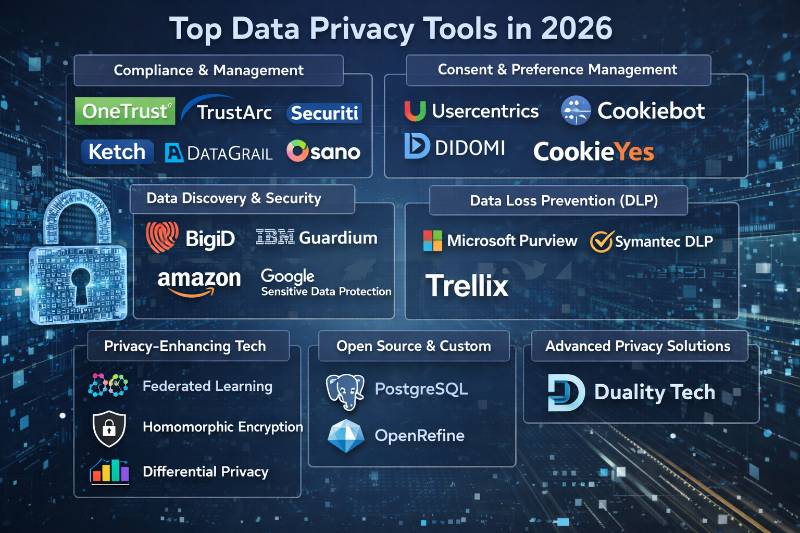
Best Data Privacy Tools (Updated for 2026)
Data privacy is no longer just a “legal checkbox.” It’s now a business capability that protects revenue, brand trust, and customer relationships—especially as regulations expand, audits get stricter, and AI increases the risk of sensitive-data exposure. A modern privacy stack usually combines governance + consent + rights requests + data discovery + security controls, with growing emphasis on AI governance and data minimization.
1) Privacy Program & Compliance Management (Your Privacy “Control Plane”)
Best for: running privacy operations end-to-end—policies, records of processing (RoPA), assessments (PIA/DPIA), vendor risk, breach workflow support, reporting, audit readiness, and continuous improvement.
Popular tools
- OneTrust — broad privacy operations coverage with strong governance workflows and enterprise program management.
- TrustArc — a well-known privacy management suite focused on program workflows, assessments, and operational compliance.
- Securiti — privacy operations plus a strong positioning around data governance and AI-era compliance workflows.
- Ketch / DataGrail / Transcend / Osano / MineOS — often shortlisted depending on focus (consent, rights requests, automation depth, or UI/implementation preferences).
- Duality Tech – A leading privacy-enhancing technology platform that enables organizations to collaborate, analyze sensitive data, and build AI models without exposing the underlying raw data. Using advanced encryption and secure computation methods, Duality allows enterprises to unlock cross-organizational insights, stay compliant with global privacy regulations, and protect proprietary information while accelerating innovation.
What to look for in 2026
- Strong data inventory + data mapping (without this, DSAR automation becomes slow and error-prone).
- Flexible workflow orchestration (legal + IT + security approvals, SLAs, escalation, evidence logs).
- “AI-era controls” for sensitive data flowing into AI tools, vector databases, copilots, and model training pipelines.
2) Consent & Preference Management (CMP)
Best for: cookie/SDK consent banners, preference centers, consent proof, regional enforcement, tag manager integrations, and consent audit trails.
Common leaders / contenders
- OneTrust — often chosen for complex multi-site, multi-brand, enterprise compliance needs.
- Usercentrics / Cookiebot — widely used CMP solutions; Cookiebot operates under the Usercentrics umbrella.
- Didomi / Ketch / Osano / CookieYes — commonly compared options that vary in UX, regional coverage, implementation simplicity, and reporting.
Key CMP selection criteria
- Regional compliance logic (GDPR/ePrivacy and applicable state/country-level rules).
- Integrations (tag managers, analytics tools, consent-mode support, SDK governance).
- Reporting quality (audit trail, proof of consent, easy testing across geographies).
- Banner customization that doesn’t harm conversion and user experience.
3) Data Subject Requests (DSAR/DSR) Automation
Best for: intake, identity verification, routing, fulfillment, secure delivery, redaction, tracking, and audit trails for access/deletion/correction/portability requests.
Common tools
- Transcend — known for automation-first fulfillment and integrations that reduce manual request handling.
- OneTrust DSAR workflows — strong fit if you already use OneTrust for privacy program operations and want everything in one system.
What matters most
- Integration coverage for your real systems: CRM, support desk, data warehouse/lake, app databases, and file stores.
- SLA tracking + clear status visibility for legal and engineering teams.
- Secure delivery and evidence logging for audit readiness.
- Redaction support for “access” responses (so you don’t accidentally expose other people’s data).
4) Data Discovery, Classification & Mapping
Best for: finding sensitive data (PII/PHI/PCI/secrets), building a data inventory, supporting RoPA/DPIAs, enabling DSAR fulfillment, and enforcing retention/minimization.
Common tools
- BigID — strong in enterprise discovery and classification across many data sources.
- IBM Guardium — strong database-focused protection with discovery/classification plus controls such as masking and monitoring.
Cloud-native options (very practical)
- Amazon Macie — commonly used for automated sensitive-data discovery in cloud storage (especially object storage).
- Google Sensitive Data Protection (formerly Cloud DLP) — discovery/classification plus de-identification capabilities and API-based enforcement patterns.
Selection notes
- Prioritize tools that support your data sources: SaaS apps, object storage, warehouses, endpoint repositories, and logs.
- Ensure classification results can drive actions: masking, deletion, retention rules, DSAR fulfillment, and access controls.
5) Data Loss Prevention (DLP) & Data Security Controls
Best for: preventing data leakage across endpoints, email, SaaS apps, and cloud storage—plus policy-based monitoring and enforcement.
Common options
- Microsoft Purview DLP — strong if you already use Microsoft security/compliance tooling; integrates across data classification and governance.
- Symantec DLP (Broadcom) — established enterprise DLP covering multiple channels (endpoint/network/cloud patterns).
- Trellix DLP — the former McAfee Enterprise DLP branding has transitioned to Trellix; often seen in legacy enterprise environments.
What to look for
- Coverage across channels you actually use (email, cloud drives, endpoints, chat tools, browsers, SaaS).
- Policy tuning that reduces false positives (or the program becomes ignored).
- Clear incident workflows for security + privacy collaboration.
- Support for modern exfiltration paths (APIs, collaboration tools, AI assistants).
6) Privacy-Enhancing Technologies (PETs)
Best for: enabling analytics and AI while reducing exposure of raw personal data.
Core PET approaches
- Differential Privacy — protects individuals while enabling aggregate insights.
- Federated Learning — trains models on decentralized data without centralizing raw data.
- Homomorphic Encryption — performs computation on encrypted data (powerful but still specialized and resource-heavy).
How PETs are used in 2026
- Privacy-preserving analytics and AI pipelines (training, evaluation, monitoring).
- Cross-organization insight sharing without moving raw datasets.
- Risk reduction for sensitive signals used in personalization and ML.
7) Open-Source & “Build Your Own” Foundations
Open-source is usually strongest as building blocks, not as a complete privacy suite.
Useful foundations
- PostgreSQL security capabilities such as role-based controls and row-level security—combined with encryption and auditing patterns.
- OpenRefine for cleaning/transforms, including anonymization and pseudonymization (best for controlled data preparation, not enterprise-wide governance).
Typical open-source-heavy architecture
Inventory + classification + access controls + audit logging + retention + DSAR workflows assembled from multiple components.
How to Choose the Right Privacy Toolset
Use this practical checklist:
- Start with obligations
- Identify which laws apply by geography, sector, and data types (consumer, employee, health, payment, children, etc.).
- Map your real data footprint
- If you can’t discover and map data, DSAR fulfillment and minimization will fail in practice.
- Pick your operating model
- Legal-led programs need strong assessments, vendor risk workflows, reporting, and audit evidence.
- Engineering-led programs need APIs, automation, integrations, and enforcement hooks.
- Prioritize integration depth
- The best tool is the one that plugs into your CRM, support desk, warehouses, cloud storage, IAM, and logging without fragile custom work.
- Plan for AI
- Track sensitive data flowing into AI tools, copilots, agents, vector stores, training datasets, and evaluation pipelines.
Emerging Trends to Watch (2026)
- Privacy + AI governance convergence (shared inventories, shared classification, shared risk controls).
- Sensitive-data discovery by default in cloud and SaaS environments (automated classification becomes a baseline expectation).
- User control and preference orchestration beyond cookies (consistent preferences across channels and touchpoints).
- Automation-first DSAR fulfillment with fewer manual steps, stronger identity verification, and better evidence logging.

Find Trusted Cardiac Hospitals
Compare heart hospitals by city and services — all in one place.
Explore Hospitals
Data privacy isn’t optional anymore — it’s a necessity. This article does a solid job of cutting through the noise and highlighting tools that actually matter in 2024. I like that it focuses on practical value instead of just listing features. With increasing regulations and evolving threats, choosing the right privacy solution can make a real difference. Definitely a useful guide for anyone serious about protecting their data.