
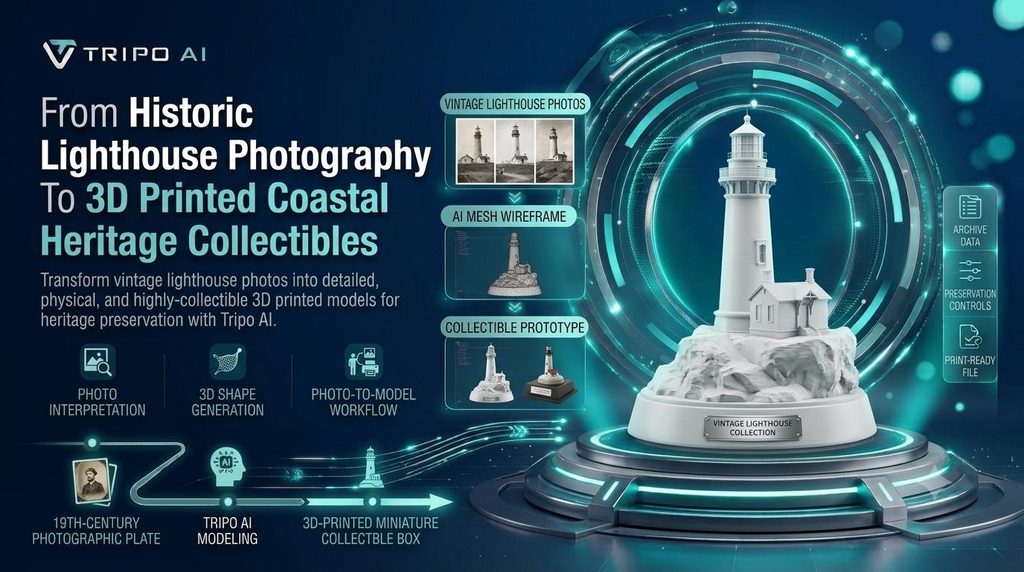
Throughout history, lighthouses have served as beacons of navigation that helped ships pass through rough seas, indicated hazardous conditions and coasts, and became icons of maritime heritage for local populations. In the modern era, many of these lighthouses are preserved by photography and can continue to tell their story even when access is denied or destroyed by time and nature.
What if those photographs were able to be more than just archival records? The 3D revolution has given rise to novel solutions such as image to 3D, which enable the creation of a detailed 3D model and collection of historic lighthouse photographs using Tripo 3D. These three-dimensional creations are a great way to honor and preserve maritime history, whether they’re for sale at a museum, a heritage organization, or a coastal tourism center.
As the photo becomes a history of the coast
Historic lighthouse photography is more than just photography of architecture. These images portray a place, a time, and the people who relied on these structures to navigate safely. Photographs capture visual information but may not provide an accurate sense of the size and form of a lighthouse. 3D models can help fill in that gap, with historical imagery being converted into objects that can be viewed from all perspectives.
With Tripo 3D Modeling Web, heritage organisations can turn lighthouse images into a realistic 3D asset that can be used to educate, preserve, display, and even sell.
We need more interactive use of coastal heritage. Why?
Historic sites and structures are vital to the relationship between people and their culture and history. But traditional exhibits are not always effective for today’s audiences.
Increasing the interaction of visitors with the building.Making the building more interactive for the visitors. People tend to recall things they can do. A lighthouse model offers a real link to history that goes beyond photographs on a wall.
Increased availability of heritage sites for use
Not all lighthouses are available for visitors. Digital and physical copies aid in maintaining their appearance and importance when the original building is hard to access.
Supporting educational storytelling
Examinations of detailed models, rather than relying on images, help students and visitors to understand lighthouse construction, coastal geography, and maritime navigation.
Making lighthouse pictures into collectibles!
Anything that carries local meaning is a desirable souvenir for coastal museums and tourism centres. Instead of selling products that are generic, companies can develop collectibles around real historical sites. A photo lighthouse can turn into a mini lighthouse, a display lighthouse, or be incorporated into a small edition heritage collection.
Tripo 3D makes this easier by creating comprehensive 3D models from reference photos that can be customized for a range of product ideas.
From the cliff of wind to the Digital craftsmanship of the Tripo 3D
It is very easy to make lighthouse models using historical photos. Tripo 3D makes the process of creating 3D assets easy for museums, tourism providers, and those wanting to create items in physical form.
Step 1: Go to Tripo 3D
The first step is to go into the Tripo AI workspace and choose a method to create your 3D model. You will need some kind of input image of the final item, and you’ll have the choice of JPG, PNG, or WEBP format to upload.
Step 2: Upload image and configure settings
Once you upload your input photo, whether you want to create the 3D model using Image to 3D, Text to 3D, or Multi-View Images, the upload will begin the 3D modeling process. Then, tailor the settings of the model generation. Select your preferred mesh quality (e.g Ultra or Smart Mesh) and an appropriate texture resolution. These settings impose control of the number of visual details required for heritage displays, collectibles, or promotional materials.
Step 3: Generate and refine
After clicking on generate, Tripo 3D will start to create an initial model in seconds. Enhance textures with built-in refinement tools, extract model parts with the asset extraction tool, and adjust them with Magic Brush for greater accuracy.
Step 4: Export
You can export your newly created model using whichever format is best suited for your specific project. Tripo allows you to export your models with all the commonly used file types, including STL, OBJ, FBX, GLB and USD. This means that you can easily integrate your model into design software, visualization software, game engines, and 3D printing workflows.
Maritime conservation comes to life!
There is often a need to balance engaging current audiences and preserving history along the coast. The use of 3-dimensional models is an excellent means of making historical landmarks more interactive and accessible to the public.
Photography can serve as archival evidence of historical sites, but also be utilized as a medium for teaching, exhibiting, or even as a collectible to inspire interest within the maritime community. 3D Artificial Intelligence can considerably improve how quickly organizations develop such assets compared to conventional modeling methods. This enables even smaller institutions to extend their preservation activities without a lot of technology.
Saving lighthouse models: the value of educational models.
A lighthouse as a digital 3D model can enable numerous initiatives other than merchandise. Interactive exhibits can include models in the exhibits, made by museums. These can be utilized by tourism organizations in promotional campaigns. These can be incorporated into maritime historical and coastal geographical educational programs in schools.
With Tripo 3D, it’s possible to develop a single resource that can be used for various purposes and keep the historical accuracy of the resource.
Digital to Printable – it’s a landmark to a keepsake!
One of the most exciting aspects of lighthouse reconstruction is the ability to create physical replicas. People like to collect, visit, and study items that have significance in some location or story. Artistic lighthouse replicas make history come to life and are a personal treasure.
There are many creators who use an image to STL workflow to prepare lighthouse models for production. This allows for the development of high-quality collectibles with a high level of detail that are both useful to manufacture and show off.
Leading the way for heritage to join the digital era
Lighthouses have been a beacon of hope for generations of sailors navigating through the sea’s turbulent waters. They continue to lead the way for people to understand more about the coastal heritage and maritime history today.
Tripo 3D enables organisations to digitise historic lighthouse photography, creating detailed 3D models and collectible products in ways that capture the lighthouses in a completely new way. From learning, displaying, visiting area attractions, to selling souvenirs, modern 3D technology puts the past closer to the people who appreciate it most.
Looking forward to creating the special coastal collectibles from historic lighthouse photographs? Experience Tripo 3D today and experience how iconic sites can be turned into 3D models and printable souvenirs for generations to come, all made easy.

Find Trusted Cardiac Hospitals
Compare heart hospitals by city and services — all in one place.
Explore Hospitals
Another important consideration is maintaining an evidence trail for digitally reconstructed heritage assets. When a model is created from historical photographs, sketches, or incomplete references, future users should be able to understand which elements are supported by evidence and which were digitally inferred. Keeping the original references, modeling decisions, revisions, and expert reviews alongside the 3D asset would make it far more useful for preservation, research, and educational purposes.