
To understand the core of Git internals, there are 3 things to we should know: objects, references, the index.
I find this model is elegant. It fits well in a small diagram, as well as in my head.
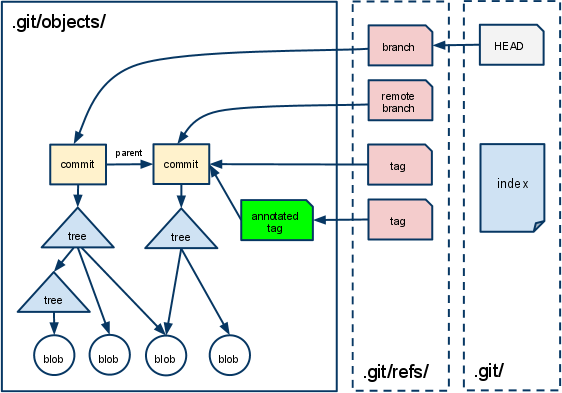
Objects
All files that you commited into a Git repository, including the commit info are stored as objects in .git/objects/.
An object is identified by a 40-character-long string – SHA1 hash of the object’s content.
There are 4 types of objects:
- blob – stores file content.
- tree – stores direcotry layouts and filenames.
- commit – stores commit info and forms the Git commit graph.
- tag – stores annotated tag.
The example will illustrate how these objects relate to each others.
References
A branch, remote branch or a tag (also called lightweight tag) in Git, is just a pointer to an object, usually a commit object.
They are stored as plain text files in .git/refs/.
Symbolic References
Git has a special kind of reference, called symbolic reference. It doesn’t point to an object directly. Instead, it points to another reference.
For instance, .git/HEAD is a symbolic reference. It points to the current branch you are working on.
The Index
The index is a staging area, stored as a binary file in .git/index.
When git add a file, Git adds the file info to the index. When git commit, Git only commits what’s listed in the index.
Examples
Let’s walkthrough a simple example, to create a Git repository, commit some files and see what happened behind the scene in .git directory.
Initialize New Repository
| 1 | $ git init canai |
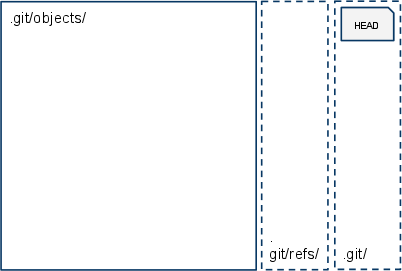
What happened:
- Empty .git/objects/ and .git/refs/ created.
- No index file yet.
- HEAD symbolic reference created. $ cat .git/HEAD ref: refs/heads/master
Add New File
| 1 2 | $ echo “A roti canai project.” >> README $ git add README |
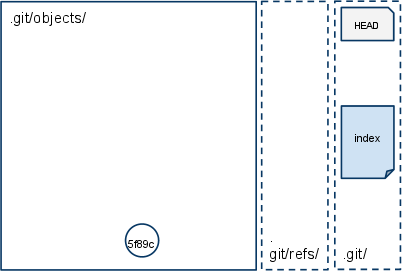
What happened:
- Index file created.
It has a SHA1 hash that points to a blob object. - Blob object created.
The content of README file is stored in this blob.
First Commit
| 1 2 3 4 | $ git commit -m’first commit’ [master (root-commit) d9976cf] first commit 1 files changed, 1 insertions(+), 0 deletions(-) create mode 100644 README |
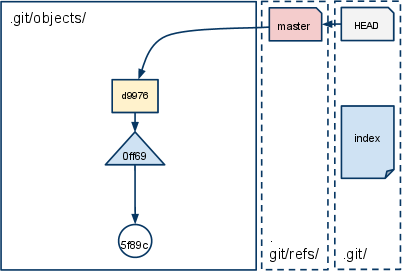
What happened:
- Branch ‘master’ reference created.
It points to the lastest commit object in ‘master’ branch. - First commit object created. It points to the root tree object.
- Tree object created.
This tree represents the ‘canai’ directory.
Add Modified File
| 1 2 | $ echo “Welcome everyone.” >> README $ git add README |
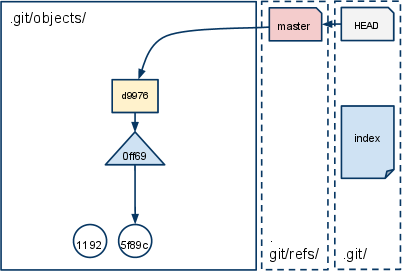
What happened:
- Index file updated.
Notice it points to a new blob? - Blob object created.
The entire README content is stored as a new blob.
Add File into Subdirectory
| 1 2 3 | $ mkdir doc $ echo “[[TBD]] manual toc” >> doc/manual.txt $ git add doc |
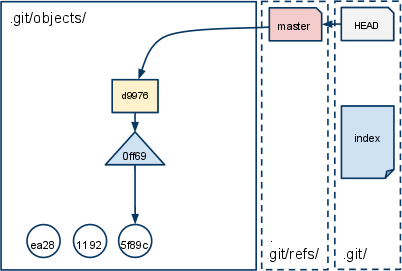
What happened:
- Index file updated.
- Blob object created.
Second Commit
| 1 2 3 4 | $ git commit -m’second commit’ [master 556eaf3] second commit 2 files changed, 2 insertions(+), 0 deletions(-) create mode 100644 doc/manual.txt |
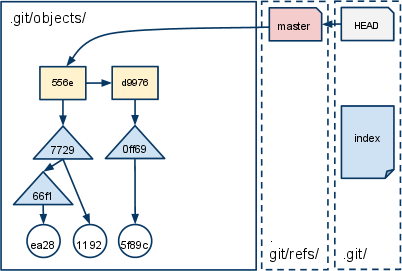
What happened:
- Branch ‘master’ reference updated.
It points to a lastest commit in this branch. - Second commit object created. Notice its ‘parent’ points to the first commit object. This forms a commit graph.
- New root tree object created.
- New subdir tree object created.
Add Annotated Tag
| 1 | $ git tag -a -m’this is annotated tag’ v0.1 d9976 |
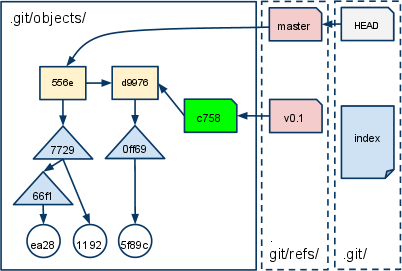
Tag reference created.
It points to a commit object.
1 2
$ cat .git/refs/tags/root-commit d9976cfe0430557885d162927dd70186d0f521e8

I’m Rajesh Kumar, a DevOps, SRE, DevSecOps, Cloud, and Platform Engineering expert passionate about sharing practical knowledge, real-world experiences, and industry best practices. I have worked at Cotocus and regularly write about technology, travel, investing, health, product reviews, and digital marketing through my various platforms.
I publish technical articles at DevOps School, travel stories at Holiday Landmark, stock market insights at Stocks Mantra, health and fitness guidance at My Medic Plus, product reviews at TrueReviewNow, and SEO and digital marketing strategies at Wizbrand.
Find Trusted Cardiac Hospitals
Compare heart hospitals by city and services — all in one place.
Explore Hospitals
Good breakdown of objects, refs, and index. One thing worth adding is how the index behaves in real workflows: it’s not just a “staging area”, it actually acts like a cached snapshot of the next tree, which is why things like merge conflicts can leave multiple stages inside it. In real CI/CD or large teams, this becomes important because the index can get out of sync with what developers assume is “working tree state”, especially during rebases or partial checkouts.