

A defect in a payment flow can freeze transactions, trigger a supervisory finding, and cost a bank customers within hours. Since core banking platforms, card processing systems, and mobile apps carry that exposure on every release, QA leads in finance choose test management software under constraints that generic buying advice ignores. Auditors request evidence, and the QA process has to produce it as part of routine work.
For that reason, a banking test management tool serves two audiences at once: the QA team executing daily runs, and the compliance function preparing for the next examination. The evaluation therefore starts with the obligations regulators impose, since those apply no matter which contract you sign.
Why Test Management Is Critical for Banking Software
Test management for banking software exists to prove which release was tested, by whom, against which requirement, and with what result. Every regulation that binds a bank converts into a specific artifact the QA function hands over on request, as the table below shows.
| Regulation | Scope | What the QA process has to produce |
| DORA, applied since 17 January 2025 | ICT risk management and resilience testing at EU financial entities | Documented test programs, results, and remediation records for ICT systems |
| PCI DSS v4.0.1 | Systems that store, process, or transmit cardholder data | Dated testing evidence after changes, mapped to individual requirements |
| PSD2 and the RTS on strong customer authentication | Payment initiation and authentication journeys | Test cases covering authentication paths and exemption logic |
| SOX | Systems feeding financial reporting at US-listed institutions | Access logs, approval trails, and change history per release |
| GDPR | Personal data used in non-production environments | Masked or synthetic test data, with a record of storage location |
When the platform does not generate these records on its own, someone assembles them manually before every audit, which is what makes audit preparation take weeks.
What Is a Test Management Solution?
A test management solution holds requirements, test cases, test runs, and defects in one repository and reports on their status. It replaces spreadsheets and disconnected trackers with a structured record of what was planned, executed, and fixed.
A TMS for banking software adds several capabilities on top of that baseline. It has to keep an unalterable log of user actions, restrict access by role, and hold test data under the controls that govern production data. Reporting also serves auditors, who ask for coverage and execution evidence per release. Because banks run long-lived core systems alongside weekly digital channel updates, the platform has to support manual regression suites and automated pipelines in parallel.
Key Requirements for Banking Test Management Software
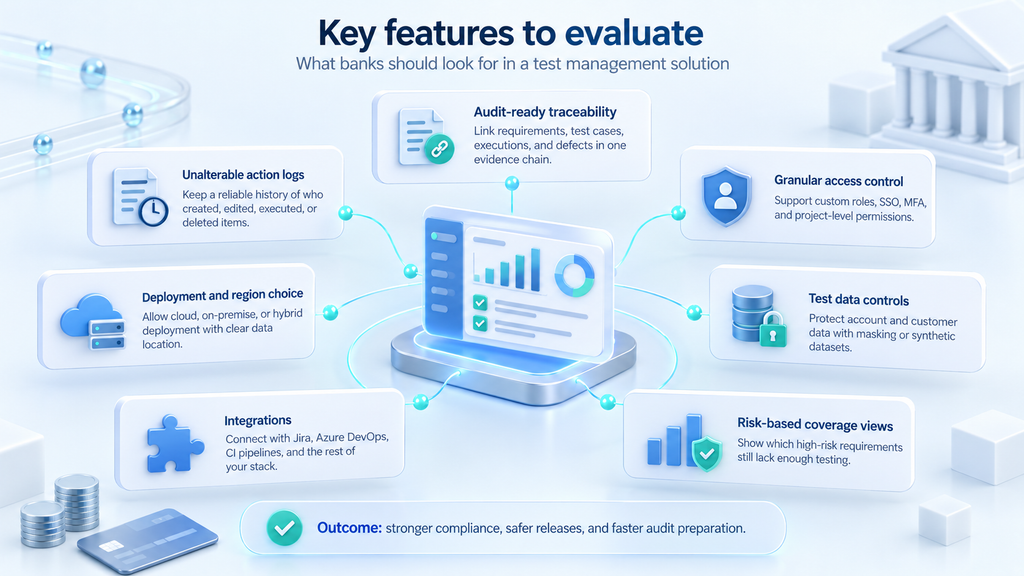
Requirements for banking test management software split into compliance features, security controls, and everyday usability. The criteria below repeat across bank QA evaluations.
- Audit-ready traceability. Requirement to test case to execution to defect, exportable as one report.
- Unalterable action logs. A record of who created, edited, executed, or deleted an item, retained after a project is archived.
- Granular access control. Custom roles, SSO, and multi-factor authentication tied to your directory service, with per-project restrictions.
- Deployment and storage region choice. Cloud, on-premise, or hybrid, with a named data center location.
- Test data controls. Masking or synthetic generation for account numbers and customer records used in test environments.
- Integrations that match your stack. Native connections to tools such as Jira and Azure DevOps, plus a documented REST API for the rest.
- Risk-based coverage views. Reports showing which high-risk requirements still have no test behind them.
Most vendors meet several of these criteria in their documentation, so the question during a trial is which ones work in the standard configuration and which require paid customization.
Best Practices for Selecting a Banking Test Management Solution
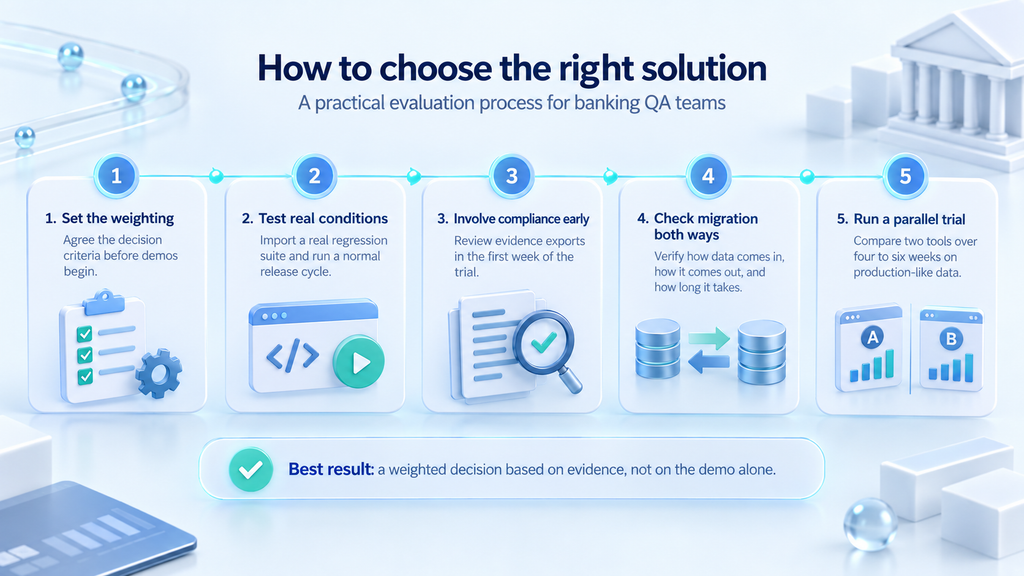
Four practices keep the decision grounded in how the tool performs on your own projects, and each takes less effort than replacing the platform two years later.
- Set the weighting before you watch a demo. Agree with QA, compliance, and security on which criteria carry the decision, and assign each a weight. With the weights agreed in advance, a convincing presentation cannot push audit logging down the priority list in favor of dashboard design.
- Evaluate under production conditions. Import a real regression suite from one core system, then run a full cycle at your normal release cadence. Vendor sample projects are small and behave predictably, while a suite of several thousand cases shows within days how the tool handles bulk edits and reporting load.
- Involve compliance in the decision from the start. Internal audit reviews a sample evidence export in the first week, so any format an examiner would reject is identified during the trial. This practice also builds the internal support the rollout needs later.
- Check the migration path in both directions. Ask how historical executions migrate in, in which format they come out, and how long each run takes. A vendor with precise answers on both counts has completed regulated migrations before.
Run the whole exercise over four to six weeks, with two tools in parallel. The benefits of a banking test management tool chosen this way become visible at the next audit, when exporting the evidence takes minutes.
Conclusion
A banking test management solution proves its value when audit evidence comes out of normal QA work automatically. Start from the regulations that bind your institution, add the controls your infrastructure team enforces, then score vendors on both before pricing enters the conversation. Teams that run a weighted trial on production-like data see the benefits within the first audit cycle, because traceability and reporting are already in place when the request arrives.

Find Trusted Cardiac Hospitals
Compare heart hospitals by city and services — all in one place.
Explore Hospitals