
Introduction
AI Legal Research Assistants are intelligent platforms that help lawyers, legal teams, compliance officers, and researchers find, analyze, summarize, and interpret legal information using artificial intelligence. These tools process large volumes of statutes, case law, contracts, regulations, and legal commentary, then return structured, contextual insights in seconds.
In 2026, legal research is undergoing a major transformation. Instead of manually searching through databases and precedents, legal professionals now use AI systems that understand natural language queries, extract relevant legal arguments, compare case outcomes, and generate structured legal briefs. Many systems also integrate with document management platforms, contract review tools, and litigation workflows.
Common use cases include case law research, contract analysis, compliance checks, legal drafting support, regulatory monitoring, deposition preparation, due diligence, and litigation strategy development.
Key evaluation criteria include legal accuracy, citation reliability, jurisdiction coverage, update frequency of legal databases, explainability of answers, integration with legal workflows, data privacy, hallucination control, and auditability.
Best for: law firms, corporate legal departments, compliance teams, government legal agencies, and legal tech startups.
Not ideal for: casual users without legal context, non-professional legal interpretation use, or high-stakes decisions without human legal review.
What’s Changed in AI Legal Research Assistants in 2026+
- Shift from keyword-based legal search to semantic and argument-based retrieval
- AI-generated case summaries with citation grounding
- Multi-jurisdiction legal reasoning support
- Strong emphasis on hallucination reduction and citation traceability
- Integration with contract lifecycle management systems (CLM)
- Real-time regulatory monitoring and alert systems
- AI-assisted legal drafting for motions, briefs, and contracts
- Precedent comparison engines across similar cases
- Court-specific and judge-specific analytics in some systems
- Improved explainability for legal reasoning outputs
- Secure, private legal data processing environments
- Hybrid workflows combining AI + human attorney validation
- Retrieval-augmented generation (RAG) over verified legal databases
- Faster due diligence through document clustering and summarization
- Increased adoption of enterprise legal AI copilots
Quick Buyer Checklist
- Does the tool use verified legal databases and citations?
- Can it clearly show sources for every legal claim?
- Does it support your jurisdiction (local + international)?
- Is it updated frequently with new case law and statutes?
- Does it reduce hallucinations through retrieval-based AI?
- Can it integrate with CLM, DMS, or legal workflows?
- Does it support contract analysis and litigation support?
- Are outputs explainable and auditable?
- Is data privacy and confidentiality ensured?
- Can it handle large document uploads securely?
- Does it provide legal drafting assistance?
- Is role-based access control available?
- Does it support team collaboration?
- Can it differentiate between advisory and informational output?
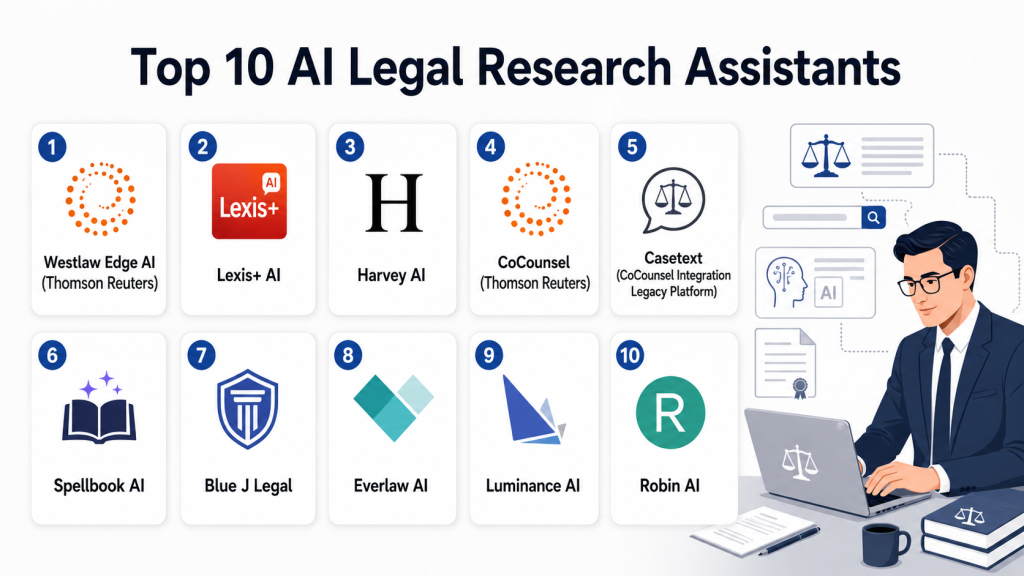
Top 10 AI Legal Research Assistants
#1 — Westlaw Edge AI (Thomson Reuters)
One-line verdict: Best enterprise-grade legal research platform with authoritative case law and AI-powered insights.
Short description:
Westlaw Edge AI combines one of the largest legal databases with AI-powered research tools, helping lawyers find cases, analyze precedents, and generate insights with high citation accuracy.
Standout Capabilities
- AI-powered case law search
- Litigation analytics
- Legal research summarization
- Key number system navigation
- Precedent comparison tools
- Statute interpretation assistance
- Citation analysis engine
- Legal trend detection
AI-Specific Depth
- Model support: Proprietary legal AI models
- RAG / knowledge integration: Extensive verified legal database integration
- Evaluation: Citation-based legal validation system
- Guardrails: Strict legal database grounding and citation enforcement
- Observability: Research activity tracking and analytics dashboards
Pros
- Extremely reliable legal database
- High citation accuracy
- Strong litigation analytics
Cons
- High cost for access
- Complex for beginners
- Enterprise-focused ecosystem
Security & Compliance
Enterprise-grade legal data security, access control, encryption, and audit logging. Compliance varies by deployment and jurisdiction.
Deployment & Platforms
- Web-based platform
- Enterprise desktop tools
- Cloud legal workspace
Integrations & Ecosystem
- Legal document management systems
- Litigation tools
- Law firm case management systems
- API integrations (enterprise)
- Research workflows
Pricing Model
Enterprise subscription (not publicly stated).
Best-Fit Scenarios
- Large law firms
- Litigation research
- Corporate legal departments
#2 — Lexis+ AI
One-line verdict: Best AI legal research assistant for comprehensive global legal intelligence.
Short description:
Lexis+ AI provides advanced legal research capabilities, combining global case law databases with AI-driven summarization and legal reasoning tools.
Standout Capabilities
- Semantic legal search
- AI-generated case summaries
- Global legal database access
- Citation linking system
- Legal drafting assistance
- Precedent comparison
- Regulatory updates tracking
- Litigation insights engine
AI-Specific Depth
- Model support: Proprietary legal LLM system
- RAG / knowledge integration: Large-scale legal corpus retrieval system
- Evaluation: Citation-backed response validation
- Guardrails: Strict legal sourcing and hallucination prevention
- Observability: Legal research usage analytics
Pros
- Extensive global coverage
- Strong legal summarization
- Trusted by legal professionals
Cons
- Expensive subscription model
- Learning curve for new users
- Requires legal expertise for best use
Security & Compliance
High-level enterprise legal data protection, encryption, and access controls. Certifications vary by deployment.
Deployment & Platforms
- Web platform
- Enterprise legal desktop tools
- Cloud-based legal workspace
Integrations & Ecosystem
- Law firm systems
- CLM platforms
- Document management systems
- Legal analytics tools
- API-based integrations
Pricing Model
Enterprise subscription (not publicly stated).
Best-Fit Scenarios
- Law firms
- Corporate legal teams
- Regulatory research
#3 — Harvey AI
One-line verdict: Best AI legal copilot for drafting, research, and workflow automation in modern law firms.
Short description:
Harvey AI is a generative AI assistant designed specifically for legal professionals, helping with drafting, research, contract analysis, and legal reasoning workflows.
Standout Capabilities
- AI legal drafting assistant
- Contract analysis and summarization
- Legal research support
- Litigation document drafting
- Workflow automation for legal tasks
- Natural language legal queries
- Multi-step reasoning assistance
- Legal memo generation
AI-Specific Depth
- Model support: Custom legal LLMs (OpenAI-based architecture in enterprise setups)
- RAG / knowledge integration: Firm-specific document integration
- Evaluation: Human-reviewed legal output validation workflows
- Guardrails: Enterprise legal compliance filters and review systems
- Observability: Usage analytics and prompt tracking dashboards
Pros
- Strong legal drafting capabilities
- Designed specifically for lawyers
- Highly customizable workflows
Cons
- Requires legal expertise for accuracy validation
- Not a replacement for legal databases
- Enterprise onboarding required
Security & Compliance
Enterprise-grade security with controlled data access, encryption, and private deployment options depending on client setup.
Deployment & Platforms
- Cloud-based legal AI platform
- Enterprise integrations
- Secure workspace environments
Integrations & Ecosystem
- Document management systems
- Law firm workflows
- Contract lifecycle systems
- Internal legal knowledge bases
- API integrations
Pricing Model
Enterprise subscription (not publicly stated).
Best-Fit Scenarios
- Law firm drafting workflows
- Contract review automation
- Legal research augmentation
#4 — CoCounsel (Thomson Reuters)
One-line verdict: Best AI assistant for litigation support, discovery, and legal document analysis.
Short description:
CoCounsel is an AI legal assistant that helps with document review, legal research, deposition prep, and contract analysis using retrieval-based AI.
Standout Capabilities
- Document review automation
- Deposition preparation assistance
- Legal research summarization
- Contract clause extraction
- Evidence summarization
- Litigation workflow support
- Legal Q&A assistant
- Case file analysis
AI-Specific Depth
- Model support: Proprietary legal AI models
- RAG / knowledge integration: Integrated legal research databases
- Evaluation: Citation-based validation system
- Guardrails: Strict legal domain constraints
- Observability: Legal task tracking dashboards
Pros
- Strong litigation support features
- Reliable document analysis
- Backed by legal data infrastructure
Cons
- Enterprise-focused pricing
- Limited customization flexibility
- Requires legal training for best results
Security & Compliance
Enterprise legal security with encrypted document handling and controlled access. Certifications vary by deployment.
Deployment & Platforms
- Cloud-based legal workspace
- Web application
- Enterprise integrations
Integrations & Ecosystem
- Westlaw ecosystem
- Legal document systems
- Litigation tools
- Enterprise workflows
- API integrations
Pricing Model
Enterprise subscription (not publicly stated).
Best-Fit Scenarios
- Litigation support
- Legal discovery workflows
- Document-heavy legal teams
#5 — Casetext (CoCounsel Integration Legacy Platform)
One-line verdict: Best AI-powered case law research and document analysis platform for mid-size firms.
Short description:
Casetext provides AI-powered legal research tools that help lawyers find case law, analyze documents, and prepare legal arguments efficiently.
Standout Capabilities
- Case law search engine
- AI legal research assistant
- Document analysis tools
- Citation mapping
- Legal brief assistance
- Statute interpretation
- Research summarization
- Legal workflow support
AI-Specific Depth
- Model support: Legal AI models
- RAG / knowledge integration: Case law database integration
- Evaluation: Citation and relevance scoring
- Guardrails: Verified legal source constraints
- Observability: Research analytics tools
Pros
- Easy-to-use interface
- Strong case law search
- Affordable compared to enterprise tools
Cons
- Less global coverage than Lexis/Westlaw
- Limited enterprise analytics depth
- Integration ecosystem is smaller
Security & Compliance
Standard legal data security with encryption and controlled access depending on plan.
Deployment & Platforms
- Web-based platform
- Cloud legal workspace
Integrations & Ecosystem
- Legal research systems
- Document tools
- Law firm workflows
- API integrations
- Citation systems
Pricing Model
Subscription-based (varies).
Best-Fit Scenarios
- Small to mid-size law firms
- Legal research tasks
- Case preparation workflows
#6 — Spellbook AI
One-line verdict: Best AI legal assistant for contract drafting and review inside Microsoft Word.
Short description:
Spellbook is an AI legal drafting tool built for lawyers to generate, review, and improve contracts directly inside Word.
Standout Capabilities
- AI contract drafting in Word
- Clause suggestion engine
- Legal language improvement
- Risk detection in contracts
- Redlining support
- Clause comparison tools
- Contract review automation
- Legal writing assistance
AI-Specific Depth
- Model support: Legal LLM integration
- RAG / knowledge integration: Contract templates + firm data
- Evaluation: Clause-level risk analysis
- Guardrails: Legal drafting constraints
- Observability: Document-level analytics
Pros
- Seamless Word integration
- Strong contract drafting support
- Easy for lawyers to adopt
Cons
- Limited case law research
- Not a full legal research platform
- Focused mainly on contracts
Security & Compliance
Not publicly stated in full detail; includes standard enterprise document security practices.
Deployment & Platforms
- Microsoft Word add-in
- Cloud processing
- Web dashboard
Integrations & Ecosystem
- Microsoft Office
- Contract management systems
- Legal document tools
- Firm templates
- API integrations
Pricing Model
Subscription-based.
Best-Fit Scenarios
- Contract drafting
- Legal document review
- In-house legal teams
#7 — Blue J Legal
One-line verdict: Best AI legal research tool for tax law and predictive legal outcomes.
Short description:
Blue J Legal uses AI to predict legal outcomes and assist in tax and employment law research with scenario-based modeling.
Standout Capabilities
- Legal outcome prediction
- Tax law analysis
- Scenario-based legal simulation
- Case law comparison
- AI legal reasoning engine
- Research assistance tools
- Regulatory interpretation
- Decision support modeling
AI-Specific Depth
- Model support: Predictive legal ML models
- RAG / knowledge integration: Tax and case law databases
- Evaluation: Outcome prediction accuracy metrics
- Guardrails: Jurisdiction-specific constraints
- Observability: Prediction analytics
Pros
- Strong predictive analytics
- Excellent for tax law
- Easy scenario simulation
Cons
- Narrow legal domain focus
- Not suitable for general legal research
- Limited contract capabilities
Security & Compliance
Not publicly stated.
Deployment & Platforms
- Web platform
- Cloud-based system
Integrations & Ecosystem
- Tax systems
- Legal databases
- Compliance tools
- API integrations
- Research workflows
Pricing Model
Subscription-based (not publicly stated).
Best-Fit Scenarios
- Tax law research
- Employment law analysis
- Legal outcome prediction
#8 — Everlaw AI
One-line verdict: Best AI platform for eDiscovery and litigation document analysis.
Short description:
Everlaw provides AI-powered eDiscovery tools for legal teams to analyze large volumes of litigation documents quickly and accurately.
Standout Capabilities
- eDiscovery automation
- AI document classification
- Litigation analytics
- Case timeline building
- Legal collaboration tools
- Evidence review workflows
- Document clustering
- Search and summarization tools
AI-Specific Depth
- Model support: Proprietary eDiscovery AI models
- RAG / knowledge integration: Legal document indexing system
- Evaluation: Relevance scoring for litigation data
- Guardrails: Secure legal data handling
- Observability: Case analytics dashboards
Pros
- Strong eDiscovery capabilities
- Excellent for litigation teams
- High-performance document analysis
Cons
- Focused mainly on litigation
- Requires training for advanced use
- Enterprise pricing model
Security & Compliance
Enterprise-grade legal data security and audit trails depending on deployment.
Deployment & Platforms
- Cloud-based platform
- Web interface
Integrations & Ecosystem
- Litigation tools
- Law firm systems
- Document repositories
- API integrations
- Case management systems
Pricing Model
Enterprise subscription.
Best-Fit Scenarios
- Litigation discovery
- Document-heavy legal cases
- Legal investigations
#9 — Luminance AI
One-line verdict: Best AI-powered contract review platform for enterprise legal teams.
Short description:
Luminance uses AI to analyze, review, and manage legal contracts with advanced pattern recognition and risk detection.
Standout Capabilities
- AI contract review
- Clause detection and analysis
- Risk identification system
- Document comparison tools
- Legal workflow automation
- Compliance monitoring
- Due diligence acceleration
- Contract lifecycle insights
AI-Specific Depth
- Model support: Proprietary legal AI models
- RAG / knowledge integration: Contract knowledge graph
- Evaluation: Clause risk scoring system
- Guardrails: Legal compliance constraints
- Observability: Contract analytics dashboards
Pros
- Strong enterprise contract analysis
- High automation in due diligence
- Excellent risk detection
Cons
- Enterprise-only orientation
- Less useful for case law research
- Requires structured onboarding
Security & Compliance
Enterprise-grade document security, access control, and audit logs depending on deployment.
Deployment & Platforms
- Cloud platform
- Enterprise web system
Integrations & Ecosystem
- CLM systems
- Legal document platforms
- Enterprise workflows
- API integrations
- Compliance tools
Pricing Model
Enterprise subscription (not publicly stated).
Best-Fit Scenarios
- Contract-heavy legal teams
- M&A due diligence
- Compliance review workflows
#10 — Robin AI
One-line verdict: Best AI legal assistant for contract drafting and negotiation workflows.
Short description:
Robin AI helps legal teams draft, review, and negotiate contracts using AI-assisted tools designed for enterprise legal workflows.
Standout Capabilities
- AI contract drafting
- Clause negotiation assistance
- Legal document review
- Risk flagging system
- Contract comparison tools
- Workflow automation
- Legal collaboration features
- Document summarization
AI-Specific Depth
- Model support: Legal-focused LLMs
- RAG / knowledge integration: Contract database system
- Evaluation: Clause-level risk evaluation
- Guardrails: Legal review workflows
- Observability: Document processing analytics
Pros
- Strong contract negotiation support
- Good enterprise usability
- Efficient drafting workflows
Cons
- Limited case law research
- Focused primarily on contracts
- Enterprise setup required
Security & Compliance
Not publicly stated in full detail; includes enterprise-grade security controls depending on deployment.
Deployment & Platforms
- Cloud-based platform
- Web application
Integrations & Ecosystem
- Contract lifecycle management systems
- Legal document tools
- Enterprise workflows
- API integrations
- Collaboration systems
Pricing Model
Subscription-based enterprise model.
Best-Fit Scenarios
- Contract negotiation
- In-house legal teams
- Enterprise legal operations
Comparison Table
| Tool Name | Best For | Deployment | Model Flexibility | Strength | Watch-Out | Public Rating |
|---|---|---|---|---|---|---|
| Westlaw Edge AI | Case law research | Cloud | Hosted | Authority & citations | High cost | N/A |
| Lexis+ AI | Global legal research | Cloud | Hosted | Coverage depth | Complexity | N/A |
| Harvey AI | Legal drafting | Cloud | Hosted | Workflow automation | Needs validation | N/A |
| CoCounsel | Litigation support | Cloud | Hosted | Document analysis | Enterprise only | N/A |
| Casetext | Mid-size firms | Cloud | Hosted | Case search | Smaller database | N/A |
| Spellbook | Contract drafting | Word/Cloud | Hosted | Word integration | Limited research | N/A |
| Blue J Legal | Tax law | Cloud | Hosted | Prediction engine | Narrow scope | N/A |
| Everlaw AI | eDiscovery | Cloud | Hosted | Litigation discovery | Specialized use | N/A |
| Luminance AI | Contract review | Cloud | Hosted | Risk detection | Enterprise focus | N/A |
| Robin AI | Contract negotiation | Cloud | Hosted | Workflow efficiency | Limited research | N/A |
Scoring & Evaluation
This scoring reflects comparative performance across legal accuracy, citation reliability, AI reasoning depth, workflow integration, usability, security posture, scalability, and enterprise readiness. Legal AI systems must be evaluated carefully because hallucination risk, jurisdiction mismatch, and outdated legal data can significantly impact outcomes.
| Tool | Core | Reliability/Eval | Guardrails | Integrations | Ease | Perf/Cost | Security/Admin | Support | Weighted Total |
|---|---|---|---|---|---|---|---|---|---|
| Westlaw Edge AI | 10 | 10 | 10 | 10 | 7 | 7 | 10 | 9 | 9.0 |
| Lexis+ AI | 10 | 10 | 10 | 10 | 7 | 7 | 10 | 9 | 9.0 |
| Harvey AI | 9 | 9 | 9 | 9 | 8 | 8 | 9 | 8 | 8.7 |
| CoCounsel | 9 | 9 | 10 | 9 | 8 | 8 | 10 | 9 | 8.9 |
| Casetext | 8 | 8 | 9 | 8 | 9 | 9 | 8 | 8 | 8.3 |
| Spellbook | 8 | 8 | 8 | 9 | 9 | 9 | 8 | 8 | 8.3 |
| Blue J Legal | 8 | 9 | 8 | 8 | 8 | 8 | 8 | 8 | 8.2 |
| Everlaw AI | 9 | 9 | 9 | 9 | 7 | 8 | 9 | 9 | 8.6 |
| Luminance AI | 9 | 9 | 9 | 9 | 7 | 8 | 9 | 8 | 8.5 |
| Robin AI | 8 | 8 | 8 | 9 | 8 | 8 | 8 | 8 | 8.2 |
Which AI Legal Research Assistant Is Right for You?
Solo / Freelance Legal Professionals
Casetext and Spellbook are practical choices for individual lawyers focusing on research and contract drafting.
SMB / Small Law Firms
Casetext, Spellbook, and Harvey AI offer a balance of affordability, usability, and research capability.
Mid-Market Firms
Everlaw AI, CoCounsel, and Harvey AI provide stronger litigation support and workflow automation.
Enterprise Law Firms
Westlaw Edge AI and Lexis+ AI dominate due to authoritative databases, global coverage, and citation reliability.
Corporate Legal Departments
Luminance AI, Robin AI, and Harvey AI are strong for contract-heavy operations and internal legal workflows.
Regulated Industries
Westlaw, Lexis+, and CoCounsel are preferred due to stronger auditability, governance, and legal grounding.
Build vs Buy
Legal research systems should almost always be bought. Building a reliable legal AI requires massive verified datasets, jurisdiction mapping, citation validation, and hallucination control systems.
Implementation Playbook
30 Days: Setup & Validation
- Identify legal use cases (research, contracts, litigation)
- Select primary AI legal assistant
- Connect legal document sources
- Run pilot research queries
- Validate citation accuracy
- Test hallucination risk cases
- Evaluate workflow fit
60 Days: Integration & Expansion
- Integrate with DMS/CLM systems
- Introduce team collaboration workflows
- Set up citation validation processes
- Train legal teams on AI usage
- Expand document ingestion
- Define compliance policies
90 Days: Scale & Governance
- Deploy across legal departments
- Implement audit and review workflows
- Optimize legal research workflows
- Standardize AI-assisted drafting
- Monitor accuracy and bias
- Build governance frameworks
Common Mistakes & How to Avoid Them
- Trusting AI outputs without citation verification
- Ignoring jurisdiction-specific legal differences
- Using non-verified legal sources
- Skipping human legal review
- Over-relying on generative summaries
- Not validating contract clauses manually
- Poor integration with legal document systems
- Ignoring confidentiality requirements
- Failing to track AI decision history
- Using general AI instead of legal-specific tools
- Not training legal teams on AI limitations
- Overlooking hallucination risks
- Not defining legal governance policies
- Treating AI as final authority in legal decisions
FAQs
1. What are AI legal research assistants?
They are tools that help lawyers find, analyze, and interpret legal information using artificial intelligence.
2. Are AI legal tools reliable?
They are helpful for research and drafting, but legal professionals must always verify outputs.
3. Can AI replace lawyers?
No. AI assists legal work but cannot replace professional legal judgment.
4. Do these tools provide citations?
Yes, top legal AI tools provide case law and statute citations.
5. Are AI legal tools safe for confidential data?
Enterprise platforms offer secure environments, but policies vary by vendor.
6. Can they draft contracts?
Yes, many tools support contract drafting and review.
7. Do they support multiple jurisdictions?
Advanced tools like Lexis+ and Westlaw support global legal systems.
8. Are these tools expensive?
Yes, enterprise legal platforms are typically high-cost.
9. Can small law firms use them?
Yes, tools like Casetext and Spellbook are designed for smaller firms.
10. Do they integrate with legal software?
Yes, many integrate with CLM, DMS, and litigation tools.
11. How do they reduce hallucinations?
They use retrieval-augmented generation and verified legal databases.
12. Can they analyze contracts?
Yes, contract review is a core feature in many platforms.
13. What is the biggest risk?
The biggest risk is incorrect legal interpretation without human review.
14. Are they updated with new laws?
Yes, enterprise tools continuously update legal databases.
Conclusion
AI Legal Research Assistants are fundamentally reshaping how legal professionals conduct research, draft documents, and manage cases. By combining large legal databases with AI reasoning systems, these platforms dramatically reduce research time while improving access to precedents and structured insights.Westlaw Edge AI and Lexis+ AI dominate high-trust legal research, while Harvey AI and CoCounsel bring workflow automation into modern law practices. Tools like Spellbook, Luminance AI, and Robin AI focus on contract intelligence, and Everlaw AI strengthens litigation discovery workflows.The most important principle in legal AI adoption is verification. These systems should accelerate legal work—not replace legal judgment. Organizations should start with pilots, enforce citation validation, and build strong governance around AI-assisted legal decision-making.

Find Trusted Cardiac Hospitals
Compare heart hospitals by city and services — all in one place.
Explore Hospitals
An important topic that could further enrich the discussion is the need for validation and traceability when using AI for legal research. Since case law, statutes, and regulatory interpretations evolve continuously, legal teams must be able to verify cited authorities, understand how conclusions were generated, and identify outdated or unsupported references. It would also be worthwhile to examine integration with knowledge management systems, collaborative review workflows, and safeguards against overreliance on AI-generated analysis, ensuring that these tools enhance legal research without replacing professional judgment.