
Introduction
AI Warehouse Slotting Optimization platforms use artificial intelligence to determine the most efficient placement of products within a warehouse. By analyzing SKU demand, picking patterns, item dimensions, order velocity, and warehouse layout, these solutions recommend optimal slot assignments to reduce travel time, improve pick efficiency, and increase overall throughput. Unlike traditional static slotting approaches, AI engines dynamically adapt to demand changes, seasonality, and shifting inventory mixes.
Real-world use cases include:
- Optimizing slot assignments for high‑velocity SKUs in e‑commerce warehouses.
- Reducing picker travel time by intelligent positional shifts.
- Dynamic re‑slotting for promotional or seasonal demand surges.
- Multi‑zone, multi‑aisle warehouse organization with robotic support.
- Simulation of aisle layout changes before implementation.
- Predictive slotting for newly introduced products.
What buyers should evaluate:
- AI model accuracy for pick efficiency and travel reduction.
- Integration with WMS, ERP, robotics, and inventory systems.
- Support for multi‑level, multi‑zone, and automated warehouses.
- Dynamic re‑slotting and simulation capabilities.
- Picker productivity tracking and KPI visualizations.
- Data privacy, governance, and auditability.
- Cost, latency, and model efficiency optimization.
- Ease of use and planner workflows.
Best for: Mid‑market to enterprise warehouses with high SKU variety, dynamic demand, or automation integration.
Not ideal for: Small warehouses with minimal SKU counts or static slotting needs; traditional manual processes can suffice.
What’s Changed in AI Warehouse Slotting Optimization in 2026+
- AI agent workflows for fully autonomous slotting recommendations.
- Multimodal data integration combining WMS, IoT sensors, robotics, and demand forecasts.
- Real‑time dynamic re‑slotting as order patterns evolve.
- Guardrails enforcing safety, aisle clearance, and load constraints.
- Cost & latency optimization through intelligent model routing and on‑prem edge compute.
- Observability dashboards for slot utilization, travel time, and throughput KPIs.
- Integrated simulation engines for “what‑if” layout planning.
- Support for robotics and automated storage & retrieval systems (ASRS).
- Predictive slotting for new SKUs using similarity and demand patterns.
- Sustainability insights (reduced travel, energy savings).
- Stronger governance and data retention controls.
- Collaboration features for warehouse planners and cross‑functional teams.
Quick Buyer Checklist
- ✅ Model accuracy for minimize picker travel and maximize throughput
- ✅ Integration with WMS, ERP, robotics, and ASRS
- ✅ Dynamic re‑slotting support
- ✅ Simulation and scenario planning
- ✅ Multi‑zone, multi‑aisle, multi‑level warehouse support
- ✅ Observability dashboards for key metrics
- ✅ Guardrails for safety & load limits
- ✅ Deployment flexibility (cloud/hybrid/on‑prem)
- ✅ Data privacy & audit logs
- ✅ Cost & latency optimization
- ✅ Ease of use for planners
- ✅ Collaboration features
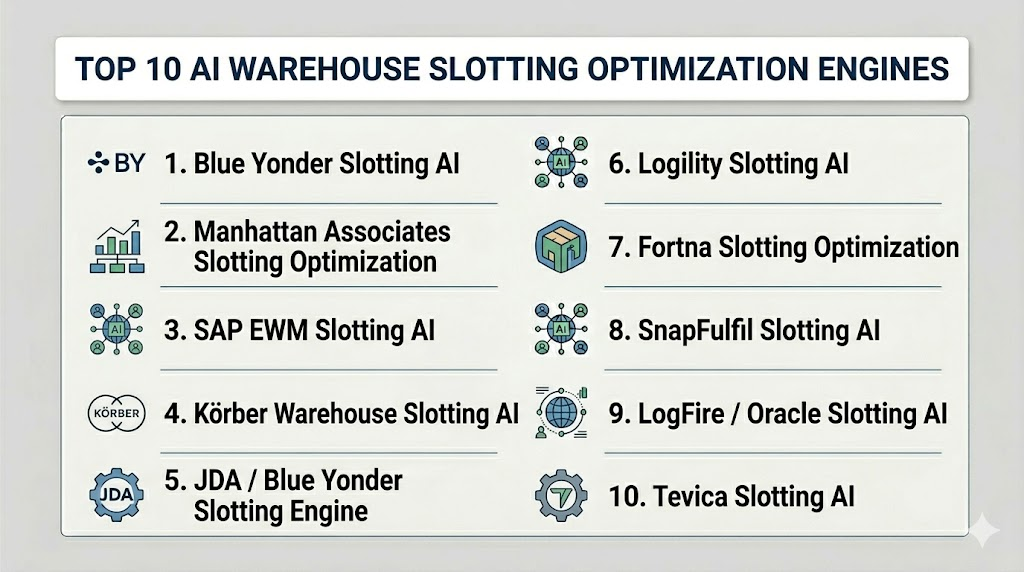
Top 10 AI Warehouse Slotting Optimization Engines
1 — Blue Yonder Slotting AI
One‑line verdict: Enterprise‑focused AI slotting engine with dynamic re‑slotting, simulation, and robotics orchestration.
Short description: Blue Yonder applies predictive demand and picking analysis to optimize SKU placement, reduce travel, and improve throughput in large warehouses.
Standout Capabilities
- Predictive slot assignments based on demand velocity.
- Multi‑zone and multi‑level support.
- Simulation of layout changes before implementation.
- Integration with robotics and ASRS systems.
- Accessibility via planner dashboards.
- KPI tracking for travel, throughput, and labor utilization.
- Automated re‑slotting triggers based on demand changes.
AI‑Specific Depth
- Model support: Proprietary AI
- RAG / knowledge integration: WMS/ERP connectors
- Evaluation: Scenario simulation & historical validation
- Guardrails: Safety, aisle clearance, load limits
- Observability: Travel, throughput, picker performance
Pros
- Best for large, complex warehouses
- Strong automation integration
- Predictive and dynamic slotting
Cons
- Premium pricing
- Setup requires WMS integration expertise
- Steep learning curve
Security & Compliance
- SSO/SAML, RBAC, encryption at rest & transit
- Audit logs & retention controls
- Certifications: Not publicly stated
Deployment & Platforms
- Cloud, Web, Hybrid
Integrations & Ecosystem
ERP/WMS connectors, ASRS/robotic system integration, analytics dashboards.
Pricing Model
- Subscription‑based; Not publicly stated
Best‑Fit Scenarios
- E‑commerce fulfillment centers
- Multi‑zone automated warehouses
- High SKU churn environments
2 — Manhattan Associates Slotting Optimization
One‑line verdict: Robust enterprise AI slotting engine integrated with Manhattan WMS and analytics for high‑throughput operations.
Short description: Provides dynamic SKU placement, pick path optimization, and simulation capabilities targeted at large, high‑throughput warehouses.
Standout Capabilities
- Demand forecasting‑driven slot recommendations.
- Multi‑aisle and multi‑depot optimization.
- Warehouse layout simulation workspace.
- Integration with Manhattan WMS and analytics.
- Re‑slotting alerts based on trend shifts.
- Optimization across zones.
AI‑Specific Depth
- Model support: Proprietary AI
- RAG / knowledge integration: WMS/ERP
- Evaluation: Historical & scenario testing
- Guardrails: Safety & storage constraints
- Observability: Picker efficiency, travel time dashboards
Pros
- Strong enterprise integration
- High throughput optimization
- Simulations before changes
Cons
- High complexity
- Expensive for smaller operations
- Requires planner training
Security & Compliance
- SSO, RBAC, encryption
- Audit logs
- Certifications: Not publicly stated
Deployment & Platforms
- Cloud, Hybrid
Integrations & Ecosystem
WMS connectors, robotics, ERP, analytics.
Pricing Model
Subscription; Not publicly stated
Best‑Fit Scenarios
- Enterprise warehouses
- High volume, multi‑zone layouts
- Complex SKU mixes
3 — SAP EWM Slotting AI
One‑line verdict: Integrated slotting AI for SAP EWM users optimizing placement and pick efficiency natively.
Short description: SAP’s embedded AI slotting module within Extended Warehouse Management (EWM) uses order history and demand forecasts to recommend optimal arrangement.
Standout Capabilities
- Seamless SAP EWM integration.
- Demand‑driven slotting suggestions.
- Travel time reduction analytics.
- Picker performance metrics.
- Simulation for seasonal changes.
- ERP data continuity.
AI‑Specific Depth
- Model support: SAP proprietary AI
- RAG / knowledge integration: SAP EWM/ERP
- Evaluation: Historical & simulation testing
- Guardrails: Load & safety compliance
- Observability: Throughput & efficiency dashboards
Pros
- Best for SAP environments
- Strong data continuity
- Predictive slotting
Cons
- Limited outside SAP
- Requires SAP expertise
- Premium licensing
Security & Compliance
SSO/SAML, encryption, audit trails, data residency options.
Deployment & Platforms
Cloud, Web
Integrations & Ecosystem
SAP EWM, ERP, analytics.
Pricing Model
Subscription; Not publicly stated
Best‑Fit Scenarios
- SAP‑centric warehouses
- High demand variability
- Integrated ERP/warehouse workflows
4 — Körber Warehouse Slotting AI
One‑line verdict: AI engine with strong automation integration, suited for ASRS‑enabled warehouses.
Short description: Optimizes SKU positioning, pick paths, and bin assignments with deep support for robotics and conveyor systems.
Standout Capabilities
- Automated SKU repositioning suggestions.
- ASRS and conveyor connectivity.
- Bin and aisle load constraint guardrails.
- Dynamic re‑slotting based on shifting patterns.
- Scenario simulation workbench.
- Picker and robot performance KPIs.
AI‑Specific Depth
- Model support: Proprietary AI
- RAG / knowledge integration: WMS & automation systems
- Evaluation: Predictive & historical testing
- Guardrails: Safety & load limits
- Observability: Utilization, travel & throughput
Pros
- Excellent automation support
- Predictive slotting
- Scalable to large operations
Cons
- Premium cost
- Complex integration
- Training required
Security & Compliance
SSO/RBAC, encryption, audit logs
Deployment & Platforms
Cloud, Web, Hybrid
Integrations & Ecosystem
WMS, ASRS, conveyors, analytics.
Pricing Model
Subscription; Not publicly stated
Best‑Fit Scenarios
- Automated fulfillment centers
- Multi‑level storage
- High‑velocity SKU environments
5 — JDA / Blue Yonder Slotting Engine
One‑line verdict: Mature AI slotting engine focused on labor productivity and travel time reduction.
Short description: Uses demand analytics and warehouse performance data to recommend slot placements that minimize labor and movement.
Standout Capabilities
- SKU velocity scoring
- Travel time modeling
- Re‑slotting simulation
- Picker performance dashboards
- Multi‑zone slot sequencing
AI‑Specific Depth
- Model support: Proprietary AI
- RAG / knowledge integration: ERP/WMS
- Evaluation: Simulation & historical tests
- Guardrails: Safety & aisle constraints
- Observability: Travel & labor time analytics
Pros
- Strong labor optimization
- Simulation capabilities
- Predictive movements
Cons
- Complex for small sites
- Premium pricing
- Requires robust WMS
Security & Compliance
SSO, encryption, audit logs
Deployment & Platforms
Cloud, Hybrid
Integrations & Ecosystem
ERP/WMS, analytics.
Pricing Model
Subscription; Not publicly stated
Best‑Fit Scenarios
- High labor cost warehouses
- Frequent demand shifts
- Multi‑zone operations
6 — Logility Slotting AI
One‑line verdict: Mid‑market focused slotting optimization with intuitive dashboards.
Short description: Provides slotting suggestions, efficiency tracking, and demand insights with easy setup for mid‑size warehouses.
Standout Capabilities
- Demand forecasting support
- Slotting recommendations
- Visual KPIs for efficiency
- Integration with key WMS systems
- Pick path analytics
AI‑Specific Depth
- Model support: Proprietary ML models
- RAG / knowledge integration: WMS connectors
- Evaluation: Historical comparison
- Guardrails: Safety parameters
- Observability: Travel & utilization
Pros
- Mid‑market friendly
- Easy dashboarding
- Rapid deployment
Cons
- Less robust simulation
- Fewer automation connectors
- Limited robotics support
Security & Compliance
Encryption, RBAC, audit logs
Deployment & Platforms
Cloud, Web
Integrations & Ecosystem
WMS connectors, analytics.
Pricing Model
Subscription; Not publicly stated
Best‑Fit Scenarios
- Mid‑size warehouses
- Manual pick zones
- Demand variability
7 — Fortna Slotting Optimization
One‑line verdict: AI slotting engine with strong simulation and layout planning tools.
Short description: Focuses on “what‑if” scenario planning alongside slotting recommendations to help warehouse planners visualize impacts.
Standout Capabilities
- Scenario simulations
- Pick path optimization
- Demand‑driven slotting
- KPI dashboards
- Layout mapping tools
AI‑Specific Depth
- Model support: Proprietary AI
- RAG / knowledge integration: WMS
- Evaluation: Scenario & historical tests
- Guardrails: Safety & load constraints
- Observability: Throughput & utilization
Pros
- Strong planning tools
- Pick path insights
- Simulations for layout changes
Cons
- Limited automation integrations
- Premium pricing
- Learning curve
Security & Compliance
Encryption, audit logs
Deployment & Platforms
Cloud, Web
Integrations & Ecosystem
WMS connectors, analytics.
Pricing Model
Subscription; Not publicly stated
Best‑Fit Scenarios
- Warehouses planning major layout changes
- Analyst‑driven environments
- Seasonal slotting challenges
8 — SnapFulfil Slotting AI
One‑line verdict: AI Slotting optimized for cloud‑native mid‑market WMS environments.
Short description: Delivers slotting suggestions and efficiency insights with strong cloud WMS integration and ease of use.
Standout Capabilities
- Cloud‑native slotting suggestions
- KPI dashboards for throughput
- Pick path analytics
- Integration with standard WMS APIs
AI‑Specific Depth
- Model support: Proprietary ML
- RAG / knowledge integration: WMS APIs
- Evaluation: Historical tests
- Guardrails: Safety constraints
- Observability: Travel & pick efficiency
Pros
- Cloud‑native simplicity
- Rapid onboarding
- Mid‑market fit
Cons
- Limited deep simulation
- Robotics support: Varies / N/A
- Less granular analytics
Security & Compliance
Encryption, audit logs
Deployment & Platforms
Cloud, Web
Integrations & Ecosystem
WMS APIs, analytics.
Pricing Model
Subscription; Not publicly stated
Best‑Fit Scenarios
- Cloud‑centric warehouses
- Mid‑market operations
- Rapid rollout needs
9 — LogFire / Oracle Slotting AI
One‑line verdict: Integrated slotting engine for Oracle WMS customers, strong in enterprise scale.
Short description: Provides intelligent slotting and travel time reduction natively within Oracle’s warehouse suite.
Standout Capabilities
- Tight Oracle WMS integration
- Demand & velocity slotting
- Travel time modeling
- Re‑slotting alerts
- KPI dashboards
AI‑Specific Depth
- Model support: Oracle AI
- RAG / knowledge integration: Oracle WMS/ERP
- Evaluation: Historical & scenario tests
- Guardrails: Safety limits
- Observability: Pick & travel KPIs
Pros
- Seamless Oracle stack integration
- Predictive slotting
- Enterprise scale
Cons
- Oracle expertise required
- Premium licensing
- Less flexible outside Oracle
Security & Compliance
SSO, RBAC, encryption
Deployment & Platforms
Cloud, Hybrid
Integrations & Ecosystem
Oracle WMS/ERP, analytics
Pricing Model
Subscription; Not publicly stated
Best‑Fit Scenarios
- Oracle‑centric enterprises
- Multi‑zone warehouses
- High throughput
10 — Tevica Slotting AI
One‑line verdict: Emerging AI slotting engine focused on automated warehouses and scalability.
Short description: Uses AI to provide slot placements, simulation, and dynamic updates for robotic and conveyor environments.
Standout Capabilities
- Dynamic slotting automation
- Simulation engine
- Robotics & ASRS support
- KPI dashboards
- Travel & throughput metrics
AI‑Specific Depth
- Model support: Proprietary AI
- RAG / knowledge integration: WMS/automation
- Evaluation: Scenario & historical tests
- Guardrails: Safety & load limits
- Observability: Utilization & travel KPIs
Pros
- Automation focus
- Emergent innovation
- Flexible architecture
Cons
- Smaller ecosystem
- Fewer integrations
- Premium positioning
Security & Compliance
Encryption, audit logs
Deployment & Platforms
Cloud, Web
Integrations & Ecosystem
WMS, ASRS, analytics
Pricing Model
Subscription; Not publicly stated
Best‑Fit Scenarios
- Automated warehouses
- Robotic picking environments
- Growing SKUs
Comparison Table
| Tool Name | Best For | Deployment | Model Flexibility | Strength | Watch‑Out | Public Rating |
|---|---|---|---|---|---|---|
| Blue Yonder Slotting AI | Enterprise & robotics | Cloud/Hybrid | Proprietary | Predictive slotting | Premium pricing | N/A |
| Manhattan Slotting | Enterprise | Cloud/Hybrid | Proprietary | WMS integration | Complex training | N/A |
| SAP EWM Slotting | SAP environments | Cloud/Web | Proprietary | SAP native | SAP only | N/A |
| Körber Slotting AI | Automation hubs | Cloud/Hybrid | Proprietary | ASRS support | Complex setup | N/A |
| Blue Yonder (JDA) Slotting | Labor optimization | Cloud/Hybrid | Proprietary | Travel & labor KPIs | Premium cost | N/A |
| Logility Slotting | Mid‑market | Cloud/Web | Proprietary | Ease of use | Fewer simulations | N/A |
| Fortna Slotting | Planning & simulation | Cloud/Web | Proprietary | Scenario planning | Less robotics | N/A |
| SnapFulfil Slotting AI | Cloud‑centric | Cloud/Web | Proprietary | Rapid onboarding | Limited deep simulation | N/A |
| LogFire (Oracle) | Oracle warehouses | Cloud/Hybrid | Proprietary | Oracle stack | Oracle expertise | N/A |
| Tevica Slotting AI | Emerging automation | Cloud/Web | Proprietary | Robotics focus | Smaller ecosystem | N/A |
Scoring & Evaluation
Scoring reflects comprehensive feature comparison using weighted criteria (Core 20%, Reliability/Evaluation 15%, Guardrails 10%, Integrations 15%, Ease 10%, Performance/Cost 15%, Security/Admin 10%, Support 5%).
| Tool | Core | Reliability/Eval | Guardrails | Integrations | Ease | Perf/Cost | Security/Admin | Support | Weighted Total |
|---|---|---|---|---|---|---|---|---|---|
| Blue Yonder Slotting AI | 9 | 9 | 9 | 9 | 7 | 8 | 8 | 7 | 8.7 |
| Manhattan Slotting | 8 | 9 | 9 | 9 | 7 | 8 | 8 | 7 | 8.5 |
| SAP EWM Slotting | 8 | 8 | 8 | 9 | 7 | 8 | 8 | 7 | 8.2 |
| Körber Slotting AI | 8 | 8 | 9 | 8 | 7 | 8 | 8 | 7 | 8.2 |
| Blue Yonder (JDA) Slotting | 8 | 8 | 8 | 8 | 7 | 8 | 8 | 7 | 8.1 |
| Logility Slotting | 7 | 7 | 8 | 7 | 9 | 7 | 7 | 7 | 7.4 |
| Fortna Slotting | 7 | 8 | 8 | 7 | 7 | 7 | 7 | 7 | 7.3 |
| SnapFulfil Slotting AI | 7 | 7 | 8 | 7 | 9 | 7 | 7 | 7 | 7.4 |
| LogFire (Oracle) Slotting | 8 | 8 | 8 | 9 | 7 | 8 | 8 | 7 | 8.2 |
| Tevica Slotting AI | 7 | 7 | 8 | 7 | 7 | 7 | 7 | 6 | 7.1 |
Top 3 for Enterprise: Blue Yonder Slotting AI, Manhattan Slotting, SAP EWM Slotting
Top 3 for SMB/Mid‑Market: Logility Slotting, SnapFulfil Slotting AI, Fortna Slotting
Top 3 for Automation & Robotics: Blue Yonder Slotting AI, Körber Slotting AI, Tevica Slotting AI
Which AI Warehouse Slotting Tool Is Right for You?
Solo / Small Warehouses
- Logility Slotting or SnapFulfil Slotting AI for easy deployment and quick insights.
SMB / Mid‑Market
- Logility or Fortna Slotting for strong dashboards and scenario planning.
Enterprise
- Blue Yonder Slotting AI, Manhattan Slotting, or SAP EWM Slotting for large, dynamic operations.
Automation & ASRS Integration
- Körber Slotting AI, Blue Yonder Slotting AI, or Tevica Slotting AI for robotics and conveyor environments.
SAP or Oracle Environments
- SAP EWM Slotting for SAP stacks; LogFire (Oracle) Slotting AI for Oracle users.
Budget vs Premium
- Budget: Logility, SnapFulfil
- Premium: Blue Yonder, Manhattan, Körber
Build vs Buy
- Small static warehouses can afford manual methods; dynamic or automated environments benefit from enterprise AI slotting.
Implementation Playbook (30 / 60 / 90 Days)
30 Days
- Pilot with key SKUs and zones.
- Validate data quality from WMS/ERP.
- Track baseline KPIs (travel time, picks/hour).
- Configure guardrails for safety & weight limits.
60 Days
- Expand pilot to multiple zones.
- Conduct scenario simulations and re‑slot tests.
- Integrate robotics or conveyors where applicable.
- Roll out observability dashboards.
90 Days
- Full warehouse rollout.
- Automate dynamic re‑slotting triggers.
- Optimize AI inference cost & latency.
- Establish governance, audit logs, and retention controls.
- Train planners and enable self‑service optimization.
Common Mistakes & How to Avoid Them
- Over‑automation without planner oversight.
- Poor data integration from WMS/ERP sources.
- Ignoring safety and load constraints.
- No observability or KPI tracking.
- Failure to simulate layout changes.
- Not validating AI models with historical data.
- Skipping scenario planning for demand shifts.
- Rushing rollout without phased pilots.
- Not aligning with robotics or automation controllers.
- Ignoring cross‑dock or inbound slotting needs.
- Inadequate collaboration workflows.
- Missing SLA or compliance guardrails.
- Ignoring seasonal demand patterns.
FAQs
1‑ What data does AI slotting optimization use?
It typically uses SKU demand history, pick frequencies, inventory counts, warehouse layout, and automation system signals.
2‑ Can AI slotting dynamically reassign slots in real time?
Yes — many engines support dynamic re‑slotting based on updated demand patterns.
3‑ Do these tools require WMS integration?
Yes — most require bi‑directional WMS connectivity for real‑time and historical data.
4‑ Are robotics and ASRS supported?
Enterprise solutions like Blue Yonder, Körber, and Tevica offer deep robotics and ASRS integration.
5‑ Can slotting analytics reduce labor costs?
Yes — by shortening picker travel paths and improving slot placement, labor productivity increases.
6‑ Is scenario planning critical?
Absolutely — it helps validate layout changes and demand shifts before physical changes.
7‑ Are these engines cloud‑only?
Most are cloud or hybrid; a few offer on‑premise where latency or data residency is a concern.
8‑ How do I measure impact?
Track KPIs like travel time, picks per hour, throughput, and order cycle time.
9‑ Can mid‑market warehouses benefit?
Yes — tools like Logility and SnapFulfil are tailored to mid‑market needs.
10‑ Do these tools support robotics?
Yes — enterprise tools integrate with robots, ASRS, and conveyors for automation optimization.
11‑ What are guardrails?
Business rules that enforce safety, load limits, aisle widths, and compliance constraints.
12‑ How often should re‑slotting occur?
It varies by demand volatility — weekly to monthly schedules are common.
Conclusion
AI Warehouse Slotting Optimization engines have become indispensable for modern warehouses striving to reduce travel time, improve throughput, and maximize labor productivity. The right choice depends on scale, automation integration, WMS ecosystem, and budget. Small to mid‑market operations benefit from tools with rapid deployment and intuitive dashboards, while enterprise warehouses gain from deep integration, dynamic re‑slotting, simulation, and automation support

Find Trusted Cardiac Hospitals
Compare heart hospitals by city and services — all in one place.
Explore Hospitals
AI warehouse slotting works best when demand patterns, SKU movement data, and layout constraints are continuously updated and accurate.