
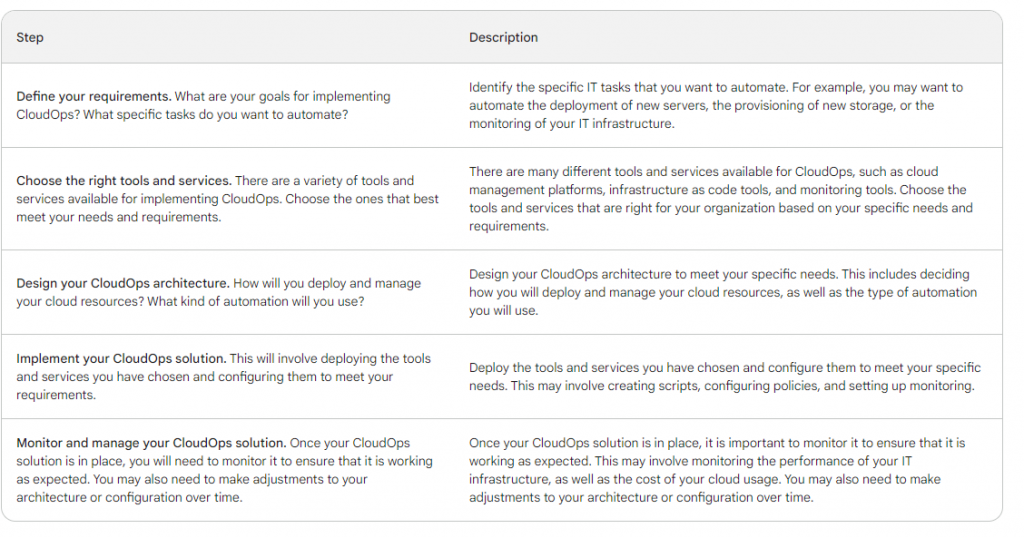
Are you planning to implement CloudOps in your organization? Then you must be aware of the challenges that come with it. CloudOps is not a simple task that can be accomplished overnight. It requires careful planning, implementation, and maintenance. In this article, we will discuss the implementation challenges of CloudOps and how to overcome them.
Understanding CloudOps
Before we delve into the implementation challenges, let’s first understand what CloudOps is. CloudOps is a combination of two terms – Cloud and Operations. It is a set of practices that are used to manage and operate applications on the cloud. CloudOps is all about optimizing the performance of applications in the cloud and ensuring their availability to end-users.
Implementation Challenges in CloudOps
- Security Challenges – Security is a major concern when it comes to CloudOps. The data stored in the cloud is vulnerable to cyber-attacks, and a single breach can lead to a massive loss of data. Therefore, it is important to implement robust security measures to protect the data. However, implementing security measures is not an easy task, and it requires a lot of expertise.
- Cost Challenges – Implementing CloudOps can be expensive. It requires a lot of investment in terms of hardware, software, and infrastructure. Moreover, the cost of cloud services can vary depending on the type of service and the provider. Therefore, it is important to understand the cost implications of CloudOps before implementing it.
- Integration Challenges – Integrating CloudOps with existing systems can be a challenge. Many organizations have legacy systems that are not compatible with cloud-based applications. Therefore, it is important to ensure that the existing systems are compatible with the cloud-based applications before implementing CloudOps.
- Training Challenges – Implementing CloudOps requires a lot of expertise. Therefore, it is important to ensure that the IT staff is trained to handle cloud-based applications. However, training the staff can be a time-consuming and expensive process.
- Vendor Lock-in Challenges – Vendor lock-in is a major concern when it comes to CloudOps. Once an organization has invested in a cloud-based service provider, it becomes difficult to switch to another provider. Therefore, it is important to choose a service provider that offers flexibility and portability.
Overcoming Implementation Challenges in CloudOps
- Security Solutions – Implementing security solutions such as firewalls, intrusion detection systems, and encryption can help protect the data stored in the cloud. Moreover, regular security audits can help detect vulnerabilities and prevent cyber-attacks.
- Cost Optimization – It is important to optimize costs by choosing the right cloud service provider and selecting the appropriate cloud services. Moreover, organizations can save costs by using open-source software and leveraging automation tools.
- Integration Solutions – It is important to ensure that the existing systems are compatible with cloud-based applications. This can be achieved by using middleware solutions and API gateways.
- Training Programs – Organizations can invest in training programs to ensure that the IT staff is well-equipped to handle cloud-based applications. Moreover, organizations can leverage online training platforms to reduce costs.
- Vendor Selection – It is important to choose a service provider that offers flexibility and portability. This can be achieved by choosing a provider that offers open standards and interoperability.
Conclusion
CloudOps is a complex task that requires careful planning, implementation, and maintenance. However, by understanding the implementation challenges and implementing the solutions discussed in this article, organizations can overcome the challenges and reap the benefits of CloudOps. So, if you are planning to implement CloudOps, make sure to take the necessary steps to ensure a successful implementation.

👤 About the Author
Ashwani is passionate about DevOps, DevSecOps, SRE, MLOps, and AiOps, with a strong drive to simplify and scale modern IT operations. Through continuous learning and sharing, Ashwani helps organizations and engineers adopt best practices for automation, security, reliability, and AI-driven operations.
🌐 Connect & Follow:
Website: WizBrand.com
Facebook: facebook.com/DevOpsSchool
X (Twitter): x.com/DevOpsSchools
LinkedIn: linkedin.com/company/devopsschool
YouTube: youtube.com/@TheDevOpsSchool
Instagram: instagram.com/devopsschool
Quora: devopsschool.quora.com
Email– contact@devopsschool.com
Find Trusted Cardiac Hospitals
Compare heart hospitals by city and services — all in one place.
Explore Hospitals