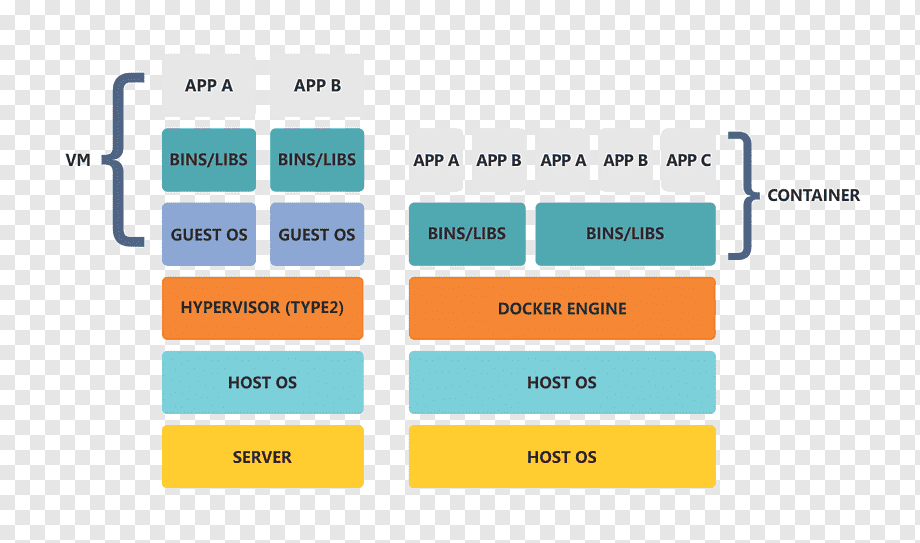
Containers and virtual machines are both technologies for isolating applications and their dependencies, but they differ in several key ways:
- Architecture: Virtual machines run on top of a host operating system and use virtualization technology to create a separate operating system environment for each virtual machine. Containers, on the other hand, share the host operating system kernel and run applications and their dependencies in isolated user spaces.
- Resource Usage: Virtual machines are resource-intensive and require more system resources than containers. Virtual machines need to run an entire operating system, which takes up more memory and storage space than a container. Containers are more lightweight and efficient, as they share the host operating system and only include the minimum necessary components to run the application.
- Deployment and Management: Virtual machines typically require manual configuration and management, including the installation of operating systems, application software, and security patches. Containers are easier to deploy and manage, as they can be bundled with all their dependencies in a single image and can be launched and managed with a single command.
- Scalability: Containers are designed for scalability and can be launched and stopped quickly and easily, making it easier to scale applications up or down as needed. Virtual machines, on the other hand, are typically slower to launch and stop, and scaling requires manual intervention.
- Portability: Containers are more portable than virtual machines, as they can be run on any host that has the Docker engine installed. Virtual machines, on the other hand, are dependent on the underlying hardware and may require reconfiguration to run on different hosts.
In summary, containers and virtual machines are both technologies for isolating applications, but they differ in their architecture, resource usage, deployment and management, scalability, and portability. Containers are generally more lightweight, efficient, and portable than virtual machines, making them a popular choice for modern application deployment and management.

I’m Rajesh Kumar, a DevOps, SRE, DevSecOps, Cloud, and Platform Engineering expert passionate about sharing practical knowledge, real-world experiences, and industry best practices. I have worked at Cotocus and regularly write about technology, travel, investing, health, product reviews, and digital marketing through my various platforms.
I publish technical articles at DevOps School, travel stories at Holiday Landmark, stock market insights at Stocks Mantra, health and fitness guidance at My Medic Plus, product reviews at TrueReviewNow, and SEO and digital marketing strategies at Wizbrand.
Find Trusted Cardiac Hospitals
Compare heart hospitals by city and services — all in one place.
Explore Hospitals