
What is Scala?
Scala stands for Scalable Language. It is a multi-paradigm programming language. Scala language includes features of functional programming and object-oriented programming. Scala is designed to interact well with mainstream platforms such as Java or C#. It shares with these languages most of the basic operators, data types, and control structures.
Scala’s type system ensures that variance annotations are sound by keeping track of the positions where a type parameter is used. These positions are classified as covariant for the types of immutable elds and method results, and contravariant for method argument types and upper type parameter bounds. Type arguments to a non-variant type parameter are always in non-variant position. The position Tips between contra- and co-variant inside a type argument that corresponds to a contravariant parameter.
History & Origin of Scala
Scala is a general purpos
Scala is a general purpose programming language. Scala was created and envented by Martin Odersky. The design of the language started in 2001 and was released to the public in early 2004. At JavaOne conference in 2012, Scala was awarded as the winner of the ScriptBowl contest. From June 2012, Scala doesn’t provide any support for .Net Framework. The latest version of scala is 2.12.6 which released on 27-Apr-2018.
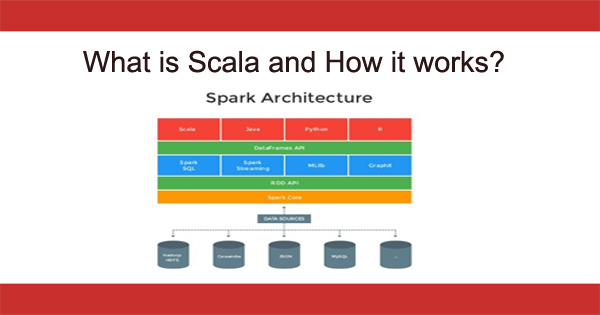
How Works Scala architecture?
Scala offers the magic of implicit conver‐sions, String instances also have access to all the methods of the StringOps class, so you can do many other things with them, such as treating a String instance as a sequence of characters.
As a result, you can iterate over every character in the string using the
foreach method:
You can treat a String as a sequence of characters in a for loop:
scala> for (c <- “hello”) println(c)
Use case of Scala
- Data pipelines.
- Microservices.
- Video transcoding systems.
- Real-time information processing.
- Ad-serving.
- Data processing.
- Communications platforms.
- Big data projects.
Feature and Advantage of using Scala
- Comparing Scala to a language such as C++ or Go is difficult. A better comparison is to Java.
- Java Compatibility and Interoperability
- String comparison advancements
- Pattern matching
- everage the advantages of JVM
- Keep their Java libraries
- Mixins, which incorporate functions in class definitions
TOP ALTERNATIVES TO SCALA
- Kotlin
- Clojure
- Go
- Haskell
- Python
- Java
- Apache Spark
- Groovy
Best Resources, Tutorials and Guide for scala
Here im going to mention top tutorials and guide for scala
Free Video Tutorials of Scala
Interview Questions and Answer for Scala
Write a few Frameworks of Scala
- Akka Framework
- Spark Framework
- Play Framework
- Scalding Framework
- Neo4j Framework
- Lift Framework
- Bowler Framework
What are the four types of scala identifiers ?
The four types of identifiers are
- Alpha numeric identifiers
- Operator identifiers
- Mixed identifiers
- Literal identifiers
Jobs & Salary Prospectus of Scala skills
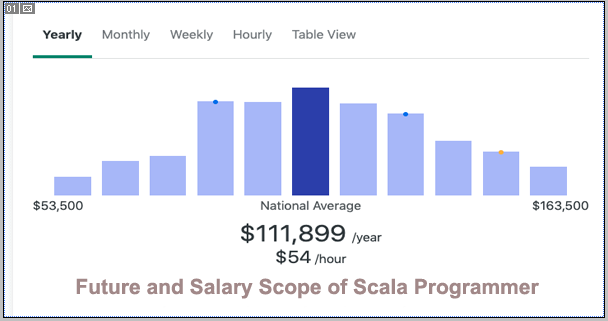
Scala is a language that’s a bit difficult to learn. Now i’m going to describe about Scala Job Opportunities for you in future, what is the Scala programmer salary, work profile, top organizations using Scala, etc.
A software engineer deals with:
- Basic System Administration
- Executing full life-cycle software development
- Producing specifications and determining operational feasibility
- Design and implementation of new features for applications
- Testing system for bugs
- Fixing errors in existing features
- Maintenance support after deployment of application
DevOpsSchool.com
Scala & Functional Programming for Beginners (Udemy)
Functional Programming in Scala Specialization (Coursera best course)

I’m Rajesh Kumar, a DevOps, SRE, DevSecOps, Cloud, and Platform Engineering expert passionate about sharing practical knowledge, real-world experiences, and industry best practices. I have worked at Cotocus and regularly write about technology, travel, investing, health, product reviews, and digital marketing through my various platforms.
I publish technical articles at DevOps School, travel stories at Holiday Landmark, stock market insights at Stocks Mantra, health and fitness guidance at My Medic Plus, product reviews at TrueReviewNow, and SEO and digital marketing strategies at Wizbrand.
Find Trusted Cardiac Hospitals
Compare heart hospitals by city and services — all in one place.
Explore Hospitals

A very efficient Scala tutorial,also a good learning resource on How SCALA works and its use cases. Would love to hear more about Spark and Scala together.
First of all thanks a lot for describing the advantage of SCALA. I have a personal request, can you please make a tutorial series which can cover the below topic. I think it will be very helpful for people who want to go to long way with SCALA.
1. Introduce with scala play framework.
2. Integration play with a different database.
3. Integration unit test.
4. Play dependency injection.
5. Play user management with secured action.
6. With a custom library and those in play project
7. Set play and spark together.
8. Call spark process from play.
9. etc
Thanks
Scala is a strong statically typed general-purpose programming language which supports both object-oriented programming and functional programming. Designed to be concise, many of Scala’s design decisions are aimed to address criticisms of Java.