Deep Learning Intermediate Training
Apply transformers and generative models, speed up training on GPUs and tune hyperparameters systematically. Learn Deep Learning through a clear Foundation to Advanced path, with hands-on labs, live cohort options, certification support and full LMS access.
Last updated
Self-paced video subscription
Billed yearly at ₹9,996. This includes all four levels, complete LMS access for one year, plus 20+ additional courses and 50+ tools access.
- All four Deep Learning levels in one price.
- 20+ additional courses and 50+ tools included, even when subscribing to one course.
- Best fit for learners who want full-library access and flexible progress.
Live & Interactive session
Instructor-led cohort, max 8 to 10 hours, with demos, labs, Q&A, assignments and practical review.
- Live small-batch cohort from soon.
- Interactive discussion and lab troubleshooting.
- Recommended for teams that need guided implementation.
1:1 Live training
The same agenda, taught one-to-one by the trainer. Start immediately, without waiting for the next batch. Max 8 to 10 hours, one-to-one.
About Deep Learning Intermediate Training.
Understand where Deep Learning fits in modern software delivery, what this level covers, and how the program builds practical confidence step by step.
Program overview
Deep Learning is taught as a practical technical skill for modern engineering, operations and platform teams. The course explains where the tool fits, how it is used in real delivery environments, and how learners can apply it through guided practice.
This DevOpsSchool Deep Learning program is built for working professionals who want usable skills instead of only conceptual exposure. The training emphasizes live examples, workflow clarity, operational controls and progressive skill depth from Foundation to Intermediate.
Private Deep Learning training for delivery teams, platform groups and engineering organizations.
DevOpsSchool provides corporate Deep Learning training for teams that need faster adoption, workflow standardization, administrative control, integration guidance and governance-ready rollout. Private batches can be aligned to development practice, release workflow, access model, maturity level and internal tooling.
- Private online or classroom delivery for engineering teams
- Aligned to Deep Learning usage maturity, admin depth and collaboration patterns
- Useful for rollout, migration, governance and workflow consistency goals
- Can be tailored for developers, administrators, DevOps teams and leadership stakeholders
Why teams use DevOpsSchool
DevOpsSchool combines live demonstration, practical workflow discussion, implementation-oriented examples, and strong post-session learning support. That makes the training more usable for real teams than generic slide-led courses.
Choose any level. The page still shows the full progression.
Foundation, Essential, Intermediate and Advanced are presented as one linked training flow. Self-paced buyers get all levels by default, even if they start from only one course page.
Instructor-led, self-paced and corporate delivery options.
Compare delivery format, duration, level access and batch style. Fees are shown only in the top decision panel and once again after the agenda.
| Duration | Mode | Level access | Batch |
|---|---|---|---|
| 8 to 10 Hrs. max | Live & Interactive | Intermediate | Public batch |
| 8 to 10 Hrs. max | 1:1 Live training | Intermediate | Starts immediately |
| 1 year LMS access | Self-paced video | All 4 levels | Anytime access |
| 3 Days | Corporate | Deep Learning Intermediate Training | Private team batch |
What learners should be able to do after Deep Learning training.
The outcomes are written for practical delivery teams: developers, DevOps engineers, release engineers, administrators and technical leads.
Build modern neural networks
Design and train CNNs, sequence models and transformers in PyTorch for real datasets.
Fine-tune pretrained models efficiently
Adapt pretrained vision and language models with transfer learning and LoRA.
Ship models to production
Optimise, deploy and monitor deep learning models with scalable training and serving tools.
Why this skill, what you will achieve, and who should attend.
Use this section to decide whether the course matches your role, current experience and expected Deep Learning responsibilities before reviewing the detailed agenda.
Why Deep Learning matters
- Deep Learning helps teams standardize a critical part of their software delivery, infrastructure, automation or operations workflow.
- It gives learners a repeatable way to move from basic usage to confident execution in team and enterprise environments.
- For DevOps and platform teams, Deep Learning becomes more valuable when connected with automation, governance, monitoring and delivery practices.
- Teams using Deep Learning effectively reduce ad-hoc execution and move toward consistent engineering standards.
Objectives
- Understand Deep Learning concepts, architecture, terminology and operational usage patterns.
- Learn practical configuration, workflow design, access controls, team usage and quality practices.
- Apply Deep Learning in real delivery workflows using automation, integrations, traceability and governance patterns.
- Build practical confidence to use Deep Learning for individual, team and organizational use cases.
Pre-requisites
- Basic computer literacy and familiarity with software development workflows.
- Helpful but not mandatory: introductory DevOps, cloud, automation or software delivery awareness.
- No deep programming background is required for the Foundation and Essential levels.
Who this course is for
- Developers, administrators and engineers who need practical Deep Learning usage skills.
- DevOps engineers, release engineers, SREs and platform teams managing delivery standards.
- Engineering leads and technical managers responsible for workflow quality, access controls and governance.
- Corporate teams migrating to or standardizing on Deep Learning.
Small-batch live training starts every month.
Weekday batches start on the 1st and weekend batches on the first Saturday of every month. One-to-one (1:1) training can start immediately; corporate sessions are scheduled on demand.
Weekend live batch
Starts on the first Saturday of every month. Weekend sessions with demos, labs and Q&A; max 10 learners.
Weekday live batch
Starts on the 1st of every month. Weekday sessions for working professionals and distributed teams; max 10 learners.
Ask advisorAgenda depth up to the selected level.
This page shows the learning flow from Foundation through Intermediate. Each level adds to the previous one, and the agenda stops at the current page level. Day counts are for corporate (day-wise) delivery; live online batches cover the same agenda in max 8 to 10 hours.
Foundation Level: neural network concepts, PyTorch setup, first modelDay 1
- Deep learning landscape: AI versus machine learning versus deep learning, where deep learning wins and its limits
- Math refresher: vectors, matrices, tensors, derivatives, chain rule and probability for neural networks
- Perceptron and multilayer networks: neurons, weights, biases, layers and forward propagation
- Activation functions: sigmoid, tanh, ReLU, GELU and softmax and when to use each
- Loss functions: mean squared error, cross-entropy and binary cross-entropy
- Backpropagation and gradient descent: computing gradients, learning rate, batch, mini-batch and stochastic updates
- Environment setup: Python, Jupyter, conda or uv, PyTorch with CUDA, Google Colab and checking the GPU
- PyTorch tensors: creation, indexing, broadcasting, device placement and autograd
- Building models: nn.Module, nn.Linear, nn.Sequential, optimizers and the training loop
- Data handling: Dataset and DataLoader, train, validation and test splits, normalisation
- Evaluation basics: accuracy, precision, recall, confusion matrix and learning curves
- First example: classify handwritten digits on MNIST or Fashion-MNIST with a fully connected network
Essential Level = Foundation + CNNs, sequence models, regularisation and transfer learningDay 2 · 2 days cumulative
- Convolutional neural networks: convolutions, kernels, stride, padding, pooling and feature maps
- CNN architectures: LeNet, VGG, ResNet skip connections and EfficientNet design ideas
- Optimizers: SGD with momentum, RMSprop, Adam and AdamW, learning rate schedules and warm-up
- Regularisation: dropout, weight decay, early stopping and data augmentation with torchvision transforms
- Normalisation and initialisation: batch norm, layer norm, Xavier and He initialisation
- Transfer learning: pretrained torchvision and timm models, freezing layers and fine-tuning heads
- Sequence models: RNN, LSTM and GRU, vanishing gradients and sequence padding
- Word embeddings: tokenisation, embedding layers, word2vec and GloVe concepts
- Keras 3 overview: Sequential and functional APIs with JAX, TensorFlow or PyTorch backends
- Experiment tracking: TensorBoard and MLflow for metrics, parameters and model artifacts
- Saving and loading models: state_dict, checkpoints and resuming training
- Debugging training: overfitting versus underfitting, exploding gradients and sanity checks on small batches
Intermediate Level = Essential + transformers, generative models and training at speedDay 3 · 3 days cumulative
- Attention and transformers: self-attention, multi-head attention, positional encoding, encoder and decoder blocks
- Hugging Face ecosystem: Transformers, Datasets and Tokenizers, pipelines and the Trainer API
- NLP tasks: text classification, named entity recognition and summarisation with pretrained models
- Vision transformers: ViT patches, CLIP image-text embeddings and when to prefer them over CNNs
- Autoencoders and VAEs: latent spaces, reconstruction loss, KL divergence and anomaly detection
- Generative adversarial networks: generator and discriminator, training instability and DCGAN
- Diffusion models: forward noising, denoising networks and text-to-image generation with diffusers
- Parameter-efficient fine-tuning: LoRA and QLoRA with the PEFT library
- Faster training: mixed precision with torch.autocast, gradient accumulation and torch.compile
- Hyperparameter tuning: grid, random and Bayesian search with Optuna
- Model interpretability: saliency maps, Grad-CAM and attention visualisation
- Troubleshooting: GPU out-of-memory errors, data loader bottlenecks, NaN losses and reproducibility seeds
Choose live training or a full year of self-paced access.
If someone buys Foundation, Essential, Intermediate or Advanced as self-paced video, the price stays the same and access is granted to all four levels by default.
Self-paced video subscription
Billed yearly at ₹9,996. This includes all four levels, complete LMS access for one year, plus 20+ additional courses and 50+ tools access.
- All four Deep Learning levels in one price.
- 20+ additional courses and 50+ tools included, even when subscribing to one course.
- Best fit for learners who want full-library access and flexible progress.
Live & Interactive session
Instructor-led cohort, max 8 to 10 hours, with demos, labs, Q&A, assignments and practical review.
- Live small-batch cohort from soon.
- Interactive discussion and lab troubleshooting.
- Recommended for teams that need guided implementation.
1:1 Live training
The same agenda, taught one-to-one by the trainer. Start immediately, without waiting for the next batch. Max 8 to 10 hours, one-to-one.
- Start immediately: no waiting for the monthly batch.
- One learner, one trainer: full attention on your questions.
- Sessions planned around your working hours.
- Your pace, with examples from your own projects and tools.
Method of training and assessment.
The course emphasizes practical demonstration, hands-on labs and assignment-based validation instead of passive lecture-only learning.
| SL | Method of training and assessment | Weightage |
|---|---|---|
| 1 | Understanding the problem space | 5% |
| 2 | Concept discussion | 10% |
| 3 | Live demo and walkthrough | 25% |
| 4 | Lab and hands-on exercises | 50% |
| 5 | Assignments and evaluation | 10% |
Labs, exercises and real workflow practice.
Every level moves from explanation to hands-on practice, review and troubleshooting.
Train your first neural network
Build, train and evaluate a PyTorch classifier on Fashion-MNIST, plot loss curves and report test accuracy.
Fine-tune a pretrained image classifier
Fine-tune a pretrained ResNet on a custom image dataset with augmentation and early stopping, and compare it with a CNN trained from scratch.
Fine-tune a transformer with LoRA
Fine-tune a small pretrained language model with LoRA on a text classification dataset, track runs in MLflow and tune it with Optuna.
Deep Learning is taught as part of a working delivery ecosystem.
You learn where the tool sits in the wider engineering workflow, not in isolation.
Core foundations
Terminology, concepts, architecture and the operating model behind the tool.
Workflow traceability
Map practical work to tasks, approvals, documentation and delivery visibility.
Automation and integration
Use Deep Learning with validation checks, automation hooks and delivery workflows.
Governance controls
Operate with permissions, approvals, policy checks and production-safe workflows.
How your practical work is assessed.
Your certificate is backed by labs, assignments, capstone thinking and completion evidence.
Assignments
Level-specific assignments verify setup, configuration, workflow quality and operating discipline.
Hands-on validation
Learners are expected to complete practical usage, automation and troubleshooting exercises.
Completion record
Certificate issuance is tied to demonstrated participation, practical completion and course-level coverage.
Led by Rajesh Kumar and the DevOpsSchool practitioner network.
Training is grounded in practical DevOps, SRE, security, release and platform engineering experience with real enterprise delivery context.
Earn a DevOpsSchool Deep Learning certificate.
Completion includes a digital certificate with credential details, practical assignments and a learning record aligned to the selected Deep Learning level.
Certificate verificationCertificate of Completion
Deep Learning Intermediate Training
Unique credential ID, verifiable online
What learners say about training with Rajesh Kumar.
“Rajesh is very good trainer. Rajesh was able to resolve our queries and question effectively. We really liked the hands-on examples covered during this training program.”
“Very well organized training, helped a lot to understand the AWS concept and detailed related to various tools. Very helpful”
“The training was very useful and interactive. Rajesh helped develop the confidence of all.”
Rated 4.6 on Google · All testimonials · Video reviews on YouTube
Quoted as published, from learners in Rajesh Kumar's live trainings across DevOpsSchool courses.
Used by developers, DevOps engineers, release leads and engineering managers.
Private batches are available for teams that want the same agenda aligned to their own tools and workflows.
Why this Deep Learning path is different.
The value is not only one course. The subscription unlocks the full learning ecosystem for one year.
| Feature | DevOpsSchool Deep Learning Training | Typical short course |
|---|---|---|
| Levels | Foundation, Essential, Intermediate, Advanced | Single generic syllabus |
| Self-paced access | All four levels plus 20+ courses and 50+ tools | Usually one course only |
| Live training | Demos, labs, Q&A and assignment review | Often lecture-heavy |
| Certificate | DevOpsSchool completion certificate | Varies by provider |
Questions learners ask before joining.
Does Foundation cost less than Advanced?
No. Self-paced pricing is intentionally the same because access includes all four levels by default.
What is included in the yearly subscription?
One year of complete LMS access, all four levels for the selected course, plus 20+ additional courses and 50+ tools access.
Can corporate teams request customization?
Yes. The live format can be aligned to team tools, governance requirements, workflows and internal delivery standards.
What is the recommended sequence?
Foundation → Essential → Intermediate → Advanced. The agenda is designed so each level builds on the previous one.
Talk to DevOpsSchool before choosing the batch.
Use this support section for batch questions, corporate planning, LMS access clarifications, or guidance on which Deep Learning level fits your team.
India / Worldwide: +91 99057 40781
USA: +1 (469) 756-6329
Email: contact@DevOpsSchool.com
Chat on WhatsAppExtend the course with articles, explainers and workflow guidance.
Continue learning with supporting articles that connect Deep Learning practices to DevOps, automation, governance and delivery workflows.
Training snapshots and certificate preview.
A look at the completion certificate and the course.
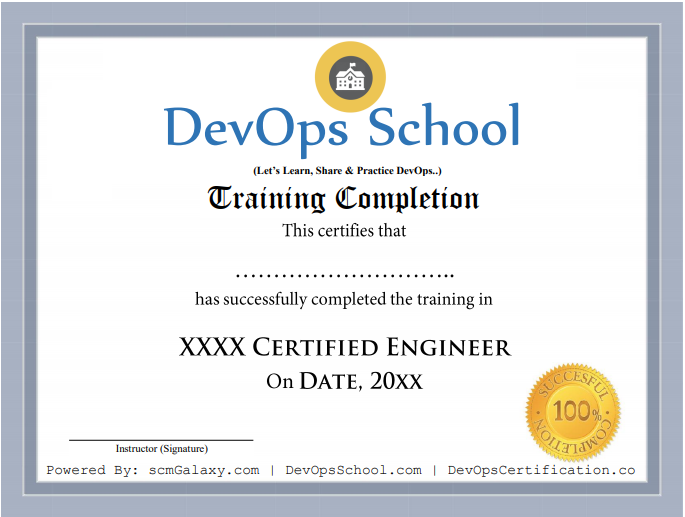
Certificate preview
See what course completion evidence looks like.
Tool-focused training
Course visuals reinforce the Deep Learning workflow and subject area.
Live batch experience
Training supports live online, private team and workshop-style delivery.
Start Deep Learning Intermediate training.
Next weekday batch starts on the 1st; weekend batch on the first Saturday. Batches are capped at 10 learners. Send your details and DevOpsSchool will share the syllabus and batch options.