Influxdb Advanced Training
Scale InfluxDB for high volume and availability, tune performance, plan retention and backups and migrate between versions. Learn Influxdb through a clear Foundation to Advanced path, with hands-on labs, live cohort options, certification support and full LMS access.
Last updated
Self-paced video subscription
Billed yearly at ₹9,996. This includes all four levels, complete LMS access for one year, plus 20+ additional courses and 50+ tools access.
- All four Influxdb levels in one price.
- 20+ additional courses and 50+ tools included, even when subscribing to one course.
- Best fit for learners who want full-library access and flexible progress.
Live & Interactive session
Instructor-led cohort, max 8 to 10 hours, with demos, labs, Q&A, assignments and practical review.
- Live small-batch cohort from soon.
- Interactive discussion and lab troubleshooting.
- Recommended for teams that need guided implementation.
1:1 Live training
The same agenda, taught one-to-one by the trainer. Start immediately, without waiting for the next batch. Max 8 to 10 hours, one-to-one.
About Influxdb Advanced Training.
Understand where Influxdb fits in modern software delivery, what this level covers, and how the program builds practical confidence step by step.
Program overview
Influxdb is taught as a practical technical skill for modern engineering, operations and platform teams. The course explains where the tool fits, how it is used in real delivery environments, and how learners can apply it through guided practice.
This DevOpsSchool Influxdb program is built for working professionals who want usable skills instead of only conceptual exposure. The training emphasizes live examples, workflow clarity, operational controls and progressive skill depth from Foundation to Advanced.
Private Influxdb training for delivery teams, platform groups and engineering organizations.
DevOpsSchool provides corporate Influxdb training for teams that need faster adoption, workflow standardization, administrative control, integration guidance and governance-ready rollout. Private batches can be aligned to development practice, release workflow, access model, maturity level and internal tooling.
- Private online or classroom delivery for engineering teams
- Aligned to Influxdb usage maturity, admin depth and collaboration patterns
- Useful for rollout, migration, governance and workflow consistency goals
- Can be tailored for developers, administrators, DevOps teams and leadership stakeholders
Why teams use DevOpsSchool
DevOpsSchool combines live demonstration, practical workflow discussion, implementation-oriented examples, and strong post-session learning support. That makes the training more usable for real teams than generic slide-led courses.
Choose any level. The page still shows the full progression.
Foundation, Essential, Intermediate and Advanced are presented as one linked training flow. Self-paced buyers get all levels by default, even if they start from only one course page.
Instructor-led, self-paced and corporate delivery options.
Compare delivery format, duration, level access and batch style. Fees are shown only in the top decision panel and once again after the agenda.
| Duration | Mode | Level access | Batch |
|---|---|---|---|
| 8 to 10 Hrs. max | Live & Interactive | Advanced | Public batch |
| 8 to 10 Hrs. max | 1:1 Live training | Advanced | Starts immediately |
| 1 year LMS access | Self-paced video | All 4 levels | Anytime access |
| 5 Days | Corporate | Influxdb Advanced Training | Private team batch |
What learners should be able to do after Influxdb training.
The outcomes are written for practical delivery teams: developers, DevOps engineers, release engineers, administrators and technical leads.
Model time series data
Design measurements, tags and fields that keep InfluxDB fast and storage efficient.
Ingest, query and visualize
Collect data with Telegraf and APIs, query it with SQL, InfluxQL or Flux and build Grafana dashboards.
Operate InfluxDB at scale
Secure, monitor, back up, cluster and tune InfluxDB deployments with automated downsampling.
Why this skill, what you will achieve, and who should attend.
Use this section to decide whether the course matches your role, current experience and expected Influxdb responsibilities before reviewing the detailed agenda.
Why Influxdb matters
- Influxdb helps teams standardize a critical part of their software delivery, infrastructure, automation or operations workflow.
- It gives learners a repeatable way to move from basic usage to confident execution in team and enterprise environments.
- For DevOps and platform teams, Influxdb becomes more valuable when connected with automation, governance, monitoring and delivery practices.
- Teams using Influxdb effectively reduce ad-hoc execution and move toward consistent engineering standards.
Objectives
- Understand Influxdb concepts, architecture, terminology and operational usage patterns.
- Learn practical configuration, workflow design, access controls, team usage and quality practices.
- Apply Influxdb in real delivery workflows using automation, integrations, traceability and governance patterns.
- Build practical confidence to use Influxdb for individual, team and organizational use cases.
Pre-requisites
- Basic computer literacy and familiarity with software development workflows.
- Helpful but not mandatory: introductory DevOps, cloud, automation or software delivery awareness.
- No deep programming background is required for the Foundation and Essential levels.
Who this course is for
- Developers, administrators and engineers who need practical Influxdb usage skills.
- DevOps engineers, release engineers, SREs and platform teams managing delivery standards.
- Engineering leads and technical managers responsible for workflow quality, access controls and governance.
- Corporate teams migrating to or standardizing on Influxdb.
Small-batch live training starts every month.
Weekday batches start on the 1st and weekend batches on the first Saturday of every month. One-to-one (1:1) training can start immediately; corporate sessions are scheduled on demand.
Weekend live batch
Starts on the first Saturday of every month. Weekend sessions with demos, labs and Q&A; max 10 learners.
Weekday live batch
Starts on the 1st of every month. Weekday sessions for working professionals and distributed teams; max 10 learners.
Ask advisorAgenda depth up to the selected level.
This page shows the learning flow from Foundation through Advanced. Each level adds to the previous one, and the agenda stops at the current page level. Day counts are for corporate (day-wise) delivery; live online batches cover the same agenda in max 8 to 10 hours.
Foundation Level: time series concepts, installation and data modelDay 1
- Introduction to InfluxDB: overview of time series databases and their significance for metrics, IoT and events
- Introduction to InfluxDB and its features: InfluxDB 1.x, 2.x and InfluxDB 3 Core and Enterprise compared
- Understanding the use cases of InfluxDB: infrastructure monitoring, IoT sensors and real-time analytics
- InfluxDB installation and setup: installing on various platforms (Linux, Windows, Docker) and InfluxDB Cloud
- Configuring InfluxDB: configuration options, data directories, object storage settings and ports
- Exploring the InfluxDB user interface and command-line tools: influxdb3 and influx CLIs and the web UI
- InfluxDB data modeling: understanding the data model of databases and buckets, measurements and series
- Measurements, tags, fields and timestamps: defining each and how they are stored
- Line protocol: measurement, tag set, field set, timestamp and write precision
- Access basics: API tokens, organizations and databases or buckets
- First writes and queries: writing line protocol from the CLI and querying it back with SQL
Essential Level = Foundation + schema design, ingestion, query languages and GrafanaDay 2 · 2 days cumulative
- Designing schemas for efficient data storage and retrieval: tag versus field choices and series cardinality
- Data ingestion via the HTTP API: v3 and v2 write endpoints and client libraries for Python, Go and Java
- Telegraf: input and output plugins, agent configuration and collecting system and application metrics
- Command-line ingestion: CSV and line protocol files, batching and write precision
- Retrieving data with SQL: SELECT, time-range WHERE clauses, GROUP BY and date_bin
- Retrieving data with InfluxQL: SELECT, GROUP BY time(), FILL and SHOW commands
- Flux query language: from, range, filter and aggregateWindow, and its maintenance status in newer versions
- Filtering, aggregating and transforming data in queries: windows, percentiles, joins and pivots
- Data visualization with Grafana: integrating InfluxDB with Grafana using SQL, InfluxQL or Flux
- Grafana dashboards: creating dashboards and panels to display time series data
- Customizing visualizations and using advanced features of Grafana: variables, transformations and alerts
Intermediate Level = Essential + downsampling, processing, security, alerting and backupDay 3 · 3 days cumulative
- Continuous queries and downsampling: understanding their role in InfluxDB 1.x and creating CQs to aggregate data
- Retention policies: configuring retention to manage data storage and expiration and shard group durations
- Tasks in InfluxDB 2.x: scheduled Flux tasks with every and cron for downsampling
- InfluxDB 3 processing engine: Python plugins triggered by writes, schedules and HTTP requests
- InfluxDB 3 caches: last value cache and distinct value cache for fast queries
- InfluxDB security and authentication: implementing security measures and access control for users and roles
- Enabling SSL/TLS encryption: secure communication with clients, Telegraf and the UI
- InfluxDB alerts and monitoring: setting up alerts based on threshold conditions or anomaly detection
- Integrating InfluxDB with alerting mechanisms like Kapacitor: TICKscripts and alert handlers
- Monitoring InfluxDB: performance and health using built-in tools or external solutions such as Telegraf and Grafana
- Backup and restore: influxd and influx backup and restore commands and object storage snapshots
- Automation: managing databases, tokens and writes from CI pipelines with the API and client libraries
Advanced Level = Intermediate + clustering, scale, performance tuning and migrationDays 4-5 · 5 days cumulative
- InfluxDB high availability and scalability: configuring HA setups using InfluxDB Enterprise clustering
- InfluxDB 3 Enterprise multi-node: ingest, query and compactor node roles and read replicas
- Cluster data distribution: understanding replication factors, sharding and data distribution in clusters
- Scaling InfluxDB: handling large data volumes and increased query throughput
- InfluxDB performance optimization: best practices for batching writes, cardinality control and query design
- Tuning storage engine parameters and configuration settings: TSM and TSI, Parquet files and compaction
- Monitoring and troubleshooting performance issues: slow queries, high cardinality and memory pressure
- InfluxDB best practices: schema design, data retention and backup strategies at scale
- Exploring advanced features: Kapacitor functions, task scheduling and user-defined processing
- Migration: moving from InfluxDB 1.x or 2.x to InfluxDB 3 with InfluxQL compatibility and data export
- Real-world use cases: best practices shared by practitioners in DevOps, IoT and industrial telemetry
- Hands-on project and Q&A: engaging in a project to apply the concepts, Q&A, key takeaways and next steps
Choose live training or a full year of self-paced access.
If someone buys Foundation, Essential, Intermediate or Advanced as self-paced video, the price stays the same and access is granted to all four levels by default.
Self-paced video subscription
Billed yearly at ₹9,996. This includes all four levels, complete LMS access for one year, plus 20+ additional courses and 50+ tools access.
- All four Influxdb levels in one price.
- 20+ additional courses and 50+ tools included, even when subscribing to one course.
- Best fit for learners who want full-library access and flexible progress.
Live & Interactive session
Instructor-led cohort, max 8 to 10 hours, with demos, labs, Q&A, assignments and practical review.
- Live small-batch cohort from soon.
- Interactive discussion and lab troubleshooting.
- Recommended for teams that need guided implementation.
1:1 Live training
The same agenda, taught one-to-one by the trainer. Start immediately, without waiting for the next batch. Max 8 to 10 hours, one-to-one.
- Start immediately: no waiting for the monthly batch.
- One learner, one trainer: full attention on your questions.
- Sessions planned around your working hours.
- Your pace, with examples from your own projects and tools.
Method of training and assessment.
The course emphasizes practical demonstration, hands-on labs and assignment-based validation instead of passive lecture-only learning.
| SL | Method of training and assessment | Weightage |
|---|---|---|
| 1 | Understanding the problem space | 5% |
| 2 | Concept discussion | 10% |
| 3 | Live demo and walkthrough | 25% |
| 4 | Lab and hands-on exercises | 50% |
| 5 | Assignments and evaluation | 10% |
Labs, exercises and real workflow practice.
Every level moves from explanation to hands-on practice, review and troubleshooting.
Install InfluxDB and store metrics
Run InfluxDB in Docker, create a database and token, write server metrics in line protocol and query them back from the CLI.
Collect, query and visualize metrics
Collect host and Docker metrics with Telegraf, query them with SQL and InfluxQL and build a Grafana dashboard with variables.
Downsampling, security and alerting
Add downsampling with a processing engine plugin or task, enable TLS and scoped tokens, alert on threshold breaches and take and restore a backup.
High-volume time series platform
Design a multi-node InfluxDB deployment for a high-volume telemetry workload, load test it, tune cardinality and queries and plan a version migration.
Influxdb is taught as part of a working delivery ecosystem.
You learn where the tool sits in the wider engineering workflow, not in isolation.
Core foundations
Terminology, concepts, architecture and the operating model behind the tool.
Workflow traceability
Map practical work to tasks, approvals, documentation and delivery visibility.
Automation and integration
Use Influxdb with validation checks, automation hooks and delivery workflows.
Governance controls
Operate with permissions, approvals, policy checks and production-safe workflows.
How your practical work is assessed.
Your certificate is backed by labs, assignments, capstone thinking and completion evidence.
Assignments
Level-specific assignments verify setup, configuration, workflow quality and operating discipline.
Hands-on validation
Learners are expected to complete practical usage, automation and troubleshooting exercises.
Completion record
Certificate issuance is tied to demonstrated participation, practical completion and course-level coverage.
Led by Rajesh Kumar and the DevOpsSchool practitioner network.
Training is grounded in practical DevOps, SRE, security, release and platform engineering experience with real enterprise delivery context.
Earn a DevOpsSchool Influxdb certificate.
Completion includes a digital certificate with credential details, practical assignments and a learning record aligned to the selected Influxdb level.
Certificate verificationCertificate of Completion
Influxdb Advanced Training
Unique credential ID, verifiable online
What learners say about training with Rajesh Kumar.
“Rajesh is very good trainer. Rajesh was able to resolve our queries and question effectively. We really liked the hands-on examples covered during this training program.”
“Very well organized training, helped a lot to understand the AWS concept and detailed related to various tools. Very helpful”
“The training was very useful and interactive. Rajesh helped develop the confidence of all.”
Rated 4.6 on Google · All testimonials · Video reviews on YouTube
Quoted as published, from learners in Rajesh Kumar's live trainings across DevOpsSchool courses.
Used by developers, DevOps engineers, release leads and engineering managers.
Private batches are available for teams that want the same agenda aligned to their own tools and workflows.
Why this Influxdb path is different.
The value is not only one course. The subscription unlocks the full learning ecosystem for one year.
| Feature | DevOpsSchool Influxdb Training | Typical short course |
|---|---|---|
| Levels | Foundation, Essential, Intermediate, Advanced | Single generic syllabus |
| Self-paced access | All four levels plus 20+ courses and 50+ tools | Usually one course only |
| Live training | Demos, labs, Q&A and assignment review | Often lecture-heavy |
| Certificate | DevOpsSchool completion certificate | Varies by provider |
Questions learners ask before joining.
Does Foundation cost less than Advanced?
No. Self-paced pricing is intentionally the same because access includes all four levels by default.
What is included in the yearly subscription?
One year of complete LMS access, all four levels for the selected course, plus 20+ additional courses and 50+ tools access.
Can corporate teams request customization?
Yes. The live format can be aligned to team tools, governance requirements, workflows and internal delivery standards.
What is the recommended sequence?
Foundation → Essential → Intermediate → Advanced. The agenda is designed so each level builds on the previous one.
Talk to DevOpsSchool before choosing the batch.
Use this support section for batch questions, corporate planning, LMS access clarifications, or guidance on which Influxdb level fits your team.
India / Worldwide: +91 99057 40781
USA: +1 (469) 756-6329
Email: contact@DevOpsSchool.com
Chat on WhatsAppExtend the course with articles, explainers and workflow guidance.
Continue learning with supporting articles that connect Influxdb practices to DevOps, automation, governance and delivery workflows.
Training snapshots and certificate preview.
A look at the completion certificate and the course.
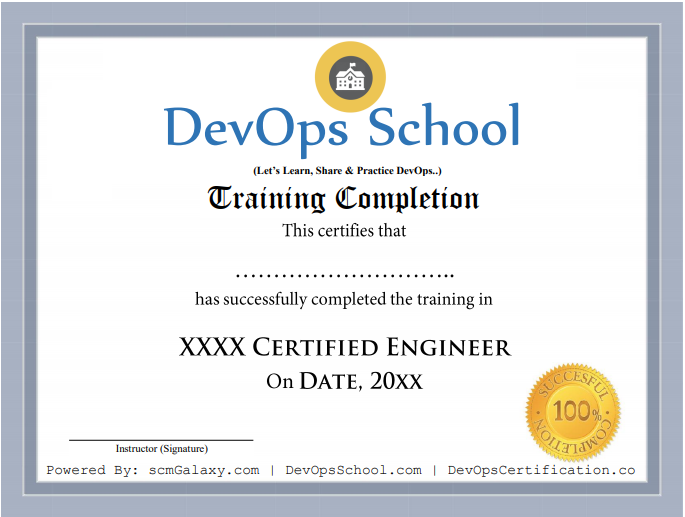
Certificate preview
See what course completion evidence looks like.

Tool-focused training
Course visuals reinforce the Influxdb workflow and subject area.
Live batch experience
Training supports live online, private team and workshop-style delivery.
Start Influxdb Advanced training.
Next weekday batch starts on the 1st; weekend batch on the first Saturday. Batches are capped at 10 learners. Send your details and DevOpsSchool will share the syllabus and batch options.