MLOps Advanced Training
Scale training and inference, apply MLOps to LLM applications, and govern models with lineage, responsible AI controls and cost tracking. Learn MLOps through a clear Foundation to Advanced path, with hands-on labs, live cohort options, certification support and full LMS access.
Last updated
Self-paced video subscription
Billed yearly at ₹9,996. This includes all four levels, complete LMS access for one year, plus 20+ additional courses and 50+ tools access.
- All four MLOps levels in one price.
- 20+ additional courses and 50+ tools included, even when subscribing to one course.
- Best fit for learners who want full-library access and flexible progress.
Live & Interactive session
Instructor-led cohort, max 8 to 10 hours, with demos, labs, Q&A, assignments and practical review.
- Live small-batch cohort from soon.
- Interactive discussion and lab troubleshooting.
- Recommended for teams that need guided implementation.
1:1 Live training
The same agenda, taught one-to-one by the trainer. Start immediately, without waiting for the next batch. Max 8 to 10 hours, one-to-one.
About MLOps Advanced Training.
Understand where MLOps fits in modern software delivery, what this level covers, and how the program builds practical confidence step by step.
Program overview
MLOps is taught as a practical technical skill for modern engineering, operations and platform teams. The course explains where the tool fits, how it is used in real delivery environments, and how learners can apply it through guided practice.
This DevOpsSchool MLOps program is built for working professionals who want usable skills instead of only conceptual exposure. The training emphasizes live examples, workflow clarity, operational controls and progressive skill depth from Foundation to Advanced.
Private MLOps training for delivery teams, platform groups and engineering organizations.
DevOpsSchool provides corporate MLOps training for teams that need faster adoption, workflow standardization, administrative control, integration guidance and governance-ready rollout. Private batches can be aligned to development practice, release workflow, access model, maturity level and internal tooling.
- Private online or classroom delivery for engineering teams
- Aligned to MLOps usage maturity, admin depth and collaboration patterns
- Useful for rollout, migration, governance and workflow consistency goals
- Can be tailored for developers, administrators, DevOps teams and leadership stakeholders
Why teams use DevOpsSchool
DevOpsSchool combines live demonstration, practical workflow discussion, implementation-oriented examples, and strong post-session learning support. That makes the training more usable for real teams than generic slide-led courses.
Choose any level. The page still shows the full progression.
Foundation, Essential, Intermediate and Advanced are presented as one linked training flow. Self-paced buyers get all levels by default, even if they start from only one course page.
Instructor-led, self-paced and corporate delivery options.
Compare delivery format, duration, level access and batch style. Fees are shown only in the top decision panel and once again after the agenda.
| Duration | Mode | Level access | Batch |
|---|---|---|---|
| 8 to 10 Hrs. max | Live & Interactive | Advanced | Public batch |
| 8 to 10 Hrs. max | 1:1 Live training | Advanced | Starts immediately |
| 1 year LMS access | Self-paced video | All 4 levels | Anytime access |
| 5 Days | Corporate | MLOps Advanced Training | Private team batch |
What learners should be able to do after MLOps training.
The outcomes are written for practical delivery teams: developers, DevOps engineers, release engineers, administrators and technical leads.
Productionise ML models
Turn experiments into versioned, containerised and served models with reproducible pipelines.
Automate the ML lifecycle
Build CI/CD and continuous training on Kubernetes, Kubeflow and Vertex AI.
Operate governed ML platforms
Monitor, scale, secure and govern models, including LLM applications, in production.
Why this skill, what you will achieve, and who should attend.
Use this section to decide whether the course matches your role, current experience and expected MLOps responsibilities before reviewing the detailed agenda.
Why MLOps matters
- MLOps helps teams standardize a critical part of their software delivery, infrastructure, automation or operations workflow.
- It gives learners a repeatable way to move from basic usage to confident execution in team and enterprise environments.
- For DevOps and platform teams, MLOps becomes more valuable when connected with automation, governance, monitoring and delivery practices.
- Teams using MLOps effectively reduce ad-hoc execution and move toward consistent engineering standards.
Objectives
- Understand MLOps concepts, architecture, terminology and operational usage patterns.
- Learn practical configuration, workflow design, access controls, team usage and quality practices.
- Apply MLOps in real delivery workflows using automation, integrations, traceability and governance patterns.
- Build practical confidence to use MLOps for individual, team and organizational use cases.
Pre-requisites
- Basic computer literacy and familiarity with software development workflows.
- Helpful but not mandatory: introductory DevOps, cloud, automation or software delivery awareness.
- No deep programming background is required for the Foundation and Essential levels.
Who this course is for
- Developers, administrators and engineers who need practical MLOps usage skills.
- DevOps engineers, release engineers, SREs and platform teams managing delivery standards.
- Engineering leads and technical managers responsible for workflow quality, access controls and governance.
- Corporate teams migrating to or standardizing on MLOps.
Small-batch live training starts every month.
Weekday batches start on the 1st and weekend batches on the first Saturday of every month. One-to-one (1:1) training can start immediately; corporate sessions are scheduled on demand.
Weekend live batch
Starts on the first Saturday of every month. Weekend sessions with demos, labs and Q&A; max 10 learners.
Weekday live batch
Starts on the 1st of every month. Weekday sessions for working professionals and distributed teams; max 10 learners.
Ask advisorAgenda depth up to the selected level.
This page shows the learning flow from Foundation through Advanced. Each level adds to the previous one, and the agenda stops at the current page level. Day counts are for corporate (day-wise) delivery; live online batches cover the same agenda in max 8 to 10 hours.
Foundation Level: MLOps concepts, ML lifecycle and first served modelDay 1
- Welcome to MLOps fundamentals: why and when we need MLOps and data scientists' pain points
- The concept of DevOps in ML: CI, CD and continuous training, and what differs for data and models
- Machine learning lifecycle: problem framing, data, features, training, evaluation, deployment, monitoring and retraining
- ML basics for engineers: features and labels, training versus inference, overfitting, precision, recall and RMSE
- Roles and hand-offs: data scientist, data engineer, ML engineer and platform engineer responsibilities
- Python project setup for ML: uv or conda environments, pinned dependencies, scripts over notebooks, project layout
- Git for ML projects: what to commit, ignoring data and model files, clean notebook diffs with nbstripout
- Data versioning with DVC: dvc init, dvc add, remote storage and reproducing a dataset version
- Experiment tracking with MLflow: tracking server, logging parameters, metrics and artifacts, comparing runs
- First model: scikit-learn Pipeline, train and test split, cross-validation and saving the model artifact
- Serving basics: a FastAPI /predict endpoint with a Pydantic request schema
- Packaging the model service: Dockerfile, image build and running the prediction API locally
- Why models decay: data drift, concept drift and feedback loops in production
Essential Level = Foundation + containers, GKE, Kubeflow Pipelines and ML CI/CDDay 2 · 2 days cumulative
- Introduction to containers: containers and container images, main Kubernetes components as an optional primer
- Lab intro: getting started with GCP and Qwiklabs, working with Cloud Build and walking through the lab solution
- Introduction to Kubernetes and Google Kubernetes Engine: compute options in detail, Kubernetes concepts, control plane
- GKE concepts and lab: Google Kubernetes Engine concepts and deploying a GKE cluster
- Deployments: ways to create deployments, services and scaling, updating deployments
- Release strategies: rolling updates, blue-green and canary deployments, lab creating GKE deployments
- Jobs and CronJobs: parallel jobs and CronJobs for scheduled training and batch scoring
- Setting up the tools: AI Platform Pipelines, now Vertex AI Pipelines, overview, concepts, when to use, ecosystem, lab
- Training, tuning and serving on AI Platform, now Vertex AI: system and concepts, reproducible dataset, tunable model
- Training containers: build and push a training container, train and tune, serve and query, custom containers lab
- Kubeflow Pipelines: system and concepts, KFP DSL, pre-built, lightweight Python and custom components, compile, upload, run
- Continuous training lab: a continuous training pipeline with Kubeflow Pipelines and Cloud AI Platform, intro and solution
- CI/CD for Kubeflow Pipelines: concept overview, Cloud Build builders, configuration and triggers, lab and summary
Intermediate Level = Essential + registries, feature pipelines, testing, serving and monitoringDay 3 · 3 days cumulative
- Model registry: MLflow registry and Vertex AI Model Registry, versions, champion and challenger aliases, approvals
- Feature pipelines and stores: Feast or Vertex AI Feature Store, offline and online features, training-serving skew
- Data validation: schema and distribution checks with TensorFlow Data Validation, Great Expectations or pandera
- Testing ML systems: pytest for feature code, model quality thresholds and behavioural tests on edge cases
- Pull request checks for ML: GitHub Actions with CML reports comparing metrics against the main branch
- Orchestrators compared: Kubeflow Pipelines, Airflow, Prefect, ZenML and Metaflow for ML workflows
- Hyperparameter tuning at scale: Optuna, Katib and Vertex AI Vizier with early stopping
- Serving on Kubernetes: KServe InferenceService, BentoML and NVIDIA Triton, autoscaling and health probes
- Batch inference: scheduled scoring jobs, Vertex AI batch prediction and writing results back to the warehouse
- Production monitoring: Evidently drift reports, Vertex AI Model Monitoring, latency and error metrics in Prometheus
- Automated retraining: drift, schedule or new-data triggers with safe validation before redeployment
- Security basics: Workload Identity, least-privilege service accounts, secrets and vulnerability scanning of images
- Troubleshooting: failed pipeline steps, caching surprises, resource limits and non-reproducible runs
Advanced Level = Intermediate + scale, LLMOps, governance and ML platformsDays 4-5 · 5 days cumulative
- MLOps maturity: assessing manual, pipeline-automated and CI/CD-automated stages and building a roadmap
- Distributed training: Ray Train, PyTorch DDP, Kubeflow Trainer and GPU node pools on Kubernetes
- Scaling inference: dynamic batching, GPU sharing with MIG or time-slicing, scale to zero with Knative
- Progressive model delivery: shadow traffic, A/B tests, KServe canary traffic splits and automated rollback
- LLMOps: prompt and model versioning, evaluation datasets, RAG pipelines, vLLM serving and guardrails
- Lineage and reproducibility: ML Metadata, artifact lineage and audit-ready records for every model version
- Model governance: model cards, approval workflows, risk tiers and EU AI Act obligations
- Responsible AI: fairness checks with Fairlearn, explanations with SHAP and human oversight in production
- ML security: model supply chain, signed model artifacts, unsafe pickle files, adversarial and data-poisoning risks
- Cost optimisation: spot GPUs, right-sized instances, cost per training run and cost per thousand predictions
- Multi-tenant ML platforms: Kubeflow profiles or Vertex AI projects, reusable components and self-service onboarding
- Portability: comparing Vertex AI, Amazon SageMaker and Azure Machine Learning and avoiding lock-in
- Capstone: enterprise MLOps platform with CI/CD/CT, monitoring, governance and an LLM use case
Choose live training or a full year of self-paced access.
If someone buys Foundation, Essential, Intermediate or Advanced as self-paced video, the price stays the same and access is granted to all four levels by default.
Self-paced video subscription
Billed yearly at ₹9,996. This includes all four levels, complete LMS access for one year, plus 20+ additional courses and 50+ tools access.
- All four MLOps levels in one price.
- 20+ additional courses and 50+ tools included, even when subscribing to one course.
- Best fit for learners who want full-library access and flexible progress.
Live & Interactive session
Instructor-led cohort, max 8 to 10 hours, with demos, labs, Q&A, assignments and practical review.
- Live small-batch cohort from soon.
- Interactive discussion and lab troubleshooting.
- Recommended for teams that need guided implementation.
1:1 Live training
The same agenda, taught one-to-one by the trainer. Start immediately, without waiting for the next batch. Max 8 to 10 hours, one-to-one.
- Start immediately: no waiting for the monthly batch.
- One learner, one trainer: full attention on your questions.
- Sessions planned around your working hours.
- Your pace, with examples from your own projects and tools.
Method of training and assessment.
The course emphasizes practical demonstration, hands-on labs and assignment-based validation instead of passive lecture-only learning.
| SL | Method of training and assessment | Weightage |
|---|---|---|
| 1 | Understanding the problem space | 5% |
| 2 | Concept discussion | 10% |
| 3 | Live demo and walkthrough | 25% |
| 4 | Lab and hands-on exercises | 50% |
| 5 | Assignments and evaluation | 10% |
Labs, exercises and real workflow practice.
Every level moves from explanation to hands-on practice, review and troubleshooting.
From notebook to prediction API
Turn a notebook model into a versioned project with DVC and MLflow tracking, then serve it through a FastAPI endpoint in a Docker container.
Continuous training pipeline on GCP
Build and push a training container, run a Kubeflow pipeline that trains, tunes and deploys a model, and trigger it from a Cloud Build CI/CD pipeline.
Monitored model with automated retraining
Register a model, deploy it with KServe, generate drifted traffic, catch the drift with Evidently and retrain through a validated pipeline run.
Capstone: governed enterprise ML platform
Deliver a multi-tenant pipeline platform that trains on GPUs, serves a canary model and a RAG endpoint, and records lineage, model cards and costs.
MLOps is taught as part of a working delivery ecosystem.
You learn where the tool sits in the wider engineering workflow, not in isolation.
Core foundations
Terminology, concepts, architecture and the operating model behind the tool.
Workflow traceability
Map practical work to tasks, approvals, documentation and delivery visibility.
Automation and integration
Use MLOps with validation checks, automation hooks and delivery workflows.
Governance controls
Operate with permissions, approvals, policy checks and production-safe workflows.
How your practical work is assessed.
Your certificate is backed by labs, assignments, capstone thinking and completion evidence.
Assignments
Level-specific assignments verify setup, configuration, workflow quality and operating discipline.
Hands-on validation
Learners are expected to complete practical usage, automation and troubleshooting exercises.
Completion record
Certificate issuance is tied to demonstrated participation, practical completion and course-level coverage.
Led by Rajesh Kumar and the DevOpsSchool practitioner network.
Training is grounded in practical DevOps, SRE, security, release and platform engineering experience with real enterprise delivery context.
Earn a DevOpsSchool MLOps certificate.
Completion includes a digital certificate with credential details, practical assignments and a learning record aligned to the selected MLOps level.
Certificate verificationCertificate of Completion
MLOps Advanced Training
Unique credential ID, verifiable online
What learners say about training with Rajesh Kumar.
“Rajesh is very good trainer. Rajesh was able to resolve our queries and question effectively. We really liked the hands-on examples covered during this training program.”
“Very well organized training, helped a lot to understand the AWS concept and detailed related to various tools. Very helpful”
“The training was very useful and interactive. Rajesh helped develop the confidence of all.”
Rated 4.6 on Google · All testimonials · Video reviews on YouTube
Quoted as published, from learners in Rajesh Kumar's live trainings across DevOpsSchool courses.
Used by developers, DevOps engineers, release leads and engineering managers.
Private batches are available for teams that want the same agenda aligned to their own tools and workflows.
Why this MLOps path is different.
The value is not only one course. The subscription unlocks the full learning ecosystem for one year.
| Feature | DevOpsSchool MLOps Training | Typical short course |
|---|---|---|
| Levels | Foundation, Essential, Intermediate, Advanced | Single generic syllabus |
| Self-paced access | All four levels plus 20+ courses and 50+ tools | Usually one course only |
| Live training | Demos, labs, Q&A and assignment review | Often lecture-heavy |
| Certificate | DevOpsSchool completion certificate | Varies by provider |
Questions learners ask before joining.
Does Foundation cost less than Advanced?
No. Self-paced pricing is intentionally the same because access includes all four levels by default.
What is included in the yearly subscription?
One year of complete LMS access, all four levels for the selected course, plus 20+ additional courses and 50+ tools access.
Can corporate teams request customization?
Yes. The live format can be aligned to team tools, governance requirements, workflows and internal delivery standards.
What is the recommended sequence?
Foundation → Essential → Intermediate → Advanced. The agenda is designed so each level builds on the previous one.
Talk to DevOpsSchool before choosing the batch.
Use this support section for batch questions, corporate planning, LMS access clarifications, or guidance on which MLOps level fits your team.
India / Worldwide: +91 99057 40781
USA: +1 (469) 756-6329
Email: contact@DevOpsSchool.com
Chat on WhatsAppExtend the course with articles, explainers and workflow guidance.
Continue learning with supporting articles that connect MLOps practices to DevOps, automation, governance and delivery workflows.
Training snapshots and certificate preview.
A look at the completion certificate and the course.
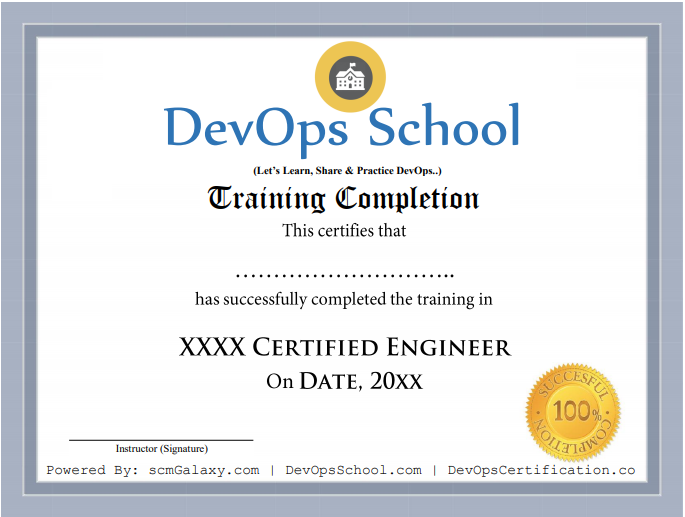
Certificate preview
See what course completion evidence looks like.
Tool-focused training
Course visuals reinforce the MLOps workflow and subject area.
Live batch experience
Training supports live online, private team and workshop-style delivery.
Start MLOps Advanced training.
Next weekday batch starts on the 1st; weekend batch on the first Saturday. Batches are capped at 10 learners. Send your details and DevOpsSchool will share the syllabus and batch options.