Powershell Intermediate Training
Use .NET from PowerShell, package script modules, automate builds with psake and CI, and test, secure and debug your scripts. Learn Powershell through a clear Foundation to Advanced path, with hands-on labs, live cohort options, certification support and full LMS access.
Last updated
Self-paced video subscription
Billed yearly at ₹9,996. This includes all four levels, complete LMS access for one year, plus 20+ additional courses and 50+ tools access.
- All four Powershell levels in one price.
- 20+ additional courses and 50+ tools included, even when subscribing to one course.
- Best fit for learners who want full-library access and flexible progress.
Live & Interactive session
Instructor-led cohort, max 8 to 10 hours, with demos, labs, Q&A, assignments and practical review.
- Live small-batch cohort from soon.
- Interactive discussion and lab troubleshooting.
- Recommended for teams that need guided implementation.
1:1 Live training
The same agenda, taught one-to-one by the trainer. Start immediately, without waiting for the next batch. Max 8 to 10 hours, one-to-one.
About Powershell Intermediate Training.
Understand where Powershell fits in modern software delivery, what this level covers, and how the program builds practical confidence step by step.
Program overview
Powershell is taught as a practical technical skill for modern engineering, operations and platform teams. The course explains where the tool fits, how it is used in real delivery environments, and how learners can apply it through guided practice.
This DevOpsSchool Powershell program is built for working professionals who want usable skills instead of only conceptual exposure. The training emphasizes live examples, workflow clarity, operational controls and progressive skill depth from Foundation to Intermediate.
Private Powershell training for delivery teams, platform groups and engineering organizations.
DevOpsSchool provides corporate Powershell training for teams that need faster adoption, workflow standardization, administrative control, integration guidance and governance-ready rollout. Private batches can be aligned to development practice, release workflow, access model, maturity level and internal tooling.
- Private online or classroom delivery for engineering teams
- Aligned to Powershell usage maturity, admin depth and collaboration patterns
- Useful for rollout, migration, governance and workflow consistency goals
- Can be tailored for developers, administrators, DevOps teams and leadership stakeholders
Why teams use DevOpsSchool
DevOpsSchool combines live demonstration, practical workflow discussion, implementation-oriented examples, and strong post-session learning support. That makes the training more usable for real teams than generic slide-led courses.
Choose any level. The page still shows the full progression.
Foundation, Essential, Intermediate and Advanced are presented as one linked training flow. Self-paced buyers get all levels by default, even if they start from only one course page.
Instructor-led, self-paced and corporate delivery options.
Compare delivery format, duration, level access and batch style. Fees are shown only in the top decision panel and once again after the agenda.
| Duration | Mode | Level access | Batch |
|---|---|---|---|
| 8 to 10 Hrs. max | Live & Interactive | Intermediate | Public batch |
| 8 to 10 Hrs. max | 1:1 Live training | Intermediate | Starts immediately |
| 1 year LMS access | Self-paced video | All 4 levels | Anytime access |
| 3 Days | Corporate | Powershell Intermediate Training | Private team batch |
What learners should be able to do after Powershell training.
The outcomes are written for practical delivery teams: developers, DevOps engineers, release engineers, administrators and technical leads.
Automate with PowerShell confidently
Use the pipeline, functions, modules and .NET types to automate Windows, Linux and cloud tasks.
Build and test automation
Create tested, analysed and documented modules and run them in psake and CI pipelines.
Operate securely at scale
Run parallel remoting, JEA, code signing and DSC to manage fleets of servers safely.
Why this skill, what you will achieve, and who should attend.
Use this section to decide whether the course matches your role, current experience and expected Powershell responsibilities before reviewing the detailed agenda.
Why Powershell matters
- Powershell helps teams standardize a critical part of their software delivery, infrastructure, automation or operations workflow.
- It gives learners a repeatable way to move from basic usage to confident execution in team and enterprise environments.
- For DevOps and platform teams, Powershell becomes more valuable when connected with automation, governance, monitoring and delivery practices.
- Teams using Powershell effectively reduce ad-hoc execution and move toward consistent engineering standards.
Objectives
- Understand Powershell concepts, architecture, terminology and operational usage patterns.
- Learn practical configuration, workflow design, access controls, team usage and quality practices.
- Apply Powershell in real delivery workflows using automation, integrations, traceability and governance patterns.
- Build practical confidence to use Powershell for individual, team and organizational use cases.
Pre-requisites
- Basic computer literacy and familiarity with software development workflows.
- Helpful but not mandatory: introductory DevOps, cloud, automation or software delivery awareness.
- No deep programming background is required for the Foundation and Essential levels.
Who this course is for
- Developers, administrators and engineers who need practical Powershell usage skills.
- DevOps engineers, release engineers, SREs and platform teams managing delivery standards.
- Engineering leads and technical managers responsible for workflow quality, access controls and governance.
- Corporate teams migrating to or standardizing on Powershell.
Small-batch live training starts every month.
Weekday batches start on the 1st and weekend batches on the first Saturday of every month. One-to-one (1:1) training can start immediately; corporate sessions are scheduled on demand.
Weekend live batch
Starts on the first Saturday of every month. Weekend sessions with demos, labs and Q&A; max 10 learners.
Weekday live batch
Starts on the 1st of every month. Weekday sessions for working professionals and distributed teams; max 10 learners.
Ask advisorAgenda depth up to the selected level.
This page shows the learning flow from Foundation through Intermediate. Each level adds to the previous one, and the agenda stops at the current page level. Day counts are for corporate (day-wise) delivery; live online batches cover the same agenda in max 8 to 10 hours.
Foundation Level: PowerShell primer, help, pipelines and providersDay 1
- Overview and PowerShell primer: Windows PowerShell 5.1 vs PowerShell 7.4 LTS and 7.5, cross-platform pwsh
- PowerShell environments: console, Windows Terminal, VS Code with the PowerShell extension, the ISE and other hosts
- Installation: winget, MSI, Homebrew, apt and dnf packages; running side by side with Windows PowerShell
- Discover stuff using help: Get-Help, Update-Help, -Examples and -Online, about_ topics
- Finding commands and making mistakes: Get-Command, verb-noun naming, Get-Verb, aliases and reading errors
- Expressions and variables: types, strings, here-strings, arrays, hashtables and automatic variables
- Flow control: if, elseif, switch, for, foreach, while and do loops
- Pipelines: objects not text, Get-Member, Select-Object, Sort-Object and Measure-Object
- Members, Where-Object and ForEach-Object: filtering and transforming objects on the pipeline
- Location, location, location: Get-Location, Set-Location, Push-Location and Pop-Location across providers
- PowerShell drives: FileSystem, Registry, Env and Cert providers and New-PSDrive
- Cutting corners in Windows Explorer: Invoke-Item to open files and folders, Start-Process
- Scripts and execution policy: .ps1 files, Set-ExecutionPolicy, RemoteSigned, Unblock-File and running scripts
Essential Level = Foundation + Functions, profiles, prompts, native tools and modulesDay 2 · 2 days cumulative
- Functions: param blocks, parameters, output and the Push-Project demo function
- Advanced functions: CmdletBinding, parameter validation attributes, Write-Verbose and -WhatIf support
- Supporting pipeline operations in functions: ValueFromPipeline and begin, process and end blocks
- Profiles and hosts: $PROFILE paths, per-host profiles, loading functions and aliases at startup, Push-Project summary
- Customising the PowerShell prompt: the prompt function, a source-control aware prompt, posh-git and oh-my-posh
- Files and data: Get-Content, Set-Content, Import-Csv, Export-Csv, ConvertFrom-Json and ConvertTo-Json
- Text processing: -match, -replace, -split, Select-String and regular expressions
- Error handling: try, catch and finally, -ErrorAction, $ErrorActionPreference, terminating vs non-terminating errors
- PowerShell commands vs console applications: using console applications in PowerShell, $LASTEXITCODE and arguments
- Capturing commands as PowerShell functions: wrapping native tools such as git, hg and dotnet, Crescendo basics
- A toast to PowerShell modules: where you find PowerShell modules, the PowerShell Gallery and module discovery
- Installing modules: Install-PSResource and Install-Module, manual module installation and PSModulePath
- Useful modules for software developers: PSReadLine, posh-git, Pester, PSScriptAnalyzer, Az and Microsoft.Graph
- Remoting basics: Enter-PSSession and Invoke-Command over WinRM and SSH
Intermediate Level = Essential + .NET interop, script modules, psake builds and testingDay 3 · 3 days cumulative
- PowerShell and .NET: referencing types, creating objects with New-Object and ::new()
- Using static and instance members: [Math], [DateTime] and [IO.Path] methods and properties
- Handling events: Register-ObjectEvent, more event handling with FileSystemWatcher and timers
- Loading assemblies: Add-Type, loading DLLs and compiling inline C#
- Sandbagging automation: the ConvertTo-Sandbags.ps1 script and revisiting it with .NET types
- Script modules: .psm1 files, .psd1 manifests, exported functions, versioning and module summary
- Automating bisections: the Find-HgChangeset function, the Hg PowerShell module and git bisect run equivalents
- Build automation with psake: the nature of the build, installing psake, running and documenting build scripts
- psake for .NET: building Visual Studio projects, why psake over raw MSBuild, the PackageZip task, configuring the build
- CI integration: running psake builds in TeamCity, plus pwsh steps in GitHub Actions and Azure Pipelines
- Testing with Pester 5: Describe, It, Should, mocks and code coverage
- Code quality: PSScriptAnalyzer rules, consistent formatting and comment-based help
- Secrets: SecretManagement and SecretStore modules instead of plain-text credentials
- Troubleshooting: Set-PSBreakpoint, VS Code debugging, Set-PSDebug, transcripts and $Error inspection
Choose live training or a full year of self-paced access.
If someone buys Foundation, Essential, Intermediate or Advanced as self-paced video, the price stays the same and access is granted to all four levels by default.
Self-paced video subscription
Billed yearly at ₹9,996. This includes all four levels, complete LMS access for one year, plus 20+ additional courses and 50+ tools access.
- All four Powershell levels in one price.
- 20+ additional courses and 50+ tools included, even when subscribing to one course.
- Best fit for learners who want full-library access and flexible progress.
Live & Interactive session
Instructor-led cohort, max 8 to 10 hours, with demos, labs, Q&A, assignments and practical review.
- Live small-batch cohort from soon.
- Interactive discussion and lab troubleshooting.
- Recommended for teams that need guided implementation.
1:1 Live training
The same agenda, taught one-to-one by the trainer. Start immediately, without waiting for the next batch. Max 8 to 10 hours, one-to-one.
- Start immediately: no waiting for the monthly batch.
- One learner, one trainer: full attention on your questions.
- Sessions planned around your working hours.
- Your pace, with examples from your own projects and tools.
Method of training and assessment.
The course emphasizes practical demonstration, hands-on labs and assignment-based validation instead of passive lecture-only learning.
| SL | Method of training and assessment | Weightage |
|---|---|---|
| 1 | Understanding the problem space | 5% |
| 2 | Concept discussion | 10% |
| 3 | Live demo and walkthrough | 25% |
| 4 | Lab and hands-on exercises | 50% |
| 5 | Assignments and evaluation | 10% |
Labs, exercises and real workflow practice.
Every level moves from explanation to hands-on practice, review and troubleshooting.
Explore a system with the pipeline
Use help and the pipeline to report the top processes, stopped services and largest files on a machine, then save it as a script.
Build a developer shell profile
Create a profile with a source-control aware prompt, a Push-Project navigation function and wrappers for console tools that accept pipeline input.
Build and test with psake
Package helper functions as a script module, write Pester tests, and run a psake build that tests, zips and publishes it from a CI job.
Powershell is taught as part of a working delivery ecosystem.
You learn where the tool sits in the wider engineering workflow, not in isolation.
Core foundations
Terminology, concepts, architecture and the operating model behind the tool.
Workflow traceability
Map practical work to tasks, approvals, documentation and delivery visibility.
Automation and integration
Use Powershell with validation checks, automation hooks and delivery workflows.
Governance controls
Operate with permissions, approvals, policy checks and production-safe workflows.
How your practical work is assessed.
Your certificate is backed by labs, assignments, capstone thinking and completion evidence.
Assignments
Level-specific assignments verify setup, configuration, workflow quality and operating discipline.
Hands-on validation
Learners are expected to complete practical usage, automation and troubleshooting exercises.
Completion record
Certificate issuance is tied to demonstrated participation, practical completion and course-level coverage.
Led by Rajesh Kumar and the DevOpsSchool practitioner network.
Training is grounded in practical DevOps, SRE, security, release and platform engineering experience with real enterprise delivery context.
Earn a DevOpsSchool Powershell certificate.
Completion includes a digital certificate with credential details, practical assignments and a learning record aligned to the selected Powershell level.
Certificate verificationCertificate of Completion
Powershell Intermediate Training
Unique credential ID, verifiable online
What learners say about training with Rajesh Kumar.
“Rajesh is very good trainer. Rajesh was able to resolve our queries and question effectively. We really liked the hands-on examples covered during this training program.”
“Very well organized training, helped a lot to understand the AWS concept and detailed related to various tools. Very helpful”
“The training was very useful and interactive. Rajesh helped develop the confidence of all.”
Rated 4.6 on Google · All testimonials · Video reviews on YouTube
Quoted as published, from learners in Rajesh Kumar's live trainings across DevOpsSchool courses.
Used by developers, DevOps engineers, release leads and engineering managers.
Private batches are available for teams that want the same agenda aligned to their own tools and workflows.
Why this Powershell path is different.
The value is not only one course. The subscription unlocks the full learning ecosystem for one year.
| Feature | DevOpsSchool Powershell Training | Typical short course |
|---|---|---|
| Levels | Foundation, Essential, Intermediate, Advanced | Single generic syllabus |
| Self-paced access | All four levels plus 20+ courses and 50+ tools | Usually one course only |
| Live training | Demos, labs, Q&A and assignment review | Often lecture-heavy |
| Certificate | DevOpsSchool completion certificate | Varies by provider |
Questions learners ask before joining.
Does Foundation cost less than Advanced?
No. Self-paced pricing is intentionally the same because access includes all four levels by default.
What is included in the yearly subscription?
One year of complete LMS access, all four levels for the selected course, plus 20+ additional courses and 50+ tools access.
Can corporate teams request customization?
Yes. The live format can be aligned to team tools, governance requirements, workflows and internal delivery standards.
What is the recommended sequence?
Foundation → Essential → Intermediate → Advanced. The agenda is designed so each level builds on the previous one.
Talk to DevOpsSchool before choosing the batch.
Use this support section for batch questions, corporate planning, LMS access clarifications, or guidance on which Powershell level fits your team.
India / Worldwide: +91 99057 40781
USA: +1 (469) 756-6329
Email: contact@DevOpsSchool.com
Chat on WhatsAppExtend the course with articles, explainers and workflow guidance.
Continue learning with supporting articles that connect Powershell practices to DevOps, automation, governance and delivery workflows.
Training snapshots and certificate preview.
A look at the completion certificate and the course.
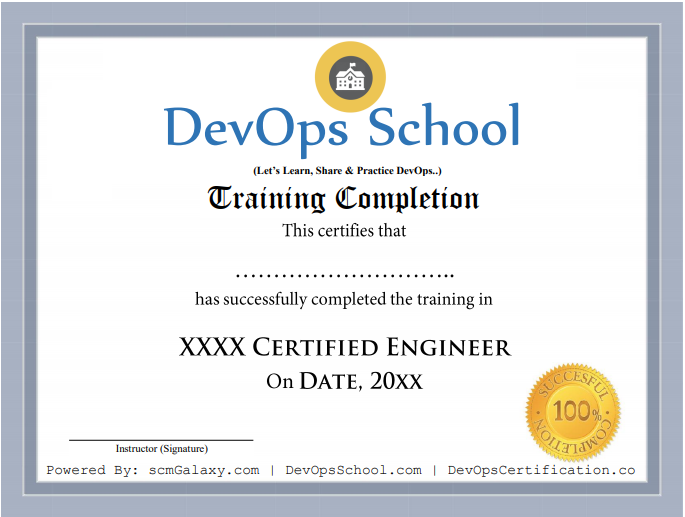
Certificate preview
See what course completion evidence looks like.
Tool-focused training
Course visuals reinforce the Powershell workflow and subject area.
Live batch experience
Training supports live online, private team and workshop-style delivery.
Start Powershell Intermediate training.
Next weekday batch starts on the 1st; weekend batch on the first Saturday. Batches are capped at 10 learners. Send your details and DevOpsSchool will share the syllabus and batch options.