kind
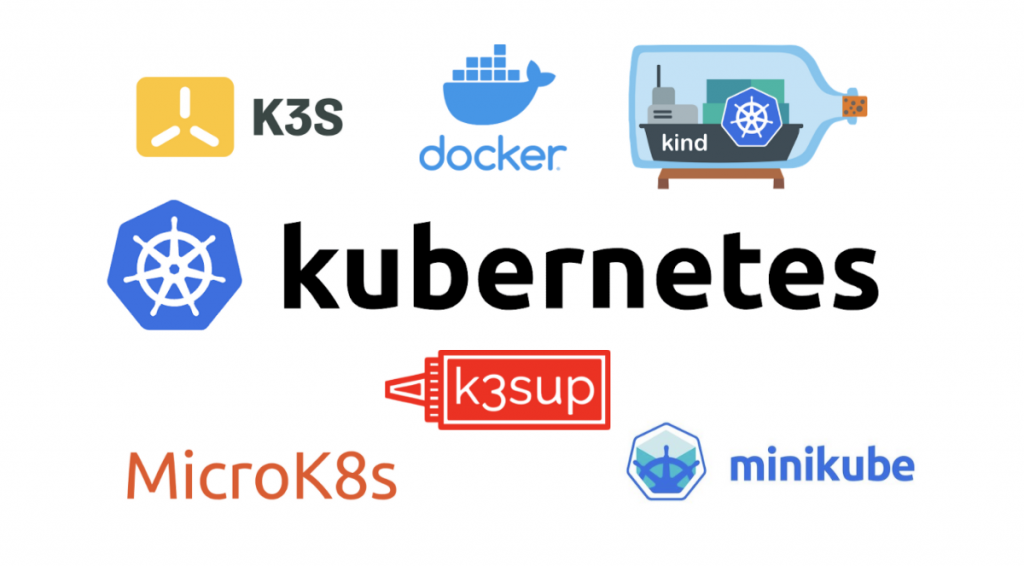
kind lets you run Kubernetes on your local computer. This tool requires that you have Docker installed and configured.
kind is a tool for running local Kubernetes clusters using Docker container “nodes”. kind was primarily designed for testing Kubernetes itself, but may be used for local development or CI.
kind consists of:
- Go packages implementing cluster creation, image build, etc.
- A command line interface (kind) built on these packages.
- Docker image(s) written to run systemd, Kubernetes, etc.
- kubetest integration also built on these packages (WIP)
minikube
Like kind, minikube is a tool that lets you run Kubernetes locally. minikube runs an all-in-one or a multi-node local Kubernetes cluster on your personal computer (including Windows, macOS and Linux PCs) so that you can try out Kubernetes, or for daily development work.
minikube is local Kubernetes, focusing on making it easy to learn and develop for Kubernetes.
All you need is Docker (or similarly compatible) container or a Virtual Machine environment, and Kubernetes is a single command away: minikube start
kubeadm
You can use the kubeadm tool to create and manage Kubernetes clusters. It performs the actions necessary to get a minimum viable, secure cluster up and running in a user friendly way.
Using kubeadm, you can create a minimum viable Kubernetes cluster that conforms to best practices. In fact, you can use kubeadm to set up a cluster that will pass the Kubernetes Conformance tests. kubeadm also supports other cluster lifecycle functions, such as bootstrap tokens and cluster upgrades.
The kubeadm tool is good if you need:
- A simple way for you to try out Kubernetes, possibly for the first time.
- A way for existing users to automate setting up a cluster and test their application.
- A building block in other ecosystem and/or installer tools with a larger scope.
- You can install and use kubeadm on various machines: your laptop, a set of cloud servers, a Raspberry Pi, and more. Whether you’re deploying into the cloud or on-premises, you can – integrate kubeadm into provisioning systems such as Ansible or Terraform.
k3d
k3d is a lightweight wrapper to run k3s (Rancher Lab’s minimal Kubernetes distribution) in docker. k3d makes it very easy to create single- and multi-node k3s clusters in docker, e.g. for local development on Kubernetes.
kOps
kops will not only help you create, destroy, upgrade and maintain production-grade, highly available, Kubernetes cluster, but it will also provision the necessary cloud infrastructure. AWS (Amazon Web Services) and GCE (Google Cloud Platform) are currently officially supported, with DigitalOcean, Hetzner and OpenStack in beta support, and Azure in alpha.
kOps is an automated provisioning system:
- Fully automated installation
- Uses DNS to identify clusters
- Self-healing: everything runs in Auto-Scaling Groups
- Multiple OS support (Amazon Linux, Debian, Flatcar, RHEL, Rocky and Ubuntu) – see the images.md
- High-Availability support – see the high_availability.md
- Can directly provision, or generate terraform manifests – see the terraform.md
Kubespray
Kubespray helps to install a Kubernetes cluster hosted on GCE, Azure, OpenStack, AWS, vSphere, Equinix Metal (formerly Packet), Oracle Cloud Infrastructure (Experimental) or Baremetal with Kubespray.
Kubespray is a composition of Ansible playbooks, inventory, provisioning tools, and domain knowledge for generic OS/Kubernetes clusters configuration management tasks.
Kubespray provides:
- Highly available cluster.
- Composable (Choice of the network plugin for instance).
- Supports most popular Linux distributions:
- Flatcar Container Linux by Kinvolk
- Debian Bullseye, Buster, Jessie, Stretch
- Ubuntu 16.04, 18.04, 20.04, 22.04
- CentOS/RHEL 7, 8, 9
- Fedora 35, 36
- Fedora CoreOS
- openSUSE Leap 15.x/Tumbleweed
- Oracle Linux 7, 8, 9
- Alma Linux 8, 9
- Rocky Linux 8, 9
- Kylin Linux Advanced Server V10
- Amazon Linux 2
- Continuous integration tests.

I’m Rajesh Kumar, a DevOps, SRE, DevSecOps, Cloud, and Platform Engineering expert passionate about sharing practical knowledge, real-world experiences, and industry best practices. I have worked at Cotocus and regularly write about technology, travel, investing, health, product reviews, and digital marketing through my various platforms.
I publish technical articles at DevOps School, travel stories at Holiday Landmark, stock market insights at Stocks Mantra, health and fitness guidance at My Medic Plus, product reviews at TrueReviewNow, and SEO and digital marketing strategies at Wizbrand.
Find Trusted Cardiac Hospitals
Compare heart hospitals by city and services — all in one place.
Explore Hospitals