
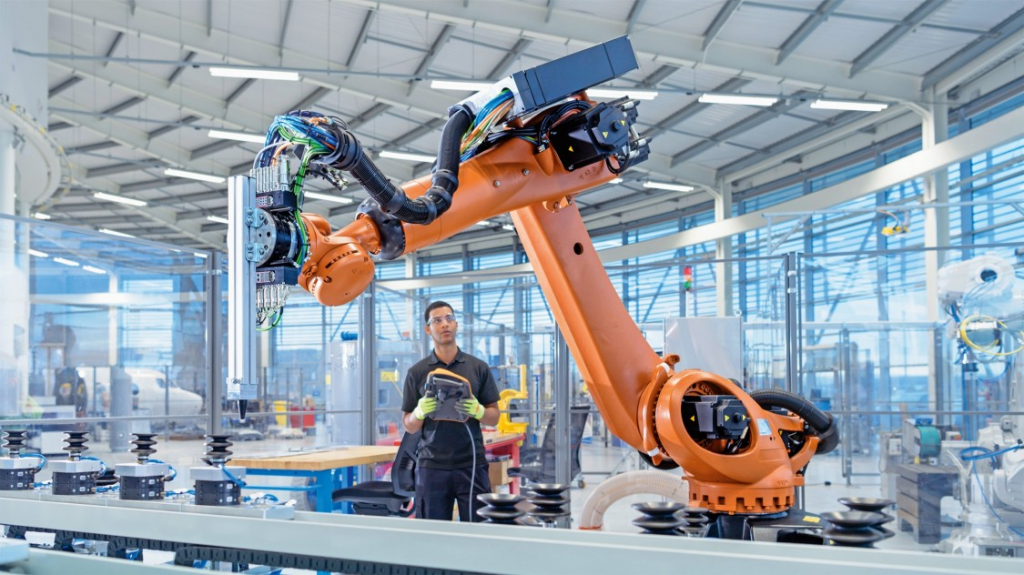
How Robots are Used in Manufacturing: A Comprehensive Guide
Robots have revolutionized the manufacturing industry over the last few decades. They have become an essential part of the production process, and their use has increased significantly with the advancement in technology. In this article, we will explore how robots are used in manufacturing and how they have made the manufacturing process more efficient and cost-effective.
Introduction
Robots are automated machines that can perform tasks with precision and speed. They are designed to perform a wide range of tasks, from simple repetitive tasks to complex operations. In manufacturing, robots are used to perform tasks that are dangerous, tedious, or require high precision. They can work 24/7 without getting tired, and they can perform tasks with a high degree of accuracy.
Types of Robots Used in Manufacturing
There are different types of robots used in manufacturing, and each type is designed to perform specific tasks. Here are some of the most common types of robots used in manufacturing:
1. Articulated Robots
Articulated robots are the most common type of robot used in manufacturing. They have a series of joints that allow them to move like a human arm. They are used for tasks that require a high degree of accuracy and flexibility, such as welding, painting, and assembly.
2. SCARA Robots
SCARA robots are designed for tasks that require high speed and precision. They have a vertical arm that moves in a circular motion and a horizontal arm that moves up and down. They are used for tasks such as pick and place, packaging, and assembly.
3. Cartesian Robots
Cartesian robots are also known as gantry robots. They have three linear axes that allow them to move in a straight line. They are used for tasks that require high precision and accuracy, such as drilling, milling, and cutting.
4. Delta Robots
Delta robots are designed for tasks that require high speed and precision. They have three arms that are connected to a central base. They are used for tasks such as pick and place, packaging, and assembly.
5. Collaborative Robots
Collaborative robots, also known as cobots, are designed to work alongside human workers. They are designed to be safe and easy to use, and they can perform tasks such as assembly, packaging, and inspection.
How Robots are Used in Manufacturing
Robots are used in manufacturing to perform a wide range of tasks. Here are some of the most common ways that robots are used in manufacturing:
1. Assembly
Robots are used in manufacturing to assemble products. They can perform tasks such as screwing, gluing, and welding. They can also perform tasks that require high precision, such as inserting small components into a product.
2. Packaging
Robots are used in manufacturing to package products. They can perform tasks such as picking and placing products into boxes, wrapping products in plastic, and labeling products.
3. Inspection
Robots are used in manufacturing to inspect products. They can perform tasks such as checking the dimensions of a product, inspecting the surface of a product for defects, and checking the weight of a product.
4. Material Handling
Robots are used in manufacturing to handle materials. They can perform tasks such as moving raw materials to the production line, moving finished products to the warehouse, and loading and unloading trucks.
5. Welding
Robots are used in manufacturing for welding tasks. They can perform tasks such as arc welding, spot welding, and laser welding. They can also perform tasks that require high precision, such as welding small components together.
Advantages of Using Robots in Manufacturing
There are several advantages of using robots in manufacturing. Here are some of the most significant advantages:
1. Increased Efficiency
Robots can perform tasks faster and more efficiently than human workers. They can work 24/7 without getting tired, and they can perform tasks with a high degree of accuracy.
2. Cost-Effective
Using robots in manufacturing can be cost-effective in the long run. Although the initial cost of purchasing and installing robots can be high, the cost of maintaining and operating robots is relatively low compared to human workers.
3. Improved Quality
Robots can perform tasks with a high degree of accuracy, which can improve the quality of the products. They can also perform tasks that are difficult or dangerous for human workers, which can reduce the risk of accidents and injuries.
4. Flexibility
Robots can be programmed to perform different tasks, which can increase the flexibility of the manufacturing process. They can also be reprogrammed quickly and easily to adapt to changes in the production process.
Conclusion
Robots have become an essential part of the manufacturing industry. They have revolutionized the way products are produced, and their use has increased significantly over the last few decades. Robots can perform tasks faster, more efficiently, and more accurately than human workers, which can improve the efficiency and quality of the manufacturing process. Although the initial cost of purchasing and installing robots can be high, the cost of maintaining and operating robots is relatively low compared to human workers. The use of robots in manufacturing is expected to continue to increase in the future, and it is an exciting time for the manufacturing industry.

👤 About the Author
Ashwani is passionate about DevOps, DevSecOps, SRE, MLOps, and AiOps, with a strong drive to simplify and scale modern IT operations. Through continuous learning and sharing, Ashwani helps organizations and engineers adopt best practices for automation, security, reliability, and AI-driven operations.
🌐 Connect & Follow:
Website: WizBrand.com
Facebook: facebook.com/DevOpsSchool
X (Twitter): x.com/DevOpsSchools
LinkedIn: linkedin.com/company/devopsschool
YouTube: youtube.com/@TheDevOpsSchool
Instagram: instagram.com/devopsschool
Quora: devopsschool.quora.com
Email– contact@devopsschool.com
Find Trusted Cardiac Hospitals
Compare heart hospitals by city and services — all in one place.
Explore Hospitals