
Introduction
Human-Robot Interaction (HRI) AI Systems focus on enabling robots to understand, communicate, and collaborate with humans in natural and intelligent ways. These systems combine artificial intelligence, machine learning, computer vision, speech recognition, natural language processing, sensor technologies, and robotics algorithms to help robots interpret human behavior and respond appropriately.
Unlike traditional robots that operate through fixed instructions, modern HRI systems are designed to interact dynamically with people. They can understand voice commands, recognize gestures, interpret emotions, adapt to user preferences, and support collaborative workflows.
Human-Robot Interaction is becoming increasingly important as robots move from controlled industrial environments into homes, hospitals, workplaces, warehouses, education, and public spaces. Organizations need robots that are safer, easier to use, and capable of working alongside humans without requiring specialized technical knowledge.
Common use cases include:
- Collaborative robots working with human employees
- Healthcare assistance and rehabilitation robots
- Customer service and hospitality robots
- Educational and training robots
- Autonomous service robots
- Assistive robots for elderly and disabled users
When evaluating HRI AI Systems, organizations should consider natural language capabilities, perception accuracy, safety mechanisms, AI model flexibility, learning capabilities, integration options, deployment models, privacy controls, scalability, reliability, and human safety requirements.
Best for: Robotics companies, healthcare providers, manufacturing organizations, research institutions, educational organizations, logistics companies, and enterprises building human-centered automation solutions.
Not ideal for: Businesses that only need simple automation, fixed workflow machines, or environments where human interaction is limited and traditional robotic systems are sufficient.
What’s Changed in Human-Robot Interaction (HRI) AI Systems in 2026+
Human-Robot Interaction is evolving as AI models become more capable and robots become more autonomous.
Key trends include:
- AI-powered conversational robots: Robots increasingly use advanced language models to understand natural human conversations and provide contextual responses.
- Multimodal interaction: Modern HRI systems combine voice, vision, gestures, touch, and environmental sensors to create more natural interactions.
- AI agents in robotics: Robots are moving toward agent-based architectures where they can plan tasks, make decisions, and collaborate with humans.
- Improved emotion and intent recognition: HRI systems are becoming better at understanding user behavior, preferences, and communication patterns.
- Human safety optimization: New systems focus heavily on collision prevention, safe movement, and predictable robot behavior.
- Simulation-based HRI testing: Organizations are increasingly testing interaction scenarios virtually before real-world deployment.
- Privacy-focused robotics: Companies require stronger controls for voice recordings, video data, and personal information collected by robots.
- Better evaluation methods: Teams are creating benchmarks for conversation quality, task completion, reliability, and human satisfaction.
- Cloud and edge AI balance: Organizations are optimizing between cloud intelligence and local processing for faster response times.
- Lower-cost robotics adoption: Improvements in hardware and AI software are making interactive robots more accessible.
Quick Buyer Checklist (Scan-Friendly)
Before selecting a Human-Robot Interaction AI System, evaluate:
- Natural language understanding capabilities
- Speech recognition and voice interaction quality
- Computer vision and perception support
- Gesture and behavior recognition
- AI model flexibility
- Hosted AI models vs custom models
- Edge processing capabilities
- Data privacy and retention controls
- Human safety mechanisms
- Testing and evaluation workflows
- Robot hardware compatibility
- API and SDK availability
- Integration with existing systems
- Monitoring and observability
- Scalability requirements
- Vendor lock-in risks
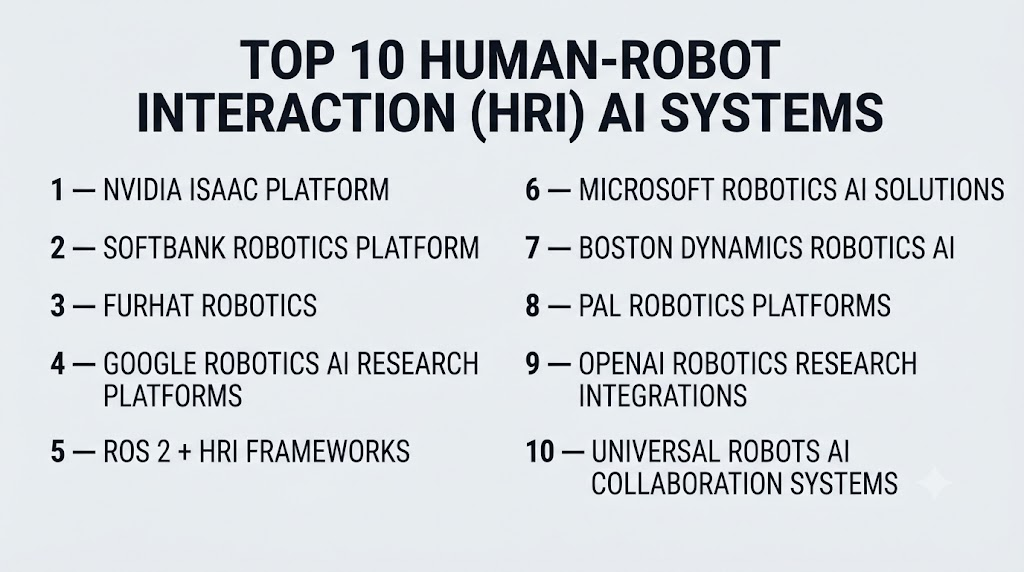
Top 10 Human-Robot Interaction (HRI) AI Systems
#1 — NVIDIA Isaac Platform
One-line verdict: Best for organizations developing intelligent robots with advanced perception and interaction capabilities.
Short description:
NVIDIA Isaac provides robotics development technologies that support AI-powered perception, simulation, and autonomous robot workflows.
It is widely used by robotics developers building intelligent machines capable of understanding and interacting with their surroundings.
Standout Capabilities
- AI-based robot perception
- Computer vision processing
- Simulation-based robotics development
- Autonomous navigation workflows
- Synthetic data generation
- Sensor integration
- Robotics AI development tools
AI-Specific Depth (Must Include)
- Model support: Supports integration with AI and machine learning workflows. Specific model support varies.
- RAG / knowledge integration: N/A
- Evaluation: Simulation testing and robotics evaluation workflows supported.
- Guardrails: Safety depends on implementation and robotics controls.
- Observability: Robotics performance monitoring varies by deployment.
Pros
- Strong AI robotics ecosystem.
- Supports advanced perception workflows.
- Suitable for enterprise robotics development.
Cons
- Requires technical expertise.
- Hardware requirements may be significant.
- More complex for beginners.
Security & Compliance
Security features depend on deployment configuration. Certifications are not publicly stated.
Deployment & Platforms
- Platforms: Linux-based robotics environments.
- Deployment: Cloud, workstation, and enterprise environments vary.
Integrations & Ecosystem
Supports robotics development ecosystems.
- Robotics frameworks
- AI models
- Simulation platforms
- Sensor systems
- Autonomous workflows
Pricing Model
Not publicly stated.
Best-Fit Scenarios
- Industrial robots
- Autonomous service robots
- Advanced robotics research
#2 — SoftBank Robotics Platform
One-line verdict: Best for organizations deploying social and service robots for human interaction.
Short description:
SoftBank Robotics develops robots designed for communication, assistance, and service-based human interaction.
These systems focus on natural engagement between humans and robots.
Standout Capabilities
- Social interaction features
- Voice-based communication
- Human-facing robot design
- Service automation
- Interactive experiences
- Educational applications
AI-Specific Depth
- Model support: Varies by robot platform.
- RAG / knowledge integration: N/A
- Evaluation: Interaction testing varies.
- Guardrails: Safety features depend on implementation.
- Observability: Varies / N/A
Pros
- Designed specifically for human interaction.
- Strong focus on usability.
- Suitable for public-facing environments.
Cons
- Limited customization compared with developer platforms.
- Availability varies by region.
- Enterprise requirements may need additional integration.
Security & Compliance
Not publicly stated.
Deployment & Platforms
Varies by robot model and deployment environment.
Integrations & Ecosystem
- Service applications
- Educational systems
- Custom software integrations
- Robotics APIs
Pricing Model
Not publicly stated.
Best-Fit Scenarios
- Hospitality robots
- Educational robots
- Customer engagement
#3 — Furhat Robotics
One-line verdict: Best for conversational robots requiring expressive human-like communication.
Short description:
Furhat Robotics develops social robots focused on conversational interaction, facial expressions, speech, and human communication research.
Standout Capabilities
- Conversational AI interaction
- Facial expression simulation
- Speech communication
- Social robotics research
- Human engagement studies
- Custom interaction design
AI-Specific Depth
- Model support: AI integrations vary.
- RAG / knowledge integration: Depends on connected systems.
- Evaluation: Conversation testing varies.
- Guardrails: Depends on deployment.
- Observability: Varies / N/A
Pros
- Strong focus on human communication.
- Useful for research and customer interaction.
- Supports expressive robot experiences.
Cons
- Specialized use cases.
- Higher complexity than software-only solutions.
- Limited industrial automation focus.
Security & Compliance
Not publicly stated.
Deployment & Platforms
Varies / N/A
Integrations & Ecosystem
- Conversational systems
- Research platforms
- AI services
- Custom applications
Pricing Model
Not publicly stated.
Best-Fit Scenarios
- Social robotics research
- Training applications
- Interactive customer experiences
#4 — Google Robotics AI Research Platforms
One-line verdict: Best for advanced robotics teams exploring AI-based interaction and reasoning.
Short description:
Google robotics research focuses on combining AI models, perception systems, and robotic capabilities to improve intelligent machine interaction.
Standout Capabilities
- AI reasoning research
- Robotics learning
- Vision-based interaction
- Language-based robot control
- Machine learning research
AI-Specific Depth
- Model support: Varies by research system.
- RAG / knowledge integration: Depends on implementation.
- Evaluation: Research benchmarks used.
- Guardrails: Varies.
- Observability: Research dependent.
Pros
- Advanced AI research capabilities.
- Strong machine learning foundation.
- Useful for innovation projects.
Cons
- Not always packaged as commercial products.
- Requires research expertise.
- Availability varies.
Security & Compliance
Not publicly stated.
Deployment & Platforms
Varies / N/A
Integrations & Ecosystem
- AI research frameworks
- Robotics systems
- Machine learning tools
- Experimental platforms
Pricing Model
Not publicly stated.
Best-Fit Scenarios
- Robotics research
- AI innovation teams
- Experimental systems
#5 — ROS 2 + HRI Frameworks
One-line verdict: Best open ecosystem for developers building customized human-robot interaction systems.
Short description:
ROS 2 provides a flexible robotics middleware foundation used to build robot applications, including perception, communication, and interaction workflows.
Standout Capabilities
- Open robotics framework
- Robot communication
- Sensor integration
- Custom interaction development
- Large developer ecosystem
- Hardware flexibility
AI-Specific Depth
- Model support: Supports integration with external AI models.
- RAG / knowledge integration: Depends on implementation.
- Evaluation: Custom testing required.
- Guardrails: Developer implemented.
- Observability: Depends on tools used.
Pros
- Highly customizable.
- Large robotics community.
- Supports many hardware platforms.
Cons
- Requires engineering knowledge.
- Security depends on implementation.
- Setup complexity can be high.
Security & Compliance
Varies / N/A
Deployment & Platforms
- Platforms: Linux, embedded systems.
- Deployment: Self-hosted.
Integrations & Ecosystem
- Robotics hardware
- AI frameworks
- Sensors
- Simulation tools
Pricing Model
Open-source.
Best-Fit Scenarios
- Robotics developers
- Research teams
- Custom robot applications
#6 — Microsoft Robotics AI Solutions
One-line verdict: Best for enterprises integrating robotics with cloud-based AI workflows.
Short description:
Microsoft robotics solutions combine cloud AI capabilities with automation and robotics development workflows.
Standout Capabilities
- Cloud AI integration
- Data processing
- Enterprise workflows
- AI application development
- Automation support
AI-Specific Depth
- Model support: Supports cloud AI integrations.
- RAG / knowledge integration: Depends on connected services.
- Evaluation: Varies.
- Guardrails: Depends on AI services.
- Observability: Available through connected monitoring systems.
Pros
- Enterprise ecosystem.
- Strong cloud integration.
- Developer-friendly tools.
Cons
- Robotics capabilities depend on implementation.
- Requires cloud expertise.
- Costs vary.
Security & Compliance
Specific certifications vary by service.
Deployment & Platforms
Cloud and hybrid deployments vary.
Integrations & Ecosystem
- Cloud services
- AI platforms
- Enterprise systems
- APIs
Pricing Model
Usage-based or subscription models may apply depending on services used.
Best-Fit Scenarios
- Enterprise automation
- Cloud-connected robots
- AI-enabled workflows
#7 — Boston Dynamics Robotics AI
One-line verdict: Best for advanced robots requiring mobility and intelligent physical interaction.
Short description:
Boston Dynamics develops advanced mobile robots designed for complex environments and physical interaction.
Standout Capabilities
- Dynamic robot movement
- Autonomous navigation
- Physical interaction
- Industrial applications
- Advanced robotics engineering
AI-Specific Depth
- Model support: Varies.
- RAG / knowledge integration: N/A
- Evaluation: Robotics testing workflows.
- Guardrails: Safety depends on deployment.
- Observability: Varies.
Pros
- Advanced physical robotics.
- Strong mobility capabilities.
- Suitable for challenging environments.
Cons
- High complexity.
- Specialized applications.
- Limited accessibility for smaller teams.
Security & Compliance
Not publicly stated.
Deployment & Platforms
Varies by robot system.
Integrations & Ecosystem
- Industrial systems
- Robotics software
- Sensor platforms
- Automation workflows
Pricing Model
Not publicly stated.
Best-Fit Scenarios
- Industrial inspection
- Research robotics
- Complex environments
#8 — PAL Robotics Platforms
One-line verdict: Best for research and service robots requiring human collaboration.
Short description:
PAL Robotics develops humanoid and service robots designed for research, healthcare, and collaborative environments.
Standout Capabilities
- Human collaboration
- Navigation
- Service robotics
- Research platforms
- Custom applications
AI-Specific Depth
- Model support: Varies.
- RAG / knowledge integration: N/A
- Evaluation: Depends on project.
- Guardrails: Safety controls vary.
- Observability: Varies.
Pros
- Strong service robotics focus.
- Research-friendly.
- Human-centered design.
Cons
- Specialized market.
- Requires robotics expertise.
- Deployment complexity.
Security & Compliance
Not publicly stated.
Deployment & Platforms
Varies.
Integrations & Ecosystem
- Robotics software
- Research systems
- Sensors
- AI applications
Pricing Model
Not publicly stated.
Best-Fit Scenarios
- Healthcare robotics
- Research projects
- Service automation
#9 — OpenAI Robotics Research Integrations
One-line verdict: Best for exploring language-based AI interaction with robotic systems.
Short description:
AI language models are increasingly being explored for robotics applications where robots need to understand instructions and interact naturally with humans.
Standout Capabilities
- Natural language interaction
- Task understanding
- Human instruction processing
- AI reasoning workflows
- Conversational interfaces
AI-Specific Depth
- Model support: Depends on selected AI models.
- RAG / knowledge integration: Possible through connected systems.
- Evaluation: Requires application-specific testing.
- Guardrails: Requires safety implementation.
- Observability: Depends on deployment tools.
Pros
- Natural interaction capabilities.
- Flexible AI workflows.
- Useful for intelligent assistants.
Cons
- Requires robotics integration.
- Physical safety remains critical.
- Performance depends on implementation.
Security & Compliance
Varies by deployment.
Deployment & Platforms
Cloud and custom deployments vary.
Integrations & Ecosystem
- Robotics platforms
- AI applications
- APIs
- Custom systems
Pricing Model
Varies.
Best-Fit Scenarios
- Conversational robots
- Research projects
- Intelligent assistants
#10 — Universal Robots AI Collaboration Systems
One-line verdict: Best for manufacturing teams deploying collaborative robots alongside humans.
Short description:
Universal Robots develops collaborative robots designed to safely work with humans in industrial environments.
Standout Capabilities
- Human-safe collaboration
- Industrial automation
- Robot programming
- Flexible deployment
- Manufacturing workflows
AI-Specific Depth
- Model support: Depends on integrations.
- RAG / knowledge integration: N/A
- Evaluation: Industrial testing workflows.
- Guardrails: Safety mechanisms depend on robot configuration.
- Observability: Varies.
Pros
- Strong collaborative robotics focus.
- Easier adoption for manufacturers.
- Flexible industrial applications.
Cons
- Primarily industrial focused.
- Advanced AI depends on integrations.
- Hardware investment required.
Security & Compliance
Not publicly stated.
Deployment & Platforms
Industrial environments.
Integrations & Ecosystem
- Manufacturing systems
- Automation platforms
- Robotics software
- Sensors
Pricing Model
Not publicly stated.
Best-Fit Scenarios
- Manufacturing collaboration
- Industrial automation
- Human-machine workflows
Comparison Table
| Tool Name | Best For | Deployment (Cloud/Self-hosted/Hybrid) | Model Flexibility (Hosted / BYO / Multi-model / Open-source) | Strength | Watch-Out | Public Rating |
|---|---|---|---|---|---|---|
| NVIDIA Isaac Platform | Enterprise robotics AI development | Cloud/Self-hosted/Hybrid | Multi-model integration | Advanced perception and simulation | Requires technical expertise | N/A |
| SoftBank Robotics Platform | Social and service robots | Varies | Platform-dependent | Human-facing interaction | Limited customization | N/A |
| Furhat Robotics | Conversational social robots | Self-hosted/Enterprise | Custom AI integrations | Expressive communication | Specialized use cases | N/A |
| Google Robotics AI Research Platforms | Advanced robotics research | Varies | Multi-model research workflows | AI innovation | Not always commercial products | N/A |
| ROS 2 + HRI Frameworks | Custom robotics development | Self-hosted | Open-source/BYO model | Flexibility and ecosystem | Requires engineering effort | N/A |
| Microsoft Robotics AI Solutions | Enterprise AI-connected robotics | Cloud/Hybrid | Hosted/BYO integration | Enterprise cloud workflows | Robotics capability varies | N/A |
| Boston Dynamics Robotics AI | Advanced mobile robots | Enterprise | Platform-based | Physical robotics capability | High complexity | N/A |
| PAL Robotics Platforms | Research and service robotics | Enterprise/Self-hosted | Custom integrations | Human collaboration | Specialized deployments | N/A |
| OpenAI Robotics Research Integrations | Language-driven robot interaction | Cloud/Hybrid | Hosted/BYO integration | Natural language interaction | Requires robotics integration | N/A |
| Universal Robots AI Collaboration Systems | Industrial collaborative robots | Enterprise | Platform integrations | Human-safe automation | Industrial focus | N/A |
Scoring & Evaluation (Transparent Rubric)
The scoring below is a comparative evaluation based on general HRI capabilities, ecosystem maturity, flexibility, developer experience, and enterprise readiness. It is not an absolute ranking because different organizations have different robotics requirements.
| Tool | Core | Reliability/Eval | Guardrails | Integrations | Ease | Perf/Cost | Security/Admin | Support | Weighted Total |
|---|---|---|---|---|---|---|---|---|---|
| NVIDIA Isaac Platform | 9 | 9 | 8 | 9 | 7 | 8 | 8 | 9 | 8.5 |
| SoftBank Robotics Platform | 8 | 7 | 8 | 7 | 8 | 7 | 7 | 8 | 7.6 |
| Furhat Robotics | 8 | 8 | 7 | 8 | 8 | 7 | 7 | 8 | 7.7 |
| Google Robotics AI Research Platforms | 9 | 9 | 7 | 8 | 6 | 8 | 7 | 8 | 8.0 |
| ROS 2 + HRI Frameworks | 9 | 8 | 7 | 10 | 6 | 9 | 7 | 9 | 8.3 |
| Microsoft Robotics AI Solutions | 8 | 8 | 8 | 9 | 8 | 7 | 9 | 9 | 8.2 |
| Boston Dynamics Robotics AI | 9 | 8 | 8 | 8 | 7 | 7 | 8 | 8 | 8.0 |
| PAL Robotics Platforms | 8 | 7 | 7 | 8 | 7 | 7 | 7 | 8 | 7.5 |
| OpenAI Robotics Research Integrations | 8 | 8 | 7 | 9 | 8 | 8 | 7 | 8 | 8.0 |
| Universal Robots AI Collaboration Systems | 9 | 8 | 9 | 8 | 8 | 8 | 8 | 9 | 8.5 |
Top 3 for Enterprise
- NVIDIA Isaac Platform
- Universal Robots AI Collaboration Systems
- Microsoft Robotics AI Solutions
Top 3 for SMB
- ROS 2 + HRI Frameworks
- Furhat Robotics
- Universal Robots AI Collaboration Systems
Top 3 for Developers
- ROS 2 + HRI Frameworks
- NVIDIA Isaac Platform
- OpenAI Robotics Research Integrations
Which Human-Robot Interaction (HRI) AI System Is Right for You?
Solo / Freelancer
Individual developers and independent researchers should prioritize flexibility, documentation, community support, and affordable experimentation.
Recommended options:
- ROS 2 + HRI Frameworks for custom development
- OpenAI Robotics Research Integrations for language-based interaction experiments
- Open-source robotics environments combined with AI models
Best practices:
- Start with simulation before physical deployment.
- Build small interaction prototypes.
- Measure response accuracy and safety early.
SMB
Small and medium businesses should focus on solutions that provide practical deployment without requiring large robotics teams.
Recommended options:
- Universal Robots AI Collaboration Systems
- Furhat Robotics
- ROS-based solutions
SMBs should evaluate:
- Ease of integration
- Maintenance requirements
- Training needs
- Hardware compatibility
- Long-term support
Mid-Market
Growing organizations usually need scalable systems that support multiple robots, teams, and operational workflows.
Recommended options:
- NVIDIA Isaac Platform
- Microsoft Robotics AI Solutions
- PAL Robotics Platforms
Important considerations:
- Centralized monitoring
- AI model management
- Security controls
- Deployment scalability
Enterprise
Large organizations require reliable robotics platforms that can operate across multiple environments.
Recommended options:
- NVIDIA Isaac Platform
- Universal Robots AI Collaboration Systems
- Microsoft Robotics AI Solutions
Enterprise buyers should prioritize:
- Governance
- Integration with existing systems
- Security management
- Operational monitoring
- Human safety validation
Regulated Industries (Finance, Healthcare, Public Sector)
Organizations operating in regulated environments should focus on:
- Data privacy
- Access controls
- Auditability
- Human oversight
- Controlled AI decision-making
Healthcare robotics, for example, requires careful handling of patient interaction data and strong safety validation.
Budget vs Premium
Budget-focused teams should consider:
- Open-source robotics frameworks
- Developer platforms
- Simulation-first approaches
Premium solutions are better when organizations need:
- Enterprise support
- Hardware integration
- Advanced safety features
- Large-scale deployment
Build vs Buy (When to DIY)
Build a custom HRI solution when:
- The interaction requirements are highly specialized.
- Internal robotics expertise exists.
- Full control over AI behavior is required.
Choose an existing platform when:
- Faster deployment is important.
- Safety requirements are significant.
- Maintenance resources are limited.
Implementation Playbook (30 / 60 / 90 Days)
First 30 Days: Pilot + Success Metrics
Focus on understanding the problem before scaling.
Activities:
- Define human interaction goals.
- Select initial robot workflows.
- Identify users and environments.
- Test AI interaction quality.
- Create performance benchmarks.
Success metrics may include:
- Task completion rate
- Response accuracy
- Human satisfaction
- Safety incidents
- Interaction latency
First 60 Days: Security + Evaluation
Improve reliability and operational readiness.
Activities:
- Build evaluation scenarios.
- Test edge cases.
- Review privacy requirements.
- Implement access controls.
- Establish AI monitoring.
AI-specific tasks:
- Create interaction test cases.
- Maintain model/version tracking.
- Perform safety reviews.
- Test unexpected user inputs.
- Validate human override mechanisms.
First 90 Days: Optimization + Scale
Prepare the system for wider deployment.
Activities:
- Optimize AI response times.
- Reduce unnecessary computation.
- Improve interaction quality.
- Expand supported workflows.
- Create governance processes.
Long-term improvements:
- Continuous evaluation
- Robot behavior monitoring
- Incident management
- Cost optimization
- Performance reporting
Common Mistakes & How to Avoid Them
- Ignoring human behavior complexity: Robots need to understand unpredictable human actions.
- Deploying without safety testing: Always validate robot responses before real-world usage.
- Skipping AI evaluation: Interaction quality should be measured continuously.
- Poor data privacy management: Voice, video, and sensor data require careful handling.
- No human override mechanisms: Critical environments should always support human control.
- Overestimating AI autonomy: AI systems still require monitoring and validation.
- Ignoring latency requirements: Slow responses create poor user experiences.
- Using generic AI models without adaptation: Robotics environments often require specialized tuning.
- Failing to test diverse users: HRI systems should work across different communication styles.
- Weak observability: Teams need visibility into robot decisions and performance.
- Ignoring integration challenges: Robots must connect with existing workflows.
- Creating vendor dependency: Flexible architectures reduce long-term risks.
- Not considering physical limitations: AI capabilities must match robot hardware.
- Skipping security planning: Connected robots can introduce operational risks.
FAQs
What is Human-Robot Interaction (HRI) AI?
Human-Robot Interaction AI enables robots to communicate, understand, and collaborate with humans using technologies such as machine learning, computer vision, speech processing, and language models.
Why is HRI AI becoming important?
As robots move into public and workplace environments, they need better communication, safety, and adaptability.
Can HRI systems understand natural language?
Many modern HRI systems support natural language interaction, but capability depends on the underlying AI models and implementation.
Do HRI AI systems support custom AI models?
Some platforms support custom models or external AI integrations. Capabilities vary by platform.
Are HRI systems safe for human environments?
Safety depends on hardware design, software controls, testing, and deployment conditions.
Can organizations self-host HRI AI systems?
Some developer-focused platforms support self-hosting, while enterprise systems may use cloud or hybrid deployment models.
How do companies evaluate HRI performance?
Organizations typically evaluate task completion, response accuracy, safety, user satisfaction, and reliability.
Are privacy controls important for HRI systems?
Yes. Robots may collect voice, video, and behavioral data, making privacy management essential.
What industries use HRI AI systems?
Common industries include manufacturing, healthcare, logistics, education, hospitality, research, and public services.
Can HRI robots replace humans?
HRI systems are generally designed to assist humans, improve productivity, and support collaboration rather than completely replace human involvement.
How expensive are HRI AI systems?
Costs vary depending on hardware, software capabilities, deployment requirements, and customization needs.
How can organizations avoid HRI vendor lock-in?
Using open standards, flexible architectures, portable AI models, and modular systems can reduce dependency risks.
Conclusion
Human-Robot Interaction AI Systems are becoming a critical technology area as robots move closer to everyday human environments. The combination of artificial intelligence, perception, language understanding, and robotics enables machines to become more helpful, adaptive, and collaborative.The best HRI solution depends on the organization’s goals, technical capabilities, safety requirements, and deployment environment. Research teams may prefer flexible frameworks, while enterprises may require complete robotics platforms with stronger operational support.Organizations should evaluate interaction quality, AI reliability, privacy controls, safety mechanisms, and scalability before selecting a platform.

Find Trusted Cardiac Hospitals
Compare heart hospitals by city and services — all in one place.
Explore Hospitals
An important aspect that could be explored further is the long-term operational management of human-robot interaction systems after deployment. As user behavior, environments, and tasks evolve, AI models and interaction patterns may require continuous refinement to maintain safety and effectiveness. Implementing performance monitoring, feedback collection, periodic model updates, and comprehensive audit trails helps organizations identify emerging issues early while ensuring HRI systems remain reliable, transparent, and aligned with real-world operational requirements.