
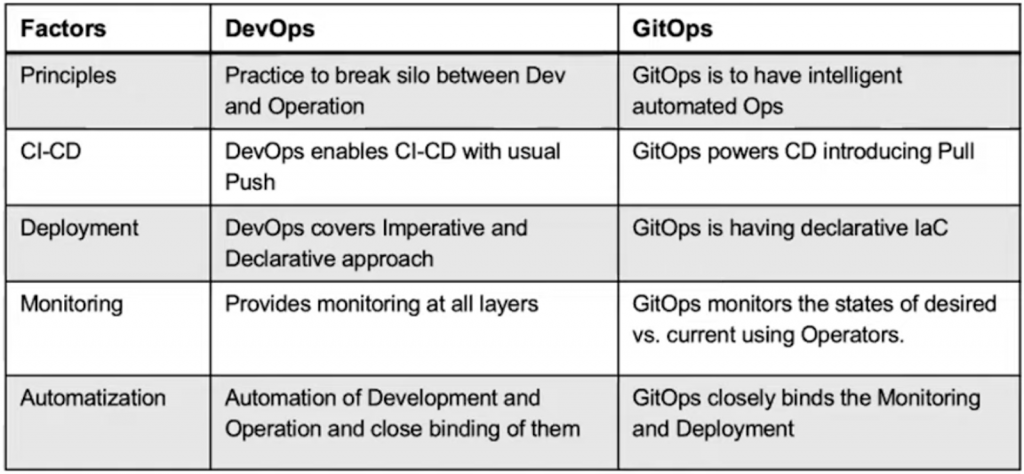
Have you ever wondered what the difference is between GitOps and CI/CD? If you have, then you’re in the right place! In this blog post, we’ll dive into the two terms and explore what sets them apart from each other.
GitOps: A Quick Overview
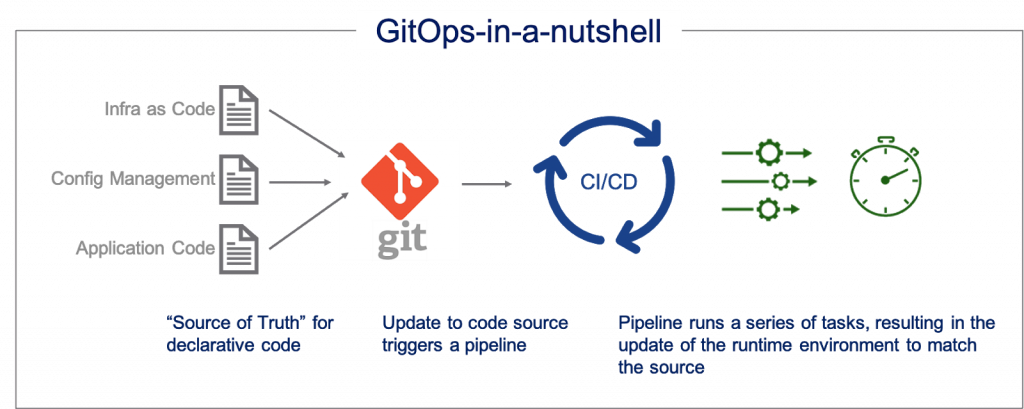
GitOps is a modern approach to continuous deployment that leverages Git as the source of truth for infrastructure and application deployment. With GitOps, all changes to infrastructure and application code are made through pull requests, which are then automatically deployed to the production environment.
CI/CD: A Quick Overview
CI/CD, on the other hand, stands for Continuous Integration/Continuous Deployment. It’s a software development process that involves continuously integrating code changes, building and testing the software, and deploying it to production. The goal of CI/CD is to automate the process of software delivery and ensure that changes are delivered to production in a timely, reliable, and repeatable manner.
The Differences Between GitOps vs CI/CD
While GitOps and CI/CD share some similarities, there are several key differences between the two approaches. Let’s take a closer look at some of the main differences:
Source of Truth
With GitOps, Git is the source of truth for all infrastructure and application changes. All changes are made through pull requests, which are then automatically deployed to production. On the other hand, with CI/CD, the source of truth is the code repository, which is used to build and test the software before it’s deployed to production.
Automation
Both GitOps and CI/CD rely heavily on automation to streamline the software delivery process. However, with GitOps, all changes are automatically deployed to production once they’re approved and merged into the main branch. With CI/CD, there are typically several stages of automation, including build, test, and deployment.
Configuration Management
GitOps places a strong emphasis on configuration management, as all infrastructure and application changes are made through Git. With CI/CD, configuration management is also important, but it’s typically handled through tools like Chef, Puppet, or Ansible.
Rollbacks
With GitOps, rollbacks are easy and straightforward, as all changes are made through Git. If there’s an issue with a deployment, you can simply roll back to a previous version of the code. With CI/CD, rollbacks can be more complex, especially if there are multiple stages of automation involved.
Which Approach Is Right for You?
So, which approach is right for you? The answer depends on your specific needs and requirements. If you’re looking for a modern approach to continuous deployment that leverages Git as the source of truth, then GitOps might be the way to go. On the other hand, if you’re looking for a more traditional approach to software delivery that involves multiple stages of automation, then CI/CD might be a better fit.
Conclusion
In conclusion, GitOps and CI/CD are both valuable approaches to software delivery, but they differ in several key ways. By understanding the differences between the two, you can determine which approach is right for your specific needs and requirements. Whether you choose GitOps or CI/CD, the goal is the same: to automate the process of software delivery and ensure that changes are delivered to production in a timely, reliable, and repeatable manner.

👤 About the Author
Ashwani is passionate about DevOps, DevSecOps, SRE, MLOps, and AiOps, with a strong drive to simplify and scale modern IT operations. Through continuous learning and sharing, Ashwani helps organizations and engineers adopt best practices for automation, security, reliability, and AI-driven operations.
🌐 Connect & Follow:
- Website: WizBrand.com
- Facebook: facebook.com/DevOpsSchool
- X (Twitter): x.com/DevOpsSchools
- LinkedIn: linkedin.com/company/devopsschool
- YouTube: youtube.com/@TheDevOpsSchool
- Instagram: instagram.com/devopsschool
- Quora: devopsschool.quora.com
- Email– contact@devopsschool.com
Find Trusted Cardiac Hospitals
Compare heart hospitals by city and services — all in one place.
Explore Hospitals
A point that is often overlooked in GitOps vs CI/CD discussions is where the responsibility for handling configuration drift actually sits in real production environments. Traditional CI/CD is largely event-driven, focusing on pushing changes at deployment time, but in real Kubernetes-based systems, manual interventions, emergency fixes, or out-of-band changes are almost inevitable and that’s where CI/CD alone starts to fall short. GitOps, on the other hand, is designed around the assumption that drift will happen and continuously reconciles the actual state back to what is defined in Git, effectively acting as an always-on enforcement layer. However, this introduces its own operational concerns that are rarely highlighted, such as the risk of overwriting urgent production hotfixes through reconciliation, potential delays or instability during controller sync under heavy load, challenges in maintaining consistency across multiple clusters with different constraints, and the dependency risk on Git itself becoming a single control plane. In real-world setups, teams often end up using a hybrid model where CI/CD manages build, testing, and artifact promotion while GitOps ensures runtime state consistency, but with controlled exceptions for emergencies. Ultimately, the key difference is less about tooling and more about whether deployments are treated as discrete actions or as continuously enforced system states, which significantly impacts reliability, incident response, and operational governance.