
By Ingrid Solberg, Brand Marketing Director
In September 2026, my team ran Profound’s free trial: 50 prompts, daily, for seven days. It did what it promised, but trial users get a recommended prompt set based on their industry and can’t customize it. Our monthly description audit starts from how the machine describes us and asks narrower questions: is the description accurate, what is the sentiment about, which source put the wording there, and in which of our nine markets? None of those questions were in the set, so in week two we started comparing Profound alternatives.
The stakes are commercial. In a Gartner survey of 646 B2B buyers, 45% reported using AI during a recent purchase, so nearly half meet a vendor’s AI description before they meet sales. The description is the brand now. What follows judges AI brand monitoring by that brand job.
What’s the Best Profound Alternative for a Brand Team?
For most brand teams, SE Visible by SE Ranking is the best Profound alternative. Each visibility and sentiment figure leads back to the unedited response it came from, with engine, market, date, and cited sources. API access comes on all plans, with a Looker Studio connector and exports for reporting; Profound reserves exports and API for Enterprise. For claim-by-claim fact-checking against your own knowledge base, traced to the source URL, Profound Enterprise still leads. Here’s how it and six others compare.
Why Do Brand Teams Look At Profound Alternatives?
Brand teams look past Profound mainly over plan access. Profound publishes two brand plans: a free 7-day trial and a custom-priced Enterprise package. FactCheck, CSV and JSON exports, and API access all sit in Enterprise.
Teams weighing Profound competitors raise four points:
- Profound’s pricing starts with a sales call. No paid brand plan carries a listed price.
- The trial can’t test your misconceptions. It runs three engines in one language and one region.
- Accuracy and data access wait for Enterprise. Claim checking and data exports need the contract.
- The homepage now leads with an “AI Marketer” agent layer. A reading-first team may not need agents.
How I compared the Profound AI alternatives below: I checked vendor pages on October 14, 2026, against my audit’s five questions: what was said, is it accurate, what’s the sentiment about, which source, which market.
How Do Profound Alternatives Compare for AI Brand Monitoring?
Seven Profound alternatives fall into three tiers: Tier 1 reads the answer and the sources behind it, Tier 2 checks the answer against facts you set, and Tier 3 measures how a whole category perceives your brand.
| Rank | Platform | Tier | Strength vs Profound | Weakness vs Profound | From |
| Anchor | Profound | Baseline | FactCheck, nine-engine menu | Enterprise-only API | Free trial; Enterprise custom |
| 1 | SE Visible by SE Ranking | 1 | Answer behind each metric | Narrower engine list, Claude planned | Free trial |
| 2 | Scrunch AI | 1 | Self-serve sentiment | One country | $250/mo |
| 3 | Rankscale | 1 | Engines on every paid plan | No fact-check listed | $99/mo with sentiment |
| 4 | Peec AI | 2 | Fact-checks from Starter | Three models below Enterprise | $95/mo |
| 5 | Goodie | 2 | All-plan sentiment | Enterprise-only claim checks | $295/mo |
| 6 | AthenaHQ | 2 | 11 models | Single region | $295/mo |
| 7 | Evertune | 3 | Attribute-level perception | Demo-only entry | $800/mo |
Tier 1: Which Profound Alternatives Show You the Answer and Its Sources?
Tier 1 Profound alternatives keep three things together: the response an engine gave, the sentiment reading on it, and the sources it cited. For a brand owner, that’s the difference between watching a score and knowing who fixes which sentence.
As Andrew Frank, Distinguished VP Analyst at Gartner, puts it: “Disinformation is no longer just a cybersecurity, legal or public affairs issue. It is a brand issue.”
1. SE Visible
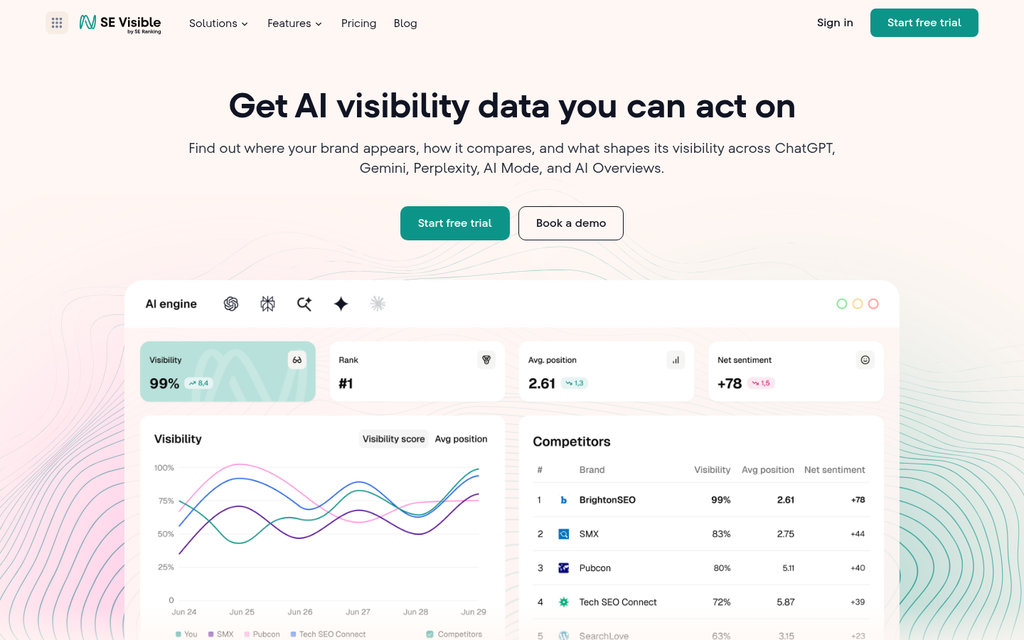
Open the Spanish project next to the German one, and the same prompts tell two different stories about your brand. SE Visible by SE Ranking is an AI visibility platform that shows what ChatGPT, Gemini, and Google’s AI Mode and AI Overviews say about your brand.
Best for: in-house brand teams and their agencies with a dedicated AI visibility mandate across more than one market.
Standout feature: Answers come from a real browser session, stored unedited with engine, market, and date. Net sentiment (-100 to +100) sits beside visibility score, average position, and share of voice; each opens into its response. Sources lists cited domains and URLs, filterable by brand mention.
SE Visible vs Profound: Prompts are yours from day one, markets go down to a city or region, and API access comes on all plans, beside a Looker Studio connector and exports. Profound leads on accuracy: Enterprise FactCheck checks each claim against your knowledge base and traces it to a URL. Choose by job: reading descriptions or auditing claims.
Pros:
- Opens each metric, sentiment included, into the dated answer behind it
- Sends AI brand mentions to Looker Studio via connector or API
- Tracks daily by default; frequency is adjustable
Cons:
- AI visibility only; SEO work lives in SE Ranking
- Claude support is planned as engine coverage grows
- In-app report building is still developing; Looker Studio and the API carry richer reports
Pricing: Plans and a free trial are on visible.seranking.com.
What I’d tell the CMO: If your team needs wording, sentiment, and source side by side per market, start here. Give SE Visible a try on your next description audit. For the SEO side, SE Ranking covers Google and traditional search; together, the two platforms give a fuller picture of your brand across search.
2. Scrunch AI
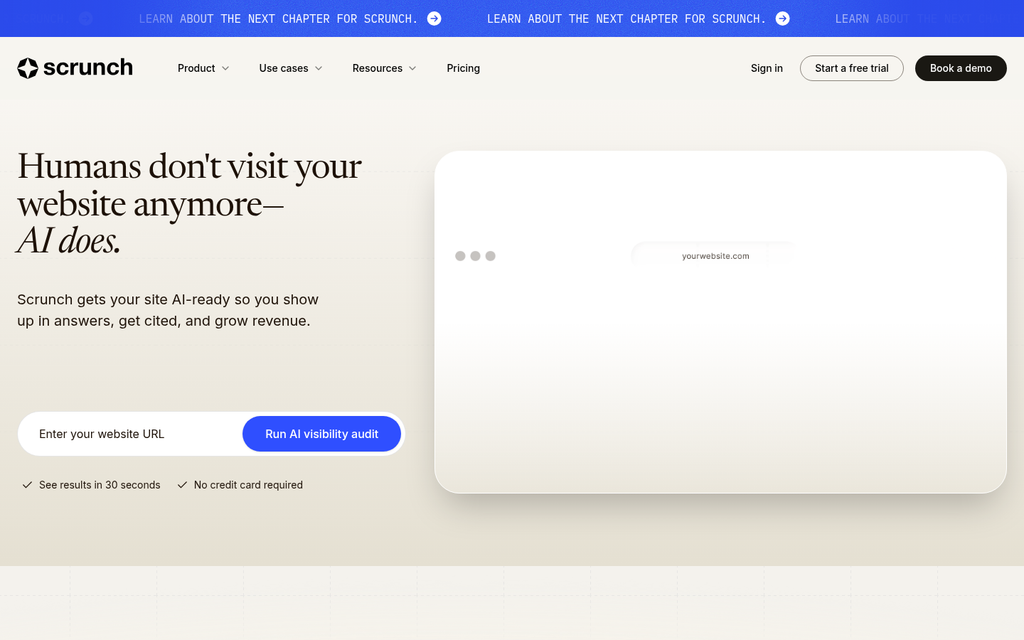
Scrunch AI pairs sentiment analysis with the citations behind each answer on a published self-serve plan.
Best for: brand teams auditing one flagship market first.
Standout feature: Scrunch AI’s Core plan keeps sentiment and citations together across 125 custom prompts and 5,000 responses a month, so a negative characterization arrives with the pages it leaned on.
Scrunch AI vs Profound: Scrunch wins on access: a published plan with your own prompts. Profound wins on accuracy: Enterprise FactCheck tests claims against your knowledge base. Weighing Profound vs Scrunch AI? Ask whether tone or truth is your open question.
Pros:
- Reads sentiment from the entry plan
- Logs citations and sources per answer
- Tracks AI agent traffic
Cons:
- Core covers one country and one language
- Looker Studio and API sit on Enterprise
Pricing: $250/mo (Core); 7-day free trial.
What I’d tell the CMO: Scrunch AI is strong AI brand tracking for one flagship market. Across nine markets, plan on Enterprise.
3. Rankscale
Rankscale, a credit-based platform, reads tone, citations, and the sources box across ChatGPT, Gemini, Claude, Copilot, and other engines.
Best for: brand teams wanting broad engine coverage in AI brand tracking.
Standout feature: Sources box analysis, on every plan, shows which sites an engine displays beside its answer. From Pro, sentiment analysis reads the tone of each of those answers.
Rankscale vs Profound: Rankscale wins on engine breadth at a published price, plus a Looker Studio connector and exports from Pro. Profound wins on depth: sentiment root-cause analysis, FactCheck, and SSO with SOC 2 on Enterprise. Rankscale watches tone widely; Profound explains it.
Pros:
- Covers DeepSeek and Mistral
- Rolls unused credits over
- Shares dashboard links
Cons:
- Lists no fact-check feature
- Sentiment starts at Pro
Pricing: $99/mo (Pro, first plan with sentiment); 7-day trial.
What I’d tell the CMO: Among Profound AI competitors, Rankscale tells you how answers sound across engines. Whether they’re true stays a brand judgment, so assign a reader who knows the positioning.
Tier 2: Which Profound Alternatives Check the Answer Against Your Own Facts?
A 2025 University of Melbourne and KPMG study of more than 48,000 people in 47 countries found 66% rely on AI output without evaluating its accuracy, so a wrong brand description travels unchecked. These Profound alternatives compare answers with facts you set, turning an inaccuracy into a logged defect with an owner.
4. Peec AI
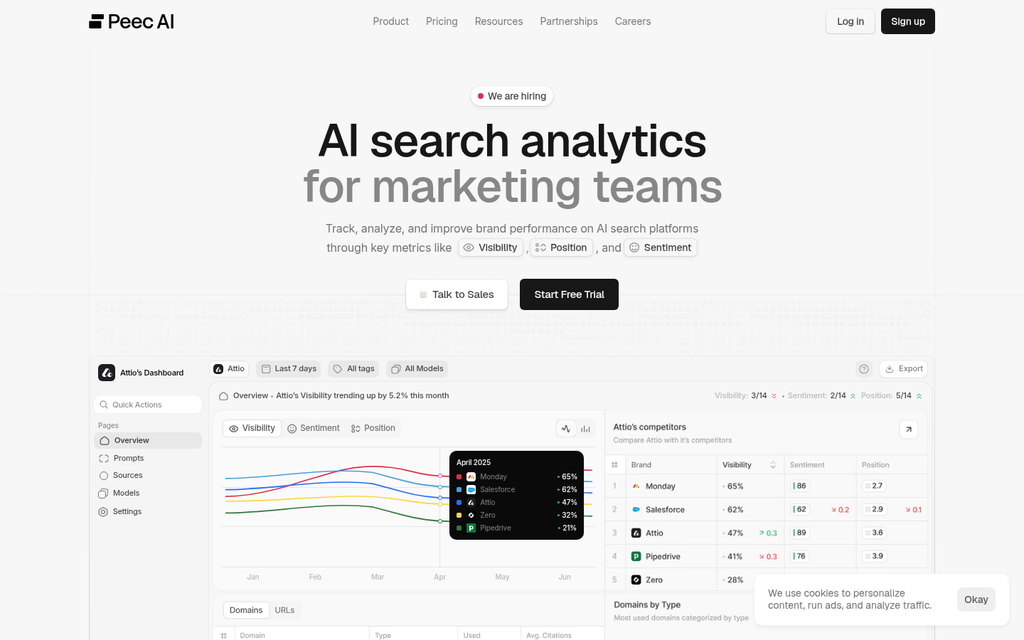
Peec AI watches visibility, sentiment, and sources, and tests engine claims against your facts.
Best for: brand teams testing a short fact sheet.
Standout feature: Peec AI’s Brand Perception, on every plan, checks answers against your stated facts, and attribute scoring shows the gap between what engines say you’re known for and your market position.
Peec AI vs Profound: Peec AI fact-checks from Starter. Profound’s FactCheck goes further, tracing each wrong claim to its URL and launching a fix agent, and Enterprise spans up to 9 engines. A stable fact list suits Peec AI; source tracing suits Profound.
Pros:
- Sorts cited sources into competitor, editorial, reference, and UGC
- Reads sentiment in AI answers
- Includes unlimited users
Cons:
- Starter checks 5 prompts against 5 facts
- Three chosen models below Enterprise
Pricing: Starter $95/mo; Enterprise custom.
What I’d tell the CMO: In Peec AI, load the five facts that cost you shortlists first, and give each one an owner. Nine markets put you on Enterprise.
5. Goodie
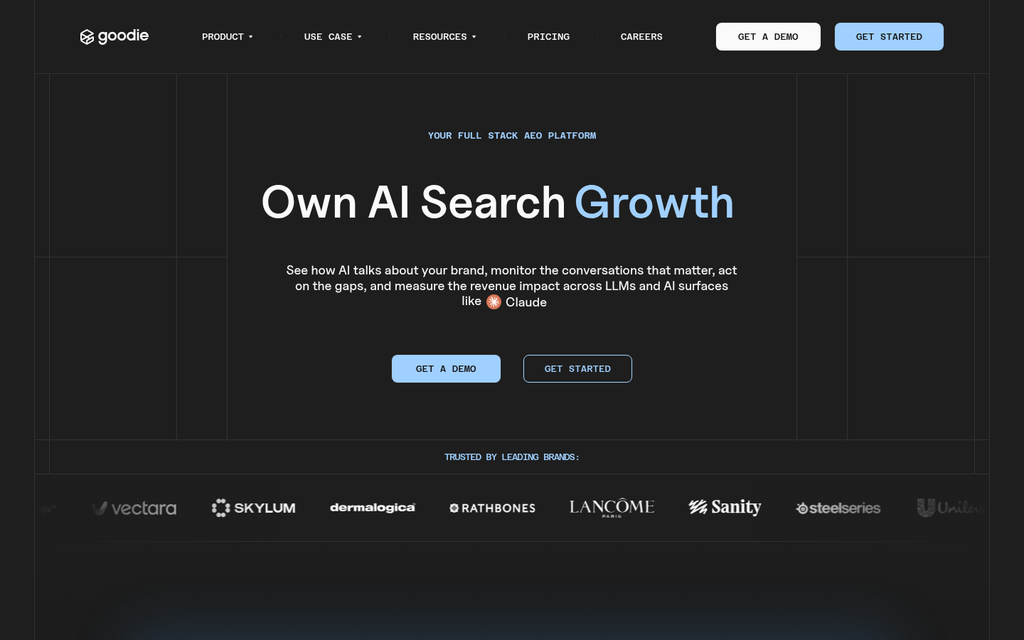
Goodie pairs AI visibility tracking with content and outreach agents.
Best for: enterprise brand teams wanting audit and fix under one contract.
Standout feature: Goodie’s Brand Command (Enterprise) audits every claim against the pillars and facts you define, then reports inaccuracy rate and adverse citation share. Optimization Actions names the publications and journalists to target for earned coverage.
Goodie vs Profound: In a Profound vs Goodie AI decision, Goodie publishes a Core plan with sentiment and citation analysis. Profound includes FactCheck on Enterprise at no extra cost and Agent Analytics on its free trial; Goodie’s equivalents are Enterprise-only. Goodie’s case rests on its agents, not its reading.
Pros:
- Tracks sentiment in AI answers on every plan
- Covers two countries from Core
- Bundles content and outreach agents
Cons:
- Claim audit and API require Enterprise
- Core’s five models leave out Gemini
Pricing: Core $295/mo; Enterprise on demo.
What I’d tell the CMO: Choose Goodie when whoever finds a misconception must fix it; plan for Enterprise from day one.
6. AthenaHQ
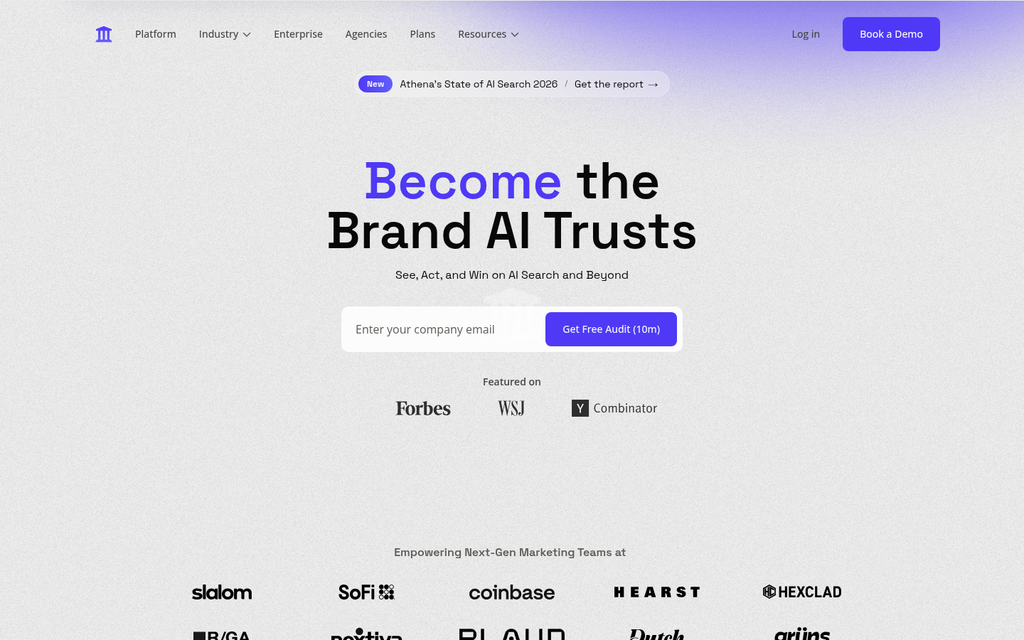
AthenaHQ reads AI brand mentions, sentiment, and citations across a wide model list, with claim review on Enterprise.
Best for: brand teams prioritizing engine breadth before claim governance.
Standout feature: AthenaHQ Enterprise adds “Knowledge Base and claim review” and Oracle discrepancy detection, flagging where answers diverge from your knowledge base. Starter already maps sentiment and citations across 11 models.
AthenaHQ vs Profound: AthenaHQ publishes a self-serve plan with 11 models and sentiment. Profound’s FactCheck goes deeper: each wrong claim leads to the page behind it, and an agent can be launched to correct it. Coverage is AthenaHQ’s argument; source-level correction is Profound’s.
Pros:
- Covers Claude, DeepSeek, and Mistral from Starter
- Offers a free 300-credit tier
- Includes unlimited members
Cons:
- Multi-country tracking is Enterprise-only
- One credit per AI response needs sizing
Pricing: Essential free; Starter $295/month.
What I’d tell the CMO: AthenaHQ shows how far a description has spread; accuracy is an Enterprise question, so scope both tiers together.
Tier 3: Which Alternative Measures Perception Across a Whole Category?
Tier 3 asks a different question: how AI models perceive your company across its category on the attributes buyers weigh, measured by sampling the same prompt repeatedly, not what ChatGPT said this morning. Among Profound alternatives, this is the board-level read.
7. Evertune
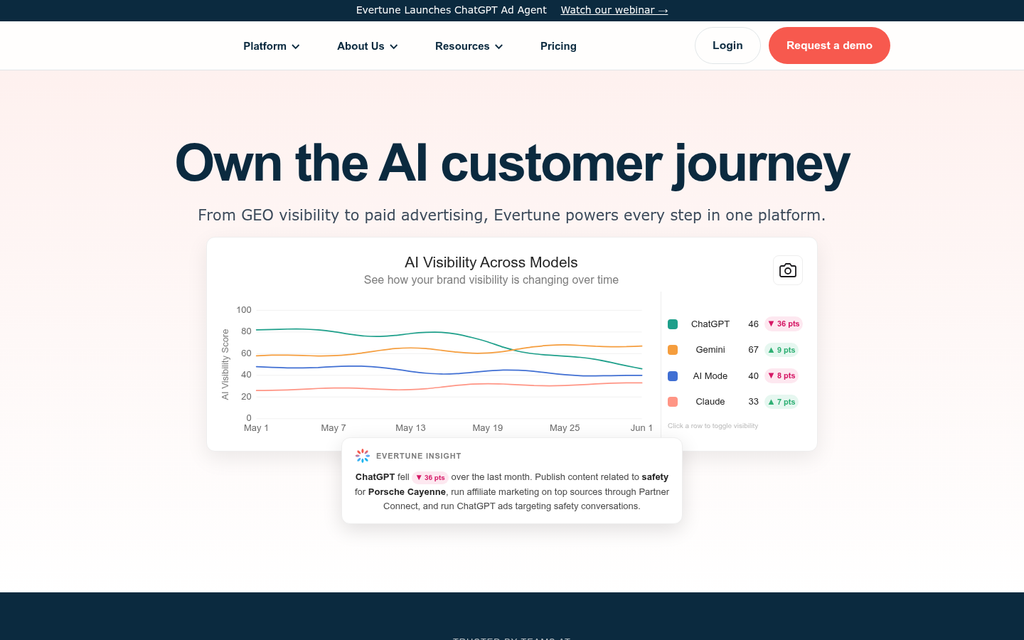
Evertune is a perception-research platform scoring how AI models position your brand against competitors.
Best for: enterprise brand leaders who owe the board a perception read.
Standout feature: Evertune runs every prompt up to 100 times on each model to build its AI Brand Score. Performance by Attribute benchmarks you on purchase dimensions such as reliability or design.
Evertune vs Profound: Evertune Pro covers 100,000 prompts across 11 AI models, with language and country tracking. Profound offers a free self-serve trial and FactCheck, which Evertune’s pages don’t name. Evertune reads category perception; Profound checks claim accuracy.
Pros:
- Separates recurring characterizations from one-off answers
- Benchmarks attributes against rivals
Cons:
- Demo-only entry, no trial stated
- AI bot analytics and SSO wait for Enterprise
Pricing: $800/month for Pro, after a demo; Enterprise custom.
What I’d tell the CMO: Bring Evertune in when the board asks how the category sees you, then route attribute gaps to product marketing and PR.
Which Profound Alternative Fits Which Brand Job?
Choose among Profound alternatives by the part of the brand job you need covered: answers, facts, or perception. A Gartner survey of 426 senior marketing leaders found 43% want a clear, simple story about brand health and business performance, and AI descriptions now belong in that story.
- If you read wording and sources across markets: SE Visible, with its brand visibility dashboard feeding the brand-health read.
- If you check answers against your brand facts: Peec AI.
- If you need claim governance at enterprise scale: Goodie or AthenaHQ Enterprise.
- If the board asks about category perception: Evertune.
Whichever you pick, log each misconception: owner, cause, fix, recheck. Then correct it at the source.
When Does Staying With Profound Make Sense?
Stay with Profound when its Enterprise layer already does your brand work. FactCheck tests each claim against a knowledge base you own and traces inaccurate ones to the exact URL behind them. Enterprise tracks up to nine engines, Claude, Copilot, DeepSeek, and Exa Search among them, while Agent Analytics reads AI crawler and referral traffic through integrations like Cloudflare.
If your team uses ChatGPT Shopping and the AI Marketer agents, switching to Profound alternatives costs more than it returns.
FAQ: Profound Alternatives for Brand Teams
What are the main competitors of Profound?
Brand teams usually weigh three groups of Profound competitors. SE Visible, Scrunch AI, and Rankscale show each answer with its sources. Peec AI, Goodie, and AthenaHQ check answers against facts you set (Goodie and AthenaHQ on Enterprise). Evertune measures category perception across AI models.
What is AI brand monitoring?
AI brand monitoring records what ChatGPT, Gemini, and Google’s AI features say about your company: its characterization, sentiment, cited sources, and share of voice. Social listening reads posts people wrote; AI visibility tools read generated answers. Trust in AI chatbot answers is 20% globally, yet buyers still read them.
How can you see how ChatGPT and Gemini describe your brand?
Run a fixed set of category and brand prompts in each market, keep every dated response, and read the wording, sentiment, and cited source together. SE Visible keeps each unedited answer alongside its engine, market, and date, so ChatGPT brand mentions stay auditable for your misconception log.

I’m Rajesh Kumar, a DevOps, SRE, DevSecOps, Cloud, and Platform Engineering expert passionate about sharing practical knowledge, real-world experiences, and industry best practices. I have worked at Cotocus and regularly write about technology, travel, investing, health, product reviews, and digital marketing through my various platforms.
I publish technical articles at DevOps School, travel stories at Holiday Landmark, stock market insights at Stocks Mantra, health and fitness guidance at My Medic Plus, product reviews at TrueReviewNow, and SEO and digital marketing strategies at Wizbrand.
Find Trusted Cardiac Hospitals
Compare heart hospitals by city and services — all in one place.
Explore Hospitals