Originally published on 2014-09-24; fully revised and updated.
Gradle is a build automation system that helps engineering teams standardize how software is built, tested, packaged, and released. If you work in DevOps, CI/CD, or platform engineering, this guide gives you a practical overview of Gradle’s model, where it fits versus Maven and Ant, and how to run a minimal project with repeatable commands.

What Gradle is and why teams use it
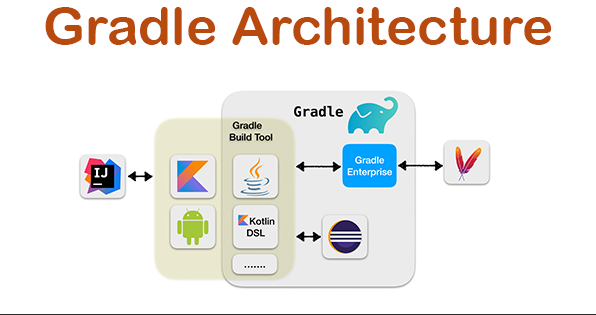
Gradle combines a task-based build model with dependency management and convention-driven defaults. Build logic is typically defined using a Groovy DSL or Kotlin DSL, which makes it easier to describe both simple and complex delivery pipelines.
- Automates compile, test, package, publish, and deployment-related steps.
- Supports multi-project builds for monorepos and modular systems.
- Integrates dependency resolution from repositories such as Maven Central.
- Works well in CI/CD through deterministic command-line execution.
How a Gradle build works
A typical Gradle run evaluates build scripts, creates a task graph based on requested goals, executes tasks in order, and produces artifacts for publication or deployment.
flowchart TD
    A[Developer updates source] --> B[Gradle evaluates build scripts]
    B --> C[Task graph is created]
    C --> D[Compile and test tasks run]
    D --> E{Build successful}
    E -- No --> F[Fix code or build logic]
    F --> B
    E -- Yes --> G[Package artifact]
    G --> H[Publish or deploy]
Gradle vs Maven vs Ant
All three tools are used in Java ecosystems, but they differ in flexibility, conventions, and how build logic is expressed.
| Tool | Build definition style | Dependency management | Flexibility | Typical fit |
|---|---|---|---|---|
| Gradle | DSL-based scripts with task graph | Built-in, repository-driven | High | Teams needing both convention and customization |
| Maven | XML (POM) with strong conventions | Built-in, repository-driven | Medium | Standardized enterprise Java builds |
| Ant | XML task scripting | Not native by default | High (manual) | Legacy or highly custom scripted builds |
Minimal Gradle project example
The example below shows a minimal Java build with dependencies and common CI-friendly commands.
Example build files
plugins {
    id 'java'
}

group = 'com.example'
version = '1.0.0'

repositories {
    mavenCentral()
}

dependencies {
    testImplementation 'junit:junit:4.13.2'
}Code language: JavaScript (javascript)
rootProject.name = 'demo-gradle'Code language: JavaScript (javascript)Common commands
# Initialize a new Gradle project (interactive)
gradle init

# List available tasks
./gradlew tasks

# Clean, compile, test, and package
./gradlew clean build

# Run tests only
./gradlew testCode language: PHP (php)
Historical roadmap notes from the original 2014 post
The original article listed the following as upcoming Gradle roadmap themes at that time:
- Configuration Tasks
- Persistable Build Configuration
- Variant Aware Dependency Management
- Parallel Task Execution
- Watcher Mode for Daemon
- Global Cache
Because this list is historical, verify current feature names and status in official Gradle release notes and documentation before using it for planning.
References and source links
- http://www.gradle.org/
- http://en.wikipedia.org/wiki/Gradle
- http://spring.io/guides/gs/gradle/
- http://developer.android.com/sdk/installing/studio-build.html
- YouTube API key setup troubleshooting video referenced in the original post
Best practices for DevOps teams using Gradle
- Use the Gradle Wrapper (
./gradlew) in CI so all environments use the same Gradle distribution. - Keep build logic modular and avoid large monolithic build scripts.
- Cache dependencies and build outputs in CI where appropriate to reduce pipeline time.
- Separate unit tests, integration tests, and packaging steps into clear tasks.
- Pin dependency versions and regularly review updates for security and compatibility.

I’m Rajesh Kumar, a DevOps, SRE, DevSecOps, Cloud, and Platform Engineering expert passionate about sharing practical knowledge, real-world experiences, and industry best practices. I have worked at Cotocus and regularly write about technology, travel, investing, health, product reviews, and digital marketing through my various platforms.
I publish technical articles at DevOps School, travel stories at Holiday Landmark, stock market insights at Stocks Mantra, health and fitness guidance at My Medic Plus, product reviews at TrueReviewNow, and SEO and digital marketing strategies at Wizbrand.
Find Trusted Cardiac Hospitals
Compare heart hospitals by city and services — all in one place.
Explore Hospitals