Managing stateful and stateless applications in a distributed environment like Kubernetes requires different approaches due to the nature of data persistence and scalability. Let’s explore how to manage both types of applications effectively:
Kubernetes is a container orchestration system that can be used to manage both stateful and stateless applications.
Stateful applications are applications that maintain state between requests. This means that the application’s data is stored in a persistent way, such as a database. When a stateful application is scaled out, the state of the application must be preserved across the different pods.
Stateless applications are applications that do not maintain state between requests. This means that the application’s data is not stored in a persistent way. When a stateless application is scaled out, the application pods can be replaced without affecting the application’s state.
Here are some of the ways to manage stateful and stateless applications in Kubernetes:
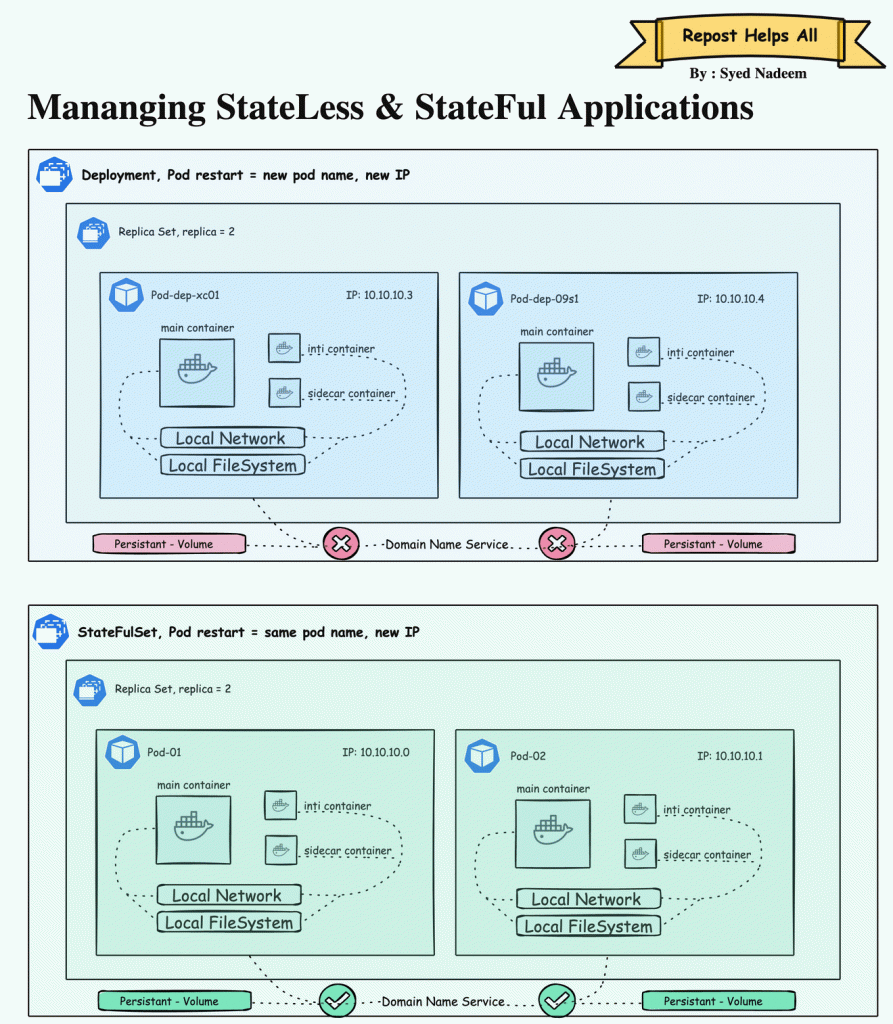
- Stateful applications: Stateful applications can be managed using Kubernetes StatefulSets. StatefulSets ensure that the state of the application is preserved across the different pods.
- Stateless applications: Stateless applications can be managed using Kubernetes Deployments. Deployments are a more lightweight way to manage stateless applications.
Managing Stateful Applications:
Stateful applications maintain data and have specific data storage requirements. Examples include databases, caching systems, and file storage. Managing stateful applications in Kubernetes involves:
- Persistent Volumes (PVs) and Persistent Volume Claims (PVCs): Use PVs and PVCs to provide persistent storage to stateful pods. PVCs can be dynamically bound to PVs, ensuring data persistence even if pods are rescheduled.
- StatefulSets: Use StatefulSets to deploy stateful applications. StatefulSets ensure stable network identities and ordered pod deployment/termination, which is crucial for maintaining data integrity.
- Headless Services: For stateful applications, use headless services to create stable network identities for each pod. This is essential for applications that require unique network identifiers.
- Data Replication and Backups: Implement data replication and regular backups to prevent data loss. Utilize Kubernetes-native solutions or external tools depending on your application’s requirements.
- Scaling: Scaling stateful applications can be more complex due to data synchronization. Consider vertical scaling (resizing pods) or sharding data across multiple instances to achieve better performance.
Managing Stateless Applications:
Stateless applications do not store persistent data, making them easier to scale and manage. Examples include web servers, load balancers, and microservices. Managing stateless applications in Kubernetes involves:
- Deployments: Use Deployments to manage stateless applications. Deployments ensure that the desired number of replicas are maintained, and they automatically replace failed pods.
- Horizontal Scaling: Stateless applications are highly suitable for horizontal scaling. You can increase the number of replicas to handle increased traffic and distribute the load.
- Health Checks: Implement readiness and liveness probes to monitor the health of stateless pods. Kubernetes can automatically restart pods that fail health checks.
- Rolling Updates: Deployments support rolling updates, allowing you to update application versions without downtime. Pods are gradually replaced with new versions.
- Load Balancing: Use Kubernetes services, particularly ClusterIP and NodePort, to distribute traffic among the pods of a stateless service.
- Auto-scaling: Kubernetes offers Horizontal Pod Autoscaling (HPA) to automatically adjust the number of replicas based on CPU or custom metrics, ensuring optimal resource utilization.
- Caching and Content Delivery Networks (CDNs): Stateless applications can benefit from caching mechanisms and CDNs to optimize response times and reduce the load on the application.
Here are some of the considerations when choosing between stateful and stateless applications:
- The type of application: Some applications are inherently stateful, such as databases. Other applications can be either stateful or stateless, depending on the requirements.
- The amount of data: Stateful applications require more data storage than stateless applications.
- The need for scalability: Stateful applications can be more difficult to scale than stateless applications.
- The budget: Stateful applications can be more expensive to deploy and maintain than stateless applications.
The best way to manage stateful and stateless applications in Kubernetes depends on the specific application and its requirements.
Here are some additional details about managing stateful and stateless applications in Kubernetes:
- Stateful applications: StatefulSets are a more complex way to manage stateful applications than Deployments. However, StatefulSets offer more features and guarantees, such as:
- Guaranteed pod identity: Each pod in a StatefulSet has a unique name and persistent volume. This ensures that the state of the application is preserved even if a pod is replaced.
- Ordered pod restart: When a StatefulSet pod is restarted, it is restarted in the same order as the other pods in the StatefulSet. This ensures that the state of the application is preserved.
- Headless service: A headless service is created for each StatefulSet. This allows the application to discover the other pods in the StatefulSet without having to know their names.
- Stateless applications: Deployments are a more lightweight way to manage stateless applications than StatefulSets. Deployments do not offer the same guarantees as StatefulSets, but they are easier to use and manage.
Here are some examples of stateful and stateless applications:
- Stateful applications:
- Databases
- Message queues
- File servers
- Stateless applications:
- Web servers
- Load balancers
- Cache servers

I’m Rajesh Kumar, a DevOps, SRE, DevSecOps, Cloud, and Platform Engineering expert passionate about sharing practical knowledge, real-world experiences, and industry best practices. I have worked at Cotocus and regularly write about technology, travel, investing, health, product reviews, and digital marketing through my various platforms.
I publish technical articles at DevOps School, travel stories at Holiday Landmark, stock market insights at Stocks Mantra, health and fitness guidance at My Medic Plus, product reviews at TrueReviewNow, and SEO and digital marketing strategies at Wizbrand.
Find Trusted Cardiac Hospitals
Compare heart hospitals by city and services — all in one place.
Explore Hospitals