
Introduction
Customer Identity and Access Management (CIAM) is a specialized category of identity solutions designed to manage customer and consumer identities across digital platforms such as websites, mobile apps, SaaS products, and online services. Unlike traditional IAM systems that focus on employees and internal users, CIAM is built for scale, performance, user experience, and privacy—often handling millions of users while ensuring seamless login journeys.
CIAM plays a critical role in modern digital businesses. It enables secure authentication, personalized customer experiences, consent management, and compliance with global privacy regulations. From social logins and passwordless authentication to progressive profiling and fraud prevention, CIAM systems sit at the heart of customer-facing digital ecosystems.
Real-world use cases include:
- E-commerce platforms managing millions of customer logins
- Banking and fintech apps requiring strong security and regulatory compliance
- Media and streaming platforms delivering personalized experiences
- SaaS products offering customer portals and self-service dashboards
When evaluating CIAM tools, organizations should look beyond basic login functionality. Key evaluation criteria include scalability, user experience, security, compliance, integration flexibility, customization, and total cost of ownership.
Best for:
CIAM tools are ideal for digital-first businesses, product-led companies, e-commerce brands, fintech platforms, SaaS providers, healthcare portals, and enterprises managing large external user bases. Roles that benefit most include CTOs, security architects, product managers, compliance teams, and digital transformation leaders.
Not ideal for:
CIAM solutions may be overkill for small internal-only teams, simple brochure websites, or organizations that only require employee IAM. In such cases, lightweight authentication systems or basic IAM tools may be more cost-effective.
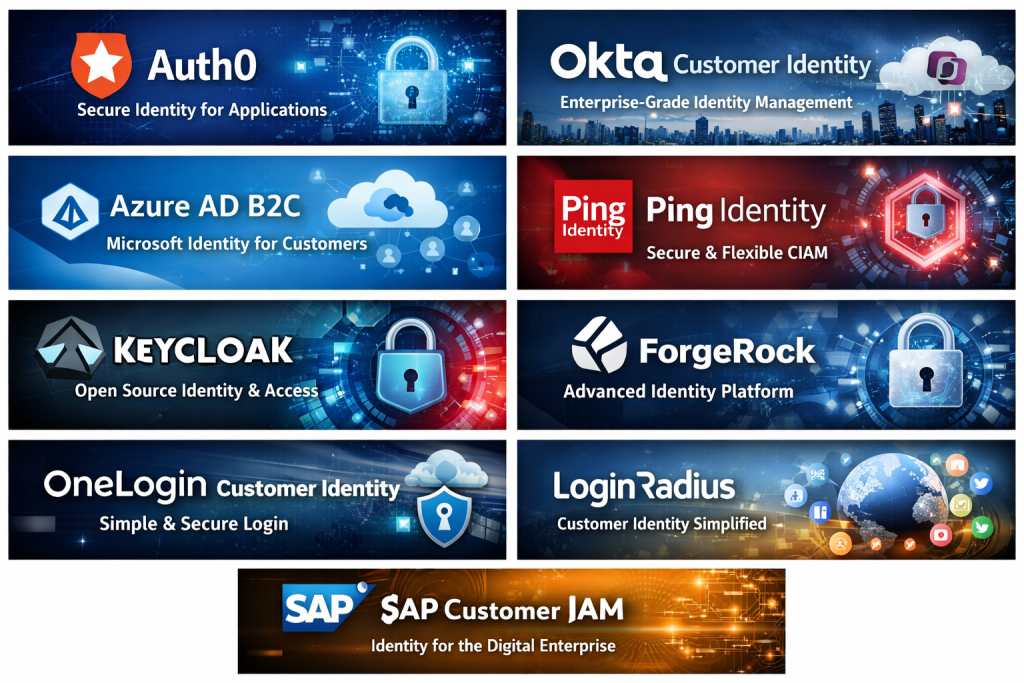
Top 10 Customer IAM (CIAM) Tools
1 — Auth0
Short description:
A cloud-native CIAM platform designed for developers and enterprises that need secure, scalable, and customizable customer authentication experiences.
Key features:
- Universal login with deep UI customization
- Social, passwordless, and multi-factor authentication
- Extensive APIs and SDKs for web and mobile apps
- Adaptive risk-based authentication
- User lifecycle and profile management
- Rules and actions for custom logic
Pros:
- Excellent developer experience
- Highly scalable and flexible
Cons:
- Pricing increases quickly at scale
- Advanced features require expertise
Security & compliance:
SSO, MFA, encryption at rest and in transit, GDPR, SOC 2, ISO standards
Support & community:
Strong documentation, active developer community, enterprise support available
2 — Okta Customer Identity
Short description:
An enterprise-grade CIAM solution focused on reliability, security, and seamless customer login journeys.
Key features:
- Centralized customer identity management
- Social login and federation
- Advanced MFA and adaptive access policies
- API access management
- Progressive profiling
- High availability infrastructure
Pros:
- Mature enterprise security controls
- Excellent uptime and reliability
Cons:
- Higher cost for small businesses
- UI customization can be complex
Security & compliance:
SSO, MFA, GDPR, SOC 2, ISO, HIPAA-ready
Support & community:
Professional onboarding, enterprise-grade support, strong partner ecosystem
3 — Amazon Cognito
Short description:
A CIAM service from AWS designed for cloud-native applications that require deep integration with AWS services.
Key features:
- User pools and identity federation
- Social and enterprise identity support
- Built-in MFA
- Token-based authentication
- Seamless AWS integration
- Auto-scaling for high traffic
Pros:
- Cost-effective at scale
- Native AWS ecosystem integration
Cons:
- Limited UI customization
- Steep learning curve for non-AWS teams
Security & compliance:
Encryption, IAM policies, GDPR, ISO, SOC compliance via AWS
Support & community:
Extensive AWS documentation, large community, paid enterprise support
4 — Azure AD B2C (Microsoft Entra External ID)
Short description:
Microsoft’s CIAM solution for managing consumer identities across web and mobile applications.
Key features:
- Customizable user journeys
- Social and local account support
- Conditional access policies
- Integration with Microsoft ecosystem
- Scalable cloud infrastructure
- Identity protection features
Pros:
- Strong enterprise and compliance capabilities
- Seamless Microsoft integration
Cons:
- Complex configuration
- UI customization requires expertise
Security & compliance:
SSO, MFA, GDPR, ISO, SOC, HIPAA-ready
Support & community:
Comprehensive documentation, enterprise Microsoft support
5 — Ping Identity (PingOne for Customers)
Short description:
A flexible CIAM platform focused on security, federation, and complex enterprise use cases.
Key features:
- Single sign-on and federation
- Adaptive authentication
- User directory services
- API security
- Cloud and hybrid deployment
- Identity orchestration
Pros:
- Strong security-first design
- Suitable for complex architectures
Cons:
- Higher implementation effort
- Premium pricing
Security & compliance:
SSO, MFA, GDPR, SOC 2, ISO standards
Support & community:
Enterprise-grade support, professional services available
6 — ForgeRock
Short description:
A comprehensive identity platform offering advanced CIAM capabilities for large enterprises and regulated industries.
Key features:
- Customer identity lifecycle management
- Advanced access management
- Identity orchestration workflows
- Fraud and risk analytics
- Omnichannel identity support
- Cloud and on-prem deployment
Pros:
- Extremely powerful and flexible
- Ideal for regulated environments
Cons:
- Complex to deploy and manage
- Requires skilled identity teams
Security & compliance:
SSO, MFA, GDPR, ISO, SOC, financial-grade security
Support & community:
Strong enterprise support, professional services-focused
7 — Keycloak
Short description:
An open-source CIAM and IAM platform suited for organizations wanting full control and customization.
Key features:
- Open-source and self-hosted
- SSO and identity federation
- Social login and MFA
- Custom themes and flows
- REST APIs
- Multi-tenant support
Pros:
- No licensing cost
- Highly customizable
Cons:
- Requires infrastructure and maintenance
- Limited commercial support
Security & compliance:
SSO, encryption, GDPR-ready, compliance depends on deployment
Support & community:
Active open-source community, documentation-driven support
8 — OneLogin Customer Identity
Short description:
A streamlined CIAM solution designed for businesses seeking fast deployment and ease of use.
Key features:
- Unified identity platform
- Social and passwordless login
- MFA and adaptive authentication
- API access management
- User provisioning
- Cloud-native design
Pros:
- Quick setup
- Clean administrative interface
Cons:
- Less customization than competitors
- Smaller ecosystem
Security & compliance:
SSO, MFA, GDPR, SOC 2, ISO standards
Support & community:
Good documentation, responsive customer support
9 — LoginRadius
Short description:
A CIAM platform focused on customer registration, social login, and consent management.
Key features:
- Social login and SSO
- Customer registration workflows
- Consent and preference management
- Identity analytics
- REST APIs
- Marketing integration support
Pros:
- Strong marketing and consent features
- User-friendly dashboards
Cons:
- Limited advanced IAM features
- Less suitable for highly regulated sectors
Security & compliance:
SSO, GDPR, SOC 2, ISO compliance
Support & community:
Helpful documentation, commercial support available
10 — SAP Customer Identity and Access Management
Short description:
An enterprise CIAM solution integrated deeply into SAP’s digital and commerce ecosystem.
Key features:
- Customer profile and consent management
- Social login and authentication
- Integration with SAP CX products
- Identity analytics
- Scalable cloud infrastructure
- Data privacy controls
Pros:
- Strong compliance and governance
- Ideal for SAP-centric organizations
Cons:
- Best value only within SAP ecosystem
- Complex licensing
Security & compliance:
GDPR, ISO, SOC, enterprise-grade security controls
Support & community:
Enterprise SAP support, extensive documentation
Comparison Table
| Tool Name | Best For | Platform(s) Supported | Standout Feature | Rating |
|---|---|---|---|---|
| Auth0 | Developers & SaaS | Cloud | Developer flexibility | N/A |
| Okta CIAM | Enterprises | Cloud | Reliability & security | N/A |
| Amazon Cognito | AWS-native apps | Cloud | AWS integration | N/A |
| Azure AD B2C | Microsoft ecosystem | Cloud | Custom user journeys | N/A |
| Ping Identity | Complex enterprises | Cloud/Hybrid | Identity federation | N/A |
| ForgeRock | Regulated industries | Cloud/On-prem | Identity orchestration | N/A |
| Keycloak | Open-source users | Self-hosted | Full customization | N/A |
| OneLogin | SMBs & mid-market | Cloud | Ease of use | N/A |
| LoginRadius | Marketing-driven teams | Cloud | Consent management | N/A |
| SAP CIAM | SAP customers | Cloud | SAP integration | N/A |
Evaluation & Scoring of Customer IAM (CIAM)
| Criteria | Weight | Description |
|---|---|---|
| Core features | 25% | Authentication, user management, identity flows |
| Ease of use | 15% | Admin UI, developer experience |
| Integrations & ecosystem | 15% | APIs, SDKs, third-party tools |
| Security & compliance | 10% | MFA, encryption, certifications |
| Performance & reliability | 10% | Scalability, uptime |
| Support & community | 10% | Documentation, help, ecosystem |
| Price / value | 15% | Cost vs features |
Which Customer IAM (CIAM) Tool Is Right for You?
- Solo users or startups: Keycloak, Amazon Cognito
- SMBs: OneLogin, LoginRadius
- Mid-market: Auth0, Azure AD B2C
- Enterprises: Okta, Ping Identity, ForgeRock, SAP CIAM
Budget-conscious teams should prioritize open-source or usage-based pricing.
Premium solutions offer stronger compliance, SLAs, and advanced security.
Choose feature depth if you need orchestration and fraud controls, or ease of use for faster time-to-market.
Scalability and compliance are critical for regulated industries.
Frequently Asked Questions (FAQs)
1. What is CIAM used for?
CIAM manages customer identities, authentication, consent, and access across digital platforms.
2. How is CIAM different from IAM?
IAM focuses on employees; CIAM is optimized for customers, scale, and user experience.
3. Is CIAM required for compliance?
Yes, many CIAM tools help meet GDPR and privacy requirements.
4. Can CIAM handle millions of users?
Most modern CIAM platforms are built for massive scale.
5. Is passwordless authentication supported?
Yes, many tools support OTP, magic links, and biometrics.
6. Are CIAM tools secure?
Leading CIAM solutions implement encryption, MFA, and auditing.
7. Is open-source CIAM safe?
Yes, if properly configured and maintained.
8. How long does CIAM implementation take?
From days for basic setups to months for enterprise deployments.
9. Can CIAM integrate with marketing tools?
Some CIAM platforms offer strong marketing and analytics integration.
10. What are common CIAM mistakes?
Ignoring user experience, underestimating scale, and poor consent management.
Conclusion
Customer IAM is no longer optional for digital businesses—it is a foundational layer for security, trust, and customer experience. The right CIAM solution enables frictionless access while protecting user data and meeting regulatory demands.
There is no single “best” CIAM tool. The ideal choice depends on organization size, technical maturity, compliance needs, budget, and ecosystem alignment. By focusing on core features, scalability, usability, and long-term value, organizations can confidently select a CIAM platform that supports both growth and trust.

Find Trusted Cardiac Hospitals
Compare heart hospitals by city and services — all in one place.
Explore Hospitals
A good CIAM platform must balance strong security with a smooth customer experience. Features like adaptive authentication, secure session handling, and simple account recovery can reduce fraud without frustrating users. Identity data protection should remain a core priority at every stage.
Customer IAM platforms manage identity at scale for consumer apps, and this comparison is spot on. I appreciate the focus on registration, authentication, and consent. Digital product teams will find this useful.
Customer Identity and Access Management tools help businesses provide secure and seamless access to their digital services. When comparing CIAM platforms, I think user-friendly authentication, scalability, privacy controls, and integration capabilities are important factors to consider. Features such as social login and adaptive authentication can also improve the customer experience without compromising security. Choosing the right solution helps organizations protect customer identities while making account access easier and more reliable.
Balancing seamless digital user experiences with airtight identity security is one of the toughest challenges when implementing customer IAM solutions. While heavy enterprise platforms offer extensive directory scalability and robust compliance frameworks, they often introduce complex integration hurdles and friction into the sign-up journey. Organizations focused on rapid consumer growth frequently achieve better engagement by prioritizing developer-friendly APIs, social login flexibility, and low-latency authentication flows. This comparison offers a practical framework for weighing security depth against user conversion priorities.
CIAM platforms should make customer login simple while keeping personal data safe. I would compare how well each tool handles registration, login, password recovery, and multi-factor authentication. It is also important to check how easily users can manage their profiles and privacy settings. Smooth integration with apps and websites, along with strong access controls, can help build a safer customer experience.
When evaluating customer identity and access management platforms, I would consider how well they support customers who use multiple login methods across different devices. Someone might initially register with an email address, later connect a social login, and eventually switch to a passkey. The platform should help maintain one consistent customer identity without accidentally creating duplicate accounts or losing purchase history and saved preferences. Account linking should also include proper verification to prevent someone from attaching another person’s login method. These capabilities are important for businesses that want to offer flexible sign-in options while keeping customer accounts consistent and secure.
Customer Identity and Access Management (CIAM) platforms help businesses manage customer registration, authentication, profile information, and access to digital services securely. Features such as single sign-on, multi-factor authentication, social login, consent management, and adaptive authentication can strengthen security while reducing friction during customer interactions. When comparing solutions, important factors include scalability, API integration, identity verification capabilities, privacy compliance, customization, and ease of implementation. Choosing the right CIAM platform can improve customer experience, reduce account-related security risks, and help organizations build lasting trust while managing growing digital user bases.
Customer identity systems need to handle sudden traffic spikes just as smoothly as they manage everyday sign-ins. For businesses with growing user bases, I’d look closely at how a CIAM platform manages consent, detects unusual login activity, and supports passwordless authentication. It’s equally important to make account recovery straightforward without creating opportunities for attackers. Getting these details right can help businesses build customer trust while keeping the sign-in experience simple.
One thing worth considering when choosing a CIAM platform is how well it handles account recovery and suspicious login attempts without making things frustrating for genuine customers. A smooth sign-up process is important, but security and privacy need equal attention. I’d also recommend testing the login experience on mobile devices and checking how easily consent preferences can be managed. These practical details can make a real difference as the customer base grows.
CIAM platforms should be evaluated for how they handle customer consent when privacy settings or data policies change. A customer may withdraw permission for one purpose while still expecting essential account functions to work normally. Teams need a reliable way to propagate consent updates across analytics tools, marketing systems, and connected services. Delayed updates can leave personal data in systems that should no longer use it. Testing these flows across integrations can expose gaps that a basic login test will miss. Clear audit records also help teams explain when consent changed and which systems received the update.
Customer Identity and Access Management platforms help businesses deliver secure, convenient digital experiences without adding unnecessary friction to registration and login processes. Features such as adaptive authentication, single sign-on, and consent management can strengthen protection while giving customers greater control over their personal information. Balancing strong security with a smooth user journey is essential for building trust, reducing account abuse, and improving customer retention.
Customer Identity and Access Management platforms help businesses manage registration, login, profiles, and access for their customers. The challenge is protecting accounts without adding unnecessary steps to every interaction. Teams should compare authentication options, account recovery, consent controls, scalability, and integration with existing applications. Privacy and secure handling of customer data also deserve careful attention. It is useful to test the complete journey, from registration through password recovery, rather than evaluating login alone. A good CIAM solution should make access convenient for legitimate users while helping businesses detect and manage suspicious activity.
Customer identity migration deserves careful planning because account records often contain years of login history, linked profiles, and customer preferences. Moving to another CIAM provider can become difficult when password hashes use incompatible formats or social login accounts depend on provider-specific identifiers. Before committing to a platform, teams should test identity export options, account-linking behavior, token compatibility, and recovery procedures for customers who cannot authenticate after migration. A phased rollout with a small user segment can reveal problems before they affect the entire customer base. It is also important to define a rollback plan that preserves account integrity and avoids duplicate customer profiles. Planning for portability early can reduce vendor lock-in and make future platform changes much less disruptive.
One difficult part of adopting a CIAM platform is moving existing customer identities without creating account access problems. Legacy systems may contain duplicate profiles, outdated email addresses, or accounts linked to different social login providers. Before migration, teams should define identity-matching rules, test account linking, and plan how users will recover access if their credentials cannot be transferred directly. A phased rollout with migration metrics can help detect login failures before they affect the entire customer base. It is also important to preserve consent records and authentication history where required. Testing these scenarios early can prevent account lockouts, reduce support requests, and make the transition safer for both customers and engineering teams.
Centralizing customer identity lifecycle management delivers friction-free social logins, progressive profiling, and adaptive authentication, safeguarding millions of user sessions across distributed web and mobile applications while enforcing strict regulatory data privacy standards globally.
Customer IAM platforms need to balance strong security with a smooth sign-up and login experience. Features like adaptive authentication, secure account recovery, consent management, and single sign-on can protect customer data while reducing unnecessary friction. Monitoring login failures and account takeover attempts also helps teams improve security without creating barriers for legitimate users.
Customer Identity and Access Management (CIAM) solutions help businesses manage customer logins, profile data, and access to digital services. When comparing platforms, I would focus on authentication options, user experience, privacy controls, and scalability. These features can improve account security while making registration and sign-in easier for customers. The right CIAM solution should balance strong protection with a smooth, convenient digital experience.
Balancing stringent security requirements with a frictionless onboarding experience is often the toughest challenge when implementing CIAM at scale. While developer-first solutions speed up initial deployment, managing consent workflows and regulatory compliance smoothly as user bases grow requires careful upfront architectural planning.
A contract repository becomes far more valuable when teams can quickly identify renewal dates, obligations, and critical clauses without manually reviewing every document. Consistent metadata, reliable search, and role-based access can improve visibility while reducing missed deadlines and compliance risks. Regularly checking extracted contract details against the original agreements also helps maintain accuracy.
Balancing frictionless user experience with rigorous compliance is always the hardest trade-off when selecting a CIAM tool, especially as modern consumer expectations shift toward passwordless auth. It’s also worth noting how crucial API security and progressive profiling become as platforms scale beyond millions of users.
Customer IAM platforms need to make account access secure without adding unnecessary friction to registration and sign-in. It is worth comparing how each solution handles account recovery, consent preferences, and identity data when customers use multiple devices or return after a long period away. Smooth recovery flows and clear session controls can reduce abandoned logins while helping businesses protect customer accounts and personal information.
Customer identity and access management plays a key role in making digital services both secure and easy to use. Features like social login, passwordless authentication, consent management, and multi-factor authentication can help businesses protect customer accounts without adding unnecessary friction. One provider worth checking out is Auth0, which offers customer identity solutions with flexible login options, identity integrations, and security features for web and mobile applications.
This article provides a clear and informative overview of Customer Identity and Access Management (CIAM) solutions, helping readers understand how these platforms secure customer identities while enhancing user experience. By outlining key features such as scalable authentication, single sign-on (SSO), user profile management, and privacy compliance, the post offers practical criteria for comparing different CIAM tools. The balanced pros and cons for each solution make it easier for organizations to evaluate options based on security needs, scalability, and integration capabilities. For teams focused on protecting customer data and streamlining access across digital services, this comparison offers valuable insights to support better decision-making.