
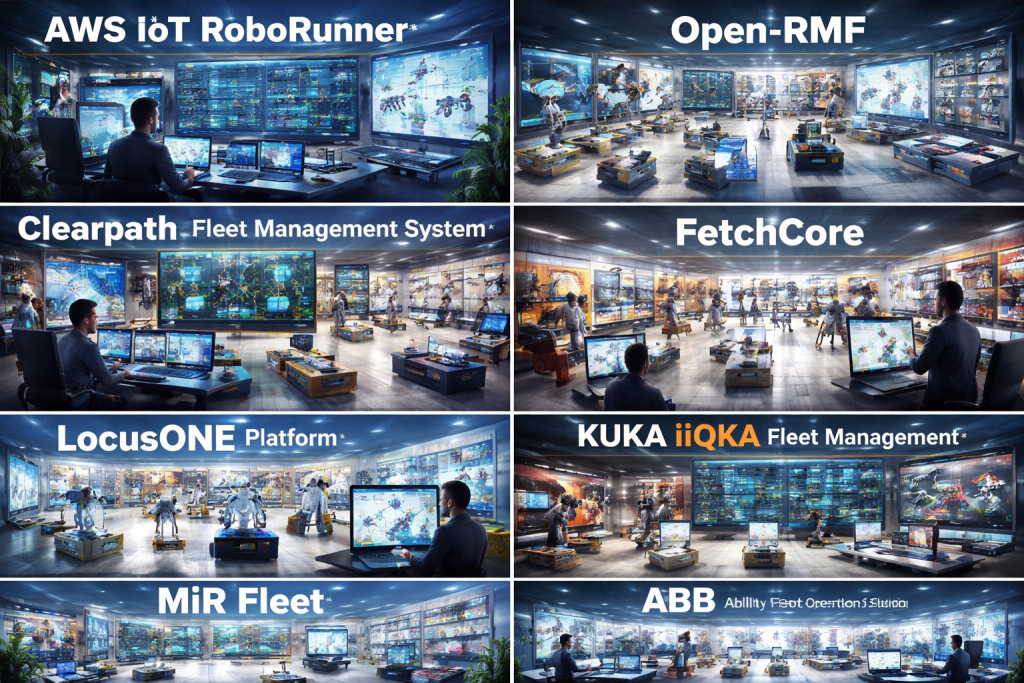
Introduction
Robotics Fleet Management Tools are software platforms designed to monitor, control, coordinate, and optimize multiple robots operating simultaneously across warehouses, factories, hospitals, campuses, and outdoor environments. Instead of managing robots one by one, these tools provide a centralized system to oversee an entire robotic fleet in real time.
As robotics adoption accelerates across logistics, manufacturing, healthcare, retail, agriculture, and smart cities, managing fleets manually becomes inefficient and risky. Fleet management tools solve this by enabling task allocation, traffic control, health monitoring, analytics, and remote updates, ensuring robots operate safely, efficiently, and at scale.
Common real-world use cases include:
- Coordinating autonomous mobile robots (AMRs) in warehouses
- Managing delivery robots across campuses or cities
- Orchestrating industrial robots in smart factories
- Monitoring cleaning, security, or inspection robots remotely
When choosing a robotics fleet management tool, users should evaluate:
- Scalability (from a few robots to thousands)
- Interoperability with different robot vendors
- Real-time visibility and control
- Integration with existing IT, ERP, WMS, or MES systems
- Security, reliability, and compliance readiness
Best for:
Robotics Fleet Management Tools are ideal for robotics engineers, operations managers, automation teams, system integrators, and enterprises running multi-robot deployments in logistics, manufacturing, healthcare, retail, agriculture, and smart infrastructure.
Not ideal for:
Solo robotics hobbyists, single-robot research projects, or early-stage prototypes may not need full fleet management platforms and can rely on basic robot control frameworks instead.
Top 10 Robotics Fleet Management Tools
1 — AWS IoT RoboRunner
Short description:
A cloud-based service that helps enterprises orchestrate and manage heterogeneous robot fleets across facilities using a unified digital map.
Key features:
- Centralized fleet orchestration
- Digital twin mapping of facilities
- Integration with multiple robot vendors
- Task dispatching and coordination
- Real-time status monitoring
- Event-driven workflows
- Cloud scalability
Pros:
- Strong scalability for large enterprises
- Vendor-agnostic approach
- Deep cloud ecosystem integration
Cons:
- Requires cloud expertise
- Cost can grow with scale
- Limited offline capabilities
Security & compliance:
Enterprise-grade encryption, IAM-based access control, audit logging, GDPR readiness.
Support & community:
Extensive documentation, enterprise support plans, strong developer ecosystem.
2 — Open-RMF (Robotics Middleware Framework)
Short description:
An open-source framework focused on coordinating fleets of robots from different vendors in shared environments.
Key features:
- Vendor-agnostic fleet coordination
- Traffic scheduling and collision avoidance
- Interoperability across robot types
- ROS 2-based architecture
- Multi-facility support
- Customizable workflows
Pros:
- Open and extensible
- Strong community adoption
- Ideal for mixed robot fleets
Cons:
- Requires engineering expertise
- Limited out-of-the-box UI
- Support depends on integrators
Security & compliance:
Varies; depends on deployment architecture and integrations.
Support & community:
Active open-source community, strong documentation, integrator-led enterprise support.
3 — Clearpath Fleet Management System
Short description:
A fleet management solution optimized for Clearpath and OTTO autonomous mobile robots in industrial environments.
Key features:
- Centralized AMR coordination
- Traffic and task management
- Real-time diagnostics
- Map-based visualization
- Industrial safety features
- Predictive maintenance insights
Pros:
- Highly reliable in industrial settings
- Tight hardware-software integration
- Strong safety focus
Cons:
- Limited to specific robot ecosystems
- Less flexible for heterogeneous fleets
- Premium pricing
Security & compliance:
Role-based access, encrypted communication, industrial security standards.
Support & community:
Strong vendor support, professional onboarding, enterprise-grade SLAs.
4 — FetchCore (Zebra Robotics Automation)
Short description:
A fleet orchestration platform designed to manage and optimize Fetch and Zebra AMR deployments.
Key features:
- Centralized fleet orchestration
- Intelligent task assignment
- Warehouse system integrations
- Fleet analytics and reporting
- Health and uptime monitoring
- Scalable architecture
Pros:
- Proven in warehouse automation
- Strong analytics capabilities
- Reliable performance at scale
Cons:
- Best suited for Fetch/Zebra robots
- Limited customization outside ecosystem
- Enterprise pricing
Security & compliance:
Enterprise security practices, encrypted data, access controls.
Support & community:
Vendor-led support, onboarding assistance, enterprise customer success teams.
5 — LocusONE Platform
Short description:
A robotics orchestration platform focused on large-scale warehouse automation using collaborative robots.
Key features:
- Multi-robot fleet coordination
- Real-time task orchestration
- Workforce collaboration tools
- Performance analytics dashboards
- High-availability architecture
- Cloud-based deployment
Pros:
- Optimized for high-volume logistics
- Strong productivity gains
- Enterprise-ready reliability
Cons:
- Logistics-focused use cases
- Limited use outside warehousing
- Premium cost structure
Security & compliance:
Enterprise encryption, audit logs, GDPR compliance readiness.
Support & community:
Dedicated enterprise support, professional services, structured onboarding.
6 — Brain Corp BrainOS Fleet Manager
Short description:
A cloud-based fleet management system designed for autonomous cleaning and service robots.
Key features:
- Centralized robot monitoring
- AI-driven performance optimization
- Remote updates and diagnostics
- Fleet analytics and insights
- Multi-location management
- User-friendly dashboards
Pros:
- Easy to use
- Strong AI-powered optimization
- Proven in commercial environments
Cons:
- Focused on service robots
- Limited industrial flexibility
- Vendor-specific ecosystem
Security & compliance:
Encrypted communication, role-based access, cloud security best practices.
Support & community:
Strong vendor support, training resources, commercial customer focus.
7 — KUKA iiQKA Fleet Management
Short description:
A fleet management solution tailored for coordinating industrial robots and mobile platforms within smart factories.
Key features:
- Industrial robot fleet coordination
- Integration with manufacturing systems
- Real-time status monitoring
- Predictive maintenance
- Secure industrial networking
- High reliability architecture
Pros:
- Industrial-grade robustness
- Deep manufacturing integration
- Trusted robotics brand
Cons:
- Less flexible for non-KUKA robots
- Complex setup
- Higher learning curve
Security & compliance:
ISO-aligned security practices, role-based access, industrial network security.
Support & community:
Strong global enterprise support, professional services, certified partners.
8 — MiR Fleet (Mobile Industrial Robots)
Short description:
A centralized fleet management system designed for MiR autonomous mobile robots.
Key features:
- Centralized fleet control
- Intelligent task scheduling
- Map-based traffic control
- Fleet analytics
- Safety zone management
- Easy configuration
Pros:
- User-friendly interface
- Reliable indoor navigation
- Quick deployment
Cons:
- Vendor-specific
- Limited cross-brand interoperability
- Scaling costs
Security & compliance:
Encrypted communication, user authentication, industrial security standards.
Support & community:
Vendor documentation, training programs, global support network.
9 — Omron Fleet Operations Workspace
Short description:
A comprehensive platform for managing Omron mobile robot fleets in industrial automation environments.
Key features:
- Fleet orchestration and traffic control
- Integration with factory automation
- Real-time visualization
- Diagnostics and maintenance alerts
- High availability design
- Scalable deployment
Pros:
- Strong industrial automation integration
- High reliability
- Well-structured workflows
Cons:
- Limited to Omron ecosystems
- Less flexible for mixed fleets
- Enterprise pricing
Security & compliance:
Industrial security standards, role-based access, encrypted communications.
Support & community:
Professional vendor support, industrial training resources.
10 — ABB Ability RobotStudio Fleet Management
Short description:
A fleet management and simulation-driven platform for managing ABB robots across production environments.
Key features:
- Fleet-level monitoring
- Simulation-driven optimization
- Digital twin capabilities
- Predictive maintenance
- Production analytics
- Integration with ABB systems
Pros:
- Strong simulation capabilities
- High industrial reliability
- Advanced analytics
Cons:
- Best suited for ABB robots
- Complex configuration
- Higher cost
Security & compliance:
Enterprise security controls, ISO-aligned practices, audit readiness.
Support & community:
Strong global support, extensive documentation, professional services.
Comparison Table
| Tool Name | Best For | Platform(s) Supported | Standout Feature | Rating |
|---|---|---|---|---|
| AWS IoT RoboRunner | Large enterprises, mixed fleets | Cloud | Vendor-agnostic orchestration | N/A |
| Open-RMF | Multi-vendor environments | On-prem / Hybrid | Open interoperability | N/A |
| Clearpath FMS | Industrial AMRs | On-prem | Industrial reliability | N/A |
| FetchCore | Warehouse automation | Cloud / Hybrid | Advanced fleet analytics | N/A |
| LocusONE | High-volume logistics | Cloud | Workforce-robot orchestration | N/A |
| BrainOS Fleet | Service robots | Cloud | AI-driven optimization | N/A |
| KUKA iiQKA | Smart factories | On-prem | Industrial integration | N/A |
| MiR Fleet | Indoor AMRs | On-prem | Ease of use | N/A |
| Omron Fleet | Factory automation | On-prem | Automation ecosystem | N/A |
| ABB Ability Fleet | Industrial robotics | On-prem / Hybrid | Simulation-based management | N/A |
Evaluation & Scoring of Robotics Fleet Management Tools
| Criteria | Weight | Description |
|---|---|---|
| Core features | 25% | Task allocation, monitoring, coordination |
| Ease of use | 15% | UI, onboarding, configuration |
| Integrations & ecosystem | 15% | ERP, WMS, ROS, APIs |
| Security & compliance | 10% | Encryption, access control |
| Performance & reliability | 10% | Uptime, latency, scalability |
| Support & community | 10% | Docs, vendor support |
| Price / value | 15% | Cost vs features |
Overall insight:
Enterprise tools score highest on reliability and security, while open frameworks excel in flexibility and interoperability.
Which Robotics Fleet Management Tool Is Right for You?
- Solo users / research teams: Open frameworks with minimal overhead
- SMBs: Easy-to-deploy, vendor-supported platforms
- Mid-market: Scalable systems with analytics and integrations
- Enterprise: Highly secure, interoperable, and reliable platforms
Budget-conscious users may favor open or vendor-bundled tools, while premium solutions deliver advanced analytics and support.
Choose feature depth for complex environments, or ease of use for rapid deployment.
Security-critical industries should prioritize compliance and auditability.
Frequently Asked Questions (FAQs)
- What is robotics fleet management?
It is the centralized coordination and monitoring of multiple robots operating together. - Do I need fleet management for small deployments?
Not always; it becomes essential as fleet size and complexity grow. - Can these tools manage robots from different vendors?
Some tools support heterogeneous fleets, others are vendor-specific. - Are these platforms cloud-based?
They can be cloud, on-prem, or hybrid depending on the tool. - How important is traffic management?
Critical for safety, efficiency, and avoiding collisions. - Are these tools secure?
Most enterprise tools include encryption, access control, and audit logs. - Do they integrate with warehouse systems?
Many integrate with WMS, ERP, and MES platforms. - What industries benefit the most?
Logistics, manufacturing, healthcare, retail, and smart infrastructure. - How long does implementation take?
From weeks to months depending on scale and customization. - What is the biggest mistake buyers make?
Choosing tools that don’t scale or integrate with existing systems.
Conclusion
Robotics Fleet Management Tools are no longer optional for organizations deploying multiple robots at scale. They provide the visibility, control, safety, and efficiency needed to operate modern robotic fleets reliably.
When choosing a solution, focus on scalability, interoperability, security, and real-world operational needs rather than just brand popularity. There is no single “best” tool—only the best fit for your specific environment, budget, and long-term robotics strategy.

Find Trusted Cardiac Hospitals
Compare heart hospitals by city and services — all in one place.
Explore Hospitals
Robotics fleet management tools need to coordinate robots sharing the same workspace, especially when several machines depend on common charging stations, corridors, or loading areas. A robot may complete its task successfully but still create delays if it blocks another robot’s route or arrives at a busy charging point. I would look for intelligent traffic management, battery-aware task allocation, and automatic recovery from communication failures. These capabilities help maintain steady operations without relying on constant manual intervention.
Age verification tools help businesses confirm user eligibility while protecting access to age-restricted services and content. Features like identity document checks, biometric verification, database validation, and privacy-focused data handling can improve accuracy. Businesses should also evaluate regulatory compliance, fraud detection, integration options, and user experience when selecting a suitable solution.
This article offers a helpful overview of robotics fleet management tools and their role in coordinating robotic systems efficiently. I find the comparison of features, advantages, and limitations useful for businesses looking to improve automation and operational productivity. When selecting a solution, organizations should consider real-time monitoring, fleet coordination, scalability, and integration with existing systems. Overall, this guide provides valuable insights for choosing the right robotics fleet management software to support reliable and efficient operations.
The comparison clearly illustrates the core architectural trade-off between vendor-locked, turnkey systems like Clearpath or MiR Fleet and open, interoperable frameworks like AWS IoT RoboRunner or Open-RMF. While single-vendor platforms offer faster initial plug-and-play reliability, facilities running mixed fleets inevitably encounter deadlocks in shared corridors and fragmented traffic management without a unified digital twin. Prioritizing VDA 5050 compliance and open middleware compatibility early in the pilot phase is typically what prevents automation teams from having to rip and replace their fleet orchestration layer as new robotic form factors are introduced.
Robotics fleet management tools should help teams monitor multiple robots without losing track of their performance or tasks. One important factor is how well the system manages robot status, battery levels, task assignments, and maintenance alerts. Teams should also check how easily the platform handles communication between robots and central control systems. Clear activity logs can help identify repeated errors and improve daily operations. I believe real-time monitoring and reliable task coordination are essential when choosing a robotics fleet management solution.
As fleets grow, traffic management and interoperability become the hard problems. Robots from different vendors need shared maps, right-of-way rules and deadlock handling. I’d look at how a platform handles disruptions like blocked aisles and how humans can intervene remotely. Over-the-air updates need staged rollouts, and charging schedules strongly affect utilization. Tracking intervention rates shows where the system struggles.
Managing a fleet of robots becomes considerably more complicated when several machines need to operate in the same physical space. A robot transporting materials may block another robot’s route, while a charging station or narrow passage can become a bottleneck during busy periods. I would assess how well robotics fleet management tools coordinate traffic, assign priorities, and resolve route conflicts without requiring constant human intervention. Another practical consideration is how the system behaves when a robot stops unexpectedly in an active working area. Good fleet coordination should account for the physical environment, not just display robot locations on a dashboard. This is particularly important in warehouses and manufacturing facilities where operational delays can affect the entire workflow.
Robotics fleet management tools help organizations coordinate, monitor, and optimize multiple robots operating across warehouses, factories, and other environments. Features such as centralized fleet control, task allocation, route optimization, real-time status monitoring, collision avoidance, and performance analytics are essential for managing robotic operations efficiently. When comparing platforms, organizations should consider compatibility with different robot models, scalability, interoperability, integration with existing systems, and ease of deployment. The right solution can improve robot utilization, reduce operational bottlenecks, simplify coordination, and support safer, more productive automation workflows.
Effective robotics fleet management depends on more than coordinating tasks; it requires reliable communication, intelligent scheduling, and continuous monitoring of robot health. Interoperability is especially important for organizations operating machines from different manufacturers, as it reduces integration challenges and supports future expansion. Evaluating traffic control, maintenance capabilities, and long-term operating costs helps businesses build safer and more efficient robotic operations.
Managing a large robot fleet requires more than tracking locations and assigning tasks efficiently. Teams should plan for situations where sensors fail, battery levels drop unexpectedly, or network delays interrupt coordination. A robot that stops in a narrow aisle can affect several other machines, so recovery procedures need to consider the whole fleet. Testing updates with different hardware configurations can also prevent version mismatches from disrupting daily operations. Maintenance teams benefit from logs that connect robot faults with map changes, software releases, and recent tasks. Clear access controls are important when remote operators can change routes or take manual control. Reviewing near misses and repeated stoppages can reveal risks before they cause serious downtime. This preparation helps keep fleet operations stable as workloads and the number of robots increase.
Managing a fleet of robots becomes much easier when teams can track performance, battery levels, and task progress from one place. I think it is also important to choose a tool that can grow as more robots are added to daily operations. Good monitoring and quick alerts can help reduce downtime and keep work running smoothly.
Robotics fleet management tools help teams coordinate multiple robots and understand their status across a worksite. Location tracking is useful, but task assignment, battery health, charging schedules, and fault alerts also matter. I would compare how each platform handles robots from different models and vendors. Teams should test what happens when a robot loses connection or blocks a shared route. Maintenance records can help spot repeated faults before they disrupt operations. Clear fleet dashboards should support quick decisions without hiding important details. A good platform should improve coordination, uptime, and safety as the number of robots grows.
Managing software versions across a large robot fleet requires careful planning, especially when robots operate around the clock. A configuration change that works on one robot may cause navigation or communication issues on another model with different firmware or sensors. Engineering teams should use staged rollouts, test updates in simulation, and deploy changes to a small group before expanding them across the fleet. It is also important to track the software and configuration version of each robot and support quick rollback when an update causes unexpected behavior. These practices help prevent fleet-wide disruptions, simplify troubleshooting, and keep automated operations stable as the robot environment evolves.
A major operational challenge missing here is managing OTA firmware rollouts across active fleets. Without automated canary deployments, dead-reckoning fallbacks during Wi-Fi packet drops, and deterministic rollback triggers at the edge, bad updates can physically brick AMRs on the warehouse floor and halt live operations.
Robotics fleet management tools help organizations coordinate multiple robots, monitor their status, and manage tasks across warehouses, factories, and other facilities. When comparing platforms, consider multi-robot scheduling, real-time telemetry, task allocation, fault alerts, and integration with warehouse or manufacturing systems. Monitoring battery levels, robot utilization, and recurring failures can help teams reduce downtime, balance workloads, and improve overall fleet performance.
Robotics fleet management tools should help operators coordinate multiple robots without creating traffic conflicts or unnecessary downtime. When comparing platforms, check how they handle task prioritization, shared charging stations, and route changes when an aisle becomes blocked. It is also worth examining whether the system records robot-level utilization and recurring fault patterns, helping teams identify bottlenecks before they affect overall facility productivity.
Transitioning from single-robot testing to multi-robot deployments makes real-time traffic coordination and map synchronization the ultimate make-or-break factors. Without robust cross-vendor interoperability early on, scaling operations across mixed hardware environments quickly leads to costly bottlenecks.
While choosing between vendor-specific platforms and vendor-agnostic frameworks like Open-RMF comes down to current hardware, the real bottleneck often surfaces during multi-vendor scaling. Striking the right balance between traffic control optimization and existing WMS/MES integration is ultimately what determines long-term deployment success.
Transitioning from a single pilot robot to a multi-vendor fleet often exposes hidden bottlenecks in traffic management and interoperability. Evaluating whether your chosen platform supports open-source frameworks like ROS 2 or requires a vendor-locked ecosystem can make or break long-term scalability.
Robotics fleet management tools are most valuable when they coordinate robot assignments, monitor battery health, and prevent traffic conflicts across busy environments. Integrating real-time performance data with predictive maintenance can reduce downtime and keep operations running smoothly as fleets grow.
Robotics fleet management tools help organizations coordinate autonomous robots, monitor task execution, optimize routes, and track operational performance across facilities. Platforms like Formant provide centralized robot monitoring, fleet visibility, and operational data insights, helping teams troubleshoot issues faster, improve resource utilization, and scale robotic deployments more efficiently.
This is a very comprehensive comparison of robotics fleet management tools that clearly explains how these platforms act as the “air traffic control” for coordinating multiple robots across warehouses, factories, hospitals, and other environments, enabling centralized task allocation, traffic control, health monitoring, and real-time analytics. By breaking down tools like AWS IoT RoboRunner, Open-RMF, Clearpath FMS, BrainOS Fleet Manager, and others with their core features, pros, and cons, the post provides practical insights for evaluating scalability, interoperability, integration with existing systems (ERP/WMS/MES), and security readiness in real-world automation deployments. This kind of comparison is especially valuable for robotics engineers and operations managers who need to choose the right solution based on fleet size, vendor diversity, and operational complexity — something that becomes essential as robotic automation moves from pilot stages to large-scale production environments.