
Introduction
Building Energy Management Systems (BEMS) are intelligent software platforms designed to monitor, analyze, control, and optimize energy consumption across buildings and facilities. By collecting real-time data from HVAC systems, lighting, meters, renewable sources, and other energy assets, BEMS help organizations reduce energy waste, lower operating costs, and meet sustainability goals without compromising occupant comfort.
In today’s environment of rising energy prices, strict carbon regulations, and growing ESG expectations, BEMS are no longer optional—they are a strategic necessity. From commercial offices and hospitals to manufacturing plants and smart campuses, organizations rely on BEMS to gain visibility into energy usage, detect inefficiencies, automate control strategies, and generate actionable insights.
Common real-world use cases include:
- Optimizing HVAC and lighting schedules
- Reducing peak demand charges
- Monitoring renewable energy generation
- Ensuring regulatory compliance and reporting
- Improving occupant comfort while cutting costs
When choosing a BEMS, users should evaluate data accuracy, analytics depth, automation capabilities, scalability, integrations, security, ease of use, and total cost of ownership. The right system aligns technical capabilities with business and sustainability objectives.
Best for:
Facility managers, energy managers, sustainability teams, real estate operators, manufacturing plants, hospitals, universities, and large enterprises managing complex energy portfolios.
Not ideal for:
Very small buildings with minimal energy complexity, residential homes with basic smart meters, or organizations seeking only simple billing dashboards rather than advanced analytics and control.
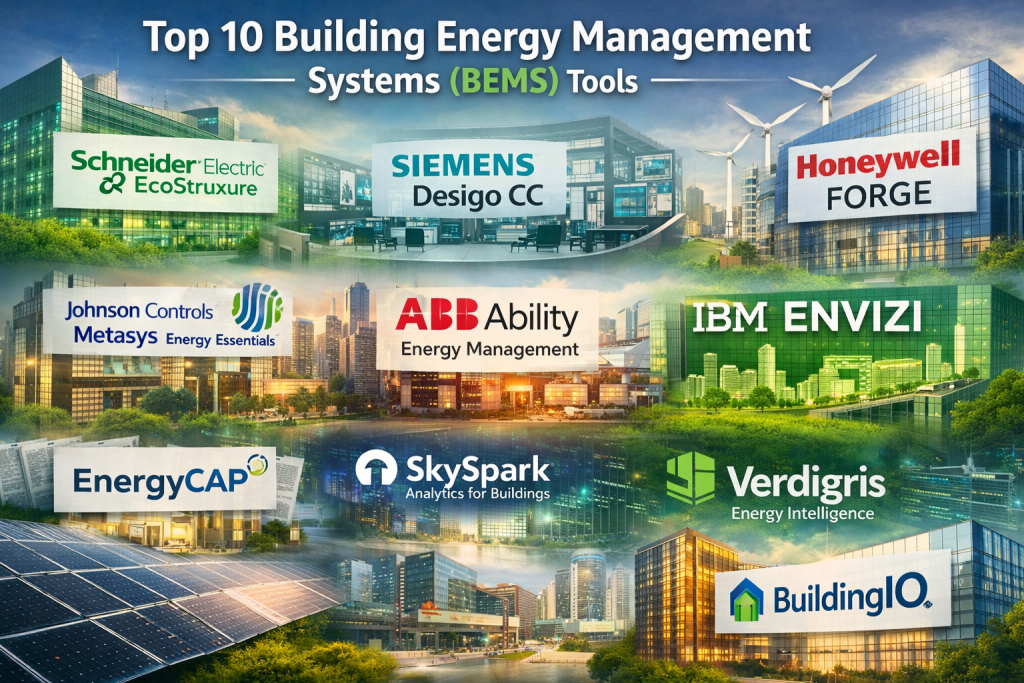
Top 10 Building Energy Management Systems (BEMS) Tools
1 — Schneider Electric EcoStruxure Building
Short description:
An enterprise-grade BEMS designed for large commercial and industrial facilities focusing on energy efficiency, automation, and sustainability.
Key features:
- Real-time energy monitoring and analytics
- Advanced HVAC and lighting control
- AI-driven optimization and fault detection
- Integration with building automation systems
- Sustainability and carbon reporting
- Scalable multi-site management
Pros:
- Extremely powerful analytics and automation
- Strong focus on sustainability and ESG
Cons:
- Higher cost than mid-market solutions
- Requires skilled implementation partners
Security & compliance:
Enterprise-grade encryption, role-based access, audit logs, GDPR, ISO standards (varies by deployment).
Support & community:
Strong global support network, extensive documentation, enterprise onboarding services.
2 — Siemens Desigo CC
Short description:
A comprehensive building management and energy optimization platform for complex infrastructures.
Key features:
- Centralized energy and building control
- Multi-system integration (HVAC, power, security)
- Advanced visualization dashboards
- Predictive analytics and alarms
- Multi-building scalability
Pros:
- Excellent integration across building systems
- Reliable and robust for mission-critical sites
Cons:
- Steep learning curve
- Premium pricing
Security & compliance:
Strong enterprise security, encryption, access controls, GDPR-ready.
Support & community:
Professional support, certified integrators, detailed training resources.
3 — Honeywell Forge Energy Optimization
Short description:
A data-driven energy management platform leveraging AI to optimize building energy performance.
Key features:
- AI-powered energy optimization
- Real-time monitoring and analytics
- Asset performance management
- Cloud-based dashboards
- Predictive maintenance insights
Pros:
- Strong AI and predictive capabilities
- Cloud-first architecture
Cons:
- Best value realized in large deployments
- Customization may require expertise
Security & compliance:
Cloud security controls, encryption, compliance frameworks vary by region.
Support & community:
Enterprise support, onboarding programs, growing user ecosystem.
4 — Johnson Controls Metasys Energy Essentials
Short description:
A flexible BEMS focusing on energy efficiency, comfort, and operational optimization.
Key features:
- Energy usage tracking and benchmarking
- HVAC and lighting optimization
- Demand response capabilities
- Customizable dashboards
- Integration with automation systems
Pros:
- Reliable and proven technology
- Good balance between control and analytics
Cons:
- UI can feel dated
- Advanced analytics may require add-ons
Security & compliance:
Role-based security, encrypted communications, compliance varies by configuration.
Support & community:
Strong global partner network and documentation.
5 — ABB Ability Energy Management
Short description:
An industrial-focused energy management platform ideal for factories and large infrastructure.
Key features:
- Energy and power quality monitoring
- Real-time dashboards and alerts
- Integration with industrial automation
- Demand management and optimization
- Multi-site analytics
Pros:
- Excellent for industrial environments
- High reliability and performance
Cons:
- Less intuitive for non-technical users
- Primarily focused on industrial use cases
Security & compliance:
Industrial-grade security, encryption, compliance standards supported.
Support & community:
Strong enterprise and industrial support services.
6 — IBM Envizi Energy Management
Short description:
A cloud-based energy and sustainability management platform focused on data-driven insights.
Key features:
- Energy data aggregation and normalization
- Sustainability and ESG reporting
- Analytics and benchmarking
- Multi-site portfolio management
- Integration with enterprise systems
Pros:
- Strong reporting and compliance features
- Scales well across portfolios
Cons:
- Limited direct control capabilities
- Relies heavily on data quality
Security & compliance:
Enterprise cloud security, GDPR, SOC-style controls.
Support & community:
Professional support, extensive documentation, enterprise onboarding.
7 — EnergyCAP Energy Management
Short description:
A comprehensive utility bill and energy data management solution.
Key features:
- Utility bill processing and validation
- Energy usage analytics
- Budgeting and forecasting
- Compliance and reporting tools
- Portfolio-wide visibility
Pros:
- Excellent for cost tracking and billing accuracy
- Easy to use for finance and energy teams
Cons:
- Limited real-time control features
- Less automation compared to full BEMS
Security & compliance:
Standard encryption, role-based access, compliance varies.
Support & community:
Good documentation, responsive customer support.
8 — SkySpark
Short description:
An analytics-focused platform specializing in fault detection and diagnostics.
Key features:
- Automated fault detection
- Rule-based and analytics-driven insights
- Energy efficiency diagnostics
- Customizable analytics models
- Integration with BMS platforms
Pros:
- Excellent at identifying inefficiencies
- Flexible analytics framework
Cons:
- Requires technical expertise
- Not a full control system
Security & compliance:
Varies by deployment and integration environment.
Support & community:
Active technical community, strong documentation.
9 — Verdigris Energy Intelligence
Short description:
An AI-driven energy intelligence platform using high-resolution data analytics.
Key features:
- AI-powered energy disaggregation
- Real-time equipment-level insights
- Anomaly detection
- Cloud dashboards
- Sustainability reporting
Pros:
- Deep visibility into energy usage
- Strong AI-driven insights
Cons:
- Hardware dependency
- Best suited for data-focused users
Security & compliance:
Cloud security practices, encryption, GDPR-ready.
Support & community:
Dedicated onboarding, responsive support team.
10 — BuildingIQ
Short description:
A cloud-based energy optimization platform focusing on HVAC efficiency.
Key features:
- HVAC optimization using machine learning
- Energy forecasting
- Automated control strategies
- Comfort optimization
- Cloud analytics
Pros:
- Proven energy savings
- Easy integration with HVAC systems
Cons:
- Narrower scope compared to full BEMS
- Less control over non-HVAC systems
Security & compliance:
Cloud encryption, access controls, compliance varies.
Support & community:
Professional support, focused user base.
Comparison Table
| Tool Name | Best For | Platform(s) Supported | Standout Feature | Rating |
|---|---|---|---|---|
| Schneider Electric EcoStruxure | Large enterprises | Cloud / On-prem | End-to-end automation | N/A |
| Siemens Desigo CC | Complex infrastructures | On-prem / Hybrid | Unified building control | N/A |
| Honeywell Forge | Large portfolios | Cloud | AI optimization | N/A |
| Johnson Controls Metasys | Commercial buildings | On-prem / Hybrid | HVAC integration | N/A |
| ABB Ability | Industrial facilities | Cloud / On-prem | Industrial reliability | N/A |
| IBM Envizi | Sustainability reporting | Cloud | ESG analytics | N/A |
| EnergyCAP | Utility cost management | Cloud | Bill validation | N/A |
| SkySpark | Analytics teams | Cloud / Hybrid | Fault detection | N/A |
| Verdigris | Data-driven orgs | Cloud | High-resolution analytics | N/A |
| BuildingIQ | HVAC optimization | Cloud | Predictive control | N/A |
Evaluation & Scoring of Building Energy Management Systems (BEMS)
| Tool | Core Features (25%) | Ease of Use (15%) | Integrations (15%) | Security (10%) | Performance (10%) | Support (10%) | Price/Value (15%) | Total Score |
|---|---|---|---|---|---|---|---|---|
| EcoStruxure | 23 | 12 | 14 | 9 | 9 | 9 | 11 | 87 |
| Desigo CC | 22 | 11 | 14 | 9 | 9 | 9 | 10 | 84 |
| Honeywell Forge | 21 | 13 | 13 | 9 | 9 | 8 | 11 | 84 |
| Metasys | 20 | 13 | 12 | 8 | 8 | 8 | 12 | 81 |
| ABB Ability | 21 | 11 | 12 | 9 | 9 | 8 | 10 | 80 |
Which Building Energy Management Systems (BEMS) Tool Is Right for You?
- Solo users or small buildings: Lightweight platforms focused on analytics and reporting
- SMBs: Cloud-based BEMS with intuitive dashboards and moderate automation
- Mid-market: Systems offering integration, forecasting, and cost control
- Enterprises: Full-scale platforms with automation, AI, compliance, and scalability
Budget-conscious users should prioritize ease of use and reporting, while premium buyers benefit from AI optimization and automation depth. Always align integration needs, scalability, and security requirements with long-term goals.
Frequently Asked Questions (FAQs)
- What is a BEMS?
A system that monitors, analyzes, and optimizes building energy usage. - How much energy can BEMS save?
Typically 10–30% depending on building complexity and usage patterns. - Is BEMS only for large buildings?
No, but larger facilities see the greatest ROI. - Do BEMS require new hardware?
Sometimes, depending on data collection needs. - How long does implementation take?
From weeks to several months for large sites. - Are cloud-based BEMS secure?
Yes, when proper encryption and access controls are used. - Can BEMS support sustainability reporting?
Most modern systems include ESG and carbon reporting. - Do BEMS replace BMS?
No, they often integrate with existing BMS. - What skills are needed to manage BEMS?
Energy management and basic data analysis skills. - What is the biggest mistake buyers make?
Choosing overly complex systems without internal expertise.
Conclusion
Building Energy Management Systems play a crucial role in reducing costs, improving efficiency, and meeting sustainability goals. While enterprise platforms deliver powerful automation and analytics, simpler solutions may be more suitable for smaller organizations. The best BEMS is not a universal winner—it is the one that aligns with your building size, operational complexity, budget, and long-term energy strategy. Thoughtful evaluation ensures maximum value and measurable impact.

Find Trusted Cardiac Hospitals
Compare heart hospitals by city and services — all in one place.
Explore Hospitals
Building energy management systems are more useful when teams track energy use across different areas of a building. Comparing real-time readings with past usage can help identify unusual consumption and possible waste. Regular sensor checks are also important because incorrect readings can affect energy decisions. A practical focus on monitoring and maintenance can help buildings use energy more efficiently.
Cloud connectivity is an important consideration for modern building energy platforms. What happens if the internet connection drops or the central management service becomes unavailable? Essential building operations should not depend entirely on a remote service. Local controllers need safe fallback schedules, clear recovery procedures, and the ability to maintain critical HVAC and other building functions until connectivity returns. This makes the system more resilient during unexpected outages.
Building energy management systems can deliver meaningful savings, but their effectiveness depends heavily on the quality of building data and how well the system integrates with existing controls. I would look beyond energy dashboards and assess whether the platform can identify equipment operating outside expected schedules, detect abnormal consumption, and help prioritize corrective actions. Interoperability with HVAC controllers, meters, sensors, and legacy building automation systems is especially important when managing a mixed portfolio of facilities. Predictive maintenance features are useful too, provided alerts are actionable and do not overwhelm facility teams with false positives. Finally, comparing energy use against occupancy, weather, and operating hours can help distinguish genuine efficiency improvements from changes in building activity.
Real-world energy efficiency in commercial facilities depends on connecting HVAC, lighting, and occupancy sensors across standard BACnet and Modbus building protocols. Modern BEMS platforms leverage predictive weather models and dynamic peak utility rate schedules to pre-cool facilities efficiently during cheaper non-peak hours. Automated fault detection and diagnostics (FDD) pinpoint failing damper actuators before they translate into inflated monthly utility expenses.
Building Energy Management Systems help facility teams monitor energy use, control building equipment, and improve operational efficiency. When comparing BEMS platforms, consider real-time monitoring, HVAC integration, occupancy-based controls, energy reporting, fault detection, automation, cybersecurity, and compatibility with existing building systems.
Building energy management systems turn utility data into savings, and this article explains the fundamentals clearly. I appreciate the coverage of scheduling and anomaly detection, which catch waste that audits miss. One practical suggestion is to benchmark consumption against weather and occupancy, since raw numbers mislead without context. Energy insight pays for itself quickly. Valuable read for facility managers.
Building Energy Management Systems (BEMS) help facility managers monitor, control, and optimize energy consumption across buildings. When comparing these systems, I would focus on real-time energy monitoring, HVAC control, automated scheduling, consumption analytics, and integration with building equipment. These features can help reduce energy waste, improve operational efficiency, and support better facility management. The right system should provide accurate energy insights, flexible controls, and clear reporting to support efficient building operations.
Building Energy Management Systems (BEMS) help organizations monitor, control, and optimize energy consumption across commercial and industrial buildings. Features such as real-time energy monitoring, HVAC automation, smart lighting control, occupancy sensing, predictive analytics, and automated reporting can improve building efficiency. When comparing solutions, businesses should consider integration with existing building infrastructure, scalability, energy analytics, automation capabilities, and implementation costs. The right platform can reduce energy waste, lower operational expenses, improve occupant comfort, and support long-term sustainability goals through smarter building operations.
Energy management software should be evaluated across different seasons and building usage patterns. Settings that work during regular office hours may not suit holidays, peak demand, or sudden occupancy changes. Comparing system recommendations with real meter data can show whether the expected savings actually occur. Teams should also define safe fallback settings for faulty sensors or missing readings. This helps maintain energy efficiency while protecting indoor conditions and equipment performance.
Building energy management systems help operators monitor energy use and control heating, cooling, lighting, and other building systems. Better visibility can reveal waste, but readings must be accurate and timely. I would compare sensor integration, energy dashboards, automated controls, alerts, and reporting. Teams should test how the system responds to occupancy changes and equipment faults. It is also useful to check whether the platform supports older building systems. Clear reports can help measure whether changes actually reduce energy use. A good BEMS should improve comfort and efficiency while giving operators reliable data to guide maintenance and energy decisions.
Building energy management systems can deliver better results when energy monitoring is connected with actual building operations rather than treated as a separate reporting task. Real-time sensor data, automated HVAC controls, and occupancy-based adjustments can help reduce waste without affecting comfort. I also think comparing energy use before and after each change is important for measuring real savings. Choosing a system that works with existing building equipment can make implementation easier and support long-term efficiency.
Building energy management systems help facility teams monitor energy consumption, optimize HVAC performance, and identify inefficiencies across commercial and residential properties. Real-time sensor data, automated controls, and consumption analytics can reduce waste while maintaining comfortable indoor conditions. Integrating these systems with lighting, occupancy sensors, and building automation platforms also supports predictive maintenance, improves operational visibility, and helps organizations make measurable progress toward energy efficiency goals.
Accurately measuring energy savings requires more than comparing utility bills before and after installing a BEMS. Changes in weather, occupancy, operating hours, and equipment loads can affect consumption independently of the system. Facility teams should establish a baseline, normalize results against these variables, and verify savings over a meaningful period. It is also useful to track whether automated HVAC adjustments maintain acceptable indoor temperatures and air quality. Without these checks, a system might appear to reduce energy use while creating discomfort or shifting costs elsewhere. A clear measurement and verification process helps organizations confirm genuine savings and make better decisions about expanding the system across additional buildings.
Building energy management systems are most effective when they help facility teams understand why energy consumption changes throughout the day. When comparing platforms, look for occupancy-based controls, equipment-level energy tracking, and alerts for unusual consumption during unoccupied hours. Reviewing energy use alongside indoor temperature and comfort data can help managers reduce waste without making offices or commercial spaces uncomfortable for occupants.
Modernizing legacy facility infrastructure requires bridging disparate field protocols like BACnet/IP and Modbus RTU into unified time-series databases. Without resilient edge IoT gateways performing local semantic normalization via Project Haystack or Brick schemas, high-frequency HVAC sensory streams saturate uplink capacity and derail automated peak-demand shedding algorithms during extreme electrical grid stress events.
Building energy management systems help facility teams monitor electricity use, control HVAC equipment, and identify energy waste across buildings. When comparing platforms, consider real-time metering, automated controls, occupancy sensors, fault alerts, and integration with existing building systems. Reviewing energy trends alongside occupancy and operating schedules can reveal avoidable consumption, reduce utility costs, and support more informed sustainability decisions.
Building Energy Management Systems help organizations monitor energy consumption, optimize HVAC operations, and reduce unnecessary electricity costs across commercial buildings. Solutions like Schneider Electric EcoStruxure Building provide real-time monitoring, automation, and energy analytics, helping facility managers improve building efficiency, reduce operating expenses, and support sustainability goals.
While choosing a high-end platform with advanced AI optimization sounds ideal on paper, the real challenge usually lies in ensuring internal teams have the operational expertise to act on those insights. Many deployments underperform not due to software limitations, but because organizations lack the bandwidth to continuously tune their HVAC and automation schedules. Aligning the complexity of the BEMS directly with the team’s daily capacity is often the most critical factor for long-term ROI.
A BEMS delivers the most value when energy savings are measured against actual building usage, not just dashboard estimates. Integrating occupancy data with HVAC schedules and tracking occupant comfort alongside consumption can help teams achieve lasting efficiency without compromising the indoor environment.