
Introduction
Reservation Management Software is a digital system designed to manage bookings, availability, scheduling, and customer reservations across one or multiple locations. It replaces manual registers, spreadsheets, and phone-based booking processes with a centralized, automated platform that works in real time.
In today’s fast-paced, customer-driven world, reservation software plays a critical role in reducing overbooking, improving customer experience, and maximizing resource utilization. From hotels and restaurants to hospitals, coworking spaces, sports facilities, and event venues, these tools ensure that every reservation is accurate, confirmed, and well-organized.
Common real-world use cases include table reservations in restaurants, room bookings in hotels, appointment scheduling in healthcare, seat management for events, and asset reservations for shared resources. Beyond bookings, modern tools also handle reminders, cancellations, payments, reporting, and integrations with POS or CRM systems.
When choosing a Reservation Management Software, buyers should evaluate ease of use, real-time availability management, scalability, integrations, security, reporting depth, and overall value for money. The right choice can streamline operations, reduce staff workload, and significantly improve customer satisfaction.
Best for:
Reservation Management Software is ideal for hospitality businesses, healthcare providers, service-based companies, multi-location enterprises, event organizers, and growing SMBs that handle recurring or high-volume bookings.
Not ideal for:
It may be unnecessary for very small businesses with extremely low booking volume, one-time events, or operations that do not rely on scheduled reservations and can be handled manually without risk.
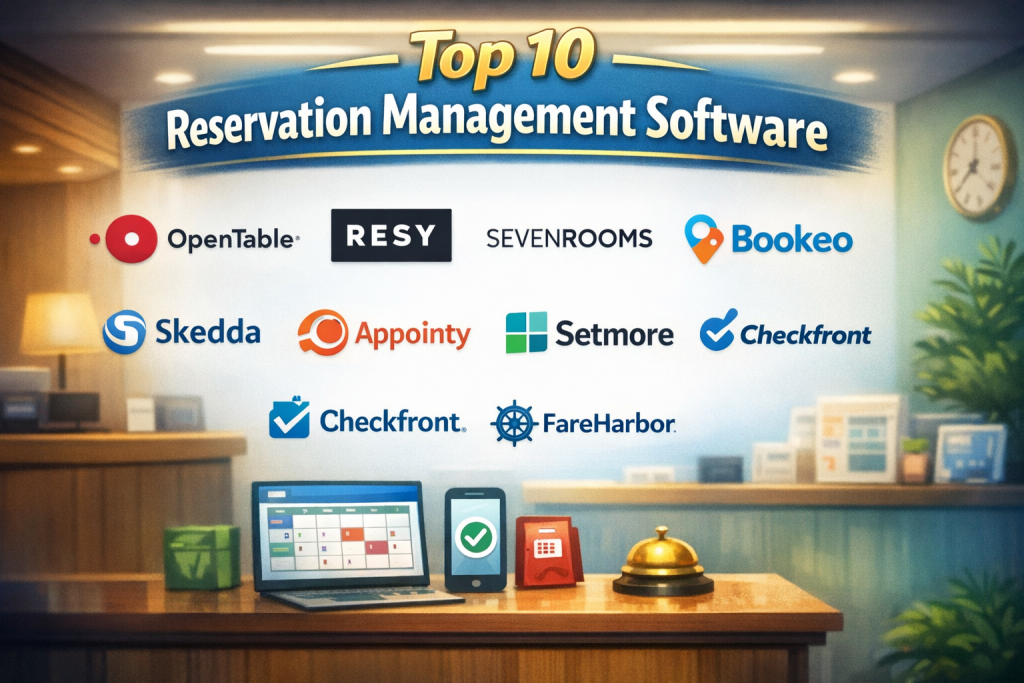
Top 10 Reservation Management Software Tools
1 — OpenTable
Short description:
A widely recognized reservation platform designed primarily for restaurants, helping manage table bookings, guest preferences, and dining operations.
Key features:
- Real-time table and seating management
- Online and mobile reservations
- Guest profiles and visit history
- Automated confirmations and reminders
- Waitlist and walk-in tracking
- Analytics on occupancy and peak hours
Pros:
- Strong brand recognition among diners
- Excellent tools for managing high-volume reservations
- Improves table turnover and utilization
Cons:
- Higher cost compared to smaller platforms
- Limited flexibility outside restaurant use cases
Security & compliance:
Data encryption, GDPR-aligned practices; compliance scope varies by region.
Support & community:
Comprehensive documentation, onboarding support, and dedicated customer service for business accounts.
2 — Resy
Short description:
A modern reservation and guest management system focused on restaurants and premium dining experiences.
Key features:
- Real-time reservation and floor management
- Dynamic seating optimization
- Guest tagging and preferences
- Integrated waitlist management
- Reservation pacing controls
- Performance and revenue insights
Pros:
- Clean, intuitive interface
- Excellent for managing peak demand
- Strong guest experience tools
Cons:
- Restaurant-focused, limited cross-industry use
- Pricing may be high for small venues
Security & compliance:
Standard encryption and privacy controls; compliance varies.
Support & community:
Responsive customer support and onboarding resources.
3 — SevenRooms
Short description:
An enterprise-grade reservation and guest experience platform for hospitality and entertainment businesses.
Key features:
- Reservation and table management
- CRM with guest profiles
- Marketing automation tools
- POS and payment integrations
- Advanced analytics and reporting
- Multi-venue support
Pros:
- Strong personalization capabilities
- Suitable for large and luxury venues
- Deep data and reporting
Cons:
- Steeper learning curve
- Higher cost for small businesses
Security & compliance:
Supports encryption, access controls, and GDPR-aligned practices.
Support & community:
Enterprise-level support, training, and dedicated account management.
4 — Bookeo
Short description:
A flexible reservation system for tours, activities, appointments, and service-based businesses.
Key features:
- Online booking and calendar management
- Multi-location support
- Automated confirmations and reminders
- Payment processing
- Custom booking rules
- Reporting and analytics
Pros:
- Easy to set up and use
- Works across multiple industries
- Affordable pricing
Cons:
- Limited advanced customization
- Basic reporting compared to enterprise tools
Security & compliance:
Standard encryption; compliance varies by payment provider.
Support & community:
Helpful documentation and responsive customer support.
5 — SimplyBook.me
Short description:
An appointment and reservation management solution for service businesses and SMBs.
Key features:
- Customizable booking website
- Staff and resource management
- Automated reminders
- Online payments
- Client profiles and history
- Marketing and promotion tools
Pros:
- User-friendly and quick setup
- Strong customization options
- Cost-effective for SMBs
Cons:
- Not ideal for very large enterprises
- Some advanced features require add-ons
Security & compliance:
Supports GDPR compliance, encryption, and role-based access.
Support & community:
Good documentation, live chat support, and onboarding guides.
6 — Skedda
Short description:
A reservation management platform focused on space and resource booking for offices, schools, and venues.
Key features:
- Space and resource scheduling
- Real-time availability views
- Booking rules and approvals
- User access controls
- Integrations with calendars
- Usage analytics
Pros:
- Excellent for space management
- Clean and intuitive UI
- Flexible booking rules
Cons:
- Limited customer-facing booking features
- Not suitable for hospitality reservations
Security & compliance:
SSO support, encryption, GDPR-compliant features.
Support & community:
Strong documentation and reliable customer support.
7 — Appointy
Short description:
A scheduling and reservation solution for service-based businesses and franchises.
Key features:
- Appointment and reservation scheduling
- Staff and service management
- Online payments
- Automated notifications
- Multi-location support
- Analytics and reporting
Pros:
- Affordable and scalable
- Works well for franchises
- Mobile-friendly booking
Cons:
- UI can feel cluttered at times
- Limited advanced reporting
Security & compliance:
Encryption and basic compliance support; varies by deployment.
Support & community:
Knowledge base, email support, and onboarding assistance.
8 — Setmore
Short description:
A simple and effective reservation and appointment scheduling tool for small teams.
Key features:
- Online booking pages
- Calendar sync
- Automated reminders
- Team scheduling
- Video appointment support
- Basic analytics
Pros:
- Very easy to use
- Free plan available
- Quick deployment
Cons:
- Limited customization
- Not suitable for complex reservation needs
Security & compliance:
Standard encryption; compliance scope is limited.
Support & community:
Helpful guides, tutorials, and responsive support.
9 — Checkfront
Short description:
A reservation and booking management platform for tours, rentals, and activities.
Key features:
- Inventory-based reservations
- Seasonal pricing and rules
- Online payments
- Channel management
- Reporting and analytics
- Customer communication tools
Pros:
- Strong inventory control
- Ideal for tours and rentals
- Flexible pricing models
Cons:
- Interface feels dated
- Learning curve for advanced features
Security & compliance:
PCI-aligned payment handling; encryption supported.
Support & community:
Good documentation and responsive support team.
10 — FareHarbor
Short description:
A reservation and booking system designed for tour operators and experience-based businesses.
Key features:
- Online and in-person reservations
- Inventory and capacity management
- Payment processing
- Partner and affiliate tools
- Reporting dashboards
- Mobile check-in support
Pros:
- Excellent for experience-based businesses
- Strong operational tools
- Reliable performance
Cons:
- Less flexible for non-tour industries
- Pricing structure may not suit small operators
Security & compliance:
Encryption, secure payments, compliance varies.
Support & community:
Dedicated onboarding, documentation, and customer support.
Comparison Table
| Tool Name | Best For | Platform(s) Supported | Standout Feature | Rating |
|---|---|---|---|---|
| OpenTable | Restaurants | Web, Mobile | Table optimization | N/A |
| Resy | Premium dining | Web, Mobile | Reservation pacing | N/A |
| SevenRooms | Enterprise hospitality | Web | Guest CRM | N/A |
| Bookeo | Tours & services | Web | Multi-industry flexibility | N/A |
| SimplyBook.me | SMB services | Web, Mobile | Custom booking sites | N/A |
| Skedda | Space management | Web | Resource scheduling | N/A |
| Appointy | Franchises | Web, Mobile | Multi-location support | N/A |
| Setmore | Small teams | Web, Mobile | Simplicity | N/A |
| Checkfront | Rentals & tours | Web | Inventory control | N/A |
| FareHarbor | Experience businesses | Web, Mobile | Capacity management | N/A |
Evaluation & Scoring of Reservation Management Software
| Criteria | Weight | Explanation |
|---|---|---|
| Core features | 25% | Booking, availability, confirmations |
| Ease of use | 15% | User and staff experience |
| Integrations & ecosystem | 15% | POS, CRM, payments |
| Security & compliance | 10% | Data protection and access control |
| Performance & reliability | 10% | Speed and uptime |
| Support & community | 10% | Help, onboarding, documentation |
| Price / value | 15% | Cost vs features |
Which Reservation Management Software Tool Is Right for You?
- Solo users & small teams: Choose simple, low-cost tools with fast setup and essential features.
- SMBs: Look for balance between flexibility, automation, and affordability.
- Mid-market businesses: Prioritize scalability, integrations, and reporting.
- Enterprise: Focus on security, customization, analytics, and multi-location support.
- Budget-conscious users: Avoid overpaying for features you don’t need.
- Regulated industries: Ensure strong security and compliance capabilities.
Frequently Asked Questions (FAQs)
1. What is reservation management software?
It is a digital system that manages bookings, availability, and customer reservations in real time.
2. Is reservation software only for restaurants?
No, it is widely used in healthcare, tourism, events, offices, and service industries.
3. Can it prevent overbooking?
Yes, real-time availability tracking significantly reduces overbooking risks.
4. Does it support online payments?
Many tools offer built-in or integrated payment processing.
5. Is it suitable for multi-location businesses?
Several tools support centralized management across locations.
6. How long does implementation take?
Most cloud-based tools can be set up within days or weeks.
7. Is customer data secure?
Reputable tools use encryption and follow data protection standards.
8. Can it send reminders automatically?
Yes, automated confirmations and reminders are standard features.
9. Are free plans reliable?
Free plans are useful for basic needs but often limited in features.
10. What is the biggest mistake buyers make?
Choosing overly complex tools instead of matching software to actual needs.
Conclusion
Reservation Management Software has become essential for businesses that rely on accurate scheduling, efficient resource use, and strong customer experience. The right platform can reduce manual work, improve operational efficiency, and drive higher customer satisfaction.
There is no single “best” tool for everyone. The ideal choice depends on industry, business size, booking volume, budget, and compliance requirements. By focusing on real needs rather than feature overload, businesses can select a solution that delivers long-term value and growth.

Find Trusted Cardiac Hospitals
Compare heart hospitals by city and services — all in one place.
Explore Hospitals
Reservation management software should handle changes without creating duplicate bookings or losing the original reservation history. For example, when a customer changes the date, party size, or service time, the system should update availability and notify the right staff members automatically. I would also check whether cancelled slots become available again immediately. Small details like these help businesses avoid scheduling conflicts and make better use of their available capacity.
Solid breakdown. The fundamental architectural split in reservation management software lies between centralized single tenant booking engines and multi tenant cloud distribution networks. Dedicated isolated tenant platforms give luxury hospitality operators complete control over guest profile databases, custom rate logic, and direct property hardware locks. However, they struggle to broadcast live availability across external global travel channels without cumbersome middleware. Distributed multi tenant networks synchronize room and table inventory instantly across global distribution channels via event driven APIs, preventing double bookings at the cost of forcing properties into rigid, standardized booking schemas.
One thing buyers should test beyond booking features is how the system handles real-world edge cases: overlapping time slots, waitlists, partial cancellations, deposits, and staff or resource constraints. A platform that syncs availability in real time but cannot manage these exceptions can still create manual work at the front desk, especially during peak hours.
One detail I would examine when choosing reservation management software is how it handles customers who arrive earlier or later than their scheduled time. A reservation system may show a table, room, or service slot as occupied for a fixed period, but real operations rarely follow an exact schedule. Early arrivals, extended visits, no-shows, and last-minute changes can create conflicts with upcoming reservations. It helps when the platform allows staff to adjust actual arrival and departure times without losing the original booking details. This gives teams a more realistic view of availability and helps avoid promising the same resource to two customers during busy periods.
Reservation management software helps businesses streamline bookings, manage availability, and provide a smoother customer experience across different service industries. Features such as real-time availability updates, automated confirmations, cancellation management, customer notifications, and calendar integration can reduce manual work and prevent double bookings. I believe ease of use, customization, reporting capabilities, and integration with payment systems are essential factors when comparing these solutions. The right platform should simplify daily operations while helping businesses optimize resource utilization, reduce scheduling conflicts, and deliver a more reliable booking experience for both customers and staff.
Reservation management software should make it easy to manage bookings, avoid double reservations, and keep availability up to date. I would check how well a system handles cancellations, booking changes, and automatic reminders. Clear booking records can help staff answer customer questions without searching through different tools. Easy integration with websites and payment systems can also reduce manual work. How can businesses use reservation software to reduce booking errors while giving customers a smooth booking experience?
Reservation management software helps businesses organize bookings, manage availability, and reduce scheduling conflicts. Features like automated confirmations, reminders, and online payments can save time and improve the customer experience. I believe businesses should compare different platforms based on their requirements, budget, and ease of use. Integration with calendars and other business tools can also make daily operations more efficient. Choosing the right solution helps reduce manual work and deliver a smoother booking experience.
An often-overlooked factor in reservation management software is how efficiently it handles no-shows, last-minute cancellations, and sudden changes in booking demand. Features like automated reminders, flexible rescheduling, and real-time availability updates become more valuable when their impact is measured through reduced empty slots and better resource utilization.
Reservation management software can help businesses avoid double bookings, streamline scheduling, and maintain accurate availability across multiple channels. Automated confirmations, cancellation tracking, and centralized customer records reduce manual coordination while creating a more consistent booking experience. Integrating payment processing and real-time inventory updates is especially valuable for businesses handling frequent reservations and last-minute changes.
Effective scheduling technology requires aligning specific inventory rules with day-to-day operational realities rather than simply chasing endless advanced features. While enterprise-grade hospitality suites deliver robust multi-venue CRM tools, lean service providers typically benefit most from agile platforms emphasizing rapid deployment and instant client notifications. Avoiding unnecessary tool bloat ensures higher internal adoption rates and ultimately delivers a frictionless booking journey for every guest.
Reservation management software helps businesses handle bookings, availability, changes, and customer details. A reliable system should prevent double bookings and show open slots clearly. Automated reminders can reduce missed appointments and help customers plan ahead. Staff also need simple tools to change reservations and manage cancellations. When comparing options, check calendar views, payment support, customer messages, and reporting. The right system should match the business’s booking rules and service needs. Clear records and easy updates can save staff time and improve the customer experience.
A reservation platform should make it easy to manage changes after a customer has confirmed a booking. Staff may need to adjust group size, extend a time slot, or move a reservation because of unexpected constraints. I’d check whether the system updates capacity, pricing, notifications, and staff schedules together whenever a change occurs. It should also show who approved the change and keep the original details available for reference. This can prevent small booking edits from creating confusion across teams or disappointing customers when they arrive.
Reservation management software helps businesses organize bookings, manage availability, and reduce scheduling conflicts. When comparing platforms, I would focus on automated confirmations, cancellation handling, calendar synchronization, and customer notifications. Real-time availability can prevent double bookings and create a smoother customer experience. The right solution should simplify daily booking tasks, save staff time, and help businesses manage reservations more reliably.
Synchronizing multi-location table and room inventory requires real-time distributed locks across reservation engines, preventing concurrent overbooking during peak demand while triggering automated guest notifications and POS integrations to maximize utilization across venues.
Reservation management software works best when it keeps availability, bookings, cancellations, and customer updates in sync across every channel. Automated reminders and real-time calendar updates can reduce no-shows and prevent double bookings. Businesses should also review reporting features and mobile usability to improve staff coordination and give customers a smoother booking experience.
Reservation management software can help businesses reduce booking conflicts, manage availability, and deliver a smoother customer experience. When comparing platforms, I would prioritize real-time availability updates, automated confirmations, flexible cancellation rules, and integration with payment and customer management systems. Clear reporting can also help businesses understand booking trends and plan resources more effectively. Mobile-friendly booking and timely reminders are valuable for both customers and staff. How can businesses automate reservations while still providing personalized support when customers need to change or resolve a booking?
One factor businesses should assess before committing to a reservation platform is how easily they can leave it without losing valuable operational data. Over time, booking histories, customer preferences, cancellation records, and reporting data become important for daily operations and future planning. Before signing a contract, I would verify whether the provider offers complete data exports, documented APIs, and practical migration options. Teams should also test whether historical records retain their meaning when transferred to another system. Without a clear exit strategy, businesses may face expensive migrations or become dependent on a vendor’s limitations. Planning for data portability early helps preserve flexibility as booking volumes grow, business models change, or new systems become necessary.
Choosing the right reservation system really comes down to mapping your specific operational workflow rather than just picking the most popular tool. For instance, inventory-heavy businesses like tour operators need robust capacity rules, whereas restaurants thrive on table-turn optimization. A common pitfall is overspending on enterprise CRM features when a simpler, focused calendar sync is all your team needs. Evaluating your actual booking volume first saves both budget and unnecessary setup friction.
Double bookings can happen when reservations come through several channels at the same time. It helps when reservation management software updates availability instantly across the website, phone bookings, and third-party platforms. Having a clear record of cancellations and no-shows can also help businesses understand demand and make better use of their available slots.
Reservation management software helps businesses coordinate bookings, manage availability, and reduce scheduling conflicts across their daily operations. Evaluating calendar synchronization, automated confirmations, cancellation handling, payment integration, and customer notifications helps organizations compare solutions that save administrative time and create a smoother booking experience for customers.
This post provides a clear and practical look at the top reservation management software tools, including their key features, advantages, and limitations. It’s really helpful for anyone evaluating solutions to streamline bookings, improve customer service, and manage availability more efficiently. Breaking down the pros and cons side by side makes it easier to compare options and choose the right system based on specific business needs and workflows.