
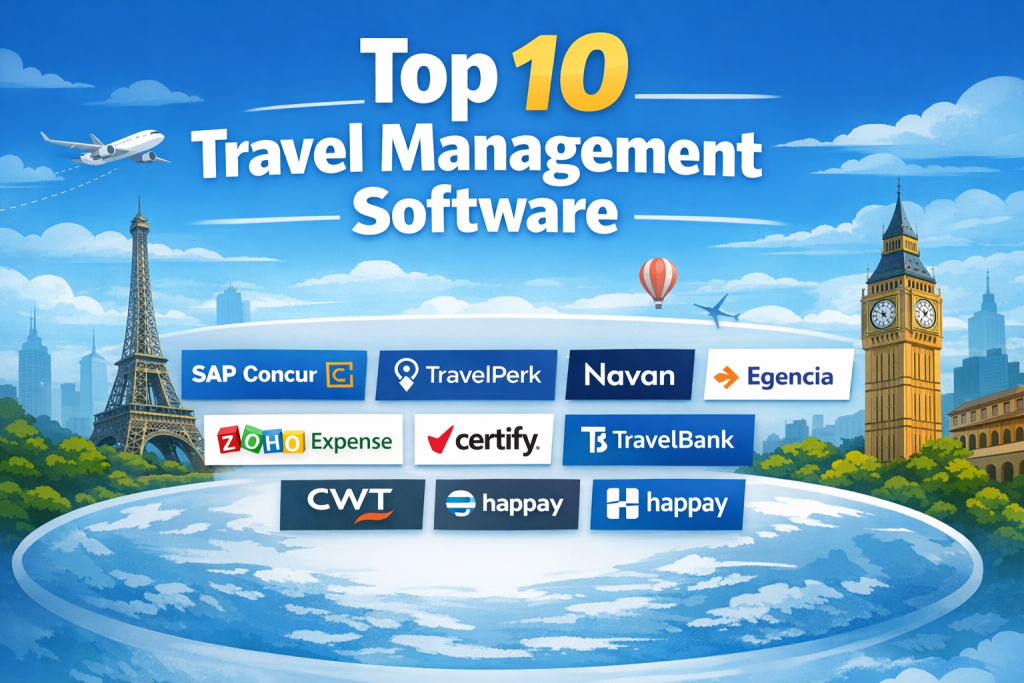
Introduction
Travel Management Software (TMS) is a centralized digital solution that helps organizations plan, book, track, and manage business travel efficiently. From flight and hotel reservations to expense tracking, policy enforcement, and traveler safety, these platforms simplify the complex workflows involved in corporate travel.
In today’s distributed and fast-moving business environment, unmanaged travel can lead to overspending, compliance risks, poor traveler experience, and lack of visibility. Travel Management Software solves these challenges by automating approvals, enforcing travel policies, providing real-time insights, and integrating with expense and HR systems.
Real-world use cases include:
- Corporate teams managing frequent domestic and international travel
- Finance teams controlling travel spend and reimbursements
- HR and operations teams ensuring traveler safety and compliance
- Travel agencies managing multiple corporate clients
When choosing a Travel Management Software, buyers should evaluate booking coverage, policy controls, expense integration, reporting, scalability, user experience, security, and customer support.
Best for:
Travel Management Software is ideal for SMBs, mid-sized companies, enterprises, travel-heavy industries, consulting firms, sales-driven organizations, and global teams that need visibility, control, and efficiency.
Not ideal for:
It may not be suitable for individual leisure travelers, very small teams with occasional travel, or organizations that prefer manual bookings or consumer travel apps.
Top 10 Travel Management Software Tools
1 — SAP Concur
Short description:
SAP Concur is an enterprise-grade travel and expense management platform designed for large organizations with complex travel policies and global operations.
Key features:
- End-to-end travel and expense management
- Automated policy enforcement
- Global travel booking inventory
- Real-time spend analytics
- Mobile expense capture
- Integration with ERP and HR systems
Pros:
- Extremely robust and scalable
- Strong reporting and compliance controls
- Trusted by global enterprises
Cons:
- Complex setup and configuration
- Higher cost compared to SMB-focused tools
Security & compliance:
SOC 2, GDPR, ISO-aligned controls, encryption, audit logs, SSO support
Support & community:
Enterprise-grade support, extensive documentation, strong partner ecosystem
2 — TravelPerk
Short description:
TravelPerk is a modern, user-friendly travel management platform focused on simplicity, flexibility, and cost control for growing businesses.
Key features:
- Centralized booking for flights, hotels, and transport
- Built-in travel policy management
- Real-time travel alerts
- Carbon footprint tracking
- Integrated expense management
- Flexible cancellation options
Pros:
- Clean and intuitive interface
- Fast onboarding
- Transparent pricing
Cons:
- Limited customization for very large enterprises
- Reporting depth is moderate
Security & compliance:
GDPR-compliant, encryption, SSO available
Support & community:
Strong onboarding, responsive support, growing user community
3 — Navan (formerly TripActions)
Short description:
Navan combines travel booking, expense management, and real-time insights into a single intelligent platform for modern organizations.
Key features:
- AI-driven travel recommendations
- Integrated travel and expense workflows
- Real-time policy compliance
- Rewards-based cost savings
- Advanced analytics
- Global inventory coverage
Pros:
- Excellent user experience
- Powerful automation
- Strong cost optimization features
Cons:
- Premium pricing
- Learning curve for advanced features
Security & compliance:
SOC 2, GDPR, SSO, encryption, audit trails
Support & community:
Dedicated account management, enterprise support, strong documentation
4 — Egencia
Short description:
Egencia is a corporate travel management solution backed by global travel expertise, focusing on policy-driven booking and traveler safety.
Key features:
- Corporate-grade travel booking
- Travel policy enforcement
- Risk management and duty of care
- Spend visibility dashboards
- Global travel support
- Mobile travel tools
Pros:
- Reliable global coverage
- Strong traveler safety features
- Good reporting tools
Cons:
- Interface feels dated
- Limited flexibility for customization
Security & compliance:
GDPR-compliant, encryption, audit logs, enterprise security standards
Support & community:
24/7 travel support, professional onboarding, enterprise-focused services
5 — Amadeus Cytric
Short description:
Amadeus Cytric is a comprehensive travel and expense platform designed for policy compliance, cost optimization, and sustainability.
Key features:
- Integrated travel and expense workflows
- Customizable approval flows
- Carbon emissions tracking
- Global content sourcing
- Policy-driven booking
- Advanced analytics
Pros:
- Strong compliance controls
- Good sustainability reporting
- Enterprise scalability
Cons:
- Setup can be time-consuming
- UI is less intuitive for new users
Security & compliance:
ISO-aligned controls, GDPR, encryption, audit logs
Support & community:
Enterprise support, professional services, detailed documentation
6 — Zoho Expense (Travel Module)
Short description:
Zoho Expense offers an affordable travel and expense solution tightly integrated with the Zoho ecosystem, ideal for SMBs.
Key features:
- Travel request and approval workflows
- Expense tracking and reimbursement
- Policy enforcement
- Receipt scanning
- Multi-currency support
- Zoho app integrations
Pros:
- Cost-effective
- Easy to use
- Strong value for small teams
Cons:
- Limited advanced travel booking options
- Best used within Zoho ecosystem
Security & compliance:
GDPR, encryption, role-based access, audit logs
Support & community:
Good documentation, responsive support, active SMB user base
7 — Certify Travel
Short description:
Certify Travel focuses on combining travel booking with expense compliance in a streamlined experience for mid-sized organizations.
Key features:
- Centralized travel booking
- Expense automation
- Policy controls
- Approval workflows
- Real-time spend insights
- Mobile expense capture
Pros:
- Easy adoption
- Strong expense compliance
- Good reporting
Cons:
- Limited global inventory
- Fewer advanced analytics features
Security & compliance:
SOC 2, encryption, audit logs, SSO support
Support & community:
Customer-centric support, onboarding assistance, mid-market focus
8 — TravelBank
Short description:
TravelBank blends travel booking with proactive budget controls, making it ideal for cost-conscious organizations.
Key features:
- Budget-first travel management
- Policy-driven bookings
- Integrated expense management
- Real-time budget tracking
- Automated approvals
- Mobile-first experience
Pros:
- Excellent cost visibility
- Simple user experience
- Transparent pricing
Cons:
- Limited enterprise features
- Reporting depth is basic
Security & compliance:
GDPR, encryption, role-based access
Support & community:
Strong onboarding, helpful support, growing user base
9 — CWT (Carlson Wagonlit Travel)
Short description:
CWT is a long-established corporate travel management platform offering global reach and personalized service.
Key features:
- Managed travel services
- Global booking and support
- Risk management tools
- Spend analytics
- Policy enforcement
- Dedicated travel consultants
Pros:
- Strong global service network
- Personalized support
- Reliable enterprise operations
Cons:
- Less modern UI
- Higher service costs
Security & compliance:
ISO standards, GDPR, enterprise security controls
Support & community:
Dedicated account managers, global support teams
10 — Happay Travel
Short description:
Happay Travel is a modern expense and travel platform popular in fast-growing markets, offering automation and spend control.
Key features:
- Integrated travel and expense workflows
- Automated policy checks
- Smart approvals
- Real-time spend dashboards
- Corporate card integration
- Mobile-first design
Pros:
- Strong automation
- Good regional support
- Easy adoption
Cons:
- Limited global presence
- Advanced reporting may be limited
Security & compliance:
Encryption, audit logs, role-based access, GDPR-aligned
Support & community:
Regional enterprise support, onboarding assistance
Comparison Table
| Tool Name | Best For | Platform(s) Supported | Standout Feature | Rating |
|---|---|---|---|---|
| SAP Concur | Large enterprises | Web, Mobile | Enterprise-grade compliance | N/A |
| TravelPerk | SMBs and mid-market | Web, Mobile | Flexible bookings | N/A |
| Navan | Fast-growing companies | Web, Mobile | AI-driven optimization | N/A |
| Egencia | Global corporations | Web, Mobile | Duty of care | N/A |
| Amadeus Cytric | Compliance-driven orgs | Web | Sustainability tracking | N/A |
| Zoho Expense | SMBs | Web, Mobile | Cost efficiency | N/A |
| Certify Travel | Mid-sized firms | Web, Mobile | Expense compliance | N/A |
| TravelBank | Budget-focused teams | Web, Mobile | Budget-first approach | N/A |
| CWT | Global enterprises | Web, Mobile | Managed travel services | N/A |
| Happay Travel | Growing businesses | Web, Mobile | Automation-first | N/A |
Evaluation & Scoring of Travel Management Software
| Evaluation Criteria | Weight | Description |
|---|---|---|
| Core features | 25% | Booking, expense, policy, reporting |
| Ease of use | 15% | User experience and onboarding |
| Integrations & ecosystem | 15% | ERP, HR, finance integrations |
| Security & compliance | 10% | Data protection and certifications |
| Performance & reliability | 10% | Stability and uptime |
| Support & community | 10% | Customer support quality |
| Price / value | 15% | ROI and affordability |
Which Travel Management Software Tool Is Right for You?
- Solo users: Lightweight expense tools or manual booking may be sufficient
- SMBs: Zoho Expense, TravelBank, TravelPerk
- Mid-market: Navan, Certify Travel, Happay Travel
- Enterprise: SAP Concur, Egencia, Amadeus Cytric, CWT
Budget-conscious teams should prioritize simplicity and transparency.
Premium buyers should focus on compliance, analytics, and scalability.
Integration-heavy organizations need strong ERP and HR connectivity.
Security-sensitive industries must prioritize audit logs, encryption, and compliance standards.
Frequently Asked Questions (FAQs)
1. What is Travel Management Software?
It is a platform that centralizes business travel booking, policy enforcement, expense tracking, and reporting.
2. Is Travel Management Software only for large companies?
No, many tools are designed specifically for SMBs and growing teams.
3. Does it replace travel agencies?
Some tools replace agencies, while others work alongside managed travel services.
4. How does it help reduce travel costs?
By enforcing policies, optimizing bookings, and improving spend visibility.
5. Is employee data secure?
Most tools offer encryption, access controls, and compliance certifications.
6. Can it integrate with accounting software?
Yes, most platforms integrate with accounting and ERP systems.
7. How long does implementation take?
It can range from a few days for SMB tools to several weeks for enterprise platforms.
8. Are mobile apps included?
Most modern tools provide mobile apps for travelers and managers.
9. What are common mistakes when choosing a tool?
Ignoring scalability, underestimating training needs, and overlooking integrations.
10. Can it handle international travel?
Yes, many platforms support global bookings, currencies, and compliance needs.
Conclusion
Travel Management Software plays a critical role in controlling costs, improving compliance, and enhancing the traveler experience. While each tool offers unique strengths, the right choice depends on company size, travel frequency, budget, integration needs, and security requirements.
There is no universal winner. Organizations should evaluate their priorities carefully and select a platform that aligns with both current needs and future growth. The best Travel Management Software is the one that fits seamlessly into your workflows while delivering measurable value.

Find Trusted Cardiac Hospitals
Compare heart hospitals by city and services — all in one place.
Explore Hospitals
Great points raised. The real operational drain in corporate travel is chasing down non-compliant expense receipts weeks after the trip has concluded. Systems that embed dynamic rate caps, preferred vendor routing, and automated pre-trip approvals directly into the checkout search flow prevent leakage upfront, rather than forcing finance teams to play policy police during month-end reimbursement reviews.
Solid comparison. The real dividing line when choosing travel software is deciding between legacy travel management suites like SAP Concur or Egencia versus modern platforms like Navan and TravelPerk. Legacy systems handle complex multi tier approval chains and negotiated corporate rates brilliantly, but newer platforms win dramatically on employee adoption. If the booking interface feels clunky, employees simply bypass the tool and book on consumer travel sites, which breaks company travel policy and destroys negotiated volume discounts.
What makes travel management software truly valuable is its ability to simplify the entire business travel experience, from booking approvals to expense reconciliation. I think real-time itinerary updates and clear visibility into travel spending are especially important for organizations managing frequent trips. When employees have flexibility and finance teams retain control over budgets and policy compliance, business travel becomes much easier to manage.
Travel management software helps organizations simplify business travel planning, booking, expense tracking, and policy compliance. When comparing different platforms, features such as centralized reservations, automated expense reporting, approval workflows, and real-time itinerary updates are important to consider. These tools can help businesses control travel costs while making the booking process more convenient for employees. Integration with accounting systems and corporate travel policies can further improve visibility and operational efficiency. Choosing the right travel management solution can streamline administrative tasks and support better travel planning.
A useful factor when comparing travel management software is how well it handles the real cost of a business trip after the booking is complete. Airfare and hotel rates are only part of the expense; baggage fees, local transport, currency conversion, and policy exceptions can increase the final amount. I would check whether the platform compares estimated costs with submitted expenses and highlights where spending exceeded the original budget. This gives finance teams a clearer view of travel costs and helps companies make better decisions about future bookings without creating unnecessary restrictions for employees.
One operational challenge that deserves more attention is how travel management systems handle last-minute disruptions across multiple bookings. When a flight is cancelled or a traveler misses a connection, the platform should help rebook the full itinerary, update expense records, and notify the right teams without creating duplicate reservations or payment issues. I would also test whether traveler location and emergency contact data remain accessible during a supplier outage. These scenarios reveal how well the system supports employees when business travel becomes unpredictable.
Travel management software is most useful when it balances company policies with employee needs. Clear booking rules can reduce extra costs, but travelers also need flexibility when plans change unexpectedly. I would check how easily the system handles cancellations, expense tracking, and approval workflows. Connecting bookings with expense reports can also reduce manual work for finance teams. How can businesses control travel spending without making work trips harder to manage?
Travel management software can save time, but it should also make travel easier for employees. Clear booking rules, quick approvals, and simple expense reports can help teams avoid confusion and extra costs. It is also important to have quick support when flights get cancelled or plans change suddenly. Companies should test these situations before choosing a tool. How can businesses make sure their travel software works well when plans change at the last minute?
Travel management software helps businesses plan trips, control costs, and manage travel bookings. One useful feature is showing whether a booking follows company policy before a traveler pays. This can reduce later approval issues. I would compare how each tool handles flight changes, cancellations, and expense reports. When plans change suddenly, travelers need clear options and quick support. Integration with company calendars and finance systems can also save time. Reports should help teams understand travel costs across departments and trips. The right platform should make business travel easier to manage while giving companies better cost control and travelers reliable help when plans change.
Travel management software can simplify corporate travel by bringing booking, expense tracking, approval workflows, and policy compliance into one system. Platforms such as SAP Concur, Navan, and TravelPerk offer different approaches to managing business trips, so the right choice depends on company size, travel frequency, budget controls, and integration with existing finance systems. I think traveler support and real-time visibility are especially important, since travel plans can change unexpectedly and employees need quick assistance when disruptions occur. A strong platform should balance cost control with a smooth booking experience while giving finance teams the reporting and oversight needed to manage travel spending effectively.
Travel management software should help organizations control travel spending while making the booking process straightforward for employees. When comparing platforms, I would examine policy enforcement, approval workflows, itinerary management, expense reconciliation, and support for handling last-minute disruptions. Another important factor is whether managers can see the full trip cost, including changes, cancellations, and additional fees, rather than only the original booking price. Testing the complete journey from travel request to reimbursement can reveal hidden administrative work and help businesses choose a system that improves visibility, supports employee safety, and keeps travel policies practical.
Enforcing travel policies while keeping employees happy is always a tough balancing act for operations teams. Moving away from manual bookings to platforms like TravelPerk or Navan streamlines approvals and gives finance better visibility over spend. However, getting departments to actually follow new expense workflows without feeling micromanaged remains the real hurdle. Transitioning smoothly requires clear communication rather than just dropping a new tool on the team.
Enforcing travel policies while keeping employees happy is always a tough balancing act for operations teams. Moving away from manual bookings to platforms like TravelPerk or Navan streamlines approvals and gives finance better visibility over spend. However, getting departments to actually follow new expense workflows without feeling micromanaged remains the real hurdle. Transitioning smoothly requires clear communication rather than just dropping a new tool on the team.
Travel management software can simplify corporate travel by bringing bookings, expense tracking, approval workflows, and policy compliance into one system. Integration with expense platforms and real-time travel alerts helps organizations control spending while giving employees greater flexibility during unexpected changes. Clear reporting and centralized itinerary management also improve visibility for finance teams and make business trips easier to coordinate.
Business travel rarely goes exactly as booked, especially when a flight cancellation forces changes to hotels, ground transport, and meeting schedules at the same time. I’d look at how travel management systems handle these linked changes and whether revised bookings remain within company policy without requiring employees to restart the approval process from scratch. Another useful consideration is how quickly travel managers can identify employees affected by a disruption and contact them with practical alternatives. That level of coordination can reduce both travel stress and avoidable last-minute expenses.
A travel management system needs to keep booking details and financial records in sync when plans change unexpectedly. For example, a flight cancellation should update the itinerary, trigger the right approval process, and capture any extra costs clearly. I’d test whether the platform handles refunds, partial cancellations, and policy exceptions without requiring staff to correct several records manually. It’s also useful to define who can approve urgent changes outside normal business hours. These checks help companies control travel spending while making disruptions easier for employees to manage.
Travel management software becomes much more useful when it balances cost control with employee convenience and safety. Companies should evaluate how well a platform handles policy compliance, last-minute itinerary changes, expense reporting, and traveler support during disruptions. Integrating booking and expense data can also help finance teams identify spending patterns and negotiate better rates. I would recommend testing the approval process for urgent trips, where delays can affect business operations. How can organizations reduce travel costs without making business travel unnecessarily complicated for employees?
Choosing the right travel management software really comes down to striking the right balance between policy enforcement and traveler flexibility. When systems become too rigid with automated approvals, employees often find workarounds using consumer booking tools instead. Focusing heavily on intuitive user experience and seamless expense integration is usually what drives actual adoption across growing teams.
A practical challenge with travel management platforms is keeping traveler information accurate when plans change across multiple systems. For example, an airline cancellation may trigger a new booking, but the updated itinerary might not reach the company’s emergency contact system or expense platform immediately. This can leave travel managers with outdated information during a disruption. Before choosing a solution, I would test how quickly itinerary changes propagate, how the system handles failed integrations, and whether administrators can identify travelers affected by an emergency. Measuring synchronization delays and maintaining a clear audit trail can help teams improve traveler safety and reduce manual coordination. These operational checks are especially important for companies managing frequent international trips across different time zones.
Travel management software should do more than help employees book flights and hotels. I think businesses should check how easily the system handles policy rules, last-minute changes, and expense tracking in one place. Clear approval steps can reduce delays, while useful reports help teams understand travel spending. It is also worth testing how quickly employees can get support when bookings change unexpectedly. How can companies make business travel easier for employees while keeping costs and policy rules under control?
Travel management software works best when it balances cost control with employee convenience and clear travel policies. Real-time itinerary updates, simple expense tracking, and quick approval workflows can reduce confusion for both travelers and finance teams. Strong reporting also helps businesses spot spending patterns and plan future trips more efficiently.
One aspect worth considering when comparing travel management platforms is how effectively they support employees during unexpected cancellations, itinerary changes, and travel disruptions. While SAP Concur focuses on enterprise compliance and TravelPerk offers flexible booking options, businesses should also evaluate refund processing, emergency assistance, and real-time expense synchronization. Testing these scenarios alongside policy compliance and total travel costs can help organizations improve employee satisfaction while maintaining stronger financial control.
Streamlining corporate trip bookings and expense reporting using software like TravelPerk or SAP Concur helps finance teams control travel spending without wading through messy spreadsheets. Centralizing flight reservations, hotel stays, and policy compliance into a single dashboard makes it much easier to track budgets and keep traveling employees safe. Choosing the right platform depends heavily on your company scale and whether you need quick cloud booking or deep enterprise compliance integration.
Managing business travel becomes more straightforward when bookings, expense tracking, approvals, and travel policies are handled through a single platform. This comparison gives organizations useful criteria for evaluating travel management software, including itinerary management, reporting capabilities, cost control, and traveler support, helping teams find a solution that fits their workflows and budget.
A travel management platform should be able to explain the financial impact of a trip after the journey is complete, not just help employees book within policy. For example, an itinerary may initially appear cost-effective but become more expensive after baggage fees, cancellation penalties, currency conversion charges, and last-minute changes are included. I would look for reconciliation between booking records, corporate card transactions, expense claims, and the final supplier invoices. Handling unused tickets and tracking credits that can be applied to future travel are also important, as these often represent overlooked savings for larger organizations. When travel and finance data are connected properly, companies can identify where policy exceptions create unnecessary costs and make future travel decisions based on the actual total cost of each trip.
Policy automation and booking aggregation solve only the front-end challenges of corporate travel. Operational success requires bidirectional webhooks connecting expense engines to ERP ledgers (such as SAP, NetSuite, or Workday), combined with automated PNR (Passenger Name Record) lifecycle synchronizations and real-time duty-of-care alerts to track traveler safety during disruptions.
Travel management software can make business trips easier to control when bookings, expenses, and company policies are connected. I’d check whether employees can submit receipts from their phones, track approval status, and see the full cost of a trip before booking. Good reporting by department can also help businesses plan travel budgets more accurately.
A travel management platform needs to handle more than routine bookings to prove its value in daily operations. When employees change plans at short notice, the system should update itineraries, notify the right people, and keep expense records consistent across connected tools. I’d also look at how it handles after-hours support, approval delays, and failed integrations, since these issues can create extra work for finance and travel teams. Clear audit logs and reliable recovery procedures can make a real difference when a booking or payment needs investigation later.
Choosing the right travel management platform really comes down to balancing automated policy enforcement with a frictionless booking experience for employees. When software feels too rigid or overly complex, adoption drops and teams tend to bypass official channels entirely. Matching the tool’s complexity to the organization’s actual travel frequency is definitely key to long-term success.
Travel management software should simplify the entire business travel process, from booking and policy approval to expense reporting and reimbursement. When comparing platforms, I would examine how well they enforce company travel policies, handle last-minute itinerary changes, consolidate receipts, and provide visibility into total trip costs. Traveler support is another important factor, particularly when flights are canceled or employees need assistance outside business hours. Testing a complete booking and expense workflow can help organizations identify hidden administrative steps and determine whether the software improves cost control without making travel more difficult for employees.
One area worth evaluating is how these platforms handle operational failures rather than just routine bookings and expense workflows. For example, when a booking API times out, an expense sync fails, or an airline changes a flight at short notice, teams need clear error handling, retry mechanisms, audit trails, and timely alerts. I would also test how the platform prevents duplicate expense records during repeated sync attempts and reconciles conflicting data between HR, finance, and travel systems. These edge cases can create hidden support costs and compliance issues after deployment. Including failure recovery, data reconciliation, and integration monitoring in the evaluation process would help organizations judge long-term reliability more accurately.
Travel management software is most useful when it simplifies bookings while helping businesses control travel costs. Companies should look beyond booking features and evaluate policy enforcement, expense tracking, approval workflows, and support during unexpected disruptions. Integration with accounting systems can also reduce manual work and improve expense reporting. A user-friendly platform makes it easier for employees to follow travel policies without unnecessary delays. How can businesses balance cost savings with employee flexibility when choosing a travel management solution?
Travel management software becomes more useful when it handles policy compliance and unexpected disruptions as smoothly as routine bookings. I would check how easily employees can change trips, receive cancellation alerts, and access support when flights are delayed or plans change. Clear approval workflows and real-time expense tracking can also reduce administrative work for finance teams. Integration with existing HR and accounting systems helps maintain accurate traveler records and simplifies reconciliation. Strong reporting on travel spending, policy exceptions, and unused bookings can help businesses control costs without making travel unnecessarily difficult for employees.
This comparison of top travel management software is a great resource for travel planners and business professionals. You’ve clearly outlined how key features such as itinerary management, travel policy compliance, expense integration, and reporting capabilities vary across platforms — which are crucial factors when selecting the right tool for an organization. The pros and cons format makes it easy to understand both strengths and limitations at a glance, helping decision-makers match solutions with their specific needs. For teams looking to simplify travel booking, enforce policies, and enhance traveler experience, this guide provides practical and actionable insights to support an informed choice.