
Introduction
Contract Analytics Tools are specialized software solutions that use artificial intelligence (AI), machine learning (ML), and advanced text analysis to extract, analyze, and monitor information from contracts. Instead of manually reading hundreds or thousands of agreements, these tools automatically identify clauses, obligations, risks, deadlines, and patterns hidden inside contract documents.
In today’s business environment, contracts govern everything—from vendor relationships and customer agreements to employment terms and compliance obligations. As organizations scale, managing contracts manually becomes risky, slow, and error-prone. Contract analytics tools help teams reduce legal risk, improve compliance, optimize costs, and gain strategic insights from their contract data.
Why Contract Analytics Tools Are Important
- Contracts contain critical financial, legal, and operational data.
- Missed clauses or deadlines can lead to penalties, disputes, or revenue leakage.
- Regulatory pressure demands better visibility and auditability.
- Businesses need faster, data-driven decision-making.
Real-World Use Cases
- Identifying non-standard or risky clauses across thousands of contracts
- Tracking renewals, expirations, and compliance obligations
- Analyzing pricing, indemnity, and liability trends
- Supporting M&A due diligence and contract audits
- Improving procurement and vendor negotiations
What to Look for When Choosing a Contract Analytics Tool
When evaluating contract analytics platforms, buyers should consider:
- Accuracy of clause extraction and classification
- AI and natural language processing capabilities
- Ease of use for legal and non-legal users
- Integration with contract lifecycle management (CLM), ERP, and CRM tools
- Security, compliance, and audit readiness
- Scalability for growing contract volumes
- Total cost of ownership and ROI
Best for:
Legal teams, procurement professionals, compliance officers, finance teams, and enterprise organizations handling large contract volumes across industries such as IT, healthcare, manufacturing, finance, retail, and energy.
Not ideal for:
Very small teams with only a handful of contracts, organizations that already manage contracts effectively through basic document storage, or users seeking simple document signing rather than deep analytics.
Top 10 Contract Analytics Tools
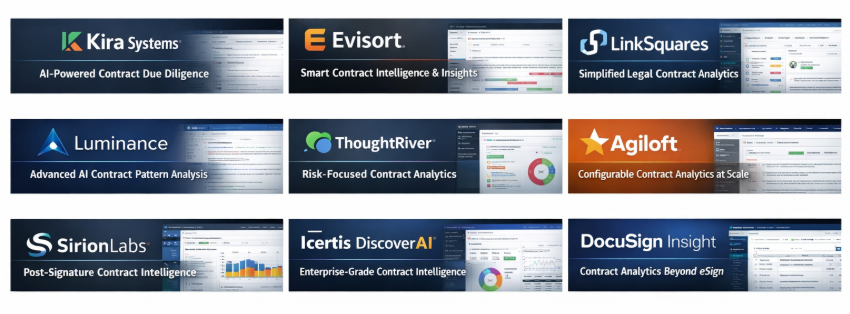
1 — Kira Systems
Short description:
Kira Systems is a leading AI-powered contract analytics platform widely used by law firms and enterprises for due diligence and contract review.
Key features:
- Machine learning-based clause identification
- Pre-trained clause library
- Custom model training
- Bulk contract analysis
- Advanced search and filtering
- Support for multiple document formats
Pros:
- High accuracy for complex legal language
- Strong adoption in legal and M&A use cases
- Flexible customization
Cons:
- Steeper learning curve for new users
- Premium pricing
Security & compliance:
Enterprise-grade encryption, role-based access, audit logs, GDPR support
Support & community:
Strong documentation, enterprise onboarding, responsive support, active legal user base
2 — Evisort
Short description:
Evisort focuses on AI-driven contract intelligence with strong integrations and real-time insights for legal and business teams.
Key features:
- Automated contract ingestion
- Clause and metadata extraction
- Contract lifecycle analytics
- Integration with business systems
- Searchable contract repository
- Obligation tracking
Pros:
- Fast deployment
- User-friendly interface
- Strong automation
Cons:
- Advanced customization may require support
- Some features gated by higher plans
Security & compliance:
SOC 2, GDPR, encryption at rest and in transit
Support & community:
Good onboarding, guided workflows, enterprise support
3 — LinkSquares
Short description:
LinkSquares combines contract analytics with lifecycle management, designed primarily for in-house legal teams.
Key features:
- AI-based clause detection
- Centralized contract repository
- Legal reporting and dashboards
- Approval and workflow automation
- Renewal and obligation alerts
Pros:
- Clean and intuitive UI
- Strong reporting for legal teams
- Integrated CLM capabilities
Cons:
- Less flexible for non-legal use cases
- Limited advanced analytics customization
Security & compliance:
SOC 2, GDPR, enterprise access controls
Support & community:
Dedicated account managers, structured onboarding
4 — Luminance
Short description:
Luminance uses advanced AI inspired by pattern recognition to analyze contracts at scale, especially in legal reviews.
Key features:
- Pattern-based contract analysis
- Visual clause comparison
- Risk flagging
- Bulk document processing
- Multilingual support
Pros:
- Excellent for large-scale reviews
- Strong visualization capabilities
- Global language support
Cons:
- Higher cost
- Interface can feel complex
Security & compliance:
ISO-aligned controls, GDPR compliance, secure hosting options
Support & community:
Enterprise support, training programs, global user base
5 — ThoughtRiver
Short description:
ThoughtRiver emphasizes risk-focused contract analysis, helping teams quickly understand legal exposure.
Key features:
- Risk scoring of contracts
- Clause deviation analysis
- Playbook-based reviews
- Collaboration tools
- Workflow approvals
Pros:
- Clear risk visualization
- Good for standard contract reviews
- Helps non-lawyers understand risk
Cons:
- Less flexible for niche clauses
- Smaller ecosystem
Security & compliance:
Enterprise security controls, GDPR support
Support & community:
Hands-on onboarding, responsive customer success team
6 — Agiloft Contract Analytics
Short description:
Agiloft offers configurable contract analytics as part of its broader contract lifecycle management platform.
Key features:
- Customizable clause extraction
- Integrated CLM workflows
- Reporting and dashboards
- AI-assisted contract review
- Role-based permissions
Pros:
- Highly configurable
- Strong enterprise scalability
- End-to-end contract management
Cons:
- Setup can be time-intensive
- UI may feel dated to some users
Security & compliance:
SOC 2, GDPR, audit trails, encryption
Support & community:
Extensive documentation, enterprise support, partner ecosystem
7 — SirionLabs
Short description:
SirionLabs focuses on post-signature contract analytics and performance management, especially for complex supplier contracts.
Key features:
- Obligation and compliance tracking
- Performance analytics
- Financial and SLA monitoring
- AI-based clause extraction
- Integration with ERP systems
Pros:
- Excellent for supplier and outsourcing contracts
- Strong analytics depth
- Enterprise-grade scalability
Cons:
- More complex implementation
- Best suited for large organizations
Security & compliance:
ISO, SOC 2, GDPR, strong audit controls
Support & community:
Enterprise onboarding, dedicated support teams
8 — Icertis DiscoverAI
Short description:
DiscoverAI is the analytics engine within Icertis, designed for enterprises needing deep contract intelligence.
Key features:
- AI-powered clause discovery
- Risk and obligation insights
- Integration with Icertis CLM
- Advanced reporting
- Large-scale contract ingestion
Pros:
- Strong enterprise focus
- Robust analytics
- Seamless CLM integration
Cons:
- Requires Icertis ecosystem
- Higher cost
Security & compliance:
Enterprise-grade security, SOC 2, GDPR
Support & community:
Global support, structured training programs
9 — DocuSign Insight
Short description:
DocuSign Insight adds analytics to signed contracts, extending beyond e-signature into intelligence.
Key features:
- Clause extraction from executed contracts
- Searchable contract repository
- Integration with DocuSign ecosystem
- Reporting and alerts
- AI-driven insights
Pros:
- Seamless with DocuSign workflows
- Easy adoption for existing users
- Strong brand trust
Cons:
- Less flexible outside DocuSign stack
- Advanced analytics limited compared to specialists
Security & compliance:
SOC 2, ISO, GDPR, encryption
Support & community:
Large documentation library, global support
10 — TermScout
Short Description:
TermScout is an AI-powered contract analysis and certification platform designed to help organizations evaluate contracts against market standards, reduce negotiation friction, and improve trust between parties. It combines advanced artificial intelligence with expert legal validation to analyze contract language, identify risk factors, and measure contract fairness. By turning complex agreements into clear, data-driven insights, TermScout enables legal, procurement, sales, and finance teams to accelerate deal cycles and improve contract transparency.
Key Features:
• AI-Powered Contract Analysis
TermScout uses advanced artificial intelligence to automatically review contracts, identify key clauses, and highlight potential risks. This significantly reduces manual review time and improves contract understanding across teams.
• Market Benchmarking and Favorability Scoring
The platform benchmarks contract terms against real-world market standards to determine whether clauses are favorable, balanced, or risky. This helps organizations negotiate from a stronger position and make informed decisions.
• Contract Certification and Transparency
TermScout provides independent contract certification, allowing businesses to demonstrate that their agreements meet recognized fairness standards. This certification improves trust and confidence among customers and partners.
• Risk Detection and Clause Insights
TermScout automatically flags unusual or high-risk clauses and provides detailed explanations, helping teams address issues before finalizing agreements. This improves contract quality and reduces future disputes.
• Collaboration Across Teams
The platform supports collaboration between legal, sales, procurement, and finance teams, ensuring all stakeholders have access to consistent contract insights and reports.
• Human Legal Expert Review
TermScout combines machine intelligence with human legal expertise to validate contract analysis results, ensuring high accuracy and reliability.
• Data-Driven Contract Insights
TermScout converts contract language into structured data, enabling organizations to analyze contract trends, track risks, and optimize contract performance across their business.
Pros:
• Strong AI-driven contract analysis capabilities
• Provides independent certification that builds trust
• Reduces contract negotiation time
• Improves risk identification and compliance management
• Offers benchmarking insights based on real contract data
• Supports collaboration between multiple business teams
Cons:
• Pricing may be expensive for small organizations
• Focuses more on analytics than full contract lifecycle management
• May require onboarding time for teams to fully utilize insights
• Limited contract drafting features compared to some CLM tools
Best For:
• Legal and compliance teams
• Procurement and vendor management teams
• Sales and revenue operations teams
• Enterprise and SaaS organizations
• Businesses managing large volumes of contracts
• Organizations aiming to improve transparency and trust in agreements
Comparison Table
| Tool Name | Best For | Platform(s) Supported | Standout Feature | Rating |
|---|---|---|---|---|
| Kira Systems | Legal due diligence | Web | High-accuracy AI models | N/A |
| Evisort | Contract intelligence | Web | Fast AI ingestion | N/A |
| LinkSquares | In-house legal teams | Web | Legal-friendly UI | N/A |
| Luminance | Large-scale reviews | Web | Visual AI analysis | N/A |
| ThoughtRiver | Risk assessment | Web | Risk scoring | N/A |
| Agiloft | Enterprise CLM | Web | Extreme configurability | N/A |
| SirionLabs | Supplier contracts | Web | Post-signature analytics | N/A |
| Icertis DiscoverAI | Enterprise analytics | Web | Deep AI insights | N/A |
| DocuSign Insight | Signed contracts | Web | Ecosystem integration | N/A |
| Seal Software | Legacy contracts | Web | Massive data handling | N/A |
Evaluation & Scoring of Contract Analytics Tools
| Tool | Core Features (25%) | Ease of Use (15%) | Integrations (15%) | Security (10%) | Performance (10%) | Support (10%) | Price/Value (15%) | Total Score |
|---|---|---|---|---|---|---|---|---|
| Kira Systems | 23 | 12 | 12 | 9 | 9 | 9 | 10 | 84 |
| Evisort | 22 | 14 | 13 | 9 | 9 | 9 | 11 | 87 |
| LinkSquares | 21 | 14 | 12 | 9 | 8 | 9 | 11 | 84 |
| Luminance | 23 | 11 | 11 | 9 | 9 | 8 | 9 | 80 |
| ThoughtRiver | 20 | 13 | 10 | 8 | 8 | 8 | 12 | 79 |
| Agiloft | 22 | 11 | 14 | 9 | 9 | 9 | 11 | 85 |
| SirionLabs | 23 | 10 | 14 | 9 | 9 | 8 | 10 | 83 |
| Icertis DiscoverAI | 24 | 10 | 14 | 9 | 9 | 9 | 9 | 83 |
| DocuSign Insight | 20 | 14 | 13 | 9 | 8 | 9 | 11 | 84 |
| Seal Software | 23 | 9 | 11 | 9 | 9 | 8 | 9 | 78 |
Which Contract Analytics Tool Is Right for You?
- Solo users: Lightweight tools or basic analytics within CLM platforms
- SMBs: Tools with fast onboarding and clear insights like Evisort or LinkSquares
- Mid-market: Balanced platforms offering analytics plus lifecycle management
- Enterprise: Advanced AI solutions like Kira, Icertis, SirionLabs
Budget-conscious: Focus on ease of use and ROI rather than advanced customization
Premium buyers: Invest in deep AI accuracy and scalability
Feature depth vs ease of use:
Legal teams may prefer depth, while business users value simplicity.
Integration needs:
Ensure compatibility with existing CRM, ERP, and document systems.
Security & compliance:
Critical for regulated industries and global enterprises.
Frequently Asked Questions (FAQs)
1. What is contract analytics?
It is the use of AI and data analysis to extract insights, risks, and obligations from contracts.
2. How accurate are contract analytics tools?
Accuracy varies, but leading tools achieve high precision with trained models.
3. Are these tools only for lawyers?
No, procurement, finance, and compliance teams also benefit.
4. Do I need CLM to use contract analytics?
Not always, but integration improves value.
5. How long does implementation take?
From a few weeks to several months, depending on complexity.
6. Can these tools analyze old contracts?
Yes, many specialize in legacy contract discovery.
7. Are they secure?
Most enterprise tools meet strict security standards.
8. Do they support multiple languages?
Some tools offer multilingual support, others are language-specific.
9. What is the biggest mistake buyers make?
Ignoring ease of use and change management.
10. Are there alternatives?
Manual review or basic document management, but with limited insight.
Conclusion
Contract analytics tools transform contracts from static documents into strategic business assets. They reduce risk, improve compliance, uncover hidden value, and empower teams with actionable insights.
The most important factors when choosing a tool are accuracy, usability, integration, security, and scalability. There is no single “best” solution for everyone—each organization must align its choice with its contract volume, risk profile, budget, and business goals.
By carefully evaluating your needs and understanding the strengths of each platform, you can select a contract analytics tool that delivers long-term value and confidence in every agreement you manage.

Find Trusted Cardiac Hospitals
Compare heart hospitals by city and services — all in one place.
Explore Hospitals
Contract analytics is valuable when it helps teams find obligations that are easy to overlook in long agreements. A clause may mention an automatic renewal, price adjustment, or notice period that becomes important months later. I would check whether the software can connect extracted clauses to specific deadlines and responsible owners, rather than simply highlighting text. That makes contract data more useful for everyday decisions and reduces the risk of missing important commitments.
Spot on. The most critical operational failure point in AI driven contract analytics is precision drift across non standard legal clauses and bespoke indemnification terms. When analytics platforms rely solely on generic pre trained models, they easily identify standard force majeure and governing law provisions but consistently misinterpret heavily negotiated, non standard liability carve outs. If an organization trusts automated extraction without rigorous human in the loop auditing and clause validation workflows, hidden renewal penalties, uncapped liabilities, and contradictory assignment terms slip past risk teams, leading to massive financial exposure post transaction.
Contract analytics tools can deliver significant value by helping organizations identify hidden risks, track important obligations, and spot renewal deadlines before they become costly issues. Combining accurate clause extraction with searchable contract repositories and automated alerts can improve compliance, reduce manual review efforts, and help legal and procurement teams make more informed decisions.
Contract analytics becomes much more useful when teams can compare how obligations are actually being fulfilled after an agreement is signed. A tool may identify renewal dates, payment terms, or service-level commitments, but the real challenge is connecting those clauses with what happens in day-to-day operations. For example, a missed delivery commitment or an unapproved price change should be traceable back to the relevant contract language and responsible business team. I would pay attention to whether these tools support obligation tracking and clear ownership, rather than focusing only on how quickly they extract clauses. That connection can make contract data useful beyond the legal department.
Contract analytics tools help organizations extract meaningful insights from complex agreements, making it easier to identify obligations, track key dates, and manage contractual risks. Features such as AI-powered clause extraction, risk identification, metadata analysis, renewal alerts, and integration with contract lifecycle management systems can significantly reduce manual review efforts. I believe accuracy, support for different contract formats, data security, and the ability to identify non-standard clauses are essential factors when comparing these solutions. The right platform should go beyond document extraction by helping legal and business teams uncover hidden risks, improve compliance, and make faster, more informed decisions throughout the contract lifecycle.
Contract analytics tools should be assessed on how well they handle clauses whose meaning depends on surrounding language rather than isolated keywords. For example, a limitation of liability may have exceptions for specific types of loss, or a renewal clause may interact with a separate notice-period provision. Extracting these clauses correctly is only the first step; reviewers need enough context to understand how the provisions work together. I would test the platform against contracts from different jurisdictions, document formats, and drafting styles, including older agreements with inconsistent terminology. It is also important to see whether reviewers can correct extraction errors and use those corrections to improve future review workflows. A useful system should clearly distinguish machine-generated suggestions from verified legal conclusions, allowing legal teams to prioritize human review where contractual ambiguity or business risk is greatest.
Contract analytics tools can help legal and business teams find key terms, renewal dates, risks, and missing details across large numbers of contracts. I would check how accurately a tool reads different contract formats and flags unusual clauses for review. Clear search results and links to the original text help users verify findings instead of relying only on automated results. Data privacy and easy integration with existing document systems also matter. How can teams use contract analytics to save review time while keeping important legal decisions under human control?
Contract analytics tools help businesses review agreements, identify risks, and extract important information efficiently. Automated analysis can reduce manual work and help teams spot unusual clauses or compliance issues. Features like clause detection, risk assessment, and searchable contract databases are especially useful. Organizations should compare accuracy, data security, and integration capabilities before choosing a solution. The right tool can improve contract management and support better business decisions.
Contract analytics tools help organizations uncover obligations, renewal dates, unusual clauses, and potential risks hidden across large volumes of legal documents. Accurate clause extraction, searchable contract repositories, and automated alerts can reduce manual review efforts while improving compliance oversight. Combining AI-driven analysis with human legal validation ensures that important terms receive proper attention before they affect business decisions.
One important factor in contract analytics is how accurately AI tools identify unusual clauses and obligations across different contract formats without missing critical legal risks. While Kira Systems emphasizes clause extraction and SirionLabs focuses on post-signature obligations, human validation remains essential for complex agreements.
Advanced AI extraction and clause-level analytics are transforming how organizations review legacy agreements and monitor ongoing obligations, but raw software capability means little without proper legal oversight. If automated metadata tagging and risk-scoring models lack alignment with internal compliance playbooks, legal teams will spend more time correcting false positives than mitigating actual risks. Striking the right balance between powerful natural language processing and rigorous human-in-the-loop validation is essential for turning static contracts into actionable intelligence.
Contract analytics tools help teams review agreements and find important terms more quickly. They can support searches for renewal dates, payment terms, risks, and missing clauses. Results still need human review, especially when wording is unclear or unusual. Teams should assess document accuracy, supported file types, privacy controls, and links with contract systems. Clear reports can help legal and business teams share findings. When choosing a tool, test it with real contracts and common tasks. This gives a better view of its value than feature lists alone.
Contract analytics becomes more useful when teams can measure how extracted information performs against real legal reviews. I’d regularly sample contracts to check whether key obligations, renewal windows, liability limits, and termination conditions were classified correctly. Any errors should feed into a review process so teams can spot recurring problems across document types. It is also worth tracking which fields need frequent manual correction, since those patterns may reveal weak templates or extraction rules. This helps maintain confidence in the results as contract volumes and formats grow.
Contract analytics tools help legal and business teams review agreements, identify risks, and track important clauses more efficiently. When comparing platforms, I would focus on clause extraction, risk detection, reporting, and integration with contract management systems. Accurate analysis and clear explanations are important for reducing manual review while keeping decisions reliable. The right tool should help teams understand contract obligations, spot potential issues, and manage agreements with greater confidence.
Contract analytics tools can help teams spot risky clauses, missing terms, and renewal dates before these issues become costly problems. However, automated findings still need human review, especially when contract language depends on legal or business context. Checking extraction accuracy and keeping clear links to the original clauses can make reviews more reliable and easier to audit.
Contract analytics tools can help legal and business teams identify important clauses, track obligations, and spot risks across large volumes of agreements. When comparing platforms, I would focus on extraction accuracy, clause search, risk flagging, and integration with existing contract management systems. It is also important to review how well a tool handles different contract formats and unusual wording, since errors can affect important decisions. Human review and clear audit trails remain essential for complex or high-risk agreements. How can organizations use contract analytics to speed up reviews while ensuring important legal details are not overlooked?
Choosing the right contract analytics tool isn’t just about feature lists; it really comes down to whether your team needs deep AI-driven risk assessment or simpler lifecycle tracking. Platforms like Kira Systems and Luminance excel at complex M&A due diligence, but smaller legal teams might find simpler repository integrations more practical. Balancing advanced customization against onboarding time is key to avoiding low user adoption. Thanks for breaking down these pros and cons so clearly.
A key concern with automated contract review is whether the system can handle documents that differ from its usual training examples. Small wording changes, handwritten amendments, or clauses spread across several sections may cause the software to overlook important obligations. Before relying on automated findings, teams should compare results with reviews completed by qualified legal professionals and record where the system makes mistakes. Testing should include unusual agreements and high-risk clauses, not just standard templates. Organizations should also keep a review history so they can trace which model or rule produced a particular finding. These practices make it easier to detect declining accuracy and maintain confidence in automated contract analysis as business requirements change.
Integrating AI-driven NLP into contract analytics pipelines accelerates clause extraction, but legal teams must combine automated risk scoring with enterprise repository syncs to ensure total visibility across legacy agreements and ongoing commercial obligations.
Contract analytics becomes more useful when teams can spot unusual clauses across many agreements without reviewing every document from scratch. I’d pay attention to whether the tool explains why a clause was flagged and lets reviewers confirm or correct the result. That feedback can help reduce repeated false alerts and make future contract reviews more reliable.
Contract analytics tools help legal and business teams extract important information from agreements, identify potential risks, and track key obligations more efficiently. Comparing AI-powered clause analysis, risk detection, searchable contract repositories, and reporting capabilities helps organizations evaluate solutions that reduce manual review effort and support more consistent contract management.
This article provides a clear and insightful comparison of the top contract analytics tools by outlining their key features, strengths, and limitations in a practical format. I especially appreciate how it highlights capabilities like AI‑powered insights, search accuracy, and workflow integration — elements that truly matter when choosing a solution to streamline contract review and risk management. For legal and business professionals looking to optimize contract processes, this guide offers valuable, easy‑to‑understand insights to support informed decision‑making.