
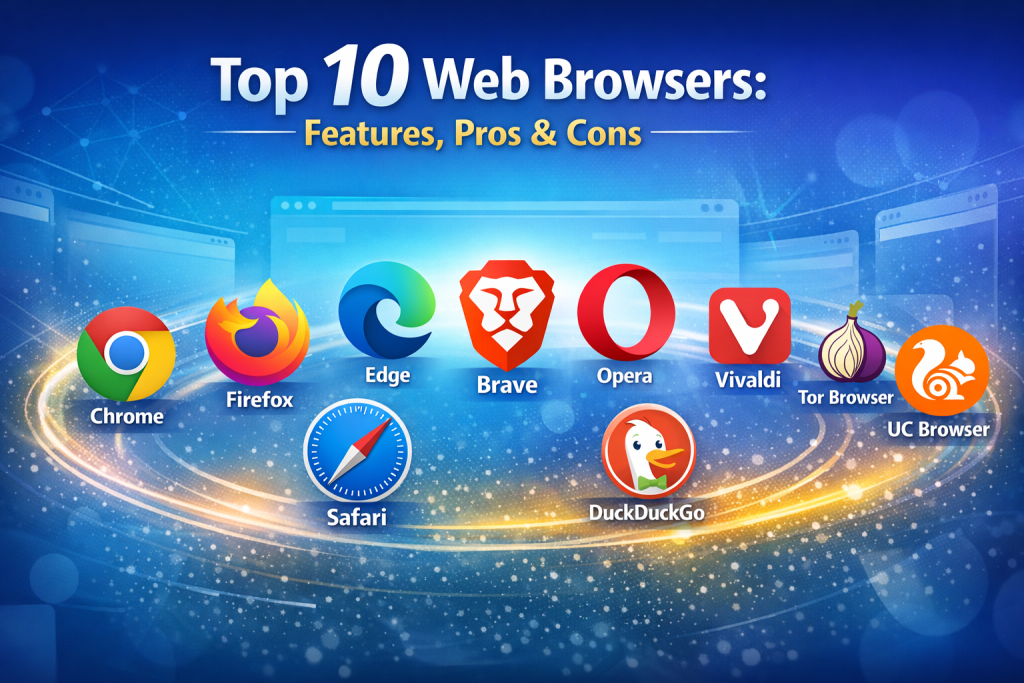
Introduction
Web browsers are the primary gateway to the internet. Every search, email, video stream, cloud app, or online transaction begins with a browser. At their core, web browsers are software applications that retrieve, render, and interact with web content—transforming raw code into usable websites and applications. Over time, browsers have evolved from simple page viewers into powerful platforms supporting extensions, developer tools, security controls, productivity features, and cross-device synchronization.
Choosing the right web browser matters more than many users realize. Performance affects how fast pages load and how responsive applications feel. Security features protect users from phishing, malware, and data leaks. Privacy controls determine how much personal data is collected or shared. Compatibility impacts whether modern web apps run smoothly. For businesses, browsers also influence compliance, identity management, and endpoint security.
Common real-world use cases include:
- Everyday browsing, research, and communication
- Remote work using SaaS tools and cloud platforms
- Software development and testing
- Online banking, payments, and secure transactions
- Media consumption and gaming
When evaluating web browsers, users should consider speed, security, privacy controls, extension ecosystem, cross-platform support, usability, and long-term support. The “best” browser is not universal—it depends on how and where it will be used.
Best for:
Web browsers benefit individual users, students, developers, remote workers, enterprises, educational institutions, and regulated industries that rely on secure and efficient access to online tools.
Not ideal for:
Users with very limited internet access, legacy-only environments, or highly specialized offline workflows may not require modern browsers or may need niche alternatives.
Top 10 Web Browsers Tools
1 — Google Chrome
Short description:
A fast, widely adopted browser known for excellent compatibility and a massive extension ecosystem. Designed for consumers, professionals, and enterprises alike.
Key features:
- High-performance Chromium-based engine
- Large extension and add-on marketplace
- Seamless sync across devices
- Built-in password manager and autofill
- Strong developer tools
- Frequent security updates
Pros:
- Excellent website compatibility
- Fast performance on modern hardware
- Rich extension ecosystem
Cons:
- High memory usage
- Privacy concerns for some users
- Can feel heavy on low-end systems
Security & compliance:
Encryption in transit, sandboxing, Safe Browsing, enterprise policies, GDPR support (varies by deployment).
Support & community:
Extensive documentation, global community, enterprise support available.
2 — Mozilla Firefox
Short description:
An open-source browser focused on privacy, customization, and transparency. Popular with privacy-conscious users and developers.
Key features:
- Strong privacy protections by default
- Open-source development model
- Extensive customization options
- Built-in tracking protection
- Developer-friendly tools
- Cross-platform sync
Pros:
- Privacy-first approach
- Highly customizable
- Independent browser engine
Cons:
- Smaller extension library than Chrome
- Some sites optimized less aggressively
- Slightly slower on certain workloads
Security & compliance:
Strong encryption, enhanced tracking protection, GDPR-aligned privacy controls.
Support & community:
Excellent community support, clear documentation, limited enterprise offerings.
3 — Microsoft Edge
Short description:
A modern Chromium-based browser tightly integrated with Windows and Microsoft services, suitable for both consumers and enterprises.
Key features:
- Chromium compatibility
- Deep Windows and Microsoft 365 integration
- Built-in security and smart features
- Vertical tabs and productivity tools
- Enterprise policy management
- Performance optimization modes
Pros:
- Strong enterprise management
- Good performance and efficiency
- Compatible with Chrome extensions
Cons:
- Best experience mainly on Windows
- Some features feel unnecessary to minimalists
- Microsoft-centric ecosystem
Security & compliance:
Enterprise-grade security, SSO, encryption, compliance controls (GDPR, ISO support varies).
Support & community:
Strong enterprise support, good documentation, growing user community.
4 — Apple Safari
Short description:
A streamlined browser optimized for Apple devices, emphasizing efficiency, battery life, and privacy.
Key features:
- Optimized for macOS and iOS
- Energy-efficient performance
- Intelligent Tracking Prevention
- Tight OS integration
- Built-in privacy reports
- Smooth user experience
Pros:
- Excellent battery efficiency
- Strong privacy defaults
- Clean and minimal interface
Cons:
- Limited to Apple ecosystem
- Smaller extension ecosystem
- Less flexible for developers
Security & compliance:
Strong sandboxing, privacy protections, encryption; compliance varies by usage context.
Support & community:
Official Apple support, smaller third-party community.
5 — Brave
Short description:
A privacy-focused browser that blocks ads and trackers by default while maintaining strong performance.
Key features:
- Built-in ad and tracker blocking
- Chromium-based compatibility
- Privacy-focused defaults
- Optional rewards system
- Fast page loading
- Cross-platform support
Pros:
- Strong privacy out of the box
- Faster load times on many sites
- Chrome extension compatibility
Cons:
- Some sites break due to blocking
- Rewards model not for everyone
- Smaller enterprise adoption
Security & compliance:
HTTPS enforcement, tracker blocking, encryption; compliance varies.
Support & community:
Active community, solid documentation, limited enterprise support.
6 — Opera
Short description:
A feature-rich browser offering built-in utilities for productivity and media consumption.
Key features:
- Integrated VPN-like feature
- Built-in ad blocker
- Sidebar apps and messengers
- Data-saving mode
- Customizable interface
Pros:
- Many built-in tools
- Lightweight feel
- Good for media-heavy browsing
Cons:
- Privacy concerns for some users
- Smaller extension ecosystem
- Limited enterprise features
Security & compliance:
Standard encryption, ad blocking; compliance varies.
Support & community:
Decent documentation, moderate community support.
7 — Vivaldi
Short description:
A highly customizable browser designed for power users who want complete control over their browsing experience.
Key features:
- Deep UI customization
- Tab stacking and tiling
- Built-in notes and tools
- Chromium compatibility
- Keyboard shortcut control
Pros:
- Extremely flexible interface
- Strong productivity features
- Power-user friendly
Cons:
- Steeper learning curve
- Can feel overwhelming
- Smaller support ecosystem
Security & compliance:
Standard Chromium security, privacy-focused options; compliance varies.
Support & community:
Active community forums, limited enterprise support.
8 — Tor Browser
Short description:
A privacy-centric browser designed for anonymous browsing and censorship resistance.
Key features:
- Onion routing for anonymity
- Strong anti-tracking protections
- Isolated sessions
- Built-in privacy safeguards
- No browsing history retention
Pros:
- Maximum privacy and anonymity
- Ideal for sensitive use cases
- Resistant to tracking
Cons:
- Slower browsing speeds
- Limited compatibility with some sites
- Not ideal for daily use
Security & compliance:
Strong encryption and anonymity; compliance not enterprise-focused.
Support & community:
Active privacy-focused community, documentation available.
9 — DuckDuckGo Browser
Short description:
A privacy-first browser emphasizing simplicity and minimal data collection.
Key features:
- Built-in tracker blocking
- Simple, clean interface
- Privacy scoring for sites
- No user profiling
- Lightweight design
Pros:
- Easy to use
- Strong default privacy
- Minimal setup required
Cons:
- Limited advanced features
- Smaller extension ecosystem
- Not ideal for power users
Security & compliance:
Encryption and privacy-first design; compliance varies.
Support & community:
Basic documentation, growing community.
10 — UC Browser
Short description:
A lightweight browser focused on speed and data compression, popular in emerging markets.
Key features:
- Data compression technology
- Fast browsing on low bandwidth
- Built-in content discovery
- Download management
- Mobile-first optimization
Pros:
- Efficient on slow networks
- Lightweight
- Popular on mobile devices
Cons:
- Privacy concerns historically
- Limited desktop adoption
- Fewer enterprise features
Security & compliance:
Varies by region and version; limited compliance transparency.
Support & community:
Moderate support, regional community focus.
Comparison Table
| Tool Name | Best For | Platform(s) Supported | Standout Feature | Rating |
|---|---|---|---|---|
| Google Chrome | General users & enterprises | Windows, macOS, Linux, Mobile | Extension ecosystem | N/A |
| Mozilla Firefox | Privacy-focused users | Windows, macOS, Linux, Mobile | Open-source privacy | N/A |
| Microsoft Edge | Enterprise & Windows users | Windows, macOS, Mobile | Enterprise integration | N/A |
| Apple Safari | Apple ecosystem users | macOS, iOS | Battery efficiency | N/A |
| Brave | Privacy-conscious users | Windows, macOS, Linux, Mobile | Built-in ad blocking | N/A |
| Opera | Media-heavy users | Windows, macOS, Linux, Mobile | Built-in tools | N/A |
| Vivaldi | Power users | Windows, macOS, Linux | Deep customization | N/A |
| Tor Browser | Anonymity seekers | Windows, macOS, Linux | Anonymous browsing | N/A |
| DuckDuckGo Browser | Simple privacy browsing | Desktop, Mobile | Privacy simplicity | N/A |
| UC Browser | Low-bandwidth users | Mobile, Desktop | Data compression | N/A |
Evaluation & Scoring of Web Browsers
| Criteria | Weight | Chrome | Firefox | Edge | Safari | Brave |
|---|---|---|---|---|---|---|
| Core features | 25% | 9 | 8 | 8 | 7 | 8 |
| Ease of use | 15% | 9 | 8 | 8 | 9 | 8 |
| Integrations & ecosystem | 15% | 9 | 7 | 9 | 7 | 7 |
| Security & compliance | 10% | 8 | 9 | 9 | 8 | 8 |
| Performance & reliability | 10% | 9 | 8 | 8 | 9 | 8 |
| Support & community | 10% | 9 | 8 | 8 | 7 | 7 |
| Price / value | 15% | 9 | 9 | 9 | 9 | 9 |
Which Web Browsers Tool Is Right for You?
- Solo users: Choose simplicity and speed (Chrome, Safari, DuckDuckGo).
- SMBs: Balance performance, security, and support (Chrome, Edge, Firefox).
- Mid-market: Focus on manageability and integrations (Edge, Chrome).
- Enterprise: Prioritize policy control, compliance, and SSO (Edge, Chrome).
- Budget-conscious: Free browsers with strong features meet most needs.
- Privacy-focused: Firefox, Brave, or Tor are strong options.
Frequently Asked Questions (FAQs)
1. Are all web browsers free?
Most mainstream browsers are free for consumers and businesses.
2. Which browser is best for privacy?
Firefox, Brave, and Tor focus heavily on privacy.
3. Do browsers affect website performance?
Yes, rendering engines and resource usage impact speed and responsiveness.
4. Is one browser safer than others?
Safety depends on update frequency, security architecture, and user behavior.
5. Can enterprises manage browsers centrally?
Yes, some browsers offer centralized policy and device management.
6. Are extensions safe to use?
Trusted extensions are generally safe, but unnecessary ones increase risk.
7. Do browsers collect personal data?
Data collection varies; privacy settings significantly affect this.
8. Is it okay to use multiple browsers?
Yes, many users separate work, personal, and testing tasks.
9. Which browser is best for developers?
Chrome and Firefox offer excellent developer tools.
10. Will one browser work best for everyone?
No, usage needs differ widely, making personalization important.
Conclusion
Web browsers are foundational tools that shape how users experience the internet. Performance, security, privacy, and usability all play critical roles in determining the right choice. While some browsers excel in enterprise environments and others prioritize privacy or customization, no single option fits every user.
The most important takeaway is to match the browser to your specific needs—whether that means productivity, compliance, anonymity, or simplicity. By understanding strengths and trade-offs, users and organizations can confidently choose a browser that supports their goals today and adapts to tomorrow’s digital landscape.

Find Trusted Cardiac Hospitals
Compare heart hospitals by city and services — all in one place.
Explore Hospitals
Great points raised. The architectural leap that made modern browsing stable was the introduction of multi-process architectures and strict Site Isolation (pioneered by Chromium). Isolating every tab, iframe, and web worker into separate operating system processes with sandboxed privileges prevents an exploit or browser crash in one tab from compromising the host OS or stealing session tokens across origins. The operational cost of this security boundary is relentless memory bloat: spawning dedicated renderers and V8 heaps across dozens of open tabs quickly consumes gigabytes of RAM. While features like memory savers and tab snoozing mitigate this on desktops, running unoptimized, heavy multi-process stacks on mobile chipsets severely degrades thermal efficiency and battery life.
A useful angle the comparison highlights: browser choice should be tied to the threat model, not just speed or features. For example, Chrome and Edge may suit enterprise policy and extension needs, while Firefox or Brave can be better defaults for reducing tracking—but extensions themselves can undermine privacy, so auditing and limiting them matters as much as picking the browser.
Web browsers have evolved beyond simply opening websites, with modern options offering features for privacy protection, performance optimization, productivity, and cross-device synchronization. Browsers such as Google Chrome, Mozilla Firefox, Microsoft Edge, and Brave cater to different user priorities, from extensive extension support to enhanced tracking protection and resource efficiency. I believe security updates, memory usage, compatibility, and control over personal data are important factors when comparing browsers. The best choice ultimately depends on individual needs, but a good browser should deliver a smooth browsing experience while protecting users from online threats and giving them greater control over their digital privacy.
For organizations choosing a web browser, enterprise compatibility deserves more attention than speed benchmarks alone. Internal applications may depend on specific authentication flows, legacy rendering behavior, browser extensions, or certificate configurations, and an automatic browser update can unexpectedly disrupt these workflows. I would recommend testing browser releases against critical business applications before broad deployment and maintaining a clear process for managing extension permissions and security updates. Another concern is profile synchronization, especially when employees use shared or managed devices to access sensitive systems. Administrators should be able to enforce security policies without unnecessarily restricting legitimate work. Evaluating these operational requirements alongside privacy protections and performance can help organizations select a browser that remains secure and dependable as their application environment evolves.
A web browser should offer more than fast page loading; privacy, security, and memory usage also matter. Too many extensions can slow performance and create security risks. I would compare how browsers handle tracking protection, password safety, and updates before choosing one for daily work. Compatibility with essential websites is equally important. How do users balance browser speed, privacy, and convenience without sacrificing security?
Web browsers help users access websites, search for information, and use online applications efficiently. Features like privacy protection, password management, tab organization, and fast page loading improve the browsing experience. When comparing browsers, users should consider security, performance, compatibility, and ease of use. Regular updates and built-in protection can help reduce online risks. Choosing the right browser supports safer and more productive internet use.
A web browser affects daily productivity, privacy, and access to online tools. Buyers should compare speed, memory use, extension support, and privacy settings. Regular security updates are also essential for safe browsing. Teams should test browsers with the websites and apps they use most. Too many extensions can slow performance or create risks. The right browser should offer reliable performance, strong security, and broad website support without making everyday tasks harder.
Choosing the right web browser makes a huge difference in speed, security, and everyday multitasking. While mainstream options like Chrome and Edge offer massive extension ecosystems and deep enterprise controls, privacy-focused alternatives protect your data with built-in ad blockers. Checking out the evaluation scores is a great way to find a browser that fits your digital workflow.
Browser updates can also create unexpected issues for organizations that depend on older internal applications or extensions. Before rolling out a new version across managed devices, I would test critical workflows, authentication methods, and required plugins in a staging environment. IT teams should have a clear process to report compatibility problems and roll back policy changes when needed. This approach reduces disruption and helps keep security updates moving without leaving employees stuck with tools they cannot use.
A web browser should offer more than fast page loading; it also needs to protect user privacy, handle modern websites reliably, and support everyday work without interruptions. When comparing browsers, I would consider memory usage, extension compatibility, tracking protection, password management, and synchronization across devices. Developer tools and standards support are particularly important for people who build and test websites across different environments. It is also worth checking how frequently security updates are released and how easily users can manage site permissions. Testing browsers with the websites and applications used most often can provide a clearer picture of real-world performance than relying on speed claims alone.
A web browser’s value depends on more than speed; privacy controls, security updates, accessibility, and compatibility with modern websites are equally important. Features such as tracker blocking, password management, and isolated browsing profiles can improve everyday safety without complicating navigation. Efficient memory usage and cross-device synchronization also contribute to a smoother experience for users who regularly switch between work and personal browsing.
One factor worth adding to browser comparisons is how performance and privacy protections change when users install multiple extensions or keep dozens of tabs open. While Chrome offers broad compatibility, Firefox uses an independent rendering engine, and Brave blocks trackers by default, real-world resource consumption can vary significantly.
Choosing a web browser involves more than speed and interface design; privacy, security, and compatibility matter just as much. Regular security updates, effective tracking protection, and clear permission controls can help users browse more safely. I would also compare memory usage and performance with the extensions and websites people actually use every day. For organizations, centralized policy management and compatibility with business applications can be equally important. How should users balance browser performance, privacy protection, and convenience when choosing a browser for everyday work?
Choosing a web browser involves more than speed; privacy controls, extension support, and memory use also affect everyday work. Users should review tracking protections and keep the browser updated to reduce security risks. Testing performance with their usual tabs and tools can help them find the right balance between convenience and resource use.
The breakdown of how different rendering engines handle resource management provides a helpful perspective for development and testing. Beyond standard speed metrics, evaluating how browsers handle memory leaks during prolonged sessions is crucial for web app reliability. It would be interesting to see future updates dive deeper into how enterprise policy controls impact extension sandboxing.
A browser’s performance matters, but so does how well it handles privacy and everyday tasks with many tabs open. I’d compare how clearly each browser manages site permissions, blocks unwanted trackers, and restores work after an unexpected crash. Small features like these can make browsing safer and less frustrating over time.
For teams building web applications, browser selection also affects the cost of testing and maintaining software. A feature that works correctly in Chromium may behave differently in Firefox or Safari because of differences in rendering engines, storage policies, and API support. Engineering teams should include cross-browser tests in their CI/CD pipelines and run them against realistic user workflows, not just individual page loads. It is also useful to track browser-specific failures after releases and test major browser updates before they reach business-critical users. A small, well-planned compatibility matrix can catch layout issues, authentication failures, and broken payment flows early. This reduces production defects without requiring teams to test every possible browser and device combination.
Selecting enterprise web browsers requires evaluating zero-trust controls, sandboxing architecture, centralized group policy management, and memory overhead to ensure secure, compliant access across distributed SaaS ecosystems without sacrificing developer velocity or end-user workstation performance.
Web browsers shape how people access information, manage online tasks, and interact with websites every day. Comparing page loading speed, privacy controls, extension support, memory usage, and cross-device synchronization offers a useful way to understand the differences between browsers and choose one that matches individual browsing habits and security preferences.