
Introduction
Age Verification Tools are digital solutions designed to confirm a user’s age before granting access to age-restricted content, products, or services. These tools play a critical role in helping organizations comply with legal regulations, protect minors, and build trust with users in an increasingly digital world. From online gaming and social media to e-commerce, fintech, healthcare, and adult content platforms, age verification has become a non-negotiable requirement.
The importance of age verification has grown rapidly due to stricter global regulations, rising concerns around child safety, and increased scrutiny of digital platforms. Laws and industry standards now expect businesses to take proactive steps to prevent underage access rather than relying on simple self-declared age checks.
Real-world use cases include:
- Preventing minors from accessing adult or gambling content
- Verifying age for alcohol, tobacco, and vape e-commerce
- Ensuring compliance in online gaming and betting platforms
- Protecting children on social networks and community platforms
- Supporting identity and age checks in financial and healthcare services
When choosing an age verification solution, users should evaluate accuracy, speed, privacy protection, regulatory compliance, global coverage, integration flexibility, and user experience. The right tool balances strong verification with minimal friction for legitimate users.
Best for:
Age Verification Tools are ideal for online platforms, SaaS companies, e-commerce businesses, gaming operators, fintech firms, healthcare providers, compliance teams, and trust & safety leaders operating in regulated or age-sensitive industries.
Not ideal for:
They may be unnecessary for internal-only tools, closed B2B systems, or platforms with no age-restricted content, where simpler access controls or manual verification processes may be sufficient.
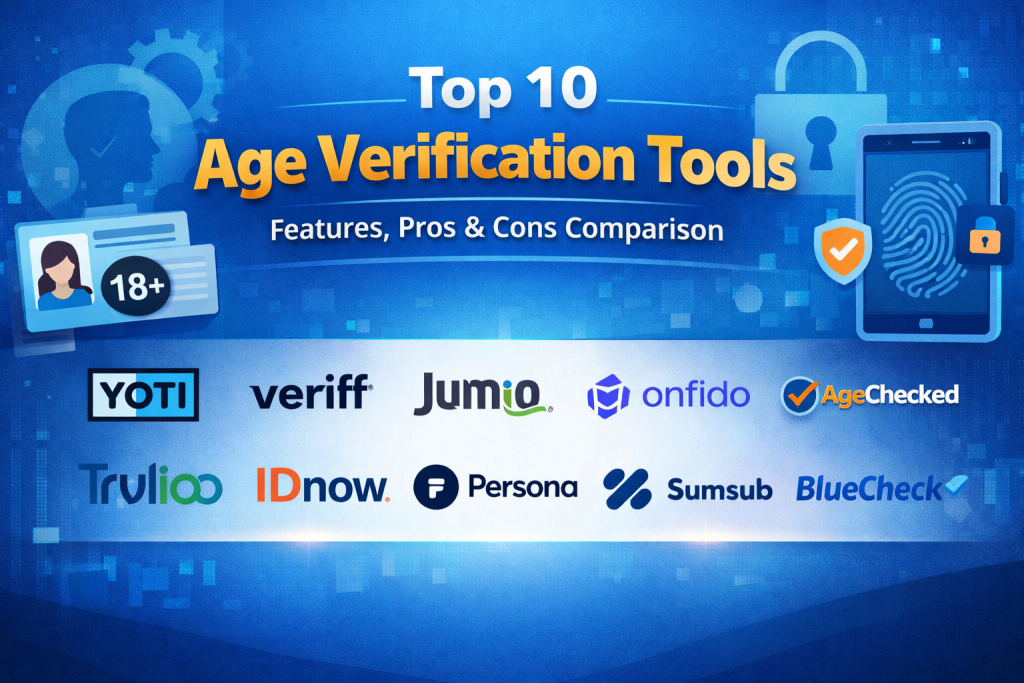
Top 10 Age Verification Tools
1 — Yoti
Short description:
A privacy-focused digital identity and age verification platform used globally across regulated industries.
Key features:
- AI-based facial age estimation
- Government ID verification
- Mobile SDKs and APIs
- Privacy-by-design architecture
- Global document coverage
- Reusable digital identity wallets
Pros:
- Strong focus on user privacy
- High accuracy across age groups
- Widely trusted by regulators
Cons:
- Higher cost for small businesses
- Setup may require technical expertise
Security & compliance:
GDPR, ISO 27001, SOC 2, encryption at rest and in transit
Support & community:
Comprehensive documentation, enterprise onboarding, responsive support
2 — Veriff
Short description:
An AI-driven verification platform offering fast age and identity checks for online businesses.
Key features:
- Real-time ID and selfie verification
- Global document support
- Automated fraud detection
- API-first architecture
- Custom verification flows
Pros:
- Very fast verification speeds
- Scales well for high-volume platforms
- Strong automation
Cons:
- Less customizable UI
- Pricing can scale quickly
Security & compliance:
GDPR, SOC 2 Type II, ISO 27001
Support & community:
Good documentation, dedicated account managers for enterprise
3 — Jumio
Short description:
Enterprise-grade identity and age verification solution used by financial and regulated organizations.
Key features:
- Biometric age estimation
- ID document verification
- Liveness detection
- AML and KYC support
- Advanced analytics
Pros:
- Highly trusted by enterprises
- Strong fraud prevention
- Extensive compliance coverage
Cons:
- Expensive for startups
- Longer onboarding process
Security & compliance:
GDPR, HIPAA, SOC 2, ISO 27001
Support & community:
Enterprise-level support, detailed onboarding resources
4 — Onfido
Short description:
A flexible identity and age verification platform with strong compliance and automation capabilities.
Key features:
- AI facial age estimation
- ID document verification
- Biometric checks
- API integrations
- Workflow customization
Pros:
- High verification accuracy
- Developer-friendly APIs
- Trusted by fintechs
Cons:
- UI customization limits
- Costs increase with volume
Security & compliance:
GDPR, ISO 27001, SOC 2
Support & community:
Strong documentation, enterprise support options
5 — AgeChecked
Short description:
A compliance-focused age verification solution tailored for age-restricted content and commerce.
Key features:
- Multiple verification methods
- Age tokenization
- Jurisdiction-specific compliance
- Minimal data retention
- Simple integration
Pros:
- Designed specifically for age compliance
- Privacy-friendly approach
- Easy to deploy
Cons:
- Limited identity verification depth
- Fewer advanced analytics
Security & compliance:
GDPR compliant, encrypted data handling
Support & community:
Good onboarding support, compliance guidance
6 — Trulioo
Short description:
A global identity and age verification platform with unmatched international coverage.
Key features:
- Access to hundreds of data sources
- Global document verification
- API-based age checks
- Fraud and risk scoring
- Regional compliance tools
Pros:
- Excellent global reach
- Strong data accuracy
- Suitable for multinational platforms
Cons:
- Complex setup
- Premium pricing
Security & compliance:
GDPR, SOC 2, ISO 27001
Support & community:
Enterprise support, extensive documentation
7— IDnow
Short description:
A European-focused identity and age verification provider with strong regulatory alignment.
Key features:
- Video-based age verification
- AI and human-assisted checks
- eID support
- Audit trails
- Compliance reporting
Pros:
- Strong EU regulatory fit
- High trust verification
- Flexible verification methods
Cons:
- Less coverage outside Europe
- Slower than pure AI solutions
Security & compliance:
GDPR, eIDAS, ISO standards
Support & community:
Professional onboarding, regional expertise
8 — Persona
Short description:
A modular identity and age verification tool built for modern SaaS platforms.
Key features:
- Customizable verification flows
- Age and identity checks
- Developer-friendly SDKs
- Workflow automation
- Risk rules engine
Pros:
- Highly customizable
- Excellent developer experience
- Modern UI
Cons:
- Requires configuration effort
- Learning curve for non-technical teams
Security & compliance:
SOC 2, GDPR, encryption standards
Support & community:
Strong documentation, growing user community
9 — Sumsub
Short description:
An all-in-one verification platform combining age checks, KYC, and fraud prevention.
Key features:
- AI age estimation
- Document verification
- AML screening
- Risk scoring
- Web and mobile SDKs
Pros:
- Broad feature set
- Competitive pricing
- Scales well
Cons:
- UI complexity
- Overkill for simple needs
Security & compliance:
GDPR, SOC 2, ISO 27001
Support & community:
Active support team, detailed knowledge base
10 — BlueCheck
Short description:
A lightweight age verification tool focused on simplicity and compliance.
Key features:
- One-time age verification
- Age token reuse
- Simple integrations
- Privacy-first design
- Fast user flow
Pros:
- Minimal user friction
- Easy implementation
- Affordable for SMBs
Cons:
- Limited advanced features
- Not suited for complex compliance
Security & compliance:
GDPR compliant, basic encryption
Support & community:
Basic documentation, responsive support
Comparison Table
| Tool Name | Best For | Platform(s) Supported | Standout Feature | Rating |
|---|---|---|---|---|
| Yoti | Regulated enterprises | Web, Mobile | Privacy-first age estimation | N/A |
| Veriff | High-volume platforms | Web, Mobile | Real-time AI verification | N/A |
| Jumio | Large enterprises | Web, Mobile | Enterprise compliance | N/A |
| Onfido | Fintech & SaaS | Web, Mobile | Biometric accuracy | N/A |
| AgeChecked | Age-restricted content | Web | Compliance specialization | N/A |
| Trulioo | Global businesses | Web, API | Worldwide coverage | N/A |
| IDnow | EU-focused platforms | Web, Mobile | Video verification | N/A |
| Persona | SaaS products | Web, Mobile | Custom workflows | N/A |
| Sumsub | All-in-one needs | Web, Mobile | AML + age checks | N/A |
| BlueCheck | SMBs | Web | Low-friction verification | N/A |
Evaluation & Scoring of Age Verification Tools
| Criteria | Weight | Score (Avg) |
|---|---|---|
| Core features | 25% | High |
| Ease of use | 15% | Medium-High |
| Integrations & ecosystem | 15% | High |
| Security & compliance | 10% | High |
| Performance & reliability | 10% | High |
| Support & community | 10% | Medium-High |
| Price / value | 15% | Medium |
Which Age Verification Tool Is Right for You?
- Solo users & startups: Prefer lightweight, affordable tools with simple integration
- SMBs: Balance cost with compliance and scalability
- Mid-market: Look for automation, analytics, and API flexibility
- Enterprise: Prioritize compliance, global coverage, and security certifications
Budget-conscious teams may accept fewer features, while premium solutions suit regulated, high-risk environments. Always align tool choice with compliance needs, expected growth, and technical capacity.
Frequently Asked Questions (FAQs)
- Are age verification tools legally required?
In many industries and regions, yes—especially for adult content, gaming, and restricted commerce. - Do these tools store user data?
Most follow data-minimization and privacy-by-design principles. - Is facial age estimation accurate?
Modern AI models are highly accurate but often combined with ID checks. - Can age verification work globally?
Some tools offer extensive international coverage, others are region-specific. - Are these tools expensive?
Pricing varies widely based on volume, features, and compliance needs. - Do they affect user experience?
Well-designed tools minimize friction while maintaining accuracy. - Can they integrate with existing systems?
Most provide APIs and SDKs for easy integration. - Are they secure?
Leading tools use encryption, audit logs, and compliance certifications. - Is age verification the same as identity verification?
Not always—some tools verify age only without full identity checks. - What is the biggest mistake buyers make?
Choosing a tool without considering long-term compliance and scalability.
Conclusion
Age Verification Tools are essential for protecting minors, meeting regulatory obligations, and building digital trust. The market offers a wide range of solutions—from lightweight, privacy-focused tools to enterprise-grade compliance platforms. What matters most is aligning the tool with your industry, risk level, user base, and growth plans. There is no single “best” solution—only the one that best fits your specific needs.

Find Trusted Cardiac Hospitals
Compare heart hospitals by city and services — all in one place.
Explore Hospitals
This is a very practical comparison post, because “age verification” isn’t just a checkbox—it’s a balance between compliance, user experience, and fraud resistance. I liked that the article highlights how tools differ on key points like verification method (ID scan, selfie/liveness, database checks, tokenized re-use), privacy controls (data minimization, retention, encryption, regional processing), accuracy and bias risks, and integration effort (SDKs, APIs, web/mobile flows). For teams choosing a solution, it’s smart to evaluate real-world needs: required jurisdictions, acceptable drop-off, how you handle edge cases (low light ID scans, older devices, accessibility), and how you’ll monitor false accepts/rejects—because those metrics directly affect both safety and revenue.