
Introduction
Merchandise Storefront Platforms are digital tools that allow individuals and businesses to design, sell, manage, and scale branded merchandise through online storefronts. These platforms typically handle essential commerce functions such as product catalogs, payments, inventory, order fulfillment, taxes, and customer management—all in one place.
In today’s creator-driven and brand-first economy, merchandise has become more than just products. It is a direct revenue stream, a community-building channel, and a brand extension. From YouTubers and musicians selling apparel to startups launching branded products and enterprises running global D2C stores, merchandise storefronts play a central role.
Real-world use cases include:
- Creators monetizing audiences through branded apparel and accessories
- Startups launching MVP products without heavy infrastructure
- SMBs expanding from offline to online retail
- Enterprises running multi-region, multi-brand commerce operations
When choosing a Merchandise Storefront Platform, buyers should evaluate:
- Product and order management depth
- Ease of setup and daily operations
- Design flexibility and branding control
- Payment, tax, and fulfillment options
- Integration with marketing, analytics, and logistics tools
- Security, compliance, and scalability
Best for:
Content creators, D2C brands, SMB retailers, marketing teams, and enterprises looking to monetize physical products, validate ideas quickly, or scale merchandise globally.
Not ideal for:
Businesses selling only digital goods, teams requiring highly custom-built commerce engines from scratch, or organizations with no need for storefront-based selling.
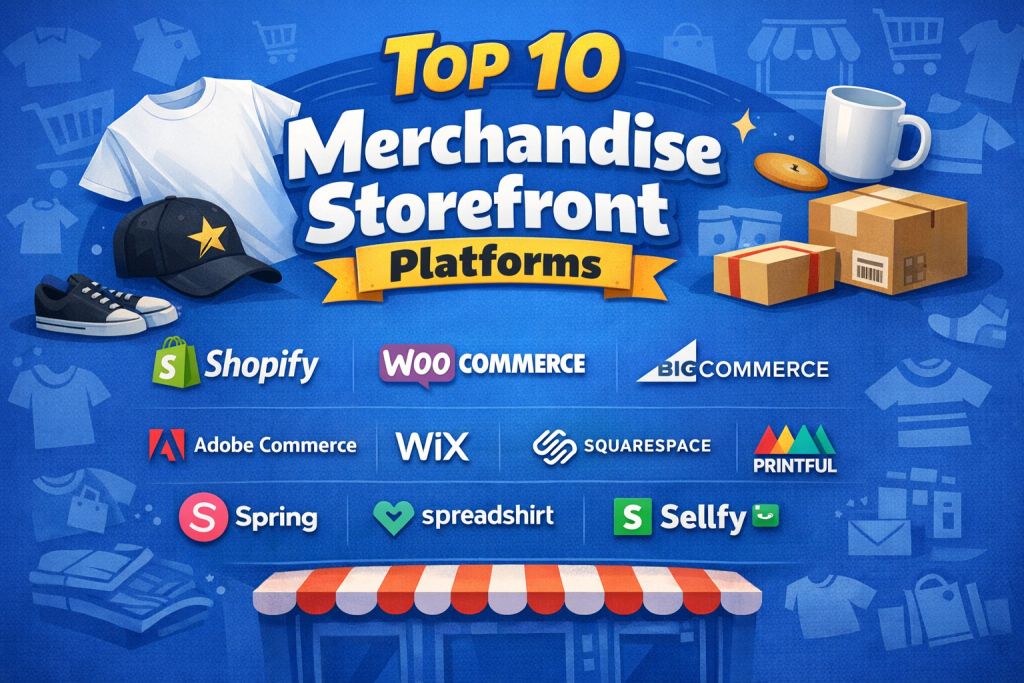
Top 10 Merchandise Storefront Platforms Tools
1 — Shopify
Short description:
A leading all-in-one commerce platform designed for businesses of all sizes to create, manage, and scale online merchandise stores globally.
Key features:
- Customizable storefront themes and branding
- Built-in checkout and payment processing
- Inventory, order, and tax management
- App ecosystem for marketing, shipping, and analytics
- Multi-channel selling (online, social, POS)
- Global currencies and localization
Pros:
- Extremely scalable from solo sellers to enterprises
- Large app and partner ecosystem
- Reliable performance and uptime
Cons:
- Monthly fees add up with apps
- Advanced customization may require developers
Security & compliance:
PCI-DSS compliant, GDPR support, encrypted transactions, role-based access controls.
Support & community:
Extensive documentation, 24/7 support plans, large global user and developer community.
2 — WooCommerce
Short description:
An open-source merchandise storefront solution built as a plugin for WordPress, offering full control and flexibility.
Key features:
- Deep WordPress integration
- Unlimited products and categories
- Extensive plugin and theme ecosystem
- Custom checkout and tax rules
- Self-hosted data ownership
Pros:
- Highly customizable and developer-friendly
- No platform transaction fees
- Strong SEO control
Cons:
- Requires hosting and maintenance
- Performance depends on setup quality
Security & compliance:
Varies by hosting and plugins; supports GDPR and encryption with proper configuration.
Support & community:
Large open-source community, documentation, paid expert support available.
3 — BigCommerce
Short description:
A robust SaaS merchandise platform focused on fast-growing brands and mid-market businesses.
Key features:
- Built-in multi-storefront support
- Advanced product and catalog management
- Headless commerce capabilities
- Native integrations with marketplaces
- Strong API-first architecture
Pros:
- Enterprise-grade features without heavy plugins
- Strong performance and reliability
- Good B2B and B2C support
Cons:
- Annual revenue limits by plan
- Smaller theme marketplace
Security & compliance:
PCI compliant, SOC 2 certified, GDPR support, enterprise security controls.
Support & community:
Dedicated onboarding, knowledge base, enterprise support options.
4 — Adobe Commerce
Short description:
A powerful enterprise commerce solution designed for complex, high-volume merchandise operations.
Key features:
- Advanced product and inventory management
- Multi-store and multi-language support
- Highly customizable checkout flows
- Enterprise-grade APIs and integrations
- AI-driven personalization tools
Pros:
- Unmatched flexibility for large operations
- Suitable for global commerce at scale
- Deep customization capabilities
Cons:
- High implementation and maintenance cost
- Requires experienced development teams
Security & compliance:
SOC 2, ISO standards support, advanced encryption, audit logs.
Support & community:
Enterprise support plans, certified partners, strong developer community.
5 — Wix
Short description:
A beginner-friendly website and merchandise storefront builder focused on ease of use and speed.
Key features:
- Drag-and-drop storefront design
- Built-in product and order management
- Integrated payments and taxes
- Mobile-optimized themes
- Marketing and email tools
Pros:
- Very easy to set up
- No technical skills required
- Affordable entry-level pricing
Cons:
- Limited scalability for large catalogs
- Less control over backend logic
Security & compliance:
PCI compliant, SSL encryption, GDPR tools available.
Support & community:
Guided onboarding, help center, community forums.
6 — Squarespace
Short description:
A design-focused commerce platform ideal for visually driven merchandise brands.
Key features:
- High-quality design templates
- Integrated inventory and checkout
- Subscription and product variants
- Built-in analytics
- Mobile-optimized storefronts
Pros:
- Excellent visual presentation
- Simple product management
- Reliable hosting included
Cons:
- Limited advanced commerce features
- Fewer integrations than competitors
Security & compliance:
SSL encryption, GDPR tools, standard payment compliance.
Support & community:
Knowledge base, email support, creator-focused community.
7 — Printful
Short description:
A print-on-demand merchandise platform that handles production and fulfillment automatically.
Key features:
- On-demand printing and shipping
- White-label branding options
- Product mockup generator
- Global fulfillment centers
- Seamless storefront integrations
Pros:
- No inventory risk
- Ideal for creators and artists
- Easy automation
Cons:
- Lower margins compared to bulk production
- Limited customization beyond catalog
Security & compliance:
GDPR compliant, secure payment handling.
Support & community:
Good documentation, creator resources, responsive support.
8 — Spring
Short description:
A creator-first merchandise platform focused on audience monetization.
Key features:
- Built-in storefront hosting
- Integrated audience tools
- On-demand production
- Global shipping
- Campaign-based selling
Pros:
- No upfront costs
- Simple setup for creators
- Handles fulfillment end-to-end
Cons:
- Limited branding flexibility
- Less control over customer data
Security & compliance:
Standard data protection practices; varies by region.
Support & community:
Creator guides, email support, community resources.
9 — Spreadshirt
Short description:
A marketplace and storefront solution for custom apparel and merchandise.
Key features:
- Marketplace exposure
- Custom storefronts
- On-demand printing
- Product design tools
- International fulfillment
Pros:
- Access to built-in audience
- No inventory management
- Easy product creation
Cons:
- Lower brand control
- Revenue share model
Security & compliance:
GDPR compliant, secure payment processing.
Support & community:
Help center, seller resources, community forums.
10 — Sellfy
Short description:
A simple commerce platform for selling physical merchandise alongside digital products.
Key features:
- Built-in storefront hosting
- Subscription and upsell tools
- Marketing automation
- Secure checkout
- Analytics dashboard
Pros:
- Fast setup
- Good for mixed product catalogs
- Affordable pricing
Cons:
- Limited design customization
- Not ideal for large-scale operations
Security & compliance:
SSL encryption, GDPR-ready tools.
Support & community:
Documentation, email support, creator-focused help content.
Comparison Table
| Tool Name | Best For | Platform(s) Supported | Standout Feature | Rating |
|---|---|---|---|---|
| Shopify | Scalable D2C brands | Web, POS | App ecosystem | N/A |
| WooCommerce | Custom WordPress stores | Web | Full control | N/A |
| BigCommerce | Mid-market brands | Web, Headless | Built-in enterprise tools | N/A |
| Adobe Commerce | Large enterprises | Web | Deep customization | N/A |
| Wix | Beginners | Web | Ease of use | N/A |
| Squarespace | Design-first brands | Web | Visual quality | N/A |
| Printful | Print-on-demand sellers | Web integrations | Fulfillment automation | N/A |
| Spring | Creators | Web | Audience monetization | N/A |
| Spreadshirt | Apparel sellers | Web | Marketplace reach | N/A |
| Sellfy | Small sellers | Web | Simple selling | N/A |
Evaluation & Scoring of Merchandise Storefront Platforms
| Criteria | Weight | Avg Score (1–5) |
|---|---|---|
| Core features | 25% | 4.5 |
| Ease of use | 15% | 4.3 |
| Integrations & ecosystem | 15% | 4.4 |
| Security & compliance | 10% | 4.2 |
| Performance & reliability | 10% | 4.4 |
| Support & community | 10% | 4.3 |
| Price / value | 15% | 4.1 |
Which Merchandise Storefront Platforms Tool Is Right for You?
- Solo creators: Look for ease of setup and fulfillment automation
- SMBs: Balance customization with operational simplicity
- Mid-market: Prioritize integrations, analytics, and scalability
- Enterprises: Focus on security, performance, and global operations
Budget-conscious users may prefer simpler SaaS or print-on-demand tools, while premium buyers benefit from enterprise-grade platforms. The right choice depends on how deeply merchandise is tied to your business strategy.
Frequently Asked Questions (FAQs)
1. Do I need technical skills to run a merchandise storefront?
Many platforms require no coding, while others allow advanced customization for developers.
2. Can I sell globally?
Most leading platforms support international payments and shipping.
3. Are print-on-demand platforms profitable?
Yes, but margins are usually lower than bulk manufacturing.
4. How important is design flexibility?
Critical for brand-focused businesses; less so for marketplace-based selling.
5. Can these platforms scale with my business?
Some scale easily, others require migration as volume grows.
6. What about taxes and compliance?
Most platforms offer automated tax tools or integrations.
7. Are these platforms secure?
Reputable providers follow industry-standard security practices.
8. Can I integrate marketing tools?
Yes, most offer built-in or third-party marketing integrations.
9. What is the biggest mistake buyers make?
Choosing based only on price, ignoring scalability and support.
10. Can I switch platforms later?
Yes, but migration can be complex depending on data volume.
Conclusion
Merchandise Storefront Platforms have become essential tools for monetizing brands, audiences, and products in the digital economy. The best platforms combine reliable commerce features, strong security, flexible integrations, and ease of use.
There is no single “best” solution for everyone. Solo creators, growing brands, and global enterprises each have different priorities. By aligning platform capabilities with your business size, budget, and long-term goals, you can choose a solution that not only sells merchandise—but strengthens your brand for the future.

Find Trusted Cardiac Hospitals
Compare heart hospitals by city and services — all in one place.
Explore Hospitals
Choosing a merchandise storefront comes down to matching your fulfillment and customization needs to your team’s capacity—whether you want a flexible setup like Shopify, WooCommerce, or BigCommerce, or print-on-demand and creator-focused workflows like Printful, Spring, or Spreadshirt. App fees, hosting upkeep, or narrower storefront control can easily creep up as product drops and orders scale. When launching a new merch line, what usually matters most to you first: fast print-on-demand fulfillment or full control over branding and checkout?
A merchandise storefront platform should make it simple to display products, manage orders, and give customers a smooth buying experience. I would compare platforms based on product catalog controls, design customization, inventory tracking, payment options, and shipping integrations. Features such as size and color variants, discount codes, order notifications, and returns management can also affect daily operations. Store owners should check mobile shopping performance, transaction fees, sales reports, and how easily the storefront connects with marketing and fulfillment tools before choosing a platform.
Merchandise storefront platforms help businesses and creators set up online stores to sell branded products, manage orders, and reach customers. When comparing these platforms, I would focus on store customization, product management, payment options, inventory tracking, shipping integrations, and pricing. These features can simplify daily operations, improve the shopping experience, and support business growth. The right platform should be easy to manage, offer reliable payment and order processing, and provide enough flexibility to meet changing business needs.
Creator merchandise platforms often struggle with post-checkout logistics when orders scale rapidly during sudden campaign spikes. Direct integration between custom storefront APIs and distributed on-demand fulfillment hubs minimizes fulfillment delays and protects brand goodwill.
Merchandise storefront platforms make it easier for businesses and creators to sell branded products online. Having simple customization options, smooth order management, and reliable payment features can make a big difference in daily operations. I think product quality and a user-friendly shopping experience are just as important for keeping customers satisfied. Choosing the right platform can help businesses manage their stores and grow their brand more effectively.
Merchandise storefront platforms help businesses and creators display products, manage orders, and handle online sales. When comparing options, consider store customization, product catalog management, payment integration, inventory tracking, shipping tools, and analytics to create a smooth shopping experience and simplify store operations.
Merchandise storefront platforms let creators sell branded goods without inventory risk, and this comparison explains the model clearly. I appreciate the coverage of product quality and fulfillment reliability, since customer blame lands on the brand. One practical note is to order samples before launching designs, because print quality varies widely. Storefronts extend brands into physical goods. Useful overview for creators.
Merchandise storefront platforms should make it easy to manage product variations, stock levels, and orders without creating confusion for customers. When comparing options, check how they handle size and color combinations, limited-edition product drops, and inventory updates across sales channels. Clear order tracking and return management can also reduce support requests when customers need to exchange items or check delivery status.
Merchandise storefront platforms make it easier for businesses and creators to manage product catalogs, customize online stores, and handle customer orders from a single place. Flexible design options, secure payment processing, inventory synchronization, and shipping integrations are important factors when selecting a solution. A smooth mobile shopping experience and reliable order management can also help build customer confidence and support long-term store growth.
Merchandise storefront platforms help businesses, creators, and organizations build online stores to sell branded products and manage the entire merchandise experience. Key features such as customizable storefronts, product catalog management, inventory tracking, payment processing, order fulfillment, shipping integrations, and sales analytics are essential when evaluating these solutions. When comparing platforms, users should consider design flexibility, pricing models, customization options, integration capabilities, scalability, and ease of use. The right solution can simplify merchandise operations, strengthen brand identity, improve the customer shopping experience, and create new revenue opportunities.
Managing several fulfillment partners can create uneven product and delivery experiences. A design may look consistent online but vary in print quality, material, or packaging. Store owners should review supplier performance using defect reports, shipping times, and customer feedback. They also need clear steps for handling damaged items, replacements, and refunds. This makes it easier to maintain customer trust as order volumes increase.
Merchandise storefront platforms help businesses sell branded products through an online store. They may support product listings, payment processing, stock tracking, and order updates. But a store needs more than a good-looking design to succeed. Teams should check setup time, shipping options, payment fees, and links to other business tools. Mobile shopping and a simple checkout can also improve the customer experience. For branded merchandise, product quality and order handling matter too. A good comparison should help businesses choose a platform that fits their budget and daily needs.
Merchandise sellers should also evaluate how a platform handles orders when fulfillment partners cannot meet the original delivery promise. For example, a product may remain available for purchase even after a supplier runs out of stock or a printing facility experiences delays. Teams need reliable inventory updates, clear order status tracking, and a process for notifying customers before small issues become complaints. I would also test how the system handles partial shipments, failed order synchronization, and refunds when fulfillment stops midway. Tracking cancellation rates, delivery delays, and repeated integration errors can help businesses spot weak points early. These operational checks are especially useful for brands that sell through multiple channels or depend on external production partners.
Comparing these storefront engines clarified that seamless catalog UX means nothing without reliable webhook idempotency and inventory race-condition handling. When flash campaigns drop, third-party dropship sync delays can quickly trigger overselling and API throttling unless asynchronous queues decouple your frontend checkout from fulfillment providers.
Merchandise storefront platforms help creators and businesses sell branded products without managing every part of an online store manually. When comparing options, look at product customization, payment methods, inventory tracking, shipping integrations, transaction fees, and store design flexibility. Testing the checkout process on mobile and reviewing profit margins after production and delivery costs can help create a smoother shopping experience and support sustainable sales.
Choosing the right merchandise platform often comes down to an early trade-off between upfront inventory risk and long-term profit margins. While print-on-demand services are great for validating a brand with zero inventory overhead, businesses eventually hit a ceiling where shifting to bulk manufacturing and scalable SaaS tools becomes essential for growth. Evaluating your catalog size and fulfillment model before committing to a platform saves a painful migration later.
Merchandise storefront platforms make it easier for businesses, creators, and organizations to sell branded products through customizable online stores. Solutions like Shopify offer storefront design, inventory management, and payment processing features, helping sellers manage orders smoothly, reach more customers, and grow their merchandise business.
Choosing a merchandise storefront should go beyond design options and setup costs. Testing product quality, delivery times, profit margins, and customer data access early can prevent costly surprises as sales grow.