
Introduction
Print Management Tools are software platforms designed to control, monitor, optimize, and secure printing activities across an organization. They help businesses manage who prints, what is printed, where it is printed, and how much it costs—whether across a single office or a global enterprise with thousands of devices.
In today’s hybrid and cost-conscious workplaces, unmanaged printing can silently drain budgets, expose sensitive data, and create compliance risks. Print management software addresses these challenges by adding visibility, governance, automation, and security to printing workflows.
Real-world use cases include:
- Reducing printing costs through quotas and rules
- Securing confidential documents with pull-printing
- Centralizing printer management across locations
- Meeting compliance requirements in regulated industries
- Supporting hybrid and remote printing scenarios
When evaluating print management tools, buyers should look at device compatibility, security controls, reporting depth, scalability, ease of use, integrations, and overall cost-to-value ratio.
Best for:
IT administrators, finance teams, compliance-driven industries, educational institutions, healthcare providers, legal firms, and enterprises managing multiple printers and users.
Not ideal for:
Very small teams with minimal printing needs, organizations that rely entirely on paperless workflows, or environments where printing volume is negligible.
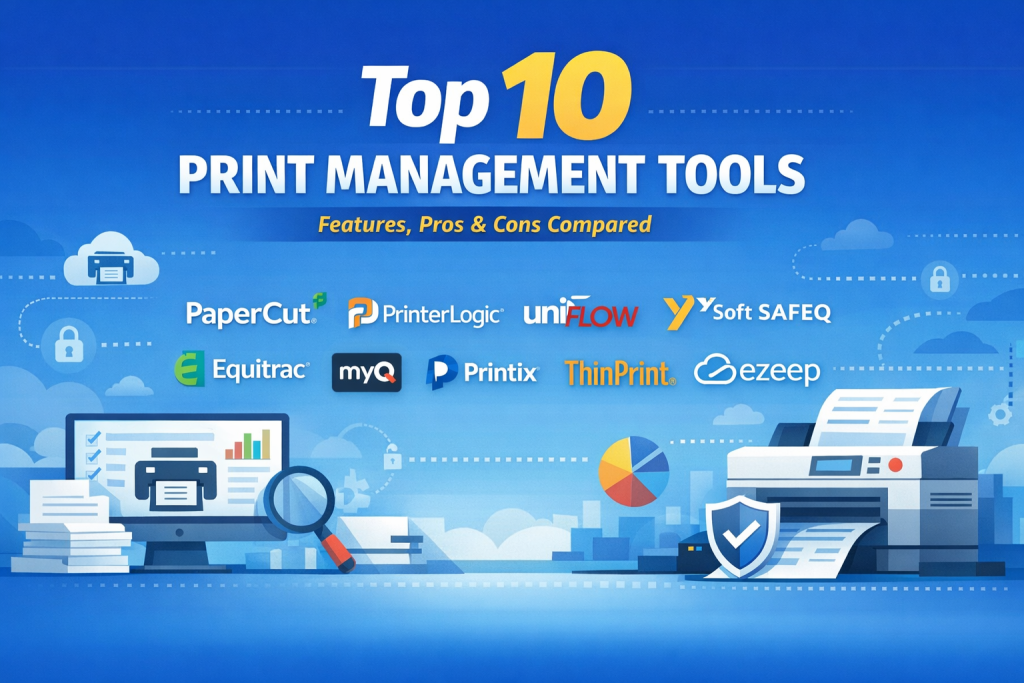
Top 10 Print Management Tools
1 — PaperCut
Short description:
A leading print management solution focused on cost control, security, and sustainability. Designed for education, healthcare, SMBs, and enterprises.
Key features
- User-based print tracking and quotas
- Secure pull printing and release stations
- Detailed cost and usage reporting
- Printer and device compatibility across vendors
- Sustainability and waste-reduction insights
- Cloud and on-prem deployment options
Pros
- Intuitive admin dashboard
- Strong balance of features and usability
Cons
- Advanced reporting requires configuration
- Some features cost extra depending on edition
Security & compliance:
Encryption, secure print release, audit logs, GDPR support
Support & community:
Extensive documentation, strong global user community, enterprise support available
2 — PrinterLogic
Short description:
A serverless print management platform that simplifies printer deployment and eliminates print servers.
Key features
- Direct IP printing without print servers
- Centralized printer deployment
- Role-based access control
- Cloud-native architecture
- Automated driver management
- Reporting and auditing
Pros
- Reduced infrastructure complexity
- Strong performance for distributed teams
Cons
- Limited advanced cost-accounting tools
- Less granular user quotas than competitors
Security & compliance:
SSO, encryption, audit trails, GDPR compliant
Support & community:
Strong onboarding resources and enterprise support
3 — uniFLOW
Short description:
An enterprise-grade solution focused on secure printing, scanning, and document workflows.
Key features
- Secure pull printing with authentication
- Advanced scan workflows
- Device-level policy enforcement
- Detailed usage analytics
- Cloud and hybrid deployment
- Strong MFP integration
Pros
- Excellent security controls
- Deep workflow automation
Cons
- Higher cost for smaller teams
- Setup can be complex
Security & compliance:
SSO, encryption, audit logs, GDPR, ISO alignment
Support & community:
Enterprise-focused support and partner ecosystem
4 — Y Soft SAFEQ
Short description:
A scalable print management and document workflow platform for large enterprises.
Key features
- Secure print release
- Centralized print policies
- Cost recovery and chargeback
- Device and vendor neutrality
- Workflow automation
- Cloud-ready architecture
Pros
- Highly scalable
- Strong compliance capabilities
Cons
- Overkill for SMBs
- Requires skilled IT administration
Security & compliance:
Encryption, audit logs, GDPR, ISO standards
Support & community:
Enterprise support with professional services
5 — Pharos
Short description:
A robust print management platform focused on security, analytics, and user accountability.
Key features
- Secure pull printing
- Mobile and cloud printing
- Print analytics and insights
- Device control policies
- High-availability architecture
Pros
- Excellent reporting depth
- Strong security posture
Cons
- UI feels dated
- Learning curve for admins
Security & compliance:
SSO, encryption, audit logs, GDPR support
Support & community:
Solid enterprise documentation and support
6 — Equitrac
Short description:
A long-standing solution focused on cost recovery and enterprise print governance.
Key features
- Detailed print cost accounting
- Secure authentication options
- Policy-based print rules
- Multi-vendor device support
- Reporting and chargeback
Pros
- Strong cost-control capabilities
- Proven enterprise reliability
Cons
- Interface feels legacy
- Less innovation compared to newer tools
Security & compliance:
Audit logs, encryption, GDPR alignment
Support & community:
Enterprise support with established user base
7 — MyQ
Short description:
A modern print and scan management platform with a strong user experience focus.
Key features
- Secure print release
- Mobile printing support
- Centralized printer management
- Scan workflows and automation
- Cloud and on-prem options
Pros
- Clean and modern UI
- Easy deployment
Cons
- Smaller ecosystem than market leaders
- Reporting less granular
Security & compliance:
Encryption, secure authentication, GDPR support
Support & community:
Responsive support and clear documentation
8 — Printix
Short description:
A cloud-native print management solution designed for modern, serverless IT environments.
Key features
- Cloud-only architecture
- Secure pull printing
- Automatic printer discovery
- Mobile and remote printing
- Centralized admin console
Pros
- Ideal for cloud-first organizations
- Minimal infrastructure overhead
Cons
- Limited offline capabilities
- Fewer advanced enterprise controls
Security & compliance:
Encryption, GDPR compliance, secure authentication
Support & community:
Good documentation and SaaS-style support
9 — ThinPrint
Short description:
A performance-focused print management platform optimized for distributed and virtual environments.
Key features
- Bandwidth-optimized printing
- Secure pull printing
- Virtual desktop support
- Cloud and hybrid deployments
- Device control policies
Pros
- Excellent performance over WAN
- Strong VDI compatibility
Cons
- Complex setup
- Premium pricing
Security & compliance:
Encryption, audit logging, GDPR alignment
Support & community:
Enterprise-grade support and training resources
10 — ezeep
Short description:
A simple cloud printing solution for SMBs and remote teams.
Key features
- Cloud-based print delivery
- Remote and mobile printing
- Centralized printer access
- Lightweight setup
- SaaS pricing model
Pros
- Easy to deploy
- Ideal for remote workforces
Cons
- Limited enterprise controls
- Basic reporting
Security & compliance:
Encryption, GDPR support
Support & community:
Standard SaaS support and documentation
Comparison Table
| Tool Name | Best For | Platform(s) Supported | Standout Feature | Rating |
|---|---|---|---|---|
| PaperCut | SMB to Enterprise | Windows, macOS, Linux, Cloud | Cost control + usability | N/A |
| PrinterLogic | Distributed Teams | Cloud, Windows | Serverless printing | N/A |
| uniFLOW | Enterprises | Cloud, On-prem | Secure workflows | N/A |
| Y Soft SAFEQ | Large Enterprises | Cloud, On-prem | Scalability & compliance | N/A |
| Pharos | Analytics-Driven Orgs | Cloud, On-prem | Deep print analytics | N/A |
| Equitrac | Cost Recovery | On-prem | Chargeback accounting | N/A |
| MyQ | Modern IT Teams | Cloud, On-prem | User experience | N/A |
| Printix | Cloud-First SMBs | Cloud | Infrastructure simplicity | N/A |
| ThinPrint | VDI & Global Orgs | Cloud, Hybrid | WAN optimization | N/A |
| ezeep | SMB & Remote Teams | Cloud | Ease of use | N/A |
Evaluation & Scoring of Print Management Tools
| Criteria | Weight | Evaluation Summary |
|---|---|---|
| Core features | 25% | Tracking, security, rules, reporting |
| Ease of use | 15% | Admin UI, deployment simplicity |
| Integrations & ecosystem | 15% | Device, OS, identity systems |
| Security & compliance | 10% | Encryption, audit logs, SSO |
| Performance & reliability | 10% | Stability, scalability |
| Support & community | 10% | Docs, onboarding, enterprise support |
| Price / value | 15% | ROI, licensing flexibility |
Which Print Management Tool Is Right for You?
- Solo users / small teams: Cloud-based tools with minimal setup
- SMBs: Balance cost control, usability, and reporting
- Mid-market: Look for security, integrations, and scalability
- Enterprises: Prioritize compliance, automation, and multi-site management
Budget-conscious organizations should focus on core features and SaaS pricing.
Premium buyers should invest in workflow automation and compliance depth.
Frequently Asked Questions (FAQs)
- What problem do print management tools solve?
They control costs, improve security, and provide visibility into printing behavior. - Are print management tools only for large companies?
No, many tools are designed for SMBs and even small distributed teams. - Do these tools support remote work?
Yes, modern platforms support cloud and remote printing. - Can print management reduce costs?
Yes, through quotas, rules, and usage analytics. - Is secure printing really necessary?
Yes, especially in healthcare, finance, and legal environments. - Are cloud print tools secure?
Most use encryption and access controls aligned with GDPR standards. - Do these tools support multi-vendor printers?
Most leading solutions are vendor-neutral. - How long does implementation take?
From a few hours for cloud tools to weeks for enterprise deployments. - What is pull printing?
Documents print only when the user authenticates at the printer. - Is print management still relevant in paperless offices?
Yes, even low print volumes benefit from security and control.
Conclusion
Print management tools play a critical role in controlling costs, securing sensitive documents, and modernizing workplace printing. While feature sets vary, the most important factors are visibility, security, scalability, and ease of administration.
There is no single “best” solution for everyone. The right tool depends on organization size, printing complexity, compliance needs, and IT strategy. By aligning tool capabilities with real-world requirements, organizations can turn printing from an unmanaged expense into a controlled, secure, and efficient process.

Find Trusted Cardiac Hospitals
Compare heart hospitals by city and services — all in one place.
Explore Hospitals
Print management tools help organizations control printing activities, monitor usage, and reduce unnecessary printing costs. Platforms like PaperCut offer print tracking, user controls, and secure printing features, helping businesses manage printers more efficiently and reduce paper waste.
Print management often gets overlooked until a department faces rising costs, printer outages, or confidential documents being left unattended. One area worth examining is how these tools handle print jobs when users move between offices, networks, or devices. Secure release is helpful, but it should also remain practical for employees who need to print quickly without creating unnecessary support requests. I would also look at how usage reports distinguish avoidable waste from legitimate business needs; raw page counts alone can lead to policies that frustrate users rather than improve efficiency. The best systems make printing more secure and accountable while keeping everyday workflows simple.
Print management tools help businesses control printing costs and manage devices more easily. Features like usage tracking and secure print release can reduce waste and protect important documents. It is also useful to have simple reports that show where printing costs are coming from. A good tool should make printing easier for employees while helping organizations save paper, time, and money.
Print environments can quietly cost a lot through waste and poor tracking. The article explains how management tools bring control over queues, quotas and secure release. Organizations often save money and improve security at the same time. Nice and practical for IT teams looking to simplify office printing.
Enterprise print management has shifted from simple paper usage accounting to becoming a core element of Zero Trust network architecture. Pull-printing mechanisms that require badge authentication or mobile MFA directly at the physical multi-function printer eliminate unattended sensitive printouts across shared office floors. Centralized driver distribution and automated printer spooler patch enforcement also reduce ongoing endpoint support tickets considerably. Consolidating multi-site print telemetry gives enterprise IT the leverage needed to negotiate transparent managed print service contracts.
Print management tools can help organizations control printing costs, improve device visibility, and protect sensitive documents. Usage reporting, secure release printing, and centralized policy management make printing easier to monitor. Reviewing actual printing patterns can reveal opportunities to reduce waste without disrupting essential workflows.
Another practical area is managing print jobs that remain stuck or unclaimed in printer queues. Employees may submit the same document multiple times after a network interruption or forget to release confidential files at the printer. Systems should automatically expire old jobs, remove cancelled requests, and prevent accidental duplicate printing during recovery. Administrators also need visibility into failed queues and repeated submission attempts. These controls can reduce paper waste, protect sensitive documents, and avoid unnecessary support work across large printing environments.
Print management tools help organizations monitor, control, and optimize printing activities across departments and connected devices. Features such as print job tracking, user authentication, usage reporting, secure printing, quota management, cost allocation, and centralized administration are important when evaluating these platforms. Different solutions offer varying capabilities in security, scalability, automation, and device compatibility. Comparing their pros and cons helps businesses reduce printing expenses, improve document security, monitor resource consumption, and manage printing infrastructure more efficiently.
Print management tools should help organizations control printing costs while keeping daily document access convenient. Comparing print quota settings, secure release through user authentication, and printer usage reports can show how well each platform supports different departments. Monitoring color printing and unnecessary repeat jobs can also reveal savings that basic page counts may miss.
Print management tools can help organizations monitor printer use, control costs, and improve document security. They may also help teams manage print queues and apply rules across different devices. Before choosing a platform, businesses should review printer compatibility, usage reports, access controls, and setup needs. Support for existing systems can make deployment much easier. It is also important to consider how the tool handles confidential documents and user permissions. Comparing the available options helps organizations choose a practical solution for their printing needs.
Print management tools can help organizations understand not only how much they print, but also where resources are being used. I would compare their ability to assign printing rules by department, track color and paper usage, and manage secure release for confidential documents. Support for different printer models and clear reporting on maintenance or supply usage can also simplify daily administration. These practical details help businesses control printing costs while keeping routine document work convenient for employees.
Analyzing network document output platforms showed that curbing paper waste requires badge-authenticated pull-printing queues. Holding print jobs in encrypted transit until users physically swipe their RFID cards at the device stops sensitive documents from sitting exposed in public printer output trays while slashing paper and toner expenses.
Print infrastructure resilience deserves attention, especially in organizations where teams depend on printed labels, invoices, prescriptions, or shipping documents. A failed print server, expired certificate, or network outage can interrupt critical workflows even when the management dashboard appears healthy. IT teams should test queue recovery, printer failover, and document resubmission to prevent lost jobs or duplicate prints. Monitoring queue delays, failed jobs, device availability, and recovery time can reveal problems before users report them. It is also worth checking whether cloud-managed printing can continue during internet disruptions and defining a safe fallback process for essential business operations.
Print management tools help organizations monitor printer usage, control printing costs, and manage devices across offices. When comparing platforms, look at print tracking, secure release, quota settings, driver support, reporting, and compatibility with existing printers and operating systems. Review print volumes and unnecessary color or duplicate jobs regularly to reduce waste, improve document security, and make printing easier to manage across teams.
Print management tools help organizations monitor printer usage, control printing costs, and manage devices across offices. Secure print release, usage reporting, device compatibility, access controls, and centralized administration are important for reducing waste and protecting sensitive documents in shared work environments.
Transitioning away from print servers through cloud-native solutions like PrinterLogic or Printix completely changes how IT manages distributed endpoints. However, the real challenge often lies in user adoption rather than software deployment when shifting to pull-printing workflows.
Print management delivers the most value when cost tracking is paired with secure print release and clear usage policies. Organizations should also review printer compatibility and actual usage data before deployment to avoid paying for features they rarely need.