
Introduction
HOA/Condo Management Software is purpose-built technology designed to help homeowners associations (HOAs), condominium associations, and property management companies efficiently manage daily operations, resident communication, finances, compliance, and long-term planning. Unlike generic property management tools, these platforms are tailored to the unique governance structure of associations—boards, committees, vendors, and residents—each with different roles and responsibilities.
In today’s environment, HOAs and condo communities face increasing complexity: rising resident expectations, stricter financial oversight, compliance requirements, maintenance coordination, and the need for transparency. Manual processes, spreadsheets, and fragmented tools often lead to errors, delays, and frustrated residents. HOA/Condo Management Software centralizes these workflows into a single system, improving accuracy, accountability, and resident satisfaction.
Common real-world use cases include:
- Online dues collection and automated accounting
- Board and committee collaboration
- Maintenance request tracking and vendor management
- Resident portals for communication and documents
- Compliance tracking, voting, and reporting
When evaluating HOA/Condo Management Software, buyers should focus on financial management depth, ease of use for non-technical board members, resident experience, scalability, security, integrations, and long-term value.
Best for:
HOA/Condo Management Software is ideal for self-managed associations, professional property managers, management companies handling multiple communities, and boards seeking transparency and operational efficiency.
Not ideal for:
Very small communities with minimal financial activity, single-building landlords without association governance, or organizations that only need basic rent collection without compliance or board management.
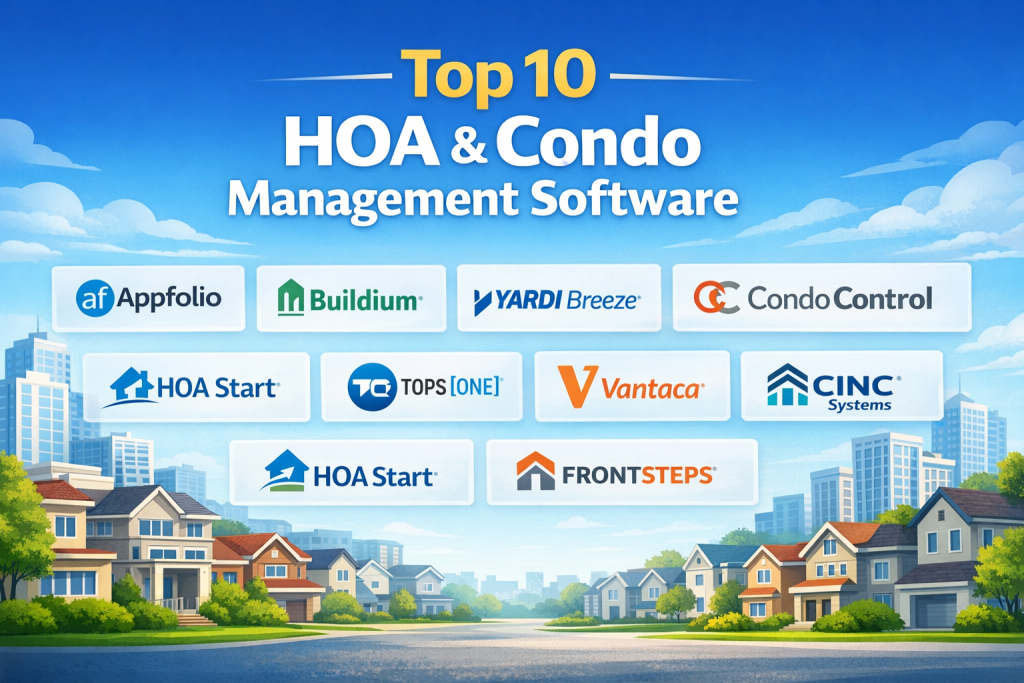
Top 10 HOA/Condo Management Software Tools
1 — AppFolio
Short description:
A comprehensive, cloud-based property and association management platform designed for professional managers and growing portfolios.
Key features:
- Integrated HOA accounting and automated workflows
- Online payments and resident portals
- Maintenance tracking with vendor coordination
- Document management and reporting
- Mobile apps for managers and residents
- Scalable portfolio management
Pros:
- Strong automation reduces manual work
- Intuitive interface for managers and residents
Cons:
- Pricing may be high for small associations
- Advanced features require configuration
Security & compliance:
Encryption, role-based access, audit logs; compliance varies by region.
Support & community:
Structured onboarding, knowledge base, responsive support, large user community.
2 — Buildium
Short description:
A popular all-in-one platform for HOA and condo management companies focused on ease of use and financial clarity.
Key features:
- HOA accounting and budgeting tools
- Resident and board portals
- Online dues and fee collection
- Maintenance and work order management
- Reporting and analytics
- Cloud-based access
Pros:
- User-friendly for non-technical boards
- Strong accounting foundation
Cons:
- Limited deep customization
- Advanced reporting can feel rigid
Security & compliance:
Data encryption, access controls; compliance varies.
Support & community:
Good documentation, onboarding resources, active user base.
3 — Yardi Breeze
Short description:
A lightweight yet powerful HOA and condo management solution designed for small to mid-sized associations.
Key features:
- Accounting and financial reporting
- Online payments and resident portals
- Maintenance tracking
- Board communication tools
- Simple setup and configuration
Pros:
- Affordable entry point
- Fast implementation
Cons:
- Limited enterprise-level features
- Fewer third-party integrations
Security & compliance:
Standard encryption and access controls.
Support & community:
Email and phone support, basic documentation.
4 — Condo Control
Short description:
A communication-centric platform built specifically for condo and HOA boards and residents.
Key features:
- Resident communication tools
- Amenity booking and requests
- Document sharing and announcements
- Violation tracking
- Mobile-friendly portals
Pros:
- Excellent resident engagement tools
- Simple for boards to adopt
Cons:
- Limited accounting depth
- Often paired with external finance tools
Security & compliance:
Encryption, role-based permissions.
Support & community:
Responsive support, onboarding assistance, active customer feedback loop.
5 — PayHOA
Short description:
A modern HOA software focused on affordability, transparency, and self-managed communities.
Key features:
- Online dues and payment processing
- Accounting and budgeting
- Board and resident portals
- Document management
- Violation and compliance tracking
Pros:
- Cost-effective for small HOAs
- Easy setup for self-managed boards
Cons:
- Limited enterprise scalability
- Fewer advanced analytics
Security & compliance:
Payment encryption, access controls.
Support & community:
Email support, growing user community, clear documentation.
6 — HOA Start
Short description:
An entry-level HOA management solution designed for small and mid-sized associations.
Key features:
- Accounting and online payments
- Resident portals
- Maintenance request tracking
- Document storage
- Basic reporting
Pros:
- Simple and affordable
- Quick onboarding
Cons:
- Limited customization
- Basic reporting capabilities
Security & compliance:
Standard security measures; compliance varies.
Support & community:
Documentation and ticket-based support.
7 — TOPS [ONE]
Short description:
A mature HOA and condo management system with strong accounting and compliance focus.
Key features:
- Advanced HOA accounting
- Resident and board portals
- Compliance and reporting tools
- Payment processing
- Customizable workflows
Pros:
- Strong financial controls
- Proven reliability
Cons:
- Interface feels dated
- Learning curve for new users
Security & compliance:
Audit logs, role-based access, encryption.
Support & community:
Dedicated support teams, long-standing user base.
8 — Vantaca
Short description:
A modern, automation-driven platform designed for professional HOA management companies.
Key features:
- Process automation and workflows
- Integrated accounting
- Resident and board communication
- Task and compliance tracking
- API-driven integrations
Pros:
- Excellent automation capabilities
- Scales well for management companies
Cons:
- Higher cost
- Overkill for very small HOAs
Security & compliance:
Enterprise-grade security, audit logs, role controls.
Support & community:
Structured onboarding, strong support, professional services available.
9 — CINC Systems
Short description:
An enterprise-grade HOA management platform emphasizing data, reporting, and scalability.
Key features:
- Advanced reporting and analytics
- Accounting and payment processing
- Resident and board portals
- Workflow automation
- Portfolio-level insights
Pros:
- Powerful reporting
- Built for large portfolios
Cons:
- Steeper learning curve
- Less suitable for small HOAs
Security & compliance:
Enterprise security controls, audit trails.
Support & community:
Dedicated account management, enterprise support.
10 — FrontSteps
Short description:
A community-focused HOA software emphasizing governance, communication, and compliance.
Key features:
- Board and committee management
- Resident portals and communication
- Document and compliance tracking
- Voting and governance tools
- Integration options
Pros:
- Strong governance features
- Good resident experience
Cons:
- Accounting often requires add-ons
- Pricing varies by module
Security & compliance:
Role-based security, encryption.
Support & community:
Onboarding support, knowledge base, community resources.
Comparison Table
| Tool Name | Best For | Platform(s) Supported | Standout Feature | Rating |
|---|---|---|---|---|
| AppFolio | Growing management companies | Web, Mobile | End-to-end automation | N/A |
| Buildium | SMB to mid-market HOAs | Web, Mobile | Ease of use | N/A |
| Yardi Breeze | Small to mid HOAs | Web | Affordable simplicity | N/A |
| Condo Control | Resident engagement | Web, Mobile | Communication tools | N/A |
| PayHOA | Self-managed HOAs | Web | Cost efficiency | N/A |
| HOA Start | Small associations | Web | Fast setup | N/A |
| TOPS [ONE] | Accounting-focused HOAs | Web | Financial controls | N/A |
| Vantaca | Professional managers | Web | Workflow automation | N/A |
| CINC Systems | Large portfolios | Web | Advanced analytics | N/A |
| FrontSteps | Governance-heavy HOAs | Web | Board management | N/A |
Evaluation & Scoring of HOA/Condo Management Software
| Criteria | Weight | Key Considerations |
|---|---|---|
| Core features | 25% | Accounting, portals, maintenance |
| Ease of use | 15% | Board and resident adoption |
| Integrations & ecosystem | 15% | Accounting, payment tools |
| Security & compliance | 10% | Access controls, encryption |
| Performance & reliability | 10% | Uptime, scalability |
| Support & community | 10% | Onboarding, responsiveness |
| Price / value | 15% | ROI vs feature depth |
Which HOA/Condo Management Software Tool Is Right for You?
- Solo or self-managed HOAs: Prioritize simplicity and cost (PayHOA, HOA Start).
- SMBs and mid-market managers: Balance features and usability (Buildium, Yardi Breeze).
- Enterprise portfolios: Focus on automation, analytics, and scalability (Vantaca, CINC Systems).
- Budget-conscious buyers: Look for transparent pricing and essential features.
- Security-focused boards: Evaluate access controls, audit logs, and compliance posture.
Frequently Asked Questions (FAQs)
1. What is HOA/Condo Management Software?
It is software designed to manage finances, communication, compliance, and operations for HOAs and condo associations.
2. Can self-managed HOAs use these tools?
Yes, many platforms are built specifically for self-managed boards with limited staff.
3. Do these tools handle accounting?
Most provide HOA-specific accounting, though depth varies by product.
4. Are resident portals included?
Yes, resident portals are a core feature for communication and payments.
5. How secure is HOA software?
Security varies by vendor but typically includes encryption and role-based access.
6. Is training required?
Basic onboarding is usually sufficient; advanced tools may need training.
7. Can the software scale with growth?
Enterprise platforms are designed to scale; entry-level tools may not.
8. Do they support online payments?
Most modern platforms include online dues and fee collection.
9. Are integrations available?
Some offer APIs and integrations; others are more closed systems.
10. What is the biggest mistake buyers make?
Choosing based on price alone without considering long-term scalability.
Conclusion
HOA/Condo Management Software plays a critical role in modern community governance, financial transparency, and resident satisfaction. The right platform can dramatically reduce administrative burden, improve communication, and support long-term growth.
There is no universal “best” solution. The ideal choice depends on community size, management structure, budget, feature needs, and growth plans. By carefully evaluating tools against real operational requirements, HOAs and condo managers can select software that delivers lasting value rather than short-term convenience.

Find Trusted Cardiac Hospitals
Compare heart hospitals by city and services — all in one place.
Explore Hospitals
HOA and condo management software can simplify the daily work of managing residential communities, shared facilities, and resident requests. Features like maintenance tracking, dues collection, document management, resident communication, and visitor management are important when comparing platforms. I would also consider accounting integrations, mobile access, and automated reminders. Easy access to community updates and transparent financial records can improve coordination between residents, board members, and property managers while reducing repetitive administrative work.
Good HOA and condo management software should make daily operations easier for both managers and residents. Features like online payment tracking, maintenance requests, and clear communication logs can reduce delays and confusion. Keeping financial records and resident updates in one place also improves trust and accountability.
HOA and condo management software simplifies property administration, and this article rounds up practical options. I appreciate the focus on dues collection and maintenance tracking. Property managers will find this helpful.
HOA and condo management software can simplify daily operations by bringing resident communication, maintenance requests, payments, and community records into one platform. When comparing solutions, I think automated billing, convenient resident portals, and transparent financial reporting are especially important. Maintenance tracking and communication tools can also help management teams respond to residents more efficiently. Choosing the right software can reduce administrative work and support a better experience for the entire community.
Managing an HOA or condominium community involves balancing financial transparency, maintenance coordination, and clear communication with residents. A useful management platform should make it easy to track service requests, schedule recurring maintenance, and maintain accurate records of budgets, fees, and vendor payments. Resident portals and automated notifications can also reduce administrative back-and-forth while keeping everyone informed about important updates. When comparing solutions, it is worth checking whether financial reports and document access can be tailored to different roles, from board members to property managers and residents. The right system can improve accountability, streamline daily operations, and help build stronger relationships within the community.
HOA and condo management software should make daily property tasks easier for managers and residents. I would check how well each platform handles maintenance requests, fee collection, resident communication, and shared documents. It is also important to review how easily managers can track payments and send community updates. Clear records and simple resident portals can help reduce confusion and improve property management.
One area worth examining in airport operations management software is how effectively it manages planned maintenance without disrupting normal airport activities. Runway inspections, taxiway repairs, equipment servicing, and terminal maintenance often require temporary restrictions on operational areas. The platform should help teams schedule these activities around flight movements, track work permits, and communicate restricted zones to the relevant departments. It is also valuable to maintain a record of maintenance completion and safety clearance before an area returns to service. This kind of planning helps airports balance infrastructure upkeep with operational continuity and passenger safety.
HOA and condo management software helps property managers and community associations streamline daily operations, maintain financial transparency, and improve communication with residents. Features such as automated dues collection, maintenance request tracking, accounting, document management, resident portals, and amenity reservations can simplify administrative tasks and keep communities organized. When comparing platforms, important factors include payment processing, financial reporting, workflow automation, mobile accessibility, integration capabilities, and data security. Choosing the right solution can reduce administrative overhead, improve resident satisfaction, and help associations manage properties more efficiently while maintaining clear records and accountability.
Managing an HOA or condo community involves much more than collecting monthly fees, especially when maintenance requests, resident communication, and shared expenses all need attention. Having these tasks organized in one place can help boards respond faster and keep residents informed. I’d give particular importance to transparent financial reports and a simple portal that residents can use without much guidance. These practical details can make community management smoother for everyone involved.
HOA and condo management platforms should be checked for how they handle disputed charges and corrections to financial records. A payment may be posted to the wrong unit, reversed later, or challenged by a resident, so the system needs a clear history of every change. Teams should verify that adjustments preserve the original entry instead of silently overwriting it. Approval rules can also help prevent one person from changing balances without review. It is useful to test reports after refunds, late-fee waivers, and account transfers. These details support accurate audits and reduce confusion during board reviews or resident disputes.
HOA and condo management software can simplify daily operations by bringing resident communication, maintenance requests, financial records, and document management into one platform. Automated payment reminders and transparent expense tracking help improve accountability while reducing administrative workloads for property managers. Choosing a solution with secure resident portals and reliable reporting capabilities can also strengthen community engagement and support more organized property management.
HOA and condo management software can help communities manage payments, maintenance requests, records, and resident communication. The best choice depends on how well it supports both managers and residents. Clear payment records and simple request tracking can reduce confusion and repeated follow-ups. Organizations should also review document access, financial reporting, mobile usability, and support for board approvals. Privacy matters because resident and payment details need careful handling. Before selecting a platform, it helps to test common tasks such as reporting a repair or reviewing a statement. A practical system can make community operations more transparent and easier to manage.
Before adopting an HOA management platform, boards should examine how easily they can export and verify their data if they decide to change providers. Financial transactions, resident records, meeting minutes, violation histories, and maintenance records may need to remain accessible for years. I would test whether exports preserve attachments, timestamps, audit history, and relationships between records, rather than just downloading basic spreadsheets. It is also worth checking whether the vendor provides a documented migration process and a clear timeline for retrieving data after contract termination. Planning for portability early can prevent expensive migration projects and reduce dependence on a single provider. This is especially important for associations that regularly elect new board members or change management companies.
HOA and condo management software helps communities manage dues, maintenance requests, resident communication, and shared records in one place. When comparing platforms, boards should consider online payment options, vendor coordination, document storage, and clear financial reporting. Easy resident access and automated reminders can reduce administrative work while helping communities handle requests and expenses more transparently.
One issue worth checking before adopting an HOA management platform is how easily an association can leave it later. Years of payment histories, meeting minutes, violation records, vendor contracts, and resident documents can become difficult to migrate if the system offers limited export options. Boards should verify that they can retrieve complete records in usable formats, preserve document relationships, and transfer essential data without losing audit history. I would also recommend testing a sample export before signing a long-term contract, including attachments and financial transaction details. Clear data ownership terms and a documented migration process can prevent costly disputes when management companies change or the association selects a different platform. This is especially important because community records may need to remain accessible long after individual board members or property managers have moved on.
Centralizing dues accounting, resident communication portals, violation tracking, and maintenance dispatching automates community governance workflows, ensuring financial transparency, reducing board administrative overhead, and maintaining strict compliance records across self-managed associations and multi-property management portfolios.
HOA and condo management software helps property managers handle resident requests, maintenance tasks, payments, and community records. When comparing platforms, I would focus on communication tools, financial management, maintenance tracking, and resident portals. These features can reduce administrative work and improve coordination with residents. The right software should simplify daily operations and help communities run more efficiently.
Choosing between accounting-heavy systems like TOPS [ONE] and communication tools like Condo Control really highlights how different board structures have conflicting needs. Often, the biggest hurdle isn’t the software’s feature set itself, but getting non-technical board members and older residents to actually adopt it.
HOA and condo management software can improve community operations by bringing dues collection, maintenance requests, and resident communication into one place. Clear financial reporting and transparent maintenance updates help build trust between residents, board members, and property managers. Choosing a platform that is easy for residents and volunteer board members to use can also improve adoption and reduce administrative work.
HOA and condo management software needs to make community decisions easy to track, not just simplify routine paperwork. When residents question a maintenance charge or a repair delay, managers should be able to show the related request, approval, expense, and update in one place. Comparing resident communication tools, vendor tracking, and financial reporting can help communities reduce misunderstandings and keep board members accountable.
Managing an HOA or condo community involves keeping track of resident requests, maintenance tasks, payments, and community notices without losing important details. A good management system can bring these activities together and make communication between residents, board members, and property managers much easier. Another platform worth looking into is Buildium, which offers property management features for handling rent and payments, maintenance requests, accounting, and resident communication.
Excellent breakdown of the top HOA and condo management software options! This article makes it easy to compare key features, benefits, and limitations — helping board members, property managers, and community administrators choose tools that truly fit their operational needs. The clear pros and cons for each solution provide practical insight, making this a valuable resource for anyone looking to streamline communication, accounting, and resident services.