
Introduction
Unmanned Aerial Vehicles (UAVs), commonly known as drones, have evolved from single-purpose devices into large, mission-critical fleets used across industries. As organizations deploy dozens—or even hundreds—of drones, UAV Fleet Management Platforms have become essential. These platforms act as the central nervous system for drone operations, helping teams plan missions, monitor fleets, manage pilots, maintain compliance, and ensure safety at scale.
At their core, UAV fleet management platforms provide visibility, control, and automation. They replace spreadsheets and manual tracking with real-time dashboards, flight logs, maintenance schedules, and compliance reporting. For regulated industries such as energy, telecom, logistics, and public safety, these platforms are no longer optional—they are operational necessities.
When choosing a UAV fleet management platform, buyers should evaluate scalability, security, regulatory support, integrations, usability, and cost. The right solution should reduce operational risk while improving efficiency and decision-making.
Best for:
UAV fleet management platforms are ideal for commercial drone operators, enterprises managing multi-drone fleets, service providers, government agencies, infrastructure inspectors, and logistics teams that rely on repeatable, compliant drone operations.
Not ideal for:
They may be unnecessary for hobbyists, single-drone users, or short-term projects where manual planning and basic flight apps are sufficient.
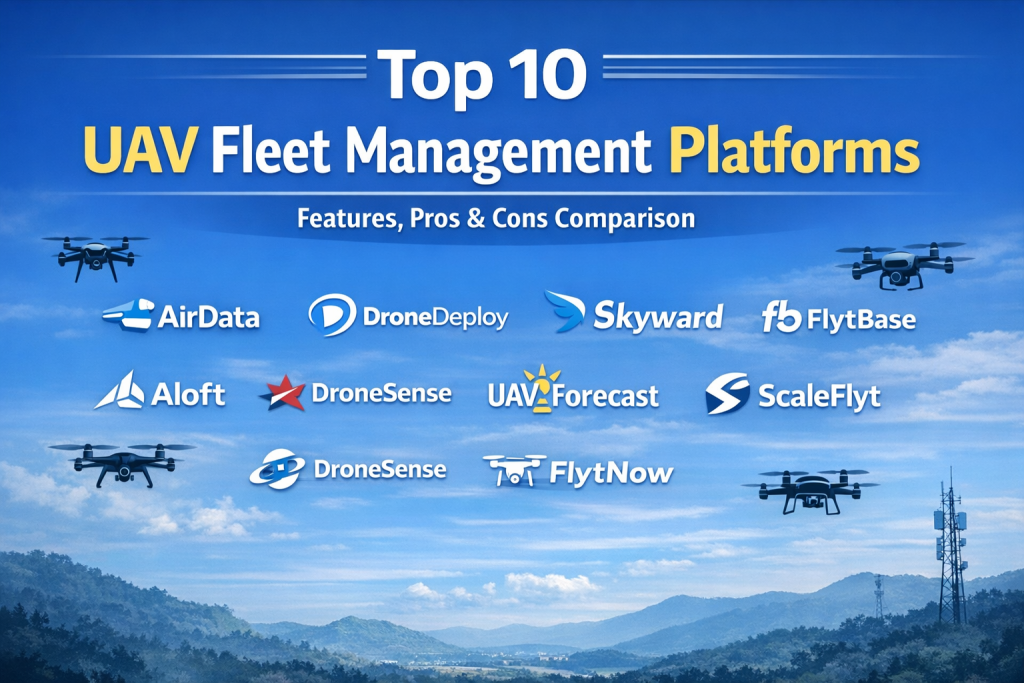
Top 10 UAV Fleet Management Platforms Tools
1 — AirData
Short description:
AirData focuses on deep analytics, flight logging, and compliance reporting. It is widely used by enterprises that need operational insights and safety tracking across large UAV fleets.
Key features
- Automated flight data capture and analytics
- Fleet health and maintenance tracking
- Pilot performance and safety scoring
- Compliance reporting and audit logs
- Real-time fleet dashboards
- Integrations with major drone manufacturers
Pros
- Excellent analytics depth
- Strong compliance and safety focus
Cons
- Interface can feel data-heavy for beginners
- Premium features can be costly
Security & compliance:
Encryption, role-based access, audit logs, GDPR-aligned data handling
Support & community:
Comprehensive documentation, enterprise onboarding, responsive support
2 — DroneDeploy
Short description:
DroneDeploy combines fleet management with mapping, inspection, and data visualization, making it popular for construction, agriculture, and infrastructure monitoring.
Key features
- Fleet and pilot management
- Mission planning and automation
- Cloud-based data processing
- Inspection and mapping workflows
- Role-based access control
- Analytics dashboards
Pros
- End-to-end operational coverage
- User-friendly interface
Cons
- Advanced features locked behind higher tiers
- Less customizable for niche workflows
Security & compliance:
Enterprise SSO, encryption, SOC-aligned controls, GDPR support
Support & community:
Strong training resources, active enterprise customer base
3 — Skyward
Short description:
Skyward emphasizes airspace intelligence and regulatory compliance, making it a strong choice for regulated and government-aligned drone operations.
Key features
- Airspace awareness and authorization workflows
- Fleet and pilot management
- Risk assessment tools
- Compliance documentation
- Mission planning
- Operational reporting
Pros
- Excellent regulatory support
- Strong risk management tools
Cons
- Interface feels enterprise-centric
- Less focus on analytics depth
Security & compliance:
Audit logs, secure data handling, regulatory compliance support
Support & community:
Professional onboarding, structured enterprise support
4 — FlytBase
Short description:
FlytBase is built for autonomous and dock-based drone operations, enabling remote monitoring and AI-driven missions.
Key features
- Autonomous mission execution
- Remote fleet monitoring
- Dock and charging station integration
- API-first architecture
- AI and automation workflows
Pros
- Strong autonomy focus
- Excellent for remote operations
Cons
- Requires higher technical expertise
- Less suitable for small teams
Security & compliance:
Encrypted communications, access controls, enterprise security standards
Support & community:
Developer-friendly documentation, enterprise support available
5 — Unifly
Short description:
Unifly specializes in UAS traffic management (UTM) and airspace coordination, often used by regulators and large infrastructure operators.
Key features
- UTM and airspace coordination
- Fleet monitoring
- Regulatory integration
- Real-time situational awareness
- Mission authorization workflows
Pros
- Best-in-class airspace management
- Strong government adoption
Cons
- Limited analytics features
- Not designed for small operators
Security & compliance:
Government-grade security, compliance-focused design
Support & community:
Enterprise and public-sector support model
6 — Aloft
Short description:
Aloft provides airspace intelligence combined with fleet management, widely used by commercial pilots and public safety agencies.
Key features
- Airspace awareness tools
- Fleet and pilot logs
- Mission planning
- Compliance reporting
- Operational dashboards
Pros
- Strong airspace intelligence
- Accessible pricing tiers
Cons
- Limited advanced analytics
- Fewer automation options
Security & compliance:
Encrypted data, role-based access, compliance-ready reporting
Support & community:
Active user community, solid documentation
7 — DroneSense
Short description:
DroneSense is designed specifically for public safety and emergency response drone operations.
Key features
- Real-time fleet visibility
- Live streaming and command tools
- Pilot coordination
- Incident logging
- Secure communications
Pros
- Purpose-built for first responders
- Real-time operational focus
Cons
- Limited commercial use cases
- Less emphasis on long-term analytics
Security & compliance:
High-security controls, encrypted communications
Support & community:
Dedicated public safety support teams
8 — UAV Forecast
Short description:
UAV Forecast focuses on weather-driven flight decision support rather than full fleet management.
Key features
- Hyper-local weather forecasting
- Flight risk indicators
- Wind and visibility modeling
- Environmental alerts
- Simple dashboards
Pros
- Excellent weather accuracy
- Lightweight and easy to use
Cons
- Not a full fleet management solution
- Limited integrations
Security & compliance:
Varies / N/A
Support & community:
Basic documentation, community-driven adoption
9 — ScaleFlyt
Short description:
ScaleFlyt targets enterprises that need to operationalize drone data across teams and systems.
Key features
- Fleet and asset tracking
- Data lifecycle management
- Enterprise integrations
- Workflow automation
- Analytics dashboards
Pros
- Strong enterprise data focus
- Good scalability
Cons
- Less beginner-friendly
- Smaller ecosystem
Security & compliance:
Enterprise encryption, access controls, GDPR-ready
Support & community:
Enterprise onboarding, professional support
10 — FlytNow
Short description:
FlytNow is designed for drone delivery operations, emphasizing fleet coordination and logistics workflows.
Key features
- Delivery mission orchestration
- Fleet tracking
- API-driven integrations
- Automation workflows
- Real-time monitoring
Pros
- Delivery-focused design
- Automation-ready
Cons
- Narrow use case
- Requires technical setup
Security & compliance:
Encrypted APIs, access controls, compliance varies by deployment
Support & community:
Technical documentation, enterprise support available
Comparison Table
| Tool Name | Best For | Platform(s) Supported | Standout Feature | Rating |
|---|---|---|---|---|
| AirData | Enterprise analytics & compliance | Web | Deep flight analytics | N/A |
| DroneDeploy | Inspection & mapping teams | Web, Mobile | End-to-end workflows | N/A |
| Skyward | Regulated operations | Web | Airspace intelligence | N/A |
| FlytBase | Autonomous fleets | Web, API | Dock-based autonomy | N/A |
| Unifly | UTM & regulators | Web | Airspace coordination | N/A |
| Aloft | Commercial pilots | Web, Mobile | Airspace awareness | N/A |
| DroneSense | Public safety | Web, Mobile | Real-time response | N/A |
| UAV Forecast | Weather planning | Mobile, Web | Weather accuracy | N/A |
| ScaleFlyt | Enterprise data ops | Web | Data orchestration | N/A |
| FlytNow | Drone delivery | Web, API | Logistics automation | N/A |
Evaluation & Scoring of UAV Fleet Management Platforms
| Criteria | Weight | Score (Avg) |
|---|---|---|
| Core features | 25% | High |
| Ease of use | 15% | Medium |
| Integrations & ecosystem | 15% | Medium |
| Security & compliance | 10% | High |
| Performance & reliability | 10% | High |
| Support & community | 10% | Medium |
| Price / value | 15% | Medium |
Which UAV Fleet Management Platforms Tool Is Right for You?
- Solo users: Lightweight tools or airspace planners are sufficient
- SMBs: Platforms with ease of use and moderate pricing work best
- Mid-market: Look for analytics, integrations, and scalability
- Enterprise: Prioritize compliance, security, automation, and APIs
Budget-conscious teams should focus on modular platforms, while premium users benefit from automation and deep analytics. If compliance is critical, regulatory-first platforms are the safest choice.
Frequently Asked Questions (FAQs)
- What is UAV fleet management software?
It centralizes drone operations, pilots, compliance, and data in one system. - Is fleet management required by law?
Not always, but it greatly simplifies compliance and audits. - Can small teams use these platforms?
Yes, many tools offer scaled-down plans. - Do these platforms support multiple drone brands?
Most enterprise tools do, but compatibility varies. - How secure is drone fleet data?
Security depends on encryption, access controls, and compliance standards. - Are these tools cloud-based?
The majority are cloud-native with web dashboards. - Can I automate drone missions?
Some platforms support advanced automation and autonomy. - What is UTM integration?
It manages airspace coordination and traffic awareness. - How long does implementation take?
From a few days to several weeks, depending on scale. - Is there a single best platform?
No—each excels in different operational scenarios.
Conclusion
UAV fleet management platforms are no longer optional for professional drone operations. They improve safety, efficiency, compliance, and scalability. The most important takeaway is that there is no universal best tool—the right platform depends on your fleet size, industry, budget, and regulatory needs. By aligning your operational goals with the strengths of each platform, you can build a future-ready UAV program with confidence.

Find Trusted Cardiac Hospitals
Compare heart hospitals by city and services — all in one place.
Explore Hospitals
One overlooked aspect of UAV fleet management is what happens when connectivity disappears during a mission. Drones operating in remote areas may temporarily lose communication with the control station, so their behavior should not depend entirely on a continuous network connection. Configurable lost-link procedures, onboard mission validation, geofencing, and reliable return-to-home logic are essential for handling unexpected communication failures safely.
An interesting challenge in large UAV operations is maintaining data accuracy when drones use different cameras, sensors, and firmware versions. Two drones inspecting the same infrastructure may produce measurements that are not directly comparable because of differences in sensor calibration or image-processing settings. Maintaining calibration histories and consistent data-capture standards is essential when drone outputs are used for engineering inspections, insurance assessments, or regulatory evidence.
Managing a UAV fleet involves more than tracking where each drone is flying. Teams also need a clear view of battery health, maintenance records, flight history, and pilot activity. A useful platform should bring these details together and make it easy to spot issues before the next mission. Flight planning, airspace awareness, and clear safety controls are also important when managing multiple drones across different locations.
Managing a UAV fleet involves more than tracking where each drone is flying. Teams also need a clear view of battery health, maintenance records, flight history, and pilot activity. A useful platform should bring these details together and make it easy to spot issues before the next mission. Flight planning, airspace awareness, and clear safety controls are also important when managing multiple drones across different locations.
UAV fleet management becomes more complex as organizations move from individual flights to coordinated operations across multiple sites. Beyond mission planning, I would evaluate how platforms handle telemetry gaps, battery-health trends, maintenance scheduling, and recovery when a drone loses connectivity during a mission. Integration with airspace restrictions and weather data is particularly important for keeping automated workflows safe and compliant. Another practical factor is whether flight logs and incident records can be exported and correlated with maintenance or inspection systems without creating data silos. A platform’s value ultimately depends on how reliably it supports safe operations, clear accountability, and actionable fleet-wide visibility as the number of aircraft grows.
UAV fleet management platforms need to do more than coordinate flight schedules; they must help operators maintain safety and operational consistency across the entire fleet. I would pay close attention to how each system handles battery and component health, maintenance intervals, mission history, and alerts for abnormal flight behavior. Integration with airspace restrictions and changing weather conditions is also essential, particularly when missions are automated or distributed across multiple locations. For enterprise deployments, reliable connectivity and clear procedures for lost-link events or interrupted missions deserve careful evaluation. The most useful platform is one that combines mission efficiency with strong compliance controls, actionable telemetry, and dependable recovery workflows.
UAV fleet management platforms are essential for coordinating drone operations, monitoring flight activity, and maintaining safety and regulatory compliance. This article provides a helpful comparison of tools designed for mission planning, fleet tracking, maintenance, and operational reporting. When choosing a platform, organizations should consider scalability, airspace management, automation features, and compatibility with their drone fleet. Selecting the right solution can improve operational efficiency, reduce risks, and make managing multiple drones much easier.
Operational success for enterprise UAV fleets hinges on automated flight logging that syncs directly with pilot certification tracking and regulatory waiver compliance. Implementing secure data offloading pipelines that push photogrammetry and LiDAR data directly into processing pipelines speeds up deliverable handoffs. Autonomous dock-in-a-box scheduling ensures remote infrastructure assets can be monitored continuously without requiring on-site technicians.
Scaling autonomous commercial drone operations requires fleet management platforms with integrated UTM connectivity and real-time airspace restriction deconfliction. Centralizing battery lifecycle tracking and automated maintenance logs based on motor flight hours prevents critical equipment failures during active field missions. Cloud-based video telemetry streaming enables remote operations centers to monitor critical aerial inspections across distributed job sites.
UAV fleet management platforms help teams manage drone inventories, monitor aircraft health, organize maintenance records, and maintain operational visibility. When comparing tools, consider fleet tracking, mission scheduling, pilot records, maintenance alerts, flight history, compliance documentation, data management, and reporting capabilities.
UAV fleet management platforms help organizations coordinate drone operations, monitor aircraft status, manage flight records, and organize maintenance activities. When comparing platforms, consider fleet visibility, mission planning, maintenance tracking, pilot management, flight logs, regulatory documentation, data security, and integration with mapping and reporting systems.
This second UAV fleet management comparison reinforces how mature the drone operations space has become. I appreciate the consistent emphasis on analytics and maintenance tracking, which extend fleet life measurably. One additional angle is insurance integration, which some platforms now support and which simplifies risk management. Operators comparing options should weigh ecosystem fit heavily. Consistent and useful coverage.
UAV fleet management platforms bring order to drone operations, and this article covers the operational realities well. What stands out to me is the focus on compliance logging and pilot management, since regulations shape every flight. One practical tip is to verify drone hardware compatibility before committing, since ecosystem support varies widely. Organized fleets fly safer and more often. Strong overview for operators.
UAV fleet management platforms help organizations monitor, control, and coordinate multiple drones from a central system. When comparing these platforms, I would focus on flight planning, real-time tracking, battery monitoring, maintenance management, and regulatory compliance features. These capabilities can improve flight safety, simplify operations, and provide better visibility across drone fleets. The right platform should support reliable fleet monitoring, efficient mission planning, and secure management of drone operations.
UAV fleet management platforms play an important role in coordinating drone operations, tracking aircraft performance, and managing multiple missions efficiently. Capabilities such as centralized fleet monitoring, flight planning, battery management, maintenance tracking, airspace awareness, and operational reporting help improve visibility and control. When evaluating solutions, organizations should consider drone compatibility, scalability, security, regulatory support, automation, and integration with existing workflows. A suitable platform can reduce operational complexity, improve flight safety, minimize downtime, and make large-scale drone operations more manageable.
UAV fleet management platforms help organizations coordinate drone operations, monitor aircraft performance, and manage multiple missions from a centralized system. Features such as real-time flight tracking, mission planning, battery monitoring, maintenance scheduling, airspace awareness, and automated reporting can improve operational efficiency and safety. When comparing platforms, teams should consider compatibility with different drone models, fleet scalability, data security, regulatory compliance, and integration with existing systems. The right solution can simplify fleet operations, reduce downtime, improve mission visibility, and support safer, more reliable drone deployments.
Drone fleet systems must be prepared for situations where control signals weaken or flight data becomes unreliable. Each drone should follow tested safety procedures, such as returning to its launch point or landing in a secure area. Engineers need to verify these responses under poor GPS coverage and sudden network interruptions. Keeping detailed records of flight disruptions helps teams identify whether the cause lies in connectivity, hardware, or software. This preparation can reduce operational risks and improve reliability across large drone fleets.
UAV fleet management platforms help operators coordinate flight schedules, monitor aircraft health, and maintain visibility across multiple drone missions. Automated maintenance alerts, flight log management, and airspace awareness can improve operational efficiency while supporting safer deployments. Integration with mapping systems, telemetry tools, and regulatory workflows also helps organizations streamline mission planning, maintain accurate records, and scale drone operations more effectively.
UAV fleet management platforms help businesses manage multiple drones and keep track of their flights. They make it easier to plan missions, monitor battery levels, and schedule maintenance. I think real-time tracking and safety alerts are important for smooth drone operations. These tools can save time and reduce manual work. A good platform helps teams manage drones safely and efficiently.
UAV fleet management platforms help teams manage drones, plan flights, and monitor their activities in one place. They make it easier to track battery levels, check flight status, and schedule regular maintenance. I think real-time monitoring and flight safety features are very important for smooth operations. These tools can save time and help teams manage multiple drones more efficiently. Choosing the right platform can make drone operations safer and more organized.
Managing a UAV fleet requires dependable coordination between flight planning, equipment maintenance, and operational oversight. Platforms that combine telemetry monitoring, automated maintenance records, and mission scheduling can help operators reduce downtime and maintain consistent performance across multiple aircraft. Strong access controls, accurate flight logs, and compliance tracking further support safer operations and provide better visibility as drone programs expand.
When comparing UAV fleet management tools, I would look closely at how they support daily operations beyond flight tracking. Teams need reliable mission records, maintenance alerts, battery status, and clear visibility into each aircraft’s availability. It is also important to check whether the platform supports the hardware and flight workflows already in use. A practical test should include a delayed mission, a low-battery warning, and a maintenance issue. These cases reveal how well the system supports real decisions. The best platform should make fleet coordination easier while keeping safety checks, records, and operational responsibilities clear.
UAV fleet management platforms help teams plan flights, track aircraft, manage pilots, and maintain mission records. The right system should support safe operations as well as efficient scheduling. I would compare flight planning, battery tracking, maintenance logs, airspace information, and compliance records. Teams should test how the platform handles lost connections, weather changes, and aircraft that need maintenance. Clear records are important when reviewing a mission or investigating an incident. Integration with different UAV models may also affect the choice. A useful platform should improve coordination while helping operators follow the rules and manage risks throughout each flight.
Drone fleet software should be evaluated for how it behaves when communication becomes unreliable, not just when every system works as expected. During remote inspections, weak network coverage can interrupt telemetry, delay commands, or leave operators without a clear view of a drone’s status. Teams should verify that each aircraft follows predefined lost-link procedures and that operators can distinguish live telemetry from outdated data. Testing should also cover recovery after a control platform outage, delayed synchronization of flight records, and safe resumption of interrupted missions. These checks help organizations identify operational weaknesses before deploying fleets across remote or high-risk locations. Reliable fallback behavior is just as important as automation when drones operate beyond constant human supervision.
Drone fleet operators should evaluate how the platform manages software updates and recovery across different aircraft models. A firmware update that works on one drone may cause compatibility issues with another, especially when fleets use mixed hardware. Teams should test updates in controlled environments, deploy them in small batches, and maintain a rollback plan before updating the entire fleet. It is also important to verify that each aircraft can enter a safe operating state if an update fails or the control link drops. Tracking firmware versions, update failures, and recovery times can help operators identify risks before they affect active missions. These practices support safer fleet expansion and reduce downtime caused by poorly managed changes.
Managing a UAV fleet becomes more complex when different drone models require separate maintenance schedules, battery types, and operating procedures. A useful comparison should look at how platforms coordinate mission planning, track flight hours, and flag aircraft that need inspection before their next deployment. Integration with flight logs and maintenance records can help operators spot recurring equipment issues and make better decisions about fleet availability.
UAV fleet management platforms need to coordinate flight schedules, battery readiness, pilot assignments, and maintenance across multiple drones. When comparing options, check how they manage airspace restrictions, weather-related flight risks, and mission records for each aircraft. Tracking battery health and recurring equipment faults can also help operators plan safer missions and reduce unexpected downtime across the fleet.
Real-time telemetry ingestion presents distinct challenges when synchronizing Beyond Visual Line of Sight flight controllers with edge docking hubs. Without ultra-low-latency MQTT broker clusters, reliable dead reckoning algorithms, and geofence enforcement protocols, managing simultaneous multi-drone autonomous missions risks severe spatial desynchronization and critical navigational failures across crowded airspace corridors.
UAV fleet management platforms are useful for tracking drone health, organizing missions, and keeping flight records in one place. A good comparison should cover aircraft compatibility, mission scheduling, battery monitoring, maintenance alerts, and compliance reporting. Teams should also test how each platform handles lost connections and failed missions, as reliable alerts and clear flight histories make fleet operations easier to manage.
UAV fleet management platforms help operators coordinate drone missions, monitor aircraft health, and manage flight records from a central system. When comparing tools, consider mission planning, live telemetry, battery tracking, maintenance alerts, and compliance reporting. Reliable flight logs and timely maintenance notifications can help teams reduce equipment downtime, improve mission coordination, and maintain safer operations across multiple drones.
Managing a UAV fleet becomes much easier when teams can coordinate flight schedules, monitor drone health, and organize mission data from one platform. Tools like FlytBase support drone automation, fleet operations, and remote monitoring, helping businesses streamline recurring missions, improve operational visibility, and scale their drone programs more efficiently.
UAV fleet management platforms help organizations plan drone missions, monitor aircraft status, manage flight operations, and keep track of fleet performance from a central dashboard. Solutions like DroneDeploy support flight planning, aerial data capture, and mission management, helping teams improve operational visibility, coordinate drone activities, and make better use of collected data.
Choosing the right fleet management platform often comes down to how well it bridges the gap between pilot operations and backend data pipelines. While enterprise platforms excel at compliance and analytics, smaller teams frequently struggle with the overhead of maintaining heavy integrations. A modular approach—where you only pay for telemetry and airspace logging as your fleet scales—usually yields the best return on investment.
Choosing between an analytics-heavy platform like AirData and an automation-first option like FlytBase really highlights how diverse commercial drone use cases have become. For scaling operations, the biggest bottleneck often isn’t just flight logging, but integrating telemetry data smoothly with existing enterprise GIS or maintenance pipelines. It would be great to see a future breakdown focusing specifically on how these platforms handle API rate limits and data export bottlenecks during high-frequency, multi-drone deployments.
A strong UAV fleet management platform should do more than track flights; it should help teams prevent battery failures, schedule maintenance, and maintain reliable safety records. Testing these features with real flight data before committing can reveal operational gaps that a feature comparison alone may miss.
Choosing an email encryption tool should involve more than checking encryption strength; recipient convenience and key management are equally important. Testing external email workflows and access revocation before deployment helps teams protect sensitive data without disrupting everyday communication.
This article offers a very practical and well‑structured comparison of UAV fleet management platforms — a space that’s becoming increasingly critical as drones are used for inspections, delivery, surveying, and public safety operations. I appreciate how it breaks down not just core features like mission planning, real‑time tracking, and regulatory compliance, but also real‑world considerations such as scalability, integration with existing systems, ease of use, and data analytics capabilities. The side‑by‑side pros and cons help readers match platform strengths to specific operational needs — whether that’s autonomous flight coordination, robust safety and geofencing support, or enterprise‑grade reporting and telemetry. For drone program managers and aviation teams evaluating management solutions, this comparison provides clear insights and decision‑support that goes beyond basic feature lists.