
Introduction
Utility Billing Software is a specialized system designed to calculate, bill, collect, and manage payments for essential services such as electricity, water, gas, wastewater, telecom, and district heating. Unlike generic accounting tools, utility billing platforms handle complex tariff structures, meter readings, usage-based pricing, subsidies, penalties, taxes, and regulatory reporting.
In today’s environment, utilities face rising customer expectations, strict compliance requirements, smart meter rollouts, and pressure to improve operational efficiency. Manual billing or outdated systems often lead to billing errors, delayed collections, revenue leakage, and customer dissatisfaction. Utility billing software helps organizations automate billing cycles, improve accuracy, ensure compliance, and enhance customer experience.
Real-world use cases include:
- Municipal corporations billing water and sewer services
- Power distribution companies managing millions of meter readings
- Gas utilities handling tiered and seasonal pricing
- Private utility providers offering digital self-service portals
When choosing a utility billing solution, buyers should evaluate billing flexibility, meter data handling, scalability, integrations, security, reporting depth, customer self-service features, and long-term support.
Best for:
Utility Billing Software is ideal for municipal utilities, energy and water providers, housing societies, campuses, industrial parks, telecom operators, and managed service providers. Finance teams, revenue managers, billing analysts, and operations leaders benefit the most.
Not ideal for:
Very small organizations with flat, non-metered pricing or businesses that only require basic invoicing may find these platforms too complex or costly compared to simple accounting tools.
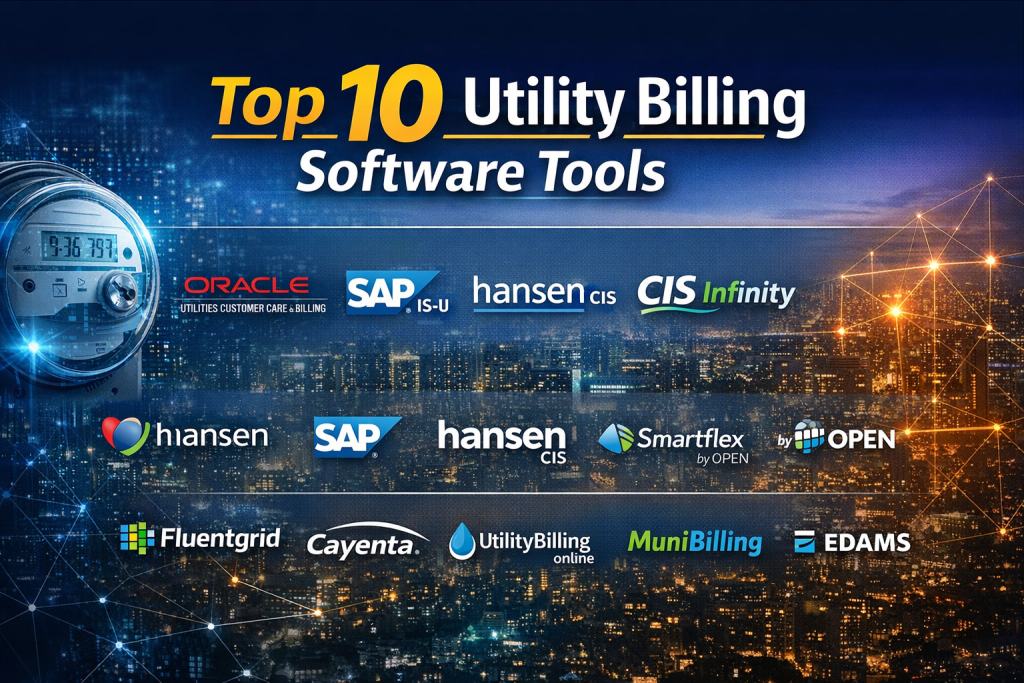
Top 10 Utility Billing Software Tools
1 — Oracle Utilities Customer Care and Billing
Oracle Utilities Customer Care and Billing
Short description:
An enterprise-grade billing and customer information system built for large electricity, gas, and water utilities with complex regulatory needs.
Key features
- Advanced tariff and rate modeling
- High-volume meter and usage processing
- Customer information system (CIS)
- Automated billing, collections, and revenue management
- Smart meter and AMI integration
- Regulatory and compliance reporting
- Scalable for millions of customers
Pros
- Extremely robust and scalable
- Designed for complex, regulated environments
- Strong ecosystem and long-term roadmap
Cons
- High implementation and licensing cost
- Requires skilled IT and consulting partners
Security & compliance
- Enterprise-grade encryption, role-based access, audit logs, GDPR-ready
Support & community
- Global enterprise support, extensive documentation, strong partner network
2 — SAP IS-U
SAP IS-U
Short description:
A comprehensive utility industry solution integrated into the SAP ecosystem, widely used by large and mid-sized utility providers.
Key features
- End-to-end utility billing and invoicing
- Meter reading and device management
- Contract and customer lifecycle management
- Integration with SAP S/4HANA Finance
- Complex tariff handling
- Regulatory and tax support
- Analytics and reporting
Pros
- Deep integration with SAP ERP
- Highly configurable billing logic
- Trusted by global utilities
Cons
- Steep learning curve
- Implementation can be lengthy
Security & compliance
- SAP enterprise security standards, GDPR, ISO-aligned controls
Support & community
- Extensive SAP documentation, global consultants, strong enterprise support
3 — Hansen CIS
Hansen CIS
Short description:
A modern customer information and billing platform for utilities transitioning to digital-first operations.
Key features
- Flexible billing and rating engine
- Customer self-service portals
- Meter and usage management
- Multi-utility support (electric, water, gas)
- Workflow automation
- Reporting and analytics
- Cloud and on-prem deployment options
Pros
- Modern UI and customer experience
- Strong multi-utility capabilities
- Good balance of flexibility and control
Cons
- Smaller ecosystem than SAP or Oracle
- Customization may require vendor support
Security & compliance
- Role-based security, encryption, audit logging, GDPR-ready
Support & community
- Dedicated utility-focused support, structured onboarding
4 — CIS Infinity
CIS Infinity
Short description:
A utility billing and CIS platform tailored for mid-sized utilities seeking reliability without extreme complexity.
Key features
- Meter-based and flat-rate billing
- Customer account management
- Payment processing and collections
- Reporting and dashboards
- Rate and tariff configuration
- Service order management
Pros
- Easier implementation than enterprise giants
- Designed specifically for utilities
- Predictable performance
Cons
- Limited advanced analytics
- UI may feel dated for some users
Security & compliance
- Standard encryption, access controls, audit trails
Support & community
- Vendor-led support, documentation focused on utilities
5 — Open International Smartflex
Open International Smartflex
Short description:
A cloud-native utility billing and CIS solution optimized for digital transformation and scalability.
Key features
- Modular, cloud-based architecture
- Flexible billing and pricing models
- Customer engagement tools
- Smart meter integration
- Real-time data processing
- Analytics and insights
- Multi-utility support
Pros
- Modern, scalable architecture
- Faster time-to-value
- Strong customer engagement focus
Cons
- Requires change management
- Pricing varies by deployment scope
Security & compliance
- Cloud security standards, encryption, GDPR-aligned
Support & community
- Strong onboarding, enterprise support, growing community
6 — Fluentgrid Utility Billing
Fluentgrid Utility Billing
Short description:
A comprehensive utility billing platform popular with public sector and emerging market utilities.
Key features
- Multi-utility billing engine
- Meter data management
- Customer lifecycle management
- Mobile workforce integration
- GIS and ERP integrations
- Analytics and reporting
Pros
- Strong public-sector experience
- Flexible deployment options
- Cost-effective for large rollouts
Cons
- UI less polished than newer SaaS tools
- Customization may take time
Security & compliance
- Role-based access, encryption, audit logs
Support & community
- Vendor-led enterprise support, regional expertise
7 — Cayenta
Cayenta
Short description:
A utility billing and CIS solution designed primarily for municipal utilities and local governments.
Key features
- Utility billing and invoicing
- Customer account management
- Meter reading and service orders
- Integration with municipal ERP
- Reporting and compliance tools
- Multi-utility support
Pros
- Strong municipal focus
- Stable and proven platform
- Good compliance support
Cons
- Limited innovation pace
- UI modernization is gradual
Security & compliance
- Standard enterprise security controls
Support & community
- Strong customer support in municipal sector
8 — Utility Billing Online
Utility Billing Online
Short description:
A cloud-based utility billing platform built for small to mid-sized utilities seeking simplicity.
Key features
- Automated billing and invoicing
- Online payment processing
- Meter reading imports
- Customer portals
- Reporting and exports
- Multi-utility billing
Pros
- Easy to use
- Lower cost of ownership
- Fast implementation
Cons
- Limited advanced customization
- Not ideal for very large utilities
Security & compliance
- Cloud security controls, encryption, basic audit logs
Support & community
- Responsive support, straightforward documentation
9 — MuniBilling
MuniBilling
Short description:
A utility billing and revenue management solution focused on municipalities and local authorities.
Key features
- Utility billing and collections
- Tax and fee integration
- Customer management
- Payment tracking
- Reporting and compliance
- Integration with municipal systems
Pros
- Municipal-specific workflows
- Simplified operations
- Cost-effective for local governments
Cons
- Less suitable for private utilities
- Limited advanced analytics
Security & compliance
- Standard municipal security practices
Support & community
- Vendor support tailored to local governments
10 — EDAMS Utility Billing
EDAMS Utility Billing
Short description:
A flexible utility billing solution designed for regional utilities and managed service providers.
Key features
- Multi-utility billing support
- Meter and usage management
- Customer self-service portals
- Payment processing
- Reporting and analytics
- Configurable billing rules
Pros
- Flexible and adaptable
- Good value for mid-sized utilities
- Straightforward setup
Cons
- Smaller global footprint
- Limited third-party ecosystem
Security & compliance
- Role-based access, encryption, audit logs
Support & community
- Direct vendor support, guided onboarding
Comparison Table
| Tool Name | Best For | Platform(s) Supported | Standout Feature | Rating |
|---|---|---|---|---|
| Oracle Utilities CCB | Large regulated utilities | Cloud / On-prem | Extreme scalability | N/A |
| SAP IS-U | SAP-centric utilities | On-prem / Cloud | Deep ERP integration | N/A |
| Hansen CIS | Digital-first utilities | Cloud / On-prem | Modern CIS design | N/A |
| CIS Infinity | Mid-sized utilities | On-prem / Cloud | Utility-focused simplicity | N/A |
| Open Int. Smartflex | Cloud-native utilities | Cloud | Modular architecture | N/A |
| Fluentgrid | Public sector utilities | Cloud / On-prem | Multi-utility support | N/A |
| Cayenta | Municipal utilities | On-prem | Government compliance | N/A |
| Utility Billing Online | SMB utilities | Cloud | Ease of use | N/A |
| MuniBilling | Local governments | Cloud / On-prem | Municipal workflows | N/A |
| EDAMS | Regional utilities | Cloud / On-prem | Flexibility | N/A |
Evaluation & Scoring of Utility Billing Software
| Criteria | Weight | Evaluation Focus |
|---|---|---|
| Core features | 25% | Billing flexibility, meter handling, tariffs |
| Ease of use | 15% | UI, onboarding, daily operations |
| Integrations & ecosystem | 15% | ERP, CRM, meter systems |
| Security & compliance | 10% | Data protection, auditability |
| Performance & reliability | 10% | Scalability, uptime |
| Support & community | 10% | Vendor support quality |
| Price / value | 15% | Total cost vs capability |
Which Utility Billing Software Tool Is Right for You?
- Solo users / small utilities: Cloud-first tools with fast setup and low cost are usually sufficient.
- SMBs: Look for configurable billing without enterprise-level complexity.
- Mid-market utilities: Balance scalability, integrations, and cost.
- Enterprises: Prioritize compliance, scalability, and long-term vendor stability.
Budget-conscious teams should favor simpler SaaS platforms, while premium buyers gain value from deep configurability and compliance. If integration and growth are key, choose systems with proven scalability and APIs.
Frequently Asked Questions (FAQs)
- What is utility billing software?
It automates billing, invoicing, and revenue management for utilities based on consumption or fixed rates. - Can it handle multiple utilities?
Yes, most modern platforms support electricity, water, gas, and more in one system. - Is cloud-based billing secure?
Reputable vendors use encryption, access controls, and compliance standards. - How long does implementation take?
From weeks for small SaaS tools to months for enterprise systems. - Does it support smart meters?
Most mid-market and enterprise tools support smart meter integrations. - Can customers pay online?
Yes, many platforms offer customer portals and digital payments. - Is customization possible?
Enterprise tools offer deep customization; SaaS tools are more standardized. - What are common mistakes?
Underestimating data migration and change management. - Is training required?
Yes, especially for complex tariff and compliance setups. - Are there alternatives?
Some ERP or accounting tools offer basic billing, but lack utility-specific depth.
Conclusion
Utility Billing Software is a mission-critical system for utilities of all sizes. The right platform improves billing accuracy, accelerates collections, ensures compliance, and enhances customer trust. While enterprise solutions deliver unmatched scalability and regulatory strength, cloud-first platforms offer speed and affordability.
There is no single “best” tool for everyone. The best choice depends on utility size, complexity, regulatory environment, budget, and long-term growth plans. Evaluating these factors carefully will ensure a billing system that supports both today’s operations and tomorrow’s expansion.

Find Trusted Cardiac Hospitals
Compare heart hospitals by city and services — all in one place.
Explore Hospitals
A utility billing platform should also be tested against unusual billing situations, not just routine monthly cycles. Consider a customer moving out mid-cycle, a meter being replaced, or a tariff changing while an invoice is being prepared. These cases can expose gaps in account transfers, prorated charges, and payment reconciliation. I would include them in any software evaluation because handling everyday bills is only part of what makes a system dependable.
Utility billing software needs to do more than generate accurate monthly invoices. It should also handle meter readings, changing tariff rates, payment tracking, and customer account updates without creating extra manual work. One important area to check is how the system manages estimated readings and billing corrections. Clear usage records and timely notifications can help utility providers reduce disputes and improve customer communication.
Utility billing systems need to handle far more than invoice generation, particularly when usage data, tariffs, and regulatory rules vary across service areas. A small meter-reading error or an outdated rate configuration can lead to billing disputes and undermine customer trust. I’d look closely at how platforms validate meter data, manage tariff changes, and support corrections without losing the audit trail. Customer portals with clear usage breakdowns can also reduce support requests by helping people understand their bills. The best solution combines accurate billing, dependable integrations, and transparent exception handling to keep revenue operations reliable.
Utility billing engines must handle complex multi-tier rate tariffs, seasonal peak pricing, and automated net metering calculations for renewable energy producers without error. Ingesting smart meter AMI data at high volume requires robust automated validation, estimation, and editing (VEE) pipelines to catch meter telemetry errors before customer invoices generate. Intuitive customer portals featuring granular usage graphs and flexible payment options significantly reduce call center billing inquiries.
Utility billing software helps service providers manage customer accounts, track consumption, generate invoices, and process payments for essential services. When comparing platforms, consider meter data integration, automated billing, payment processing, usage tracking, customer portals, overdue reminders, reporting, and support for different billing models.
Utility billing software affects millions of households, and this comparison approaches it with appropriate rigor. What stands out to me is the focus on meter data management and rate flexibility, which are the core of accurate billing. One suggestion is to test customer portal usability as carefully as backend logic, since confusing bills drive support volume. Transparent billing builds public trust. Solid and practical overview.
Utility billing software helps service providers manage customer accounts, calculate usage-based charges, generate invoices, and process payments. When comparing solutions, I would focus on automated billing, meter data integration, payment processing, customer portals, and reporting capabilities. These features can reduce billing errors and improve customer service. The right software should simplify billing operations, provide accurate consumption records, and help utility providers manage payments and customer accounts efficiently.
Utility billing software helps service providers manage customer accounts, meter readings, invoicing, payments, and consumption records more efficiently. Features such as automated billing, meter data integration, payment processing, tariff management, usage tracking, and customer portals can simplify complex billing operations. When comparing solutions, organizations should consider billing accuracy, scalability, integration capabilities, reporting, regulatory support, and ease of use. The right platform can reduce manual errors, improve revenue collection, streamline customer service, and provide greater transparency into utility consumption and payments.
Utility billing platforms should be able to correct charges without losing a clear record of what customers were originally billed. Late meter data, inaccurate readings, or revised rates can all affect amounts after invoices go out. Teams should test how adjustments appear in customer accounts, payment histories, and finance reports. Every change should include a clear reason and an audit trail for later review. This reduces billing disputes and helps keep account balances consistent across connected systems.
Utility billing software helps service providers manage customer accounts, meter readings, invoices, and payments with greater accuracy. Automated consumption calculations, flexible billing rules, and timely notifications can reduce administrative workload while improving transparency for customers. Integrating these systems with smart meters and customer service platforms also supports faster issue resolution, better usage insights, and more efficient revenue management.
Utility billing software helps companies manage bills, payments, and customer records in one place. It can reduce manual work and help avoid billing mistakes. I think automatic bill generation and payment reminders are useful features for saving time. These tools also make it easier for customers to track their bills and payments. Choosing the right software can make billing faster and more accurate.
Utility billing software must turn meter readings, rates, and customer records into accurate bills. Errors can affect trust and create costly support work. I would compare meter data integration, tariff rules, payment handling, account adjustments, and customer notifications. Teams should test estimated readings, late payments, and changes to rates. Clear audit records help explain how a bill was calculated. The platform should also support secure customer access and reliable reporting. A useful system should reduce manual corrections while making billing easier to review. Accuracy, flexibility, and clear communication matter as much as automation features.
Utilities need a reliable process for correcting bills when new meter data arrives after an invoice has been issued. For example, a faulty reading may lead to an estimated charge that differs greatly from the customer’s actual consumption. The system should support transparent adjustments, preserve the original invoice, and explain how each correction affects the final amount. Teams should also test how revised charges flow into payment records, refunds, accounting systems, and customer statements. Keeping a clear history of these changes helps staff resolve disputes and gives auditors a traceable record of every adjustment. These capabilities are especially important for utilities that process large volumes of readings from automated meters.
Utility billing software should calculate charges accurately even when customers have different tariffs, meter types, and billing cycles. When comparing platforms, check how they handle estimated readings, corrected meter data, and adjustments to previous bills. A clear process for explaining unusual charges and resolving billing disputes can reduce customer complaints while helping utility providers maintain accurate account balances.
Ingesting high-frequency Advanced Metering Infrastructure (AMI) intervals directly into relational billing engines causes debilitating lock contention during monthly invoice generation. Without decoupled time-series event streaming and pre-aggregation pipelines, complex multi-tier tariff calculations trigger severe database CPU spikes. Platform architects must enforce asynchronous ledger reconciliation to process high-volume meter events without degrading customer portal latency.
Utility billing software helps providers calculate charges, manage customer accounts, track payments, and handle billing cycles for services such as water, electricity, and gas. When comparing platforms, look at meter data integration, flexible rate plans, payment processing, overdue notices, and customer self-service options. Accurate meter readings and clear billing records can reduce disputes, prevent calculation errors, and help providers deliver a smoother customer experience.
Utility billing software helps service providers manage customer accounts, meter readings, invoices, and payment records for electricity, water, gas, and other essential services. Platforms like Oracle Utilities offer billing, customer management, and usage tracking capabilities, helping utility companies reduce manual errors, streamline billing operations, and provide customers with more reliable service.
Transitioning from legacy systems to cloud-native platforms like Smartflex or Hansen CIS brings incredible flexibility, but change management is often the biggest hurdle for teams used to traditional workflows. Beyond handling complex tiered tariffs, how do these solutions perform when synchronizing real-time data from large-scale smart meter rollouts without disrupting daily billing cycles.
A utility billing platform should do more than automate invoices; it should also make usage and charges easy for customers to understand. Reliable meter data, transparent bill calculations, and smooth integration with payment systems can reduce disputes and improve payment collection.
This is a very practical and comprehensive breakdown of utility billing software — a space that’s often overlooked but critically important for utilities and service providers dealing with complex tariffs, meter data, and regulatory demands. The article not only highlights the core capabilities like flexible billing logic, multi‑utility support, and customer self‑service, but also clearly outlines real‑world trade‑offs such as implementation complexity, scalability differences, and integration challenges across platforms such as enterprise solutions like Oracle and SAP right down to simpler, cloud‑first tools designed for smaller utilities. By comparing pros and cons side‑by‑side and emphasizing factors like compliance, security, and total cost of ownership, this guide makes it much easier for decision‑makers to align software choice with their specific operational and long‑term strategic needs.