
Introduction
Pipeline Integrity Management Software (PIMS) plays a critical role in ensuring the safety, reliability, and regulatory compliance of oil, gas, water, and chemical pipelines. These platforms help operators continuously monitor pipeline conditions, assess risks, manage inspections, detect corrosion or leaks, and prevent failures that could lead to environmental damage, financial losses, or safety incidents.
In today’s environment of aging infrastructure, stricter regulations, and rising operational complexity, manual spreadsheets and fragmented systems are no longer sufficient. Pipeline Integrity Management Software brings data-driven decision-making by consolidating inspection data, inline inspection (ILI) results, GIS information, maintenance history, and risk models into a single, auditable system.
Why it matters
- Prevents catastrophic pipeline failures and leaks
- Improves regulatory compliance and audit readiness
- Extends asset life and reduces unplanned downtime
- Optimizes inspection and maintenance budgets
Common real-world use cases
- Corrosion growth monitoring and prediction
- Risk-based inspection (RBI) planning
- Managing ILI, hydrotest, and direct assessment data
- Regulatory reporting and compliance tracking
What to look for when choosing a solution
- Strong data management for ILI, GIS, and inspection records
- Advanced analytics and risk modeling
- Ease of use for engineers and field teams
- Scalability across thousands of pipeline segments
- Security and compliance for critical infrastructure
Best for:
Pipeline Integrity Management Software is ideal for oil & gas operators, pipeline owners, midstream companies, utilities, integrity engineers, compliance managers, and large asset-heavy enterprises managing long-distance or high-risk pipelines.
Not ideal for:
Small operators with very limited pipeline assets or organizations needing only basic asset tracking may find full PIMS platforms too complex or costly, and may prefer lightweight maintenance tools.
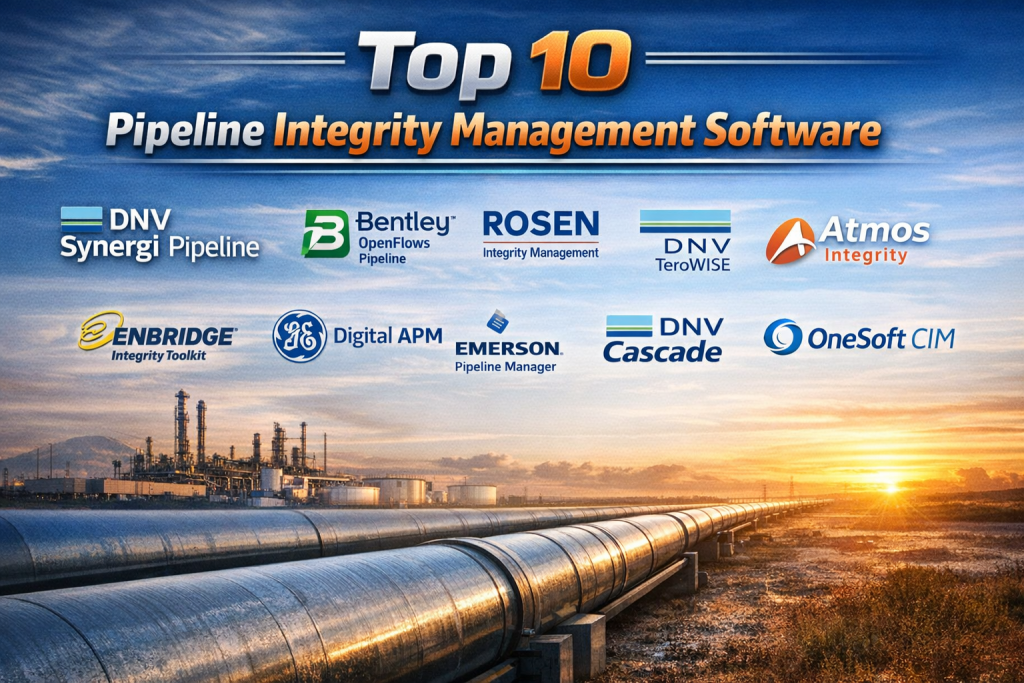
Top 10 Pipeline Integrity Management Software Tools
1 — DNV Synergi Pipeline
Short description:
A comprehensive integrity and risk management platform designed for complex pipeline networks and regulatory-heavy environments.
Key features
- Risk-based inspection (RBI) modeling
- Corrosion growth and failure probability analysis
- GIS and inline inspection (ILI) data integration
- Regulatory compliance workflows
- Scenario-based risk simulations
- Centralized asset data repository
Pros
- Highly trusted in safety-critical industries
- Strong analytical depth and standards alignment
Cons
- Steep learning curve
- Premium pricing for smaller operators
Security & compliance:
ISO-aligned controls, role-based access, audit trails, enterprise-grade security
Support & community:
Excellent documentation, global enterprise support, strong consulting ecosystem
2 — Bentley OpenFlows Pipeline
Short description:
An engineering-focused platform combining hydraulic modeling with pipeline integrity and performance management.
Key features
- Hydraulic and transient flow modeling
- Integration with engineering design tools
- Asset condition monitoring
- GIS and SCADA connectivity
- Scenario analysis for failure impact
Pros
- Strong engineering accuracy
- Seamless integration with Bentley ecosystem
Cons
- Less intuitive for non-engineers
- Requires configuration expertise
Security & compliance:
Enterprise authentication, access controls, compliance-ready
Support & community:
Extensive documentation, training programs, professional services
3 — ROSEN Integrity Management
Short description:
A data-driven integrity management platform backed by extensive inspection and engineering expertise.
Key features
- Inline inspection data analysis
- Corrosion and crack growth modeling
- Fitness-for-service assessments
- Risk ranking and prioritization
- Inspection planning optimization
Pros
- Deep inspection expertise
- Strong analytical accuracy
Cons
- Heavily dependent on ROSEN services
- Limited flexibility for custom workflows
Security & compliance:
Secure data handling, compliance with industry standards
Support & community:
Strong expert support, limited community-driven resources
4 — DNV TeroWISE
Short description:
An advanced analytics platform for pipeline condition monitoring and life-cycle risk management.
Key features
- Predictive analytics and degradation modeling
- Integrity threat assessment
- Digital twin concepts
- Data quality management
- Long-term asset planning
Pros
- Forward-looking risk insights
- Excellent lifecycle perspective
Cons
- Complex implementation
- Best suited for large enterprises
Security & compliance:
Enterprise security, audit logging, compliance-ready
Support & community:
High-quality enterprise support, limited peer community
5 — Atmos Integrity
Short description:
A practical integrity management solution focused on usability and regulatory compliance.
Key features
- Asset and inspection tracking
- Corrosion management
- Risk scoring dashboards
- Regulatory reporting tools
- Workflow automation
Pros
- User-friendly interface
- Faster onboarding
Cons
- Fewer advanced analytics
- Limited customization for complex assets
Security & compliance:
Role-based access, audit logs, compliance-focused
Support & community:
Responsive customer support, good onboarding resources
6 — Enbridge Integrity Toolkit
Short description:
An internally developed enterprise-grade platform designed for large-scale pipeline operators.
Key features
- Enterprise asset data integration
- Integrity threat management
- Advanced risk modeling
- Operational analytics
- Regulatory compliance reporting
Pros
- Built for large networks
- Highly scalable
Cons
- Limited availability externally
- Customization complexity
Security & compliance:
High-security enterprise controls, regulatory-grade compliance
Support & community:
Internal enterprise support model
7 — GE Digital APM
Short description:
A broad asset performance management solution with strong pipeline integrity capabilities.
Key features
- Predictive maintenance analytics
- Asset health monitoring
- Risk-based inspection
- Integration with IoT and SCADA
- Enterprise dashboards
Pros
- Strong analytics and AI capabilities
- Scales across asset classes
Cons
- Pipeline-specific depth may vary
- Complex deployment
Security & compliance:
Enterprise-grade security, SOC-aligned controls
Support & community:
Global support network, extensive documentation
8 — Emerson Pipeline Manager
Short description:
A monitoring-centric solution focused on real-time pipeline performance and leak detection.
Key features
- Real-time monitoring
- Leak detection analytics
- Integration with control systems
- Alarm and event management
- Operational dashboards
Pros
- Strong real-time visibility
- Reliable industrial-grade system
Cons
- Limited long-term integrity modeling
- Best used with other tools
Security & compliance:
Industrial security standards, access controls
Support & community:
Strong industrial support, training resources
9 — DNV Cascade
Short description:
A risk modeling platform focused on consequence and probability assessment for pipelines.
Key features
- Quantitative risk assessment
- Consequence modeling
- Scenario simulations
- Regulatory alignment
- Reporting tools
Pros
- Excellent risk visualization
- Regulatory-friendly outputs
Cons
- Narrower scope than full PIMS
- Requires complementary systems
Security & compliance:
Secure enterprise deployment, audit-ready
Support &community:
Professional support, consulting-driven usage
10 — OneSoft CIM
Short description:
A modern, cloud-enabled platform specializing in inspection data management and analytics.
Key features
- Inline inspection data ingestion
- Advanced anomaly analysis
- Cloud-based dashboards
- Integrity assessment workflows
- API integrations
Pros
- Modern UI and analytics
- Strong ILI handling
Cons
- Limited non-ILI asset coverage
- Cloud dependency concerns
Security & compliance:
Encryption, role-based access, compliance-ready
Support & community:
Good documentation, responsive support team
Comparison Table
| Tool Name | Best For | Platform(s) Supported | Standout Feature | Rating |
|---|---|---|---|---|
| DNV Synergi Pipeline | Large regulated operators | Web, Enterprise | Risk-based integrity modeling | N/A |
| Bentley OpenFlows Pipeline | Engineering-driven teams | Desktop, Cloud | Hydraulic simulation | N/A |
| ROSEN Integrity Management | Inspection-heavy pipelines | Enterprise | ILI analytics | N/A |
| DNV TeroWISE | Lifecycle risk planning | Enterprise | Predictive degradation | N/A |
| Atmos Integrity | Mid-sized operators | Web | Ease of use | N/A |
| Enbridge Integrity Toolkit | Large networks | Enterprise | Scalability | N/A |
| GE Digital APM | Multi-asset enterprises | Cloud, Enterprise | AI-driven APM | N/A |
| Emerson Pipeline Manager | Real-time monitoring | Industrial systems | Leak detection | N/A |
| DNV Cascade | Risk analysts | Enterprise | Quantitative risk | N/A |
| OneSoft CIM | ILI-focused teams | Cloud | Inspection analytics | N/A |
Evaluation & Scoring of Pipeline Integrity Management Software
| Criteria | Weight | Score Considerations |
|---|---|---|
| Core features | 25% | Integrity modeling, inspection handling |
| Ease of use | 15% | UI, onboarding effort |
| Integrations & ecosystem | 15% | GIS, SCADA, ILI tools |
| Security & compliance | 10% | Audit logs, access control |
| Performance & reliability | 10% | Stability at scale |
| Support & community | 10% | Vendor responsiveness |
| Price / value | 15% | ROI vs cost |
Which Pipeline Integrity Management Software Tool Is Right for You?
- Solo users & small teams: Simpler tools like Atmos Integrity
- Mid-market operators: OneSoft CIM or GE Digital APM
- Large enterprises: DNV Synergi, TeroWISE, Bentley
- Budget-conscious: Prioritize usability over advanced analytics
- Compliance-heavy environments: DNV and ROSEN solutions
- Scalability needs: GE Digital and Enbridge-style platforms
Frequently Asked Questions (FAQs)
1. What is Pipeline Integrity Management Software?
It is software designed to monitor, assess, and manage pipeline health and risks.
2. Is PIMS required by regulations?
In many regions, integrity management is mandatory for regulated pipelines.
3. Can PIMS prevent leaks?
It reduces risk significantly through early detection and planning.
4. Does it support inline inspection data?
Most modern platforms support ILI data ingestion and analysis.
5. How long does implementation take?
From weeks to several months depending on complexity.
6. Is cloud deployment safe for pipelines?
Yes, when enterprise-grade security controls are used.
7. Are these tools suitable for water pipelines?
Some are, but many focus primarily on oil and gas.
8. Do I need GIS integration?
Highly recommended for spatial risk visualization.
9. What is the biggest mistake buyers make?
Underestimating data quality and change management.
10. Is there one best solution?
No, the best choice depends on asset size, risk, and budget.
Conclusion
Pipeline Integrity Management Software is no longer optional for serious pipeline operators. The right platform protects people, the environment, and business continuity by transforming raw inspection data into actionable insights. While enterprise solutions offer unmatched depth, simpler tools may be more practical for smaller operators.
Ultimately, the “best” Pipeline Integrity Management Software depends on your assets, regulatory exposure, team expertise, and long-term strategy—not on a single universal winner.

Find Trusted Cardiac Hospitals
Compare heart hospitals by city and services — all in one place.
Explore Hospitals
