
Introduction
Seismic Interpretation Software plays a critical role in understanding the Earth’s subsurface by transforming raw seismic data into meaningful geological and structural insights. These tools enable geoscientists to visualize, analyze, and interpret seismic surveys, helping them identify faults, horizons, stratigraphic features, and potential hydrocarbon reservoirs with higher confidence.
In industries such as oil & gas, geothermal energy, carbon capture and storage (CCS), and subsurface research, accurate seismic interpretation directly impacts exploration success, drilling safety, and investment decisions. Modern platforms combine 3D visualization, AI-assisted interpretation, attribute analysis, and integration with geological and reservoir modeling workflows, significantly reducing interpretation time while improving accuracy.
When choosing a seismic interpretation tool, users should evaluate factors such as data handling capability, interpretation workflows, AI/ML support, performance on large datasets, collaboration features, security, and integration with broader subsurface software ecosystems. The right choice depends on the scale of operations, technical expertise, regulatory needs, and long-term project goals.
Best for:
Geophysicists, seismic interpreters, exploration teams, subsurface engineers, research institutions, and energy companies working with 2D/3D/4D seismic data across oil & gas, geothermal, mining, and CCS projects.
Not ideal for:
Teams without seismic data, very small academic projects requiring only basic visualization, or organizations that only need simple geological mapping without subsurface seismic complexity.
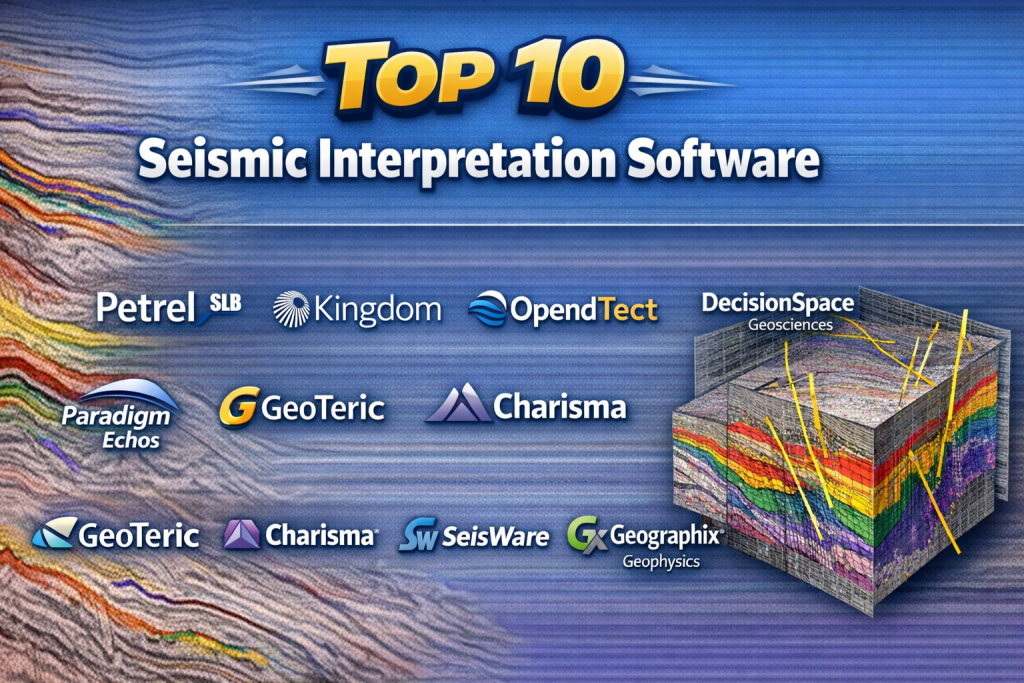
Top 10 Seismic Interpretation Software Tools
1 — Petrel
Short description:
A comprehensive subsurface interpretation platform widely used in oil & gas for seismic interpretation, geological modeling, and reservoir analysis.
Key features:
- Advanced 2D/3D/4D seismic interpretation
- Automated fault and horizon extraction
- AI-assisted seismic attribute analysis
- Integrated geological and reservoir modeling
- Large-scale dataset performance optimization
- Collaboration across multidisciplinary teams
Pros:
- Industry-standard with deep functionality
- Strong integration across subsurface workflows
Cons:
- Steep learning curve
- Premium enterprise pricing
Security & compliance:
Enterprise-grade security, SSO, role-based access, data encryption, compliance varies by deployment.
Support & community:
Extensive documentation, professional training, strong enterprise support, large global user base.
2 — Kingdom
Short description:
A powerful seismic interpretation system focused on exploration and development workflows with strong visualization capabilities.
Key features:
- 2D/3D seismic interpretation tools
- Horizon and fault mapping
- Seismic attribute computation
- Well-seismic integration
- Cross-section and map generation
Pros:
- User-friendly compared to many enterprise tools
- Strong exploration-focused workflows
Cons:
- Limited advanced AI features
- Less suitable for ultra-large datasets
Security & compliance:
Standard enterprise security, access controls, varies by deployment.
Support & community:
Good documentation, responsive support, established professional community.
3 — OpendTect
Short description:
An open and extensible seismic interpretation platform popular in academia and industry for attribute analysis and plugins.
Key features:
- Open architecture with plugin ecosystem
- 2D/3D seismic interpretation
- Advanced seismic attributes
- Machine learning extensions
- Visualization and cross-plotting
Pros:
- Highly flexible and customizable
- Strong academic and research adoption
Cons:
- Interface less polished than premium tools
- Some advanced features require add-ons
Security & compliance:
Varies / N/A depending on deployment and plugins.
Support & community:
Active community, good documentation, commercial support available.
4 — DecisionSpace Geosciences
Short description:
An enterprise geoscience suite delivering integrated seismic interpretation and subsurface analysis workflows.
Key features:
- High-performance seismic visualization
- Automated interpretation workflows
- Multi-disciplinary data integration
- Cloud and on-premise support
- Collaborative project environments
Pros:
- Scales well for enterprise operations
- Strong performance on large datasets
Cons:
- Complex setup
- Higher total cost of ownership
Security & compliance:
Enterprise security, encryption, access control, compliance varies.
Support & community:
Professional enterprise support, structured onboarding, limited public community.
5 — Paradigm Echos
Short description:
A specialized seismic interpretation platform designed for structural and stratigraphic analysis.
Key features:
- Advanced seismic visualization
- Horizon and fault picking
- Structural modeling tools
- Attribute-based interpretation
- Workflow automation
Pros:
- Strong interpretation accuracy
- Focused seismic workflows
Cons:
- Smaller ecosystem
- Limited integration outside Paradigm stack
Security & compliance:
Standard enterprise security features.
Support & community:
Good vendor support, moderate user base.
6 — GeoTeric
Short description:
An AI-driven seismic interpretation tool emphasizing automated fault and horizon detection.
Key features:
- Machine learning-based interpretation
- Rapid fault detection
- Attribute-driven analysis
- Works alongside major platforms
- Visualization and validation tools
Pros:
- Significant time savings
- Strong AI capabilities
Cons:
- Dependent on data quality
- Best used with other platforms
Security & compliance:
Varies / N/A depending on integration environment.
Support & community:
Specialized support, growing professional community.
7 — Charisma
Short description:
A modern seismic interpretation platform focusing on intuitive workflows and advanced visualization.
Key features:
- 2D/3D seismic interpretation
- Automated horizon tracking
- Structural modeling
- Interactive visualization
- Integration with geological workflows
Pros:
- Clean, intuitive interface
- Faster learning curve
Cons:
- Smaller market presence
- Fewer third-party integrations
Security & compliance:
Standard security, role-based access.
Support & community:
Good onboarding, responsive vendor support.
8 — SeisWare
Short description:
A practical seismic interpretation and mapping solution popular among small to mid-sized exploration teams.
Key features:
- Seismic interpretation and mapping
- Well log integration
- Structural contouring
- Cross-sections and visualization
- Lightweight performance
Pros:
- Cost-effective
- Easy to deploy and use
Cons:
- Limited advanced automation
- Not ideal for very large projects
Security & compliance:
Varies / N/A.
Support & community:
Good customer support, smaller but active user base.
9 — Geographix
Short description:
A long-established geoscience interpretation platform integrating seismic, well, and geological data.
Key features:
- Seismic interpretation
- Well and map-based analysis
- Data management tools
- Structural and stratigraphic workflows
- Integration with exploration datasets
Pros:
- Proven reliability
- Broad exploration functionality
Cons:
- Interface feels dated
- Slower innovation cycle
Security & compliance:
Enterprise security features vary by configuration.
Support & community:
Strong documentation, long-standing user community.
10 — JewelSuite Geophysics
Short description:
A modular geophysics platform offering seismic interpretation and subsurface analysis tools.
Key features:
- Seismic visualization
- Structural interpretation
- Integrated geophysical workflows
- Modular architecture
- Cross-discipline data handling
Pros:
- Flexible modular design
- Suitable for mixed geoscience teams
Cons:
- Requires configuration effort
- Smaller ecosystem
Security & compliance:
Varies / N/A.
Support & community:
Vendor support available, niche professional community.
Comparison Table
| Tool Name | Best For | Platform(s) Supported | Standout Feature | Rating |
|---|---|---|---|---|
| Petrel | Large enterprises | Windows / Cloud | End-to-end subsurface integration | N/A |
| Kingdom | Exploration teams | Windows | User-friendly seismic workflows | N/A |
| OpendTect | Research & customization | Windows / Linux | Open plugin ecosystem | N/A |
| DecisionSpace | Enterprise projects | Windows / Cloud | High-performance datasets | N/A |
| Paradigm Echos | Structural interpretation | Windows | Interpretation precision | N/A |
| GeoTeric | AI-driven workflows | Windows | ML-based automation | N/A |
| Charisma | Fast interpretation | Windows | Intuitive UX | N/A |
| SeisWare | SMB exploration | Windows | Cost-effective mapping | N/A |
| Geographix | Traditional exploration | Windows | Broad geoscience coverage | N/A |
| JewelSuite | Modular geophysics | Windows | Flexible architecture | N/A |
Evaluation & Scoring of Seismic Interpretation Software
| Criteria | Weight | Description |
|---|---|---|
| Core features | 25% | Interpretation depth, automation, visualization |
| Ease of use | 15% | Learning curve, UI clarity |
| Integrations & ecosystem | 15% | Compatibility with other subsurface tools |
| Security & compliance | 10% | Data protection and access control |
| Performance & reliability | 10% | Handling large seismic volumes |
| Support & community | 10% | Documentation and vendor support |
| Price / value | 15% | Cost versus delivered capability |
Which Seismic Interpretation Software Tool Is Right for You?
- Solo users & academics: OpendTect, SeisWare
- SMBs: Kingdom, Charisma
- Mid-market: GeoTeric, Paradigm Echos
- Enterprise: Petrel, DecisionSpace
Budget-conscious teams may prioritize usability and essential features, while enterprises benefit from scalability, integration, and automation. Security-sensitive environments should favor platforms with strong access controls and compliance support.
Frequently Asked Questions (FAQs)
- What is seismic interpretation software used for?
It analyzes seismic data to identify subsurface structures, faults, and reservoirs. - Is AI important in seismic interpretation?
Yes, AI accelerates horizon and fault detection and improves consistency. - Can these tools handle 4D seismic data?
Many enterprise platforms support time-lapse (4D) analysis. - Are these tools cloud-ready?
Some offer cloud or hybrid deployments; others remain desktop-focused. - Do small teams need enterprise tools?
Not always—lighter tools may be more cost-effective. - How steep is the learning curve?
Varies widely; modern UX tools are easier to adopt. - Is data security a concern?
Yes, especially for regulated energy projects. - Can seismic tools integrate with geological models?
Most leading platforms support integrated workflows. - Are open-source options viable?
Yes, especially for research and customization. - What is the biggest mistake buyers make?
Choosing overly complex software without matching team expertise.
Conclusion
Seismic interpretation software is a cornerstone of modern subsurface analysis, enabling safer drilling, better resource evaluation, and more confident exploration decisions. While enterprise platforms offer unmatched depth and scalability, lighter and AI-driven tools provide speed and accessibility. The best solution depends on your data complexity, team size, budget, and long-term integration needs. By aligning these factors with the right tool, organizations can unlock maximum value from their seismic data rather than relying on a one-size-fits-all solution.

Find Trusted Cardiac Hospitals
Compare heart hospitals by city and services — all in one place.
Explore Hospitals