
Introduction
Customs Brokerage Software is a specialized category of trade compliance and logistics technology designed to help importers, exporters, and licensed customs brokers manage the complex process of customs clearance. These tools automate documentation, tariff classification, duty and tax calculations, filing with customs authorities, and compliance reporting across countries and trade lanes.
In today’s global trade environment, customs regulations change frequently, penalties for non-compliance are severe, and shipment volumes are growing rapidly. Manual processes or fragmented systems often lead to delays, fines, shipment holds, and unhappy customers. Customs brokerage software reduces these risks by bringing accuracy, visibility, and repeatability into the clearance process.
Common real-world use cases include:
- Filing import and export declarations with national customs authorities
- Managing Harmonized System (HS) codes and duty calculations
- Ensuring compliance with trade agreements and sanctions
- Coordinating data between freight forwarders, carriers, and ERP systems
When evaluating customs brokerage software, buyers should focus on regulatory coverage, automation depth, integration capabilities, ease of use, audit readiness, and scalability. The right platform should reduce manual work while improving compliance confidence.
Best for:
Customs brokerage software is ideal for licensed customs brokers, freight forwarders, import/export managers, global manufacturers, retailers, and 3PLs handling frequent cross-border shipments or operating in highly regulated trade environments.
Not ideal for:
These tools may be excessive for very small businesses with infrequent international shipments, or companies that rely entirely on third-party brokers and do not need in-house visibility or control.
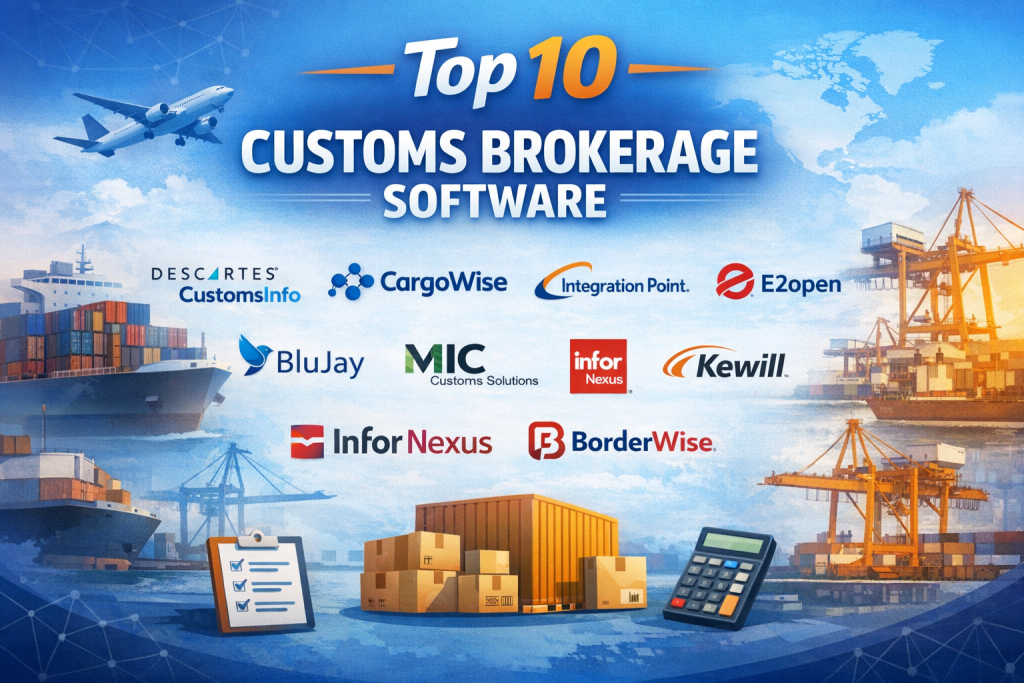
Top 10 Customs Brokerage Software Tools
1 — Descartes CustomsInfo
Descartes Systems Group
Short description:
A comprehensive global trade content and customs compliance platform designed for enterprises managing complex international trade operations.
Key features:
- Global customs regulations and tariff databases
- HS code classification assistance
- Automated duty and tax calculation
- Restricted party and sanctions screening
- Trade agreement eligibility checks
- Audit-ready compliance documentation
Pros:
- Extremely strong regulatory data coverage
- Trusted by large multinational enterprises
Cons:
- Higher cost compared to SMB-focused tools
- Requires onboarding time to realize full value
Security & compliance:
Enterprise-grade security, audit logs, role-based access, GDPR-aligned controls.
Support & community:
Strong enterprise support, detailed documentation, dedicated account management.
2 — WiseTech Global CargoWise Customs
WiseTech Global
Short description:
An integrated customs and logistics solution embedded within the broader CargoWise platform for freight forwarders and brokers.
Key features:
- Direct electronic customs filing
- Integrated freight and customs workflows
- Multi-country compliance support
- Real-time shipment status visibility
- Automated document generation
Pros:
- End-to-end logistics and customs integration
- Scales well for high-volume operations
Cons:
- Interface can feel complex for new users
- Best value realized only when using full CargoWise suite
Security & compliance:
Strong access controls, audit trails, compliance reporting.
Support & community:
Global support network, training programs, active professional community.
3 — Integration Point
Integration Point
Short description:
A trade compliance platform focused on automating customs, export controls, and trade agreement management.
Key features:
- Import/export compliance automation
- Free trade agreement management
- Product classification workflows
- Denied party screening
- Compliance reporting and dashboards
Pros:
- Deep compliance functionality
- Strong analytics and reporting
Cons:
- Less focused on operational logistics
- Requires clean master data to perform best
Security & compliance:
SOC-aligned controls, audit logs, role-based permissions.
Support & community:
Enterprise-grade support and onboarding services.
4 — Amber Road (now part of E2open)
E2open
Short description:
A well-established global trade management solution covering customs filing, compliance, and supply chain collaboration.
Key features:
- Automated customs filings
- Trade content and regulatory updates
- Landed cost calculation
- Supplier collaboration tools
- Compliance risk monitoring
Pros:
- Strong global trade content
- Proven track record with enterprises
Cons:
- Interface can feel dated in places
- Pricing may be high for mid-sized firms
Security & compliance:
Enterprise security standards, compliance monitoring, audit trails.
Support & community:
Robust customer support and professional services.
5 — SAP Global Trade Services (GTS)
SAP
Short description:
An enterprise-grade customs and trade compliance solution tightly integrated with SAP ERP ecosystems.
Key features:
- Customs declaration management
- Trade compliance and sanctions screening
- Product classification and valuation
- Duty drawback and preference processing
- Deep ERP integration
Pros:
- Ideal for SAP-centric enterprises
- Highly configurable for complex needs
Cons:
- Complex implementation
- High total cost of ownership
Security & compliance:
Strong enterprise security, audit readiness, regulatory compliance controls.
Support & community:
Large global partner ecosystem and extensive documentation.
6 — BluJay Customs (now part of E2open)
BluJay Solutions
Short description:
A customs brokerage solution aimed at improving filing accuracy and operational efficiency for brokers and forwarders.
Key features:
- Automated entry filing
- Customs communication tools
- Compliance reporting
- Broker workflow management
- Integration with TMS systems
Pros:
- Broker-friendly workflows
- Strong operational focus
Cons:
- Limited appeal outside brokerage use cases
- UI less modern than newer platforms
Security & compliance:
Standard enterprise security, compliance reporting.
Support & community:
Dedicated support teams and onboarding assistance.
7 — MIC Customs Solutions
MIC
Short description:
A specialized customs and global trade compliance platform with strong European and multinational coverage.
Key features:
- Multi-country customs filing
- Tariff and origin management
- Export control screening
- Compliance analytics
- ERP integrations
Pros:
- Excellent international customs coverage
- Strong compliance depth
Cons:
- Learning curve for new users
- Less suitable for very small teams
Security & compliance:
ISO-aligned security controls, audit logs, GDPR compliance.
Support & community:
Strong customer support and regional expertise.
8 — Kewill Customs (now part of BluJay/E2open)
Kewill
Short description:
A long-standing customs brokerage and trade compliance solution with strong filing and documentation capabilities.
Key features:
- Customs declaration automation
- Broker workflow management
- Trade compliance checks
- Reporting and audit support
- Multi-country filing
Pros:
- Proven reliability
- Suitable for regulated environments
Cons:
- Legacy user experience
- Limited innovation compared to newer tools
Security & compliance:
Standard compliance controls and audit trails.
Support & community:
Professional support services, smaller user community today.
9 — Infor Nexus Customs
Infor
Short description:
A cloud-based trade and customs compliance solution integrated into the Infor supply chain network.
Key features:
- Customs compliance automation
- Supplier and partner collaboration
- Trade document management
- Risk and exception monitoring
- ERP and supply chain integration
Pros:
- Strong network-based collaboration
- Good visibility across supply chains
Cons:
- Best suited for Infor customers
- Customization may require effort
Security & compliance:
Cloud security controls, audit logging, compliance reporting.
Support & community:
Enterprise support and partner ecosystem.
10 — BorderWise
BorderWise
Short description:
A more focused customs brokerage solution designed for small to mid-sized brokers seeking simplicity and speed.
Key features:
- Customs entry filing
- Document management
- Duty and tax calculations
- Broker workflow automation
- Reporting tools
Pros:
- Easier to use than enterprise platforms
- Faster deployment
Cons:
- Limited advanced compliance analytics
- Smaller global coverage
Security & compliance:
Varies by deployment; standard access controls.
Support & community:
Responsive customer support, smaller user community.
Comparison Table
| Tool Name | Best For | Platform(s) Supported | Standout Feature | Rating |
|---|---|---|---|---|
| Descartes CustomsInfo | Large enterprises | Cloud | Global regulatory content | N/A |
| CargoWise Customs | Freight forwarders | Cloud | End-to-end logistics integration | N/A |
| Integration Point | Compliance-driven orgs | Cloud | Trade compliance depth | N/A |
| Amber Road (E2open) | Global traders | Cloud | Trade content & compliance | N/A |
| SAP GTS | SAP enterprises | On-prem / Cloud | Deep ERP integration | N/A |
| BluJay Customs | Customs brokers | Cloud | Broker workflows | N/A |
| MIC Customs | Multinationals | Cloud | Multi-country filing | N/A |
| Kewill Customs | Regulated brokers | On-prem / Cloud | Proven reliability | N/A |
| Infor Nexus | Supply chain networks | Cloud | Partner collaboration | N/A |
| BorderWise | SMB brokers | Cloud | Simplicity & speed | N/A |
Evaluation & Scoring of Customs Brokerage Software
| Criteria | Weight | Average Score (Example) |
|---|---|---|
| Core features | 25% | High |
| Ease of use | 15% | Medium |
| Integrations & ecosystem | 15% | High |
| Security & compliance | 10% | High |
| Performance & reliability | 10% | High |
| Support & community | 10% | Medium |
| Price / value | 15% | Medium |
Which Customs Brokerage Software Tool Is Right for You?
- Solo users / SMBs: Look for simpler tools like BorderWise that emphasize usability and quick deployment.
- Mid-market firms: Platforms such as BluJay or Integration Point balance compliance depth with operational efficiency.
- Enterprises: SAP GTS, Descartes, and E2open excel in scale, compliance, and integration.
- Budget-conscious teams: Prioritize ease of use and essential filing features over advanced analytics.
- Highly regulated industries: Choose tools with strong audit trails, compliance reporting, and regulatory updates.
Frequently Asked Questions (FAQs)
1. What does customs brokerage software automate?
It automates filing, classification, duty calculation, documentation, and compliance reporting.
2. Do I still need a licensed customs broker?
Yes. Software supports brokers but does not replace legal licensing requirements.
3. Is customs software country-specific?
Some tools specialize in certain regions, while others support multi-country operations.
4. How long does implementation take?
From weeks for SMB tools to several months for enterprise platforms.
5. Can it integrate with ERP systems?
Most modern platforms support ERP and logistics integrations.
6. How does it reduce compliance risk?
By enforcing standardized workflows, validations, and audit trails.
7. Is cloud deployment common?
Yes, most modern solutions are cloud-based.
8. What are common mistakes when choosing a tool?
Underestimating data quality requirements and integration needs.
9. Are these tools scalable?
Enterprise platforms are highly scalable; SMB tools have practical limits.
10. What is a good alternative for low-volume shippers?
Outsourcing entirely to third-party brokers may be sufficient.
Conclusion
Customs brokerage software plays a critical role in modern global trade by reducing compliance risk, improving efficiency, and increasing visibility across borders. The best solution depends on shipment volume, regulatory complexity, budget, and integration needs. Rather than chasing a universal “best” tool, organizations should focus on fit, scalability, and compliance confidence. With the right choice, customs operations become a competitive advantage instead of a bottleneck.

Find Trusted Cardiac Hospitals
Compare heart hospitals by city and services — all in one place.
Explore Hospitals
This is a really helpful comparison of customs brokerage software! I appreciate how the article breaks down each tool’s key features and honestly shares the pros and cons — it makes understanding the differences between solutions much easier. For anyone working in international trade or logistics and trying to streamline clearance processes, this overview gives practical insights to make a smarter choice. Great, informative read!