
Introduction
Trade Compliance Software helps organizations manage, automate, and monitor compliance with international trade laws, regulations, and restrictions. As global supply chains expand and regulations become stricter, businesses must ensure that every shipment, transaction, and partner complies with customs rules, export controls, sanctions, and trade agreements.
The importance of trade compliance has grown sharply due to rising penalties, frequent regulatory changes, and increased scrutiny from authorities. A single compliance failure can lead to heavy fines, shipment delays, reputational damage, or even suspension of trading rights. Trade Compliance Software reduces these risks by embedding compliance checks directly into daily operations.
Common real-world use cases include denied party screening, export license management, customs documentation, classification of goods (HS/ECCN), trade agreement qualification, audit preparation, and automated regulatory reporting.
When choosing Trade Compliance Software, buyers should evaluate regulatory coverage, automation depth, ease of use, integration with ERP systems, scalability, security standards, and ongoing regulatory updates. The right solution not only ensures compliance but also improves operational efficiency and decision-making.
Best for:
Trade Compliance Software is ideal for importers, exporters, manufacturers, distributors, logistics providers, customs brokers, and multinational enterprises operating across borders. Compliance managers, supply chain leaders, and legal teams benefit most.
Not ideal for:
Very small businesses with occasional international shipments or companies operating strictly within domestic markets may find full-scale trade compliance platforms unnecessary. In such cases, basic customs filing tools or manual processes may suffice.
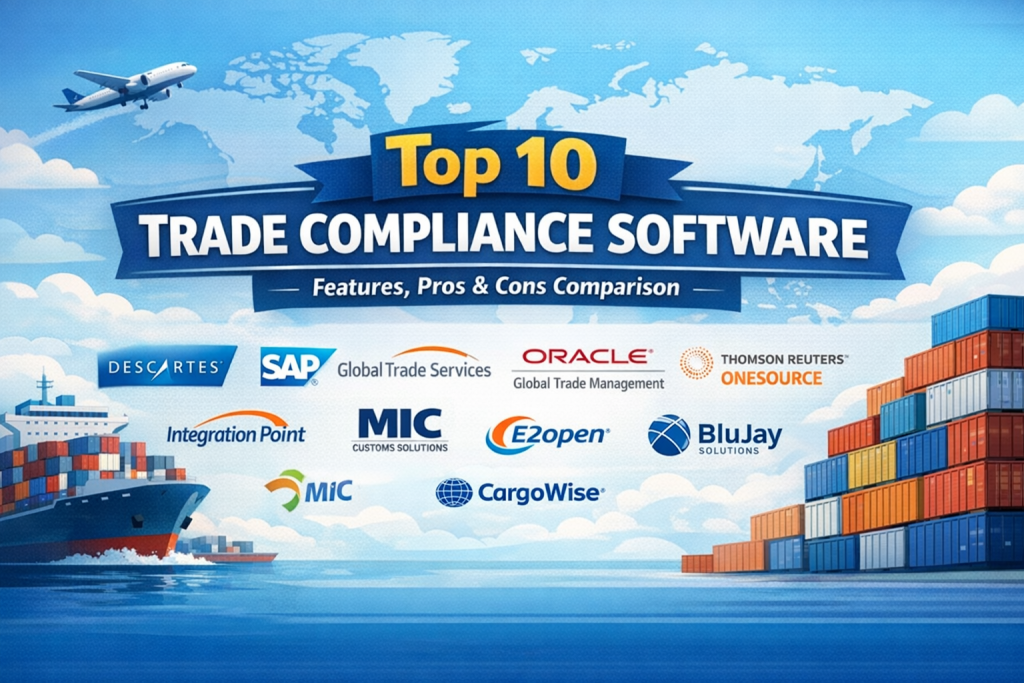
Top 10 Trade Compliance Software Tools
1 — Descartes Systems Group
Short description:
A comprehensive global trade compliance and logistics platform designed for large enterprises managing complex international trade operations.
Key features
- Denied party and restricted party screening
- Export control and licensing management
- HS/ECCN classification tools
- Customs filing and documentation
- Trade agreement qualification
- Audit trail and compliance reporting
Pros
- Very strong global regulatory coverage
- Highly scalable for complex enterprises
Cons
- Steeper learning curve
- Premium pricing
Security & compliance: SOC-aligned controls, encryption, audit logs, GDPR-ready
Support & community: Enterprise-grade support, onboarding services, extensive documentation
2 — SAP Global Trade Services
Short description:
An enterprise-grade trade compliance solution embedded within the SAP ecosystem for end-to-end compliance automation.
Key features
- Integrated denied party screening
- Export/import compliance workflows
- License and embargo management
- Product classification automation
- Customs processing integration
- Real-time compliance monitoring
Pros
- Seamless SAP ERP integration
- Highly configurable workflows
Cons
- Requires SAP expertise
- Implementation can be lengthy
Security & compliance: ISO standards, role-based access, audit logs
Support & community: Strong SAP support network, partner ecosystem
3 — Amber Road
Short description:
A cloud-based global trade compliance platform focused on automation and regulatory accuracy.
Key features
- Trade agreement management
- Export controls and license tracking
- Restricted party screening
- Product classification tools
- Duty optimization analytics
Pros
- Strong automation capabilities
- User-friendly dashboards
Cons
- Limited customization in some modules
- Pricing scales quickly with usage
Security & compliance: Encryption, compliance reporting, GDPR-ready
Support & community: Dedicated account support, training resources
4— Oracle Global Trade Management
Short description:
An advanced trade compliance module designed for enterprises using Oracle supply chain systems.
Key features
- Global trade controls management
- License and permit tracking
- Trade agreement qualification
- Customs documentation automation
- Regulatory change management
Pros
- Deep integration with Oracle SCM
- Strong analytics
Cons
- Best suited for Oracle-centric environments
- Higher implementation cost
Security & compliance: Enterprise-grade security, audit trails
Support & community: Oracle enterprise support, implementation partners
5 — Thomson Reuters ONESOURCE
Short description:
A trusted compliance platform combining trade, tax, and regulatory intelligence.
Key features
- Import/export compliance management
- Restricted party screening
- Classification and valuation tools
- Audit-ready documentation
- Regulatory content updates
Pros
- Strong regulatory expertise
- Reliable compliance content
Cons
- Interface feels dated to some users
- Premium pricing
Security & compliance: SOC controls, encryption, audit logs
Support & community: High-quality documentation, professional support
6 — Integration Point
Short description:
A cloud-native trade compliance solution focused on automation and operational efficiency.
Key features
- Export control management
- Restricted party screening
- Classification automation
- Compliance workflow orchestration
- Reporting and audit tools
Pros
- Modern cloud architecture
- Flexible configuration
Cons
- Smaller ecosystem than large vendors
- Advanced features may require setup time
Security & compliance: Secure cloud hosting, compliance monitoring
Support & community: Responsive support, onboarding assistance
7 — MIC Customs Solutions
Short description:
A specialized solution for customs and trade compliance with strong European regulatory support.
Key features
- Customs filing automation
- Export/import compliance
- Tariff and duty calculation
- Trade agreement management
- Compliance analytics
Pros
- Strong customs expertise
- Highly configurable
Cons
- Interface can feel complex
- Longer implementation cycles
Security & compliance: Audit logs, access controls, GDPR-compliant
Support & community: Regional expertise, professional services
8 — E2open
Short description:
A connected supply chain platform with integrated global trade compliance capabilities.
Key features
- Denied party screening
- Export licensing workflows
- Trade agreement optimization
- Supplier collaboration
- Risk monitoring
Pros
- Strong network-based visibility
- Scales well globally
Cons
- Requires ecosystem onboarding
- Feature depth varies by module
Security & compliance: Enterprise security, compliance reporting
Support & community: Enterprise support, training programs
9 — BluJay Solutions
Short description:
A trade compliance and logistics platform aimed at mid-market and enterprise users.
Key features
- Export compliance management
- Restricted party screening
- Customs documentation
- Trade agreement support
- Analytics and reporting
Pros
- Balanced feature set
- Easier adoption than heavy enterprise tools
Cons
- Limited advanced analytics
- Customization constraints
Security & compliance: Standard encryption, audit trails
Support & community: Helpful documentation, customer support
10 — CargoWise
Short description:
A global logistics and trade management system widely used by freight forwarders and customs brokers.
Key features
- Customs compliance automation
- Trade documentation management
- Regulatory validation checks
- Integrated logistics workflows
- Reporting and compliance audit support
Pros
- Strong logistics + compliance integration
- Widely adopted globally
Cons
- Interface can be overwhelming
- Requires training for full value
Security & compliance: Role-based access, audit logs
Support & community: Large user base, global support network
Comparison Table
| Tool Name | Best For | Platform(s) Supported | Standout Feature | Rating |
|---|---|---|---|---|
| Descartes Systems Group | Large global enterprises | Cloud, Enterprise | Global regulatory coverage | N/A |
| SAP Global Trade Services | SAP-centric enterprises | SAP, Cloud | Deep ERP integration | N/A |
| Amber Road | Automated trade compliance | Cloud | Trade agreement automation | N/A |
| Oracle Global Trade Management | Oracle SCM users | Oracle, Cloud | Advanced analytics | N/A |
| Thomson Reuters ONESOURCE | Compliance-focused enterprises | Cloud | Regulatory intelligence | N/A |
| Integration Point | Modern cloud users | Cloud | Flexible workflows | N/A |
| MIC Customs Solutions | Customs-heavy operations | Cloud, On-prem | Customs expertise | N/A |
| E2open | Network-based supply chains | Cloud | Ecosystem visibility | N/A |
| BluJay Solutions | Mid-market logistics teams | Cloud | Ease of adoption | N/A |
| CargoWise | Freight forwarders | Cloud | Logistics + compliance | N/A |
Evaluation & Scoring of Trade Compliance Software
| Criteria | Weight | Key Considerations |
|---|---|---|
| Core features | 25% | Screening, licensing, classification, automation |
| Ease of use | 15% | UI clarity, learning curve |
| Integrations & ecosystem | 15% | ERP, WMS, TMS connectivity |
| Security & compliance | 10% | Encryption, audit logs, standards |
| Performance & reliability | 10% | Scalability, uptime |
| Support & community | 10% | Training, documentation |
| Price / value | 15% | ROI, scalability of pricing |
Which Trade Compliance Software Tool Is Right for You?
- Solo users / small businesses: Lightweight or modular tools with basic screening and documentation
- SMBs: Cloud platforms with automation and affordable pricing
- Mid-market: Balanced solutions offering compliance depth and integration
- Enterprises: Full-scale platforms with global coverage and advanced controls
Budget-conscious users should prioritize usability and essential features, while premium buyers benefit from deep automation and analytics.
Organizations with complex ERP landscapes must ensure integration and scalability, while regulated industries should emphasize security, auditability, and compliance certifications.
Frequently Asked Questions (FAQs)
- What is Trade Compliance Software?
It automates and manages adherence to international trade regulations. - Why is trade compliance critical?
Non-compliance can result in fines, delays, and reputational damage. - Do small businesses need trade compliance software?
Only if they trade internationally on a regular basis. - Can these tools integrate with ERP systems?
Most enterprise tools support ERP integration. - How long does implementation take?
From weeks for SMB tools to several months for enterprise platforms. - Is denied party screening mandatory?
Yes, for most international trade operations. - Are these tools cloud-based?
Most modern platforms are cloud-native. - How often are regulations updated?
Leading vendors update content continuously. - What are common mistakes buyers make?
Underestimating complexity and ignoring integration needs. - Is there a single best tool for everyone?
No, the best choice depends on business size and trade complexity.
Conclusion
Trade Compliance Software has become a necessity for organizations operating in global markets. The right platform reduces regulatory risk, improves efficiency, and provides confidence in cross-border operations.
When choosing a solution, focus on regulatory coverage, automation depth, integration capabilities, and security. There is no universal winner—the best tool is the one that aligns with your trade volume, compliance complexity, and long-term growth strategy.

Find Trusted Cardiac Hospitals
Compare heart hospitals by city and services — all in one place.
Explore Hospitals
This article offers a very strong overview of trade compliance software by connecting it directly to real risks like fines, shipment delays, and loss of trading rights, while showing how automation can embed compliance into day-to-day operations. The way it differentiates heavyweight, ERP-centric platforms (SAP GTS, Oracle GTM), regulatory-content-driven solutions (Thomson Reuters ONESOURCE), and logistics-focused systems (Descartes, CargoWise, BluJay, E2open, MIC) makes it easier for organizations to align tools with their trade volume, supply-chain model, and existing IT landscape. The emphasis on denied party screening, HS/ECCN classification, license and embargo management, customs filing, and continuous regulatory updates is especially useful for buyers who might otherwise underestimate how complex cross-border trade compliance really is. Overall, this guide is a solid starting point for compliance, logistics, and supply chain leaders seeking to move from manual or spreadsheet-based checks to a robust, auditable, and scalable global trade compliance framework.