
Introduction
Cold Chain Monitoring Platforms are specialized software and hardware-enabled systems designed to continuously track temperature, humidity, location, and handling conditions of sensitive goods as they move through the supply chain. These platforms are critical wherever products must stay within strict environmental thresholds—from manufacturing and storage to transportation and last-mile delivery.
Their importance has grown rapidly with the expansion of pharmaceutical distribution, biologics, vaccines, fresh food logistics, specialty chemicals, and high-value perishables. A single temperature excursion can lead to regulatory violations, product spoilage, recalls, financial loss, or even patient safety risks. Cold chain monitoring platforms help organizations move from reactive damage control to proactive, data-driven prevention.
In real-world use, these platforms support vaccine distribution programs, global seafood exports, dairy logistics, frozen foods, clinical trial shipments, and high-risk medical devices. When choosing a solution, buyers should evaluate sensor accuracy, real-time visibility, alerting capabilities, analytics, compliance readiness, integrations, scalability, and total cost of ownership—not just basic temperature tracking.
Best for:
Cold Chain Monitoring Platforms are ideal for pharmaceutical companies, biotech firms, food & beverage producers, logistics providers, cold storage operators, hospitals, laboratories, and regulatory-driven enterprises that cannot afford quality deviations.
Not ideal for:
They may be unnecessary for non-perishable goods, very small local businesses with minimal compliance exposure, or operations where temperature variation does not impact safety or quality. In such cases, simpler data loggers or manual checks may be sufficient.
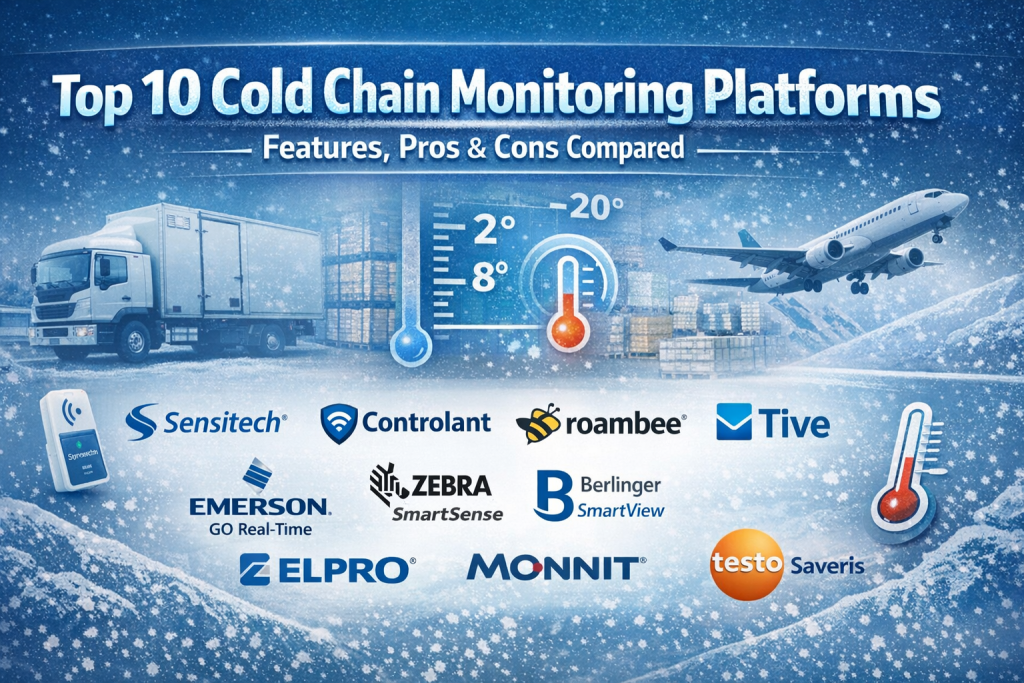
Top 10 Cold Chain Monitoring Platforms Tools
1 — Sensitech
Short description:
A long-established cold chain leader offering end-to-end monitoring, analytics, and regulatory-ready reporting for global enterprises.
Key features
- Real-time and historical temperature monitoring
- Multi-modal shipment tracking (air, sea, road)
- Advanced analytics for excursion root-cause analysis
- Configurable alerts and escalation workflows
- Compliance reporting for regulated industries
- Enterprise dashboards and benchmarking
Pros
- Highly trusted in pharmaceutical and food sectors
- Deep analytics and reporting capabilities
Cons
- Premium pricing for smaller organizations
- Implementation can be complex
Security & compliance:
Encryption, role-based access, audit logs, regulatory compliance support (varies by deployment).
Support & community:
Strong enterprise onboarding, dedicated account teams, extensive documentation.
2 — Controlant
Short description:
A cloud-based real-time visibility platform focused on high-value, high-risk cold chain shipments worldwide.
Key features
- Real-time IoT sensor data streaming
- Live location and condition tracking
- Predictive risk analytics
- Automated alerts and intervention workflows
- Integration with ERP and logistics systems
- Scalable global coverage
Pros
- Excellent real-time visibility
- Strong predictive analytics
Cons
- Cost may be high for low-volume shippers
- Requires process maturity to maximize value
Security & compliance:
Enterprise-grade security, data encryption, compliance alignment varies by industry.
Support & community:
High-touch enterprise support, strong onboarding programs.
3 — Roambee
Short description:
A logistics intelligence platform combining sensor data with AI to deliver actionable cold chain insights.
Key features
- Multi-sensor tracking (temperature, shock, humidity)
- AI-driven shipment intelligence
- Real-time alerts and analytics
- Carrier and lane performance benchmarking
- API-first integration model
Pros
- Powerful analytics and visualization
- Flexible integration ecosystem
Cons
- Learning curve for advanced analytics
- Best suited for mid-market and enterprise
Security & compliance:
Encryption, access controls, auditability features available.
Support & community:
Good documentation, enterprise support options.
4 — Tive
Short description:
A modern, user-friendly cold chain visibility platform focused on ease of use and fast deployment.
Key features
- Real-time temperature and location tracking
- Simple dashboard and alerting
- Multi-carrier shipment visibility
- Customizable rules and notifications
- Analytics for exception management
Pros
- Very intuitive interface
- Faster deployment than many competitors
Cons
- Less deep analytics than legacy platforms
- Limited customization at extreme scale
Security & compliance:
Standard cloud security, encryption, role-based access.
Support & community:
Strong onboarding, responsive customer support.
5 — Emerson (GO Real-Time)
Short description:
An industrial-grade monitoring solution built for high reliability in regulated cold chain environments.
Key features
- High-accuracy temperature sensors
- Continuous real-time monitoring
- Compliance-ready reporting
- Industrial-grade reliability
- Scalable deployment across facilities
Pros
- Extremely reliable hardware
- Trusted in regulated industries
Cons
- Less modern UI compared to newer platforms
- Higher upfront costs
Security & compliance:
Strong compliance alignment, audit logs, data integrity controls.
Support & community:
Global enterprise support and service network.
6 — Zebra Technologies SmartSense
Short description:
An enterprise cold chain solution combining sensors, analytics, and operational insights.
Key features
- IoT sensors for temperature monitoring
- Real-time alerts and dashboards
- Facility and fleet visibility
- Integration with enterprise systems
- Predictive maintenance insights
Pros
- Strong enterprise ecosystem
- Reliable sensor technology
Cons
- Best value at larger scale
- Configuration complexity
Security & compliance:
Enterprise-grade security, compliance-ready controls.
Support & community:
Extensive enterprise support and partner ecosystem.
7 — Berlinger SmartView
Short description:
A compliance-focused platform widely used in vaccine and pharmaceutical cold chains.
Key features
- Precise temperature data logging
- Real-time cloud monitoring
- WHO and pharma compliance alignment
- Alarm management and escalation
- Centralized reporting
Pros
- Strong regulatory credibility
- High sensor accuracy
Cons
- Narrower use outside pharma
- Limited advanced analytics
Security & compliance:
Strong compliance alignment, audit trails, secure data handling.
Support & community:
Industry-specific expertise, focused support.
8 — ELPRO
Short description:
A validation-focused cold chain monitoring platform designed for regulated environments.
Key features
- Environmental monitoring and validation
- Temperature mapping support
- Compliance reporting
- Alarm and excursion management
- Data integrity controls
Pros
- Excellent for validation-heavy industries
- Strong documentation
Cons
- Less logistics-focused
- Conservative user interface
Security & compliance:
Strong compliance, audit logs, data integrity features.
Support & community:
Specialized regulatory support and training.
9 — Monnit
Short description:
A flexible IoT sensor platform adaptable for cold chain monitoring across facilities and transport.
Key features
- Wireless temperature sensors
- Real-time alerts and dashboards
- Custom thresholds and notifications
- Scalable sensor network
- API integrations
Pros
- Cost-effective
- Flexible deployment options
Cons
- Less specialized for pharma logistics
- Limited advanced analytics
Security & compliance:
Standard IoT security, encryption options vary.
Support & community:
Good documentation, SMB-friendly support.
10 — Testo Saveris
Short description:
A monitoring platform combining professional measurement accuracy with centralized data management.
Key features
- High-precision temperature sensors
- Continuous monitoring and logging
- Alarm management
- Centralized dashboards
- Compliance reporting
Pros
- Measurement accuracy
- Strong reliability
Cons
- Less shipment-centric
- Traditional UI design
Security & compliance:
Secure data handling, compliance support varies by setup.
Support & community:
Established documentation and technical support.
Comparison Table
| Tool Name | Best For | Platform(s) Supported | Standout Feature | Rating |
|---|---|---|---|---|
| Sensitech | Large regulated enterprises | Cloud, IoT | Deep analytics | N/A |
| Controlant | Global real-time shipments | Cloud, IoT | Predictive risk alerts | N/A |
| Roambee | Data-driven logistics teams | Cloud, API | AI shipment intelligence | N/A |
| Tive | Fast-moving logistics teams | Cloud | Ease of use | N/A |
| Emerson GO | Regulated industries | Cloud, Industrial IoT | Hardware reliability | N/A |
| Zebra SmartSense | Enterprise operations | Cloud, IoT | Enterprise ecosystem | N/A |
| Berlinger SmartView | Pharma & vaccines | Cloud | Regulatory trust | N/A |
| ELPRO | Validation-heavy industries | Cloud | Compliance focus | N/A |
| Monnit | Cost-conscious teams | Cloud, IoT | Flexible sensors | N/A |
| Testo Saveris | Facility monitoring | Cloud | Measurement accuracy | N/A |
Evaluation & Scoring of Cold Chain Monitoring Platforms
| Criteria | Weight | Sensitech | Controlant | Roambee | Tive | Emerson |
|---|---|---|---|---|---|---|
| Core features | 25% | High | High | High | Medium | High |
| Ease of use | 15% | Medium | Medium | Medium | High | Medium |
| Integrations & ecosystem | 15% | High | High | High | Medium | High |
| Security & compliance | 10% | High | High | Medium | Medium | High |
| Performance & reliability | 10% | High | High | Medium | Medium | High |
| Support & community | 10% | High | High | Medium | High | High |
| Price / value | 15% | Medium | Medium | Medium | High | Medium |
Which Cold Chain Monitoring Platforms Tool Is Right for You?
- Solo users or small businesses: Look for simpler, cost-effective platforms with easy setup and basic alerts.
- SMBs: Balance usability with analytics and integrations; avoid over-engineering.
- Mid-market: Prioritize scalability, real-time visibility, and reporting depth.
- Enterprise: Focus on compliance, global coverage, advanced analytics, and reliability.
Budget-conscious teams may accept fewer advanced features, while premium buyers should demand predictive insights and automation. Integration needs, regulatory exposure, and growth plans should drive the final decision.
Frequently Asked Questions (FAQs)
- What is cold chain monitoring?
It is the continuous tracking of environmental conditions to protect temperature-sensitive goods. - Do I need real-time monitoring or is logging enough?
Real-time monitoring enables intervention before losses occur. - Are these platforms required by regulations?
In many pharma and food sectors, monitoring is strongly recommended or mandated. - How accurate are sensors?
Accuracy varies by vendor; high-end platforms offer pharmaceutical-grade precision. - Can these tools integrate with ERP systems?
Most enterprise platforms support integrations. - Are they expensive?
Costs vary widely based on scale, features, and sensor usage. - Do they support global shipments?
Leading platforms offer multi-country coverage. - What happens during a temperature excursion?
Alerts trigger corrective action and generate audit records. - Is historical data important?
Yes, for audits, root-cause analysis, and continuous improvement. - What’s the biggest mistake buyers make?
Choosing based on price alone instead of risk and compliance needs.
Conclusion
Cold Chain Monitoring Platforms play a critical role in protecting product quality, regulatory compliance, and brand trust. The best solutions combine accurate sensing, real-time visibility, actionable analytics, and strong compliance support.
There is no universal winner. The right platform depends on industry, scale, regulatory exposure, budget, and operational maturity. By focusing on what truly matters to your use case, you can select a solution that delivers long-term value rather than short-term convenience.

Find Trusted Cardiac Hospitals
Compare heart hospitals by city and services — all in one place.
Explore Hospitals
Cold chain monitoring platforms are essential for maintaining product quality and safety during the storage and transportation of temperature-sensitive goods, including pharmaceuticals, vaccines, and perishable food. Features such as real-time temperature tracking, humidity monitoring, automated alerts, GPS visibility, and compliance reporting help organizations identify deviations before they lead to product loss. I believe sensor accuracy, connectivity in remote locations, historical data tracking, and integration with logistics systems are important factors when comparing these solutions. The right platform should provide reliable end-to-end visibility, helping businesses reduce spoilage, maintain regulatory compliance, and ensure temperature-sensitive products reach their destinations in optimal condition.
Cold chain monitoring platforms help teams track temperature and storage conditions during the transport of food, medicines, and other sensitive goods. I would check how quickly a platform sends alerts when temperatures move outside safe limits and whether it keeps accurate records for audits. Reliable sensors and clear reports can help teams find problems before products are damaged. It is also important to check how the system works when internet access is weak or unavailable. How can businesses reduce product loss and maintain accurate monitoring across the entire supply chain?
Keeping products within the right temperature range during transport and storage is essential for protecting their quality and safety. I think real-time alerts are especially useful when temperatures go outside the allowed limits, as teams can respond before products are damaged. It is also important to check whether the platform stores reliable records for each shipment and location. Having this information available can make it easier to investigate issues and improve cold chain operations over time.
The difference between Controlant’s predictive risk alerts and ELPRO’s validation-focused monitoring highlights why cold chain requirements vary significantly across industries. Beyond sensor accuracy, companies should evaluate how quickly teams can respond to temperature excursions, especially during transit or connectivity disruptions.
Cold chain monitoring platforms track temperature and other conditions during the storage and transport of sensitive goods. They help teams spot changes that may affect food, medicine, or other products. Useful tools should provide timely alerts, clear history, and reliable sensor data. Location tracking can also help teams understand where a problem occurred. When comparing platforms, review sensor support, alert settings, data retention, and offline handling. Teams should set limits based on product needs and approved procedures. Good monitoring can reduce waste and support safer handling throughout the supply chain.
Cold chain monitoring platforms are essential for maintaining product quality across temperature-sensitive supply chains, particularly in pharmaceuticals, food distribution, and healthcare. Real-time sensor data, automated threshold alerts, and shipment-level traceability help teams respond quickly to temperature deviations before products become unusable. Reliable connectivity, accurate historical records, and clear compliance reporting are key to reducing spoilage and maintaining confidence throughout transportation and storage.
Cold chain teams should also consider how monitoring records hold up during audits or disputes with transport partners. Each temperature alert needs a clear timeline, including the shipment location, device identity, and any action taken by staff. Access controls can prevent unauthorized changes to records after delivery. It is also useful to set rules for keeping historical readings and linking them to shipment documents. These steps make investigations easier and help teams explain decisions when product quality comes into question.
Cold chain monitoring platforms are most valuable when they provide timely alerts for temperature changes before products become unsafe or unusable. Teams should check sensor accuracy, connectivity during transit, and how well the system records temperature history for audits. Clear escalation procedures can help staff respond quickly to deviations and protect sensitive goods throughout storage and delivery.
Cold chain monitoring platforms help businesses track temperature conditions and protect sensitive products during storage and transportation. When comparing tools, I would focus on real-time sensor data, automated alerts, shipment tracking, and compliance reports. Reliable monitoring can help teams respond quickly to temperature changes and reduce product loss. The right platform should improve visibility and maintain product quality throughout the supply chain.
Deploying real-time IoT sensors across transit corridors captures critical temperature deviations instantly, triggering automated corrective interventions, preventing high-value cargo spoilage, and maintaining strict regulatory compliance trails across pharmaceutical and food logistics networks.
Cold chain monitoring platforms help businesses protect temperature-sensitive products throughout storage and transportation. When comparing solutions, I would prioritize real-time temperature tracking, automated alerts, reliable sensor connectivity, and complete shipment records. Clear reports can help teams identify repeated temperature deviations and take corrective action before products are damaged. Battery life, offline data storage, and sensor calibration are also important for maintaining accuracy during long journeys. How can businesses use cold chain monitoring data to prevent product losses while meeting safety and compliance requirements?
One area worth examining is how these platforms distinguish a genuine temperature excursion from a faulty sensor or a device that needs calibration. A misleading reading can trigger unnecessary product disposal, while an undetected sensor fault can put an entire shipment at risk. Teams should assess whether the system tracks calibration history, flags unusual sensor behavior, and records gaps in data collection. It is also useful to test how readings are recovered after connectivity returns and whether the original timestamps remain intact. Keeping sensor maintenance records linked to shipment histories can help quality teams investigate incidents and support audit reviews. These controls make monitoring data more dependable when teams must decide whether temperature-sensitive goods remain safe to use.
Choosing between real-time streaming and basic logging often comes down to the financial impact of a single excursion rather than initial software costs. While platforms like Controlant and Sensitech excel in high-stakes pharmaceutical logistics, smaller distributors might find that alerting latency matters more than advanced analytics. A key operational challenge is ensuring that automated escalation workflows actually reach the right personnel before spoilage occurs. Integrating these insights directly with ERP systems helps teams transition from reactive damage control to predictable compliance.
Cold chain monitoring becomes especially important when a temperature sensor stops reporting during transport. It helps when platforms flag missing readings as well as temperature changes, so teams don’t mistake a data gap for safe conditions. Keeping a record of corrective actions can also help businesses investigate damaged shipments and improve handling procedures for future deliveries.
Cold chain monitoring platforms help businesses maintain temperature-sensitive products within required conditions throughout storage and transportation. Comparing real-time sensor tracking, automated temperature alerts, shipment visibility, compliance reporting, and historical data analysis helps organizations reduce spoilage risks, maintain product quality, and improve traceability across the supply chain.