
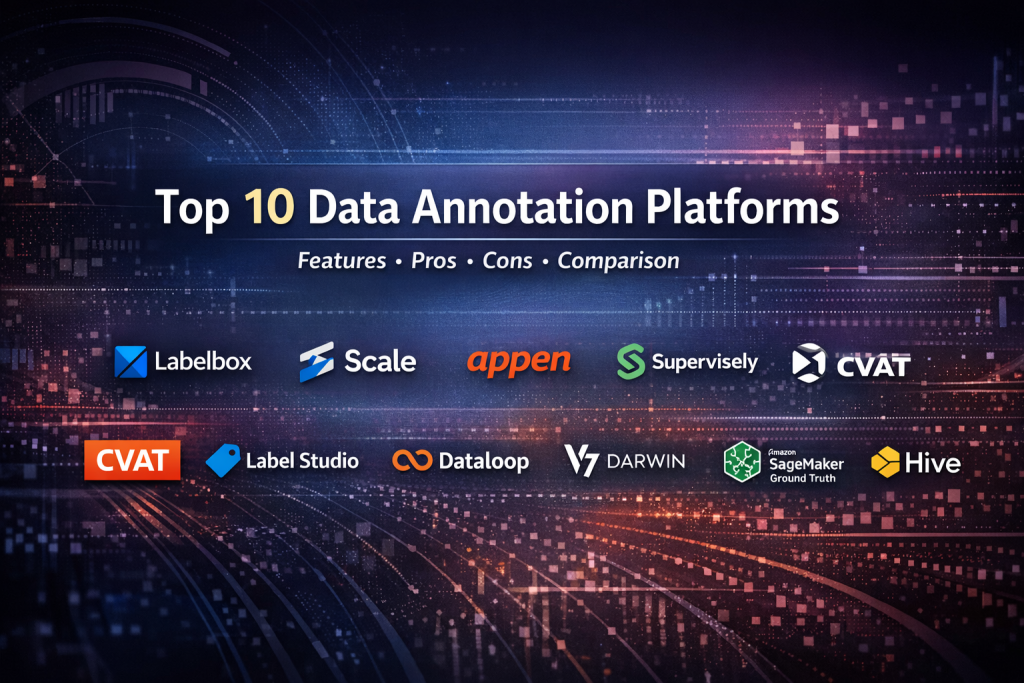
Introduction
Data Annotation Platforms are specialized tools used to label raw data—such as images, videos, text, audio, and sensor streams—so that machine learning (ML) and artificial intelligence (AI) models can learn from it. These platforms sit at the critical intersection between raw data collection and model training, transforming unstructured or semi-structured data into high-quality, machine-readable datasets.
As AI adoption accelerates across industries, the importance of accurate, scalable, and secure data annotation has grown dramatically. Poorly labeled data leads to biased models, weak predictions, and unreliable outcomes. High-quality annotation, on the other hand, directly improves model accuracy, reduces training cycles, and lowers long-term AI costs.
Common real-world use cases include:
- Computer vision for autonomous vehicles and surveillance
- Natural language processing (NLP) for chatbots and search
- Speech recognition and voice assistants
- Medical imaging and diagnostics
- Retail product tagging and recommendation systems
When choosing a Data Annotation Platform, users should evaluate:
- Supported data types and annotation methods
- Workflow automation and quality control
- Scalability and workforce options
- Security, compliance, and governance
- Integrations with ML pipelines and cloud platforms
Best for:
Data Annotation Platforms are ideal for AI/ML engineers, data scientists, research teams, AI startups, enterprises building production-grade models, and regulated industries requiring auditable labeling workflows.
Not ideal for:
Teams working with very small datasets, rule-based systems, or projects that do not rely on supervised learning may not need full-featured annotation platforms and can use simpler or manual alternatives.
Top 10 Data Annotation Platforms Tools
1 — Labelbox
Short description:
Labelbox is an enterprise-grade data annotation platform designed for computer vision and NLP teams building large-scale production models.
Key features:
- Image, video, text, and audio annotation
- Model-assisted labeling and automation
- Workflow orchestration and QA tools
- Dataset versioning and experiment tracking
- Collaboration and role-based access
- Native ML pipeline integrations
Pros:
- Highly polished enterprise UX
- Strong automation and QA workflows
- Scales well for large teams
Cons:
- Premium pricing
- Overkill for small teams
Security & compliance:
SSO, encryption, audit logs, SOC 2, GDPR support
Support & community:
Excellent documentation, enterprise onboarding, dedicated support
2 — Scale AI
Short description:
Scale AI combines a powerful annotation platform with managed human labeling services for high-accuracy datasets.
Key features:
- Managed labeling workforce
- Computer vision, NLP, and sensor fusion
- Active learning and model feedback loops
- High-precision quality assurance
- Custom workflows for regulated industries
Pros:
- Extremely high annotation accuracy
- Ideal for mission-critical AI systems
Cons:
- Very expensive
- Limited self-serve flexibility
Security & compliance:
SOC 2, ISO, GDPR, enterprise-grade controls
Support & community:
White-glove enterprise support, minimal community focus
3— Appen
Short description:
Appen provides large-scale data annotation and data collection services powered by a global crowd workforce.
Key features:
- Text, image, video, and audio labeling
- Crowd-based annotation at scale
- Linguistic and multilingual support
- Custom quality scoring models
- Data collection + annotation
Pros:
- Massive global workforce
- Strong NLP and language coverage
Cons:
- Less modern UI
- Longer turnaround for custom projects
Security & compliance:
ISO certifications, GDPR compliance
Support & community:
Managed services, enterprise account teams
4 — Supervisely
Short description:
Supervisely is a developer-focused platform for computer vision annotation and dataset management.
Key features:
- Image and video labeling
- Custom plugins and scripts
- Dataset visualization and analytics
- Self-hosted and cloud options
- Active learning workflows
Pros:
- Highly customizable
- Strong for CV research teams
Cons:
- Steeper learning curve
- Limited NLP support
Security & compliance:
Varies by deployment (self-hosted available)
Support & community:
Good docs, active technical community
5 — CVAT
Short description:
CVAT is an open-source annotation platform widely used for image and video labeling in computer vision projects.
Key features:
- Bounding boxes, polygons, keypoints
- Video frame annotation
- Model-assisted labeling
- Self-hosting support
- Open-source extensibility
Pros:
- Free and open-source
- Strong CV tooling
Cons:
- Requires technical setup
- Limited enterprise features
Security & compliance:
Varies by deployment (self-managed)
Support & community:
Large open-source community, community-driven support
6 — Label Studio
Short description:
Label Studio is a flexible open-source annotation tool supporting text, image, audio, and video labeling.
Key features:
- Multi-modal annotation support
- Custom labeling interfaces
- ML backend integrations
- Cloud and self-hosted options
- Active learning hooks
Pros:
- Extremely flexible
- Affordable and open-source
Cons:
- UI less polished
- Manual QA setup required
Security & compliance:
Varies by deployment
Support & community:
Strong open-source community, commercial support available
7 — Dataloop
Short description:
Dataloop offers an end-to-end data annotation and data operations platform for AI pipelines.
Key features:
- Image, video, and text annotation
- Dataset management and automation
- Pipeline orchestration
- Quality metrics and audits
- Model feedback loops
Pros:
- Strong data operations focus
- Good balance of UI and depth
Cons:
- Smaller ecosystem
- Less brand recognition
Security & compliance:
SOC 2, GDPR, enterprise security
Support & community:
Enterprise support, solid documentation
8 — V7 Darwin
Short description:
V7 Darwin specializes in high-performance computer vision annotation for medical and industrial imaging.
Key features:
- Advanced image and video annotation
- AI-assisted labeling
- Dataset version control
- Review and audit workflows
- Medical imaging support
Pros:
- Excellent CV performance
- Strong healthcare use cases
Cons:
- Limited NLP support
- Premium pricing
Security & compliance:
HIPAA, GDPR, SOC 2
Support & community:
Enterprise onboarding, responsive support
9 — Amazon SageMaker Ground Truth
Short description:
Amazon SageMaker Ground Truth is a managed data labeling service tightly integrated with AWS ML services.
Key features:
- Human and automated labeling
- Built-in AWS integrations
- Active learning
- Scalable workforce options
- Secure cloud-native architecture
Pros:
- Seamless AWS ecosystem fit
- Highly scalable
Cons:
- AWS lock-in
- Complex pricing
Security & compliance:
AWS security standards, SOC, ISO, GDPR
Support & community:
AWS documentation, enterprise support plans
10 — Hive
Short description:
Hive provides managed annotation services with a focus on content moderation and media understanding.
Key features:
- Image, video, and text labeling
- Human-in-the-loop workflows
- Content moderation models
- Fast turnaround times
- API-driven integration
Pros:
- High accuracy
- Strong moderation expertise
Cons:
- Limited self-serve tooling
- Pricing not transparent
Security & compliance:
Enterprise-grade controls, GDPR support
Support & community:
Managed services, enterprise support
Comparison Table
| Tool Name | Best For | Platform(s) Supported | Standout Feature | Rating |
|---|---|---|---|---|
| Labelbox | Enterprise AI teams | Cloud | End-to-end annotation + ML ops | N/A |
| Scale AI | Mission-critical AI | Cloud | Managed high-accuracy labeling | N/A |
| Appen | Global NLP datasets | Cloud | Massive crowd workforce | N/A |
| Supervisely | CV research teams | Cloud / Self-hosted | Custom CV workflows | N/A |
| CVAT | Open-source CV projects | Self-hosted | Free, extensible | N/A |
| Label Studio | Multi-modal projects | Cloud / Self-hosted | Extreme flexibility | N/A |
| Dataloop | Data operations | Cloud | Pipeline orchestration | N/A |
| V7 Darwin | Medical imaging | Cloud | CV version control | N/A |
| SageMaker GT | AWS users | Cloud | Native AWS integration | N/A |
| Hive | Content moderation | Cloud | Managed labeling speed | N/A |
Evaluation & Scoring of Data Annotation Platforms
| Criteria | Weight | Average Score |
|---|---|---|
| Core features | 25% | High |
| Ease of use | 15% | Medium–High |
| Integrations & ecosystem | 15% | High |
| Security & compliance | 10% | High |
| Performance & reliability | 10% | High |
| Support & community | 10% | Medium–High |
| Price / value | 15% | Medium |
Which Data Annotation Platforms Tool Is Right for You?
- Solo users: Open-source tools like CVAT or Label Studio
- SMBs: Label Studio Cloud, Supervisely
- Mid-market: Dataloop, V7 Darwin
- Enterprise: Labelbox, Scale AI, SageMaker Ground Truth
Budget-conscious: Open-source and self-hosted solutions
Premium solutions: Managed services with SLAs
Feature depth vs ease: Enterprise tools offer depth; open-source offers flexibility
Integrations: Cloud-native tools suit MLOps pipelines
Security: Regulated industries need SOC 2, HIPAA, GDPR support
Frequently Asked Questions (FAQs)
- What is a Data Annotation Platform?
A tool that labels raw data for training ML models. - Why is annotation quality important?
It directly impacts model accuracy and bias. - Are open-source tools reliable?
Yes, but they require more setup and governance. - Do I need human annotators?
Yes, especially for high-accuracy or subjective tasks. - Can annotation be automated?
Partially, using model-assisted labeling. - What data types are supported?
Images, video, text, audio, and sensor data. - How do platforms ensure quality?
QA workflows, consensus scoring, audits. - Are these tools secure?
Enterprise tools offer strong compliance; self-hosted varies. - What is active learning?
Using models to prioritize data needing labels. - Common mistakes?
Ignoring QA, underestimating costs, poor guidelines.
Conclusion
Data Annotation Platforms are a foundational layer of modern AI systems. The right platform improves data quality, accelerates model development, and ensures compliance and scalability. There is no universal “best” tool—each platform excels in different scenarios.
When choosing, focus on your data type, team size, budget, integration needs, and security requirements. A well-aligned annotation strategy pays long-term dividends in model performance and AI success.

Find Trusted Cardiac Hospitals
Compare heart hospitals by city and services — all in one place.
Explore Hospitals
For large annotation projects, task allocation can have a major effect on both quality and delivery time. Sending every sample through the same review process may waste expert time on simple cases while leaving difficult examples under-checked. I would look for confidence-based task routing, skill-based assignments, and clear escalation paths for disputed labels. This allows experienced reviewers to focus on complex data while keeping routine annotation work moving efficiently.
Data annotation quality can drift even when the platform and workflow remain unchanged. Different annotators may interpret the same instruction differently, especially when labels involve unclear categories or borderline examples. I would pay attention to inter-annotator agreement, reviewer feedback, and the process for resolving disputed labels. These checks help teams identify inconsistent training data before it affects model accuracy, rather than discovering the problem after deployment.
Data annotation quality has a direct impact on how well machine learning models perform. One important factor when choosing a platform is how easily teams can review labels, correct mistakes, and maintain consistent annotation standards. Features like collaboration, quality checks, and clear task tracking can make large projects easier to manage. Regular reviews of annotated data can help catch errors early and improve the reliability of training datasets.
Data annotation platforms can accelerate AI development, but annotation quality depends on more than the speed of the labeling interface. Clear guidelines, consistent reviewer feedback, and well-designed quality checks are essential when multiple annotators work on the same dataset. I’d also look at how platforms track disagreements, manage changing label taxonomies, and identify recurring errors before they affect model performance. Active learning can reduce repetitive work, but teams still need to validate automated suggestions rather than accept them blindly. Strong dataset versioning and traceability make it much easier to understand why a model behaves differently after retraining.
Data annotation platforms play a crucial role in preparing high-quality datasets for machine learning and AI applications. This article offers a helpful comparison of tools for labeling images, videos, text, and audio, along with their key features and limitations. When choosing a platform, teams should consider annotation accuracy, workflow automation, scalability, security, and integration with existing ML pipelines. Selecting the right data annotation solution can improve dataset quality, streamline model development, and support more reliable AI outcomes.
The efficiency of large-scale dataset labeling programs hinges on model-assisted pre-annotation workflows and programmatic consensus validation checks among multiple annotators. Platforms that incorporate automated quality scoring identify low-performing labeling contractors early and flag ambiguous edge-case guidelines before entire batches are compromised. Tight API integrations between annotation tools and enterprise cloud storage eliminate cumbersome, error-prone manual dataset export pipelines.
Data annotation platforms help teams label images, text, audio, and video to prepare high-quality datasets for machine learning models. When comparing tools, consider annotation accuracy, supported data types, collaboration workflows, quality checks, automation support, reviewer controls, dataset management, and integration with machine learning pipelines.
Data annotation platforms power the AI era behind the scenes, and this comparison covers the landscape thoughtfully. What resonates with me is the attention to quality control workflows, since noisy labels undermine everything downstream. One practical suggestion is to invest in annotator training and feedback loops, because domain knowledge improves accuracy more than any interface feature. Good data beats clever models. Well observed article.
Data annotation platforms help teams label images, text, audio, and video to prepare high-quality datasets for machine learning models. When comparing solutions, I would focus on annotation accuracy, workflow automation, collaboration features, quality control, and support for different data types. These capabilities can improve dataset consistency and reduce manual labeling effort. The right platform should simplify data preparation, support efficient review processes, and help teams build more reliable AI models.
Data annotation platforms play a crucial role in preparing high-quality datasets for training and evaluating machine learning models. Features such as image, text, audio, and video annotation, collaborative workflows, quality assurance, automation, and integration with AI pipelines can significantly improve labeling efficiency. When comparing platforms, teams should consider annotation accuracy, scalability, supported data formats, customization options, security, and overall cost. Choosing the right solution can reduce manual effort, improve dataset consistency, and help organizations build more reliable AI models.
Annotation quality depends on how consistently different reviewers interpret the same labeling instructions. Teams should record disputed cases and update guidelines when the same confusion keeps appearing. Tracking reviewer agreement and correction rates can reveal issues that fast completion times might hide. If labeling rules change, previously tagged samples may need another review before training begins. This helps maintain dependable datasets and reduces avoidable model errors in future releases.
Data annotation platforms help teams label images, text, and other data for training AI models. They make the labeling process easier and help improve data quality. Features like team collaboration and quality checks can save time and reduce mistakes. I think choosing an easy-to-use platform is important for managing large projects. Good data labeling helps build more accurate and reliable AI models.
Data annotation platforms help teams turn raw data into labeled examples for training and evaluating models. Label quality matters because mistakes can carry into the model’s behavior. I would compare task design, reviewer workflows, quality checks, access controls, and support for different data types. Teams should test how the platform handles unclear examples and disagreements between annotators. Clear guidelines can improve consistency, but they need regular review as projects evolve. It is also important to protect sensitive data and track changes to labels. A useful platform should make annotation efficient while keeping the resulting dataset accurate and suitable for its intended purpose.
Annotation quality should be measured beyond the number of completed tasks or the speed of delivery. When multiple reviewers label the same sample differently, teams need a clear process to resolve conflicts and keep labeling standards consistent. I would establish reference datasets with expert-approved labels, run periodic blind reviews, and track disagreement rates across annotators and data categories. It is also useful to record why labels change, so recurring problems can lead to better guidelines rather than repeated corrections. These checks help teams spot subtle quality issues before they affect model training. Over time, the resulting audit history can also show whether changes in annotation practices improve consistency across new datasets.
Data annotation platforms should make it easy to maintain consistent labels across large datasets and distributed teams. When comparing tools, check whether they support reviewer disagreements, configurable quality checks, and clear instructions for ambiguous examples. Measuring annotator agreement and tracking corrections over time can help teams identify confusing labeling rules before they affect model training and evaluation.
Active-learning annotation loops often fall short when handling consensus arbitration across non-deterministic multi-annotator inputs. When subjective label distributions produce ambiguous ground truth, downstream model training suffers from hidden label noise. Data engineering teams must implement strict inter-annotator agreement metrics and automated canary validation checks before streaming newly labeled batches into model training workflows.
Data annotation platforms help teams label images, text, audio, and video so machine learning models can learn from reliable examples. When comparing tools, look at labeling accuracy, review workflows, team collaboration, automation features, and support for different data types. Clear labeling guidelines and regular quality checks can reduce inconsistent annotations and improve model performance as datasets grow.
Data annotation platforms help teams label images, text, audio, and video to create high-quality datasets for training machine learning models. Tools like Label Studio support multiple data types, customizable labeling workflows, and team collaboration, helping organizations streamline annotation tasks, improve dataset consistency, and prepare training data more efficiently.
Choosing between open-source tools like CVAT and managed platforms often comes down to data governance versus upfront engineering bandwidth. While self-hosted options give teams granular control over sensitive pipelines, the hidden maintenance cost of custom QA workflows can quickly catch smaller teams off guard.
The real value of a data annotation platform lies in maintaining consistent labeling quality as datasets grow, not just speeding up the workflow. Clear annotation guidelines, reviewer checks, and dataset versioning can reduce errors and help teams build more reliable machine learning models.
This article provides a very practical and comprehensive comparison of data annotation platforms — a foundational category for building high‑quality datasets that power machine learning, computer vision, and NLP models. I appreciate how it goes beyond simple feature lists to highlight real‑world considerations such as annotation quality controls, workflow customization, scalability for large datasets, integration with ML pipelines, and support for collaborative labeling. The balanced pros and cons help readers understand trade‑offs between advanced automation (like active learning and model‑in‑the‑loop), platform usability, pricing, and data security — all of which are crucial when choosing the right tool for specific project needs. Whether someone is working on autonomous systems, medical imaging, or text classification, this structured comparison offers clear insights that make it much easier to evaluate and select the best data annotation solution.