
Introduction
Data Center Infrastructure Management (DCIM) refers to a category of software tools designed to monitor, manage, and optimize physical data center resources such as power, cooling, racks, servers, storage, and network equipment. DCIM bridges the long-standing gap between IT operations and facilities management, providing a single, unified view of the data center environment.
In today’s world of hybrid IT, cloud expansion, edge computing, and rising energy costs, DCIM has become more critical than ever. Data centers are under constant pressure to deliver high availability, energy efficiency, capacity planning accuracy, and regulatory compliance—all while keeping costs under control.
Why DCIM Is Important
- Prevents downtime by proactively detecting power, cooling, and capacity risks
- Improves energy efficiency and reduces operational costs
- Enables accurate capacity and growth planning
- Supports sustainability and compliance initiatives
- Provides real-time visibility across distributed environments
Common Real-World Use Cases
- Power and cooling optimization
- Rack space and asset lifecycle management
- Predictive capacity planning
- Data center consolidation or expansion
- Compliance audits and reporting
What to Look for When Choosing a DCIM Tool
When evaluating DCIM platforms, buyers should assess:
- Depth of monitoring and analytics
- Ease of deployment and usability
- Integration with ITSM, BMS, and cloud tools
- Security and compliance capabilities
- Scalability across multiple sites
- Vendor support and long-term roadmap
Best for:
DCIM tools are ideal for data center managers, IT operations teams, facilities engineers, cloud service providers, colocation operators, and large enterprises running mission-critical infrastructure.
Not ideal for:
Organizations with fully outsourced data centers, very small server rooms, or cloud-only workloads may find full DCIM platforms excessive and may prefer lighter monitoring alternatives.
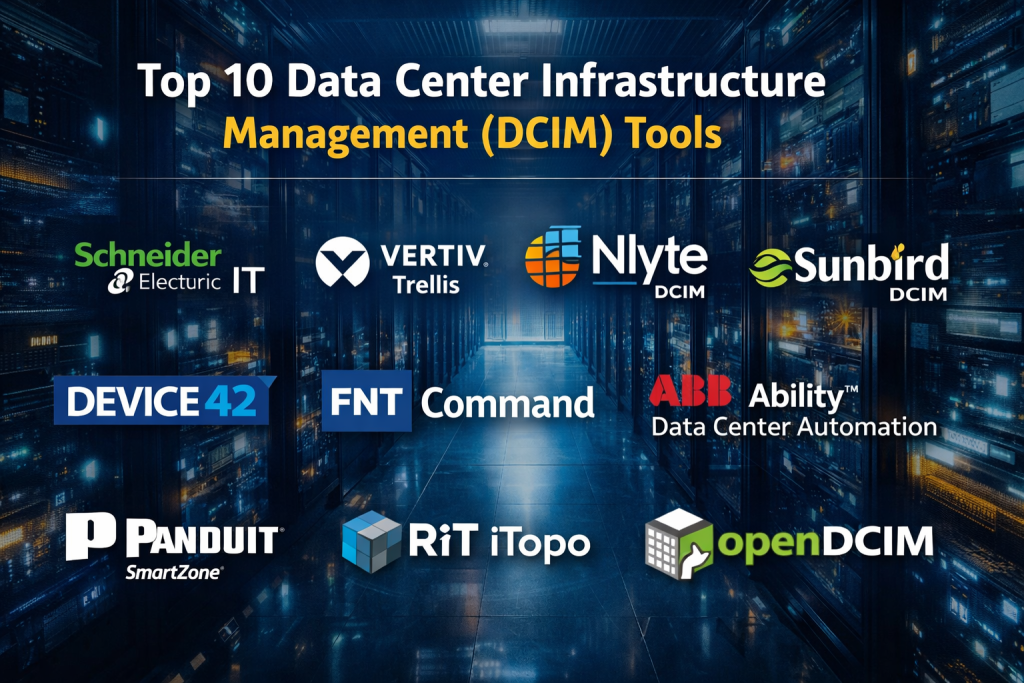
Top 10 Data Center Infrastructure Management (DCIM) Tools
#1 — Schneider Electric EcoStruxure IT
Short description:
A comprehensive DCIM platform focused on real-time monitoring, power visibility, and predictive analytics for enterprise and colocation data centers.
Key features
- Real-time power and environmental monitoring
- AI-driven predictive failure analytics
- Asset and rack-level visibility
- Capacity planning and reporting
- Integration with UPS, PDUs, and sensors
- Cloud-based and on-prem deployment options
Pros
- Industry-leading power and energy insights
- Strong analytics and alerting
- Scales well for large environments
Cons
- Premium pricing
- Steeper learning curve for new users
Security & compliance:
SSO, encryption, audit logs, ISO-aligned practices, GDPR-ready
Support & community:
Enterprise-grade support, extensive documentation, strong onboarding services
#2 — Vertiv Trellis
Short description:
An enterprise-grade DCIM solution designed for large, complex, and distributed data centers requiring deep operational intelligence.
Key features
- Integrated power, cooling, and space monitoring
- Advanced capacity modeling
- Workflow and change management
- Multi-site and global visibility
- Custom dashboards and analytics
Pros
- Very strong enterprise scalability
- Excellent modeling and forecasting
- Deep facilities integration
Cons
- High implementation effort
- Best suited for large organizations
Security & compliance:
Role-based access, encryption, compliance reporting support
Support & community:
Dedicated enterprise support, professional services required for setup
#3 — Nlyte
Short description:
A flexible DCIM platform emphasizing automation, asset lifecycle management, and hybrid data center visibility.
Key features
- Asset and inventory lifecycle tracking
- Power and space optimization
- Workflow automation
- API-driven integrations
- Support for hybrid and edge environments
Pros
- Strong automation capabilities
- Flexible architecture
- Good hybrid support
Cons
- Interface can feel complex
- Requires configuration effort
Security & compliance:
SSO, audit logs, encryption, GDPR support
Support & community:
Good documentation, enterprise support, smaller community than legacy vendors
#4 — Sunbird DCIM
Short description:
A modern, browser-based DCIM platform focusing on visualization, usability, and rapid deployment.
Key features
- 3D data center visualization
- Real-time monitoring
- Capacity and change management
- Open API ecosystem
- Quick deployment model
Pros
- Very intuitive UI
- Fast time to value
- Strong visualization tools
Cons
- Advanced analytics less deep than competitors
- Premium pricing for full features
Security & compliance:
SSO, encryption, audit logging, GDPR-ready
Support & community:
Responsive support, strong onboarding, growing user base
#5 — Device42
Short description:
An automated infrastructure discovery and DCIM solution ideal for hybrid IT and CMDB-driven environments.
Key features
- Automated asset discovery
- Dependency mapping
- Power and environmental monitoring
- IP address management (IPAM)
- CMDB integrations
Pros
- Excellent auto-discovery
- Easy deployment
- Strong ITSM integrations
Cons
- Less facilities-focused than traditional DCIM
- Visualization less advanced
Security & compliance:
Encryption, RBAC, audit logs, compliance-ready
Support & community:
Strong documentation, responsive vendor support
#6 — FNT Command
Short description:
A powerful infrastructure management platform combining DCIM, network documentation, and service modeling.
Key features
- End-to-end infrastructure documentation
- Capacity and dependency modeling
- Workflow automation
- Multi-layer service views
- Telecom and network focus
Pros
- Excellent documentation depth
- Strong service modeling
- Good for regulated industries
Cons
- Complex configuration
- UI feels dated to some users
Security & compliance:
ISO-aligned controls, audit trails, role-based security
Support & community:
Enterprise support model, professional services recommended
#7 — ABB Ability Data Center Automation
Short description:
An industrial-grade DCIM solution combining automation, energy efficiency, and facilities control.
Key features
- Power and cooling automation
- Energy efficiency optimization
- Integration with building systems
- Predictive maintenance
- Real-time dashboards
Pros
- Strong facilities automation
- Reliable industrial-grade performance
- Sustainability-focused
Cons
- Limited IT asset depth
- Best suited for large facilities
Security & compliance:
Enterprise-grade security, industrial compliance standards
Support & community:
Strong vendor support, limited open community
#8 — Panduit SmartZone
Short description:
A DCIM platform focused on physical infrastructure visibility, connectivity, and intelligent cabling.
Key features
- Rack and cabling visibility
- Power and environmental monitoring
- Asset tracking
- Capacity analytics
- Integration with physical infrastructure
Pros
- Excellent physical layer visibility
- Strong cable management
- Reliable monitoring
Cons
- Less IT-centric analytics
- Smaller ecosystem
Security & compliance:
RBAC, encryption, compliance-ready features
Support & community:
Vendor-led support, good documentation
#9 — RiT iTopo
Short description:
A visual-first DCIM platform known for accurate real-time modeling of physical data center infrastructure.
Key features
- Real-time infrastructure modeling
- 3D visualization
- Power and space management
- Change management workflows
- Multi-site support
Pros
- High-accuracy visualization
- Strong physical modeling
- Good for complex layouts
Cons
- Smaller vendor ecosystem
- UI can feel technical
Security & compliance:
Encryption, RBAC, audit logging
Support & community:
Good vendor support, limited community size
#10 — OpenDCIM
Short description:
An open-source DCIM solution suitable for budget-conscious teams and smaller data centers.
Key features
- Asset and rack management
- Power and space tracking
- Basic reporting
- Customization via open codebase
- Community-driven development
Pros
- No licensing cost
- Highly customizable
- Transparent architecture
Cons
- Limited enterprise features
- No official vendor support
Security & compliance:
Varies / community-managed
Support & community:
Active community forums, documentation quality varies
Comparison Table
| Tool Name | Best For | Platform(s) Supported | Standout Feature | Rating |
|---|---|---|---|---|
| EcoStruxure IT | Large enterprises | Cloud / On-prem | Predictive power analytics | N/A |
| Vertiv Trellis | Global data centers | On-prem | Capacity modeling | N/A |
| Nlyte | Hybrid environments | Cloud / On-prem | Automation workflows | N/A |
| Sunbird DCIM | Fast deployment | Browser-based | 3D visualization | N/A |
| Device42 | IT-centric teams | Cloud / On-prem | Auto-discovery | N/A |
| FNT Command | Regulated industries | On-prem | Service modeling | N/A |
| ABB Ability | Industrial facilities | On-prem | Automation & energy | N/A |
| Panduit SmartZone | Physical infrastructure | On-prem | Intelligent cabling | N/A |
| RiT iTopo | Complex layouts | On-prem | Real-time modeling | N/A |
| OpenDCIM | Budget users | On-prem | Open-source | N/A |
Evaluation & Scoring of Data Center Infrastructure Management (DCIM)
| Criteria | Weight | Evaluation Notes |
|---|---|---|
| Core features | 25% | Monitoring depth, asset tracking, analytics |
| Ease of use | 15% | UI, deployment speed, learning curve |
| Integrations & ecosystem | 15% | ITSM, BMS, APIs |
| Security & compliance | 10% | Access control, auditability |
| Performance & reliability | 10% | Scalability, uptime |
| Support & community | 10% | Documentation, vendor support |
| Price / value | 15% | ROI vs cost |
Which Data Center Infrastructure Management (DCIM) Tool Is Right for You?
- Solo users / SMBs: Open-source or lighter DCIM tools
- Mid-market: Device42, Sunbird DCIM, Nlyte
- Enterprise: EcoStruxure IT, Vertiv Trellis, ABB Ability
- Budget-focused: OpenDCIM
- Feature depth: Vertiv, Schneider Electric
- Ease of use: Sunbird DCIM
- High compliance needs: FNT Command, ABB Ability
Frequently Asked Questions (FAQs)
- Is DCIM only for large data centers?
No. While enterprises benefit most, smaller facilities can also gain visibility and efficiency. - How long does DCIM implementation take?
Anywhere from a few weeks to several months, depending on complexity. - Does DCIM replace monitoring tools?
DCIM complements and often integrates with monitoring platforms. - Is cloud-based DCIM secure?
Yes, when supported by strong encryption and access controls. - Can DCIM reduce energy costs?
Yes, energy optimization is one of its primary benefits. - Do DCIM tools support edge data centers?
Many modern platforms now support edge environments. - Is DCIM expensive?
Costs vary widely based on scale, features, and licensing. - What is the biggest DCIM mistake?
Overbuying features without clear operational goals. - Can DCIM integrate with ITSM tools?
Most enterprise platforms support ITSM integration. - Is open-source DCIM reliable?
It can be, but requires in-house expertise and maintenance.
Conclusion
Data Center Infrastructure Management (DCIM) tools play a vital role in ensuring uptime, optimizing costs, and enabling sustainable growth in modern data centers. From power monitoring to capacity planning and compliance reporting, DCIM platforms provide the operational intelligence required to run resilient infrastructure.
There is no single “best” DCIM tool for everyone. The right choice depends on organization size, technical maturity, budget, and operational priorities. By clearly defining your needs and evaluating tools against practical criteria, you can select a DCIM solution that delivers real, long-term value.

Find Trusted Cardiac Hospitals
Compare heart hospitals by city and services — all in one place.
Explore Hospitals