
The shift to the cloud is no longer a trend; it is the standard operating model for modern businesses. In this landscape, the role of the Solutions Architect has become increasingly critical. It’s not just about knowing which services exist; it’s about knowing how to stitch them together to solve complex business problems securely, efficiently, and cost-effectively.
If you are an engineer looking to level up, or a manager aiming to guide your team, understanding the path to becoming an Azure Solutions Architect is essential. This guide is designed to cut through the noise. Drawing on decades of industry observation across DevOps, SRE, and cloud disciplines, we will walk through exactly what this role entails, why the certification matters, and a pragmatic roadmap to achieving it.
We will focus on practical skills, real-world applications, and how this certification fits into the broader ecosystem of cloud operations.
Why Becoming an Azure Solutions Architect Matters
The tech industry is full of specialists. You have developers writing code, ops engineers managing servers, and security analysts locking things down. The Solutions Architect is the bridge between these worlds and the business goals.
Companies are aggressively moving to Microsoft Azure. They need professionals who can look at a monolithic on-premises application and design a strategy to migrate it to the cloud using microservices, managed databases, and serverless functions. They need someone who understands that every technical decision has a cost and a security implication.
Earning the Azure Solutions Architect certification validates that you possess this high-level, strategic viewpoint. It proves you have the expertise to design identity, governance, data storage, business continuity, and infrastructure solutions on Azure. It is a major career differentiator for senior engineers and a vital credential for technical leaders.
Deep Dive: The Azure Solutions Architect Certification
This certification is the gold standard for designing cloud and hybrid solutions that run on Microsoft Azure. It goes beyond just knowing how to configure a virtual machine. It tests your ability to translate business requirements into secure, scalable, and reliable technical architectures.
What it is
The Azure Solutions Architect certification is an expert-level credential. It assesses your mastery in designing end-to-end solutions on Azure.
It is not a test of speed-clicking through the Azure portal. It is a test of design principles. You are expected to know when to choose an SQL Database over Cosmos DB, how to design a multi-region disaster recovery plan, and how to implement governance policies that keep costs down without stifling innovation. It requires a deep understanding of networking, virtualization, identity, security, business continuity, disaster recovery, data management, and governance.
Who should take it
This certification is not for beginners just starting with the cloud. It is designed for experienced IT professionals.
You should consider this certification if:
- You are a Senior Software Engineer wanting to move into system design.
- You are an existing Cloud Administrator or DevOps Engineer looking to step up into an architectural role.
- You have significant experience operating Azure solutions and want to validate your design skills.
- You are a technical manager who needs to understand cloud architecture deeply to lead teams effectively.
Skills you’ll gain
Preparing for this certification forces you to connect the dots between isolated Azure services. You move from thinking about “how to build” to “what to build and why.”
Beyond just passing an exam, the study process equips you with robust practical skills:
- Advanced Networking and Connectivity: You will learn to design complex VNet topologies, hybrid connectivity using ExpressRoute or VPN, and secure global load balancing solutions.
- Identity and Security Governance: You will master designing identity management solutions using Azure Active Directory (Entra ID), implementing conditional access, and designing governance hierarchies using Management Groups and Azure Policy.
- Data Platform Design: You will gain the ability to recommend the right data storage solution based on requirements for relational data, NoSQL, and data warehousing, balancing performance and cost.
- Business Continuity and Disaster Recovery (BCDR): You will learn to design highly available solutions that can survive regional failures, defining RTO (Recovery Time Objective) and RPO (Recovery Point Objective) strategies.
- Infrastructure and Application Design: You will understand how to design compute solutions using VMs, Kubernetes (AKS), App Service, and Functions, choosing the right tool for the workload.
Real-world projects you should be able to do after it
A certified architect shouldn’t just know theory; they should be able to execute. After mastering the materials for this certification, you should be comfortable leading complex projects.
Here are examples of projects you would be equipped to handle:
- Migrating a Legacy ERP System: Design and plan the lift-and-shift migration of a critical on-premises application to Azure VMs, including designing the supporting network, storage, and a backup strategy for the new environment.
- Designing a Global E-commerce Platform: Architect a microservices-based e-commerce site using Azure Kubernetes Service (AKS) across multiple regions for high availability, using Azure Front Door for global traffic routing and Cosmos DB for multi-master data replication.
- Implementing a Secure Hybrid Cloud Network: Connect an on-premises data center securely to Azure, designing a hub-and-spoke network topology with a firewall in the hub VNet to inspect all traffic between on-prem and the cloud spokes.
- Establishing Cloud Governance for an Enterprise: Define and implement a governance structure for a large organization using Azure Management Groups, Blueprints, and Policies to ensure compliance standards (like HIPAA or GDPR) are met automatically and costs are controlled through budgets.
Preparation plan
Your preparation time will vary wildly depending on your starting point. Here are three pragmatic approaches.
The 60-Day Plan (For those with some Azure experience but new to architecture):
- Weeks 1-2: Focus heavily on Azure networking and core infrastructure (VMs, storage accounts). Do hands-on labs building VNets and peering them.
- Weeks 3-4: Dive deep into Identity (Azure AD) and Governance (Policy, RBAC). These are dry topics but critical for the exam.
- Weeks 5-6: Study data platforms and application architecture (AKS, App Service, Functions). Focus on when to use which service.
- Weeks 7-8: Focus on “design” topics: High Availability, Disaster Recovery, Cost Optimization, and monitoring. Take practice tests to identify weak areas.
The 30-Day Plan (For experienced Azure administrators):
- Week 1: Review networking and identity concepts quickly. Spend time on hybrid connectivity scenarios.
- Week 2: Focus entirely on data solutions and app modernization services. Understand the trade-offs between different database options.
- Week 3: Dedicate this week to BCDR strategies, backup, and site recovery. This is often a weak point for admins.
- Week 4: Intense practice tests and reviewing whitepapers on Azure architecture frameworks.
The 7-14 Day Sprint (For existing architects just needing validation):
- Days 1-5: Rapidly review the official study guide to identify gaps in your knowledge (e.g., specific SKUs or new services).
- Days 6-12: Focus heavily on case study-style questions and practice exams. The exam requires reading long scenarios and making decisions.
- Days 13-14: Final review of governance policies and cost management tools.
Common mistakes candidates make
Many smart engineers fail this certification on the first try. It is usually not a lack of technical knowledge, but a failure to understand the exam’s perspective.
Avoid these common pitfalls:
- Thinking like an Administrator, not an Architect: The exam asks which solution fits best based on requirements, not just how to configure a service. Don’t get lost in the weeds of configuration steps unless asked.
- Ignoring Non-Functional Requirements: Architects must obsess over cost, security, compliance, and operational excellence. If you design the fastest solution but it costs a fortune and is insecure, it’s the wrong answer.
- Neglecting Business Continuity: Failing to deeply understand backup strategies, site recovery, and high-availability options across regions is a frequent cause of failure.
- Rushing the Case Studies: The exam includes long case studies. Candidates often skim these and miss crucial constraints hidden in the text that dictate the correct answer. Read them thoroughly.
Master Certification Guide
Below is a consolidated view of the Azure Solutions Architect certification details.
| Track | Level | Certification Name | Who it’s for | Prerequisites | Skills Covered | Recommended Order |
| Cloud Architecture | Expert | Azure Solutions Architect | Senior Engineers, Tech Leads, Architects | Deep knowledge of Azure administration and development. Prior experience in IT operations. | Design for identity, security, governance, data, apps, and infrastructure. | Take after gaining significant hands-on Azure experience (e.g., after AZ-104 or AZ-204 equivalent knowledge). |
Choose Your Path: The Ops Ecosystem
An Azure Solutions Architect does not exist in a vacuum. You must understand how your designs affect the teams that build and run them. Depending on your interests, your architectural foundation can lead you down several specialized paths.
1. DevOps
The architect designs the house; DevOps builds the assembly line that constructs it. An architect with a DevOps mindset ensures that the infrastructure they design can be defined as code (IaC), automated, and deployed via CI/CD pipelines. You focus on making architecture reproducible and deployable.
2. DevSecOps
Security cannot be an afterthought in architecture. In this path, you integrate security controls directly into your architectural designs and pipelines. You move from just using Azure Firewall to designing automated security scanning, identity governance, and compliance guardrails that are baked into the platform from day one.
3. SRE (Site Reliability Engineering)
Architects design for reliability, but SREs ensure it happens in production. An architect pursuing the SRE path focuses intensely on designing systems that are observable. You prioritize metrics, logs, and tracing in your design to ensure that when things break (and they will), the system can heal itself or be quickly debugged.
4. AIOps / MLOps
As AI becomes central to business, architects need to know how to design infrastructure that supports it. This path involves architecting scalable pipelines for data ingestion, model training, and model serving using tools like Azure Machine Learning, ensuring these compute-hungry workloads are cost-effective and performant.
5. DataOps
Modern architecture is data-driven. The DataOps path is for architects who specialize in designing robust data platforms. You focus on creating reliable data lakes, efficient ETL/ELT processes, and ensuring data quality and governance flow smoothly from source to analytics capability like Azure Synapse.
6. FinOps
Cloud spend is a major concern for executives. An architect with a FinOps focus designs with cost as a primary constraint. You become an expert at utilizing reserved instances, spot VMs, auto-scaling, and governance tagging to ensure the company gets maximum value for every dollar spent on Azure.
Mapping Roles to Recommended Certifications
Depending on your current role, the Azure Solutions Architect certification might be your next step or a future goal. Here is how it fits into various career profiles.
| Current Role | Recommended Certification Path & Context |
| DevOps Engineer | Start with Azure Administrator foundations. Then move to DevOps specific certifications. Finally, tackle Azure Solutions Architect to understand the broader system you are automating. |
| SRE | Deepen networking and monitoring skills first. The Azure Solutions Architect cert is crucial later to understand how to design systems for inherent reliability and failure tolerance. |
| Platform Engineer | You are building the internal product for developers. The Azure Solutions Architect certification is essential to design scalable, multi-tenant platforms on Azure Kubernetes Service or App Service. |
| Cloud Engineer | This is your natural progression. After mastering administration, the Azure Solutions Architect certification is the definitive step up to a senior design role. |
| Security Engineer | Focus on Azure Security specific certifications first. Then, use the Azure Solutions Architect cert to understand the full scope of infrastructure you need to secure. |
| Data Engineer | Focus on Azure Data specific certifications. Later, the Azure Solutions Architect cert helps you understand how your data pipelines integrate with applications and networking. |
| FinOps Practitioner | While not primary, understanding architecture is key to cost control. The Azure Solutions Architect cert helps you understand why resources are deployed, enabling better cost optimization conversations. |
| Engineering Manager | You don’t need to configure routers, but you need to know what your team is talking about. The Azure Solutions Architect certification gives you the necessary technical depth to validate strategies and lead effectively. |
What’s Next After Azure Solutions Architect?
Once you have achieved the expert-level architect certification, where do you go from there? You have three main directions for growth.
1. Same Track (Deepening Expertise):
Stay technical and go deeper into specialized Azure areas. Look for advanced specializations in areas like networking, SAP on Azure, or Azure Virtual Desktop. These demonstrate niche expertise that is highly valued.
2. Cross-Track (Broadening Horizons):
A great architect often understands more than one cloud or discipline. Consider exploring certifications in Kubernetes (CKA/CKAD) to master the container orchestration layer regardless of the cloud provider. Alternatively, look at major security certifications like CISSP to solidify your standing as a security-conscious architect.
3. Leadership:
If your goal is management or C-level positions (CTO, VP of Engineering), you need to pivot from pure technical skills to business alignment and framework management. Look into certifications related to IT service management (ITIL), enterprise architecture frameworks like TOGAF, or agile leadership.
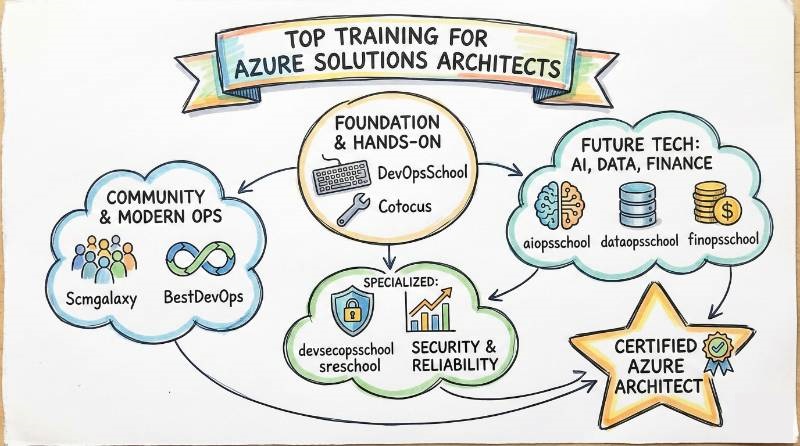
Top Training Institutions for Azure Solutions Architect
Choosing the right training partner is crucial for success. Based on the provided list, here are institutions that can help prepare you for this journey.
- DevOpsSchool: A primary destination for comprehensive cloud and DevOps training. They offer structured courses specifically designed for the Azure Solutions Architect track, focusing on hands-on skills aligned with industry demands.
- Cotocus: Known for providing specialized consulting and training services. Their approach often integrates real-world consulting experience into their training modules, offering practical insights for aspiring architects.
- Scmgalaxy: A community-driven platform focused on SCM and DevOps. They provide valuable resources, tutorials, and training that build the foundational skills necessary for high-level cloud architecture.
- BestDevOps: This platform focuses on curating the best DevOps practices and tools. Their training aligns architecture principles with modern DevOps workflows, ensuring your designs are automatable.
- devsecopsschool: For architects who want to prioritize security. Their training emphasizes integrating security into every phase of the architectural design process on Azure.
- sreschool: Focuses on Site Reliability Engineering principles. Training here helps architects design systems that are not just functional but also resilient, observable, and manageable at scale.
- aiopsschool: Ideal for architects looking to specialize in infrastructure for AI/ML. They cover the intersection of cloud architecture and operationalizing machine learning workloads.
- dataopsschool: Provides training focused on the data lifecycle. Essential for architects designing data-intensive applications, covering databases, data lakes, and pipelines on Azure.
- finopsschool: Focuses on the financial aspect of the cloud. Their training helps architects design cost-aware solutions and implement governance to manage cloud spend effectively.
FAQs on Azure Solutions Architect
1. How hard is the Azure Solutions Architect exam? It is quite challenging because it tests your ability to solve complex problems, not just remember facts. You need a mix of study and real experience to pass.
2. Do I need to be a programmer? No, but you should understand how apps work. You will need to read some basic code and scripts to design the best infrastructure for them.
3. What is the difference between AZ-104 and AZ-305? AZ-104 is for Administrators who manage the cloud daily. AZ-305 is for Architects who design the cloud strategy and structure.
4. How much can I earn as an Azure Solutions Architect? In India and globally, this is one of the highest-paying roles in tech. It is a senior-level position with great growth potential.
5. How long does the certification stay valid? It is valid for one year. You can renew it for free every year by passing a quick online assessment from Microsoft.
6. Can I take this exam without any prior cloud experience? It is not recommended. You should have at least 1-2 years of experience working with Azure before trying the Architect level.
7. Is this certification recognized globally? Yes, Microsoft certifications are respected by companies all over the world, including major tech hubs in the US, Europe, and India.
8. Does DevOpsSchool provide lab access? Yes, most top institutions like DevOpsSchool provide hands-on labs so you can practice in a real Azure environment.
9. How many exams do I need to pass for the Expert title? Usually, you need to pass the Administrator Associate (AZ-104) and then the Solutions Architect Design (AZ-305).
10. Is the study material from GurukulGalaxy helpful? Yes, GurukulGalaxy is a known resource for keeping up with the latest trends and certification paths for software engineers.
11. What is the best way to start? Start by getting a free Azure account and practicing the basics of virtual machines and networking.
12. Will this certification help me move into management? Definitely. It shows you understand the business side of technology, which is exactly what engineering managers need.
Frequently Asked Questions (FAQs) on Azure Solutions Architect
Here are answers to common questions aspiring architects ask.
1. Is the Azure Solutions Architect exam difficult?
Yes, it is considered one of the more challenging Azure certifications. It requires not just factual knowledge but the ability to synthesize information and make complex design decisions under time pressure through case studies.
2. Do I need to know how to code to pass?
You don’t need to be a software developer. However, you must understand reading and interpreting JSON (for ARM templates/Bicep) and have a solid grasp of scripting via PowerShell or Azure CLI to understand automation concepts.
3. How long does the certification last?
Microsoft role-based certifications expire after one year. However, you can renew them for free by passing an online assessment on Microsoft Learn within six months prior to expiration.
4. What is the best prerequisite for this certification?
While there are no official prerequisites, attempting this without prior Azure experience is very difficult. Ideally, you should hold the Azure Administrator Associate certification or have equivalent hands-on experience for at least 1-2 years.
5. Does this certification guarantee a job?
No certification guarantees a job. However, the Azure Solutions Architect badge is highly respected in the industry. It significantly increases your visibility to recruiters and validates your skills for senior-level roles.
6. How much time should I dedicate to study?
If you are already working with Azure daily, plan for 4-6 weeks of focused evening and weekend study (approx. 40-60 hours). If you are newer to the platform, you may need 3-4 months of preparation.
7. What is the difference between an Administrator and an Architect?
An Administrator executes and maintains. They know how to create a VM or configure a firewall rule. An Architect decides why a VM is needed instead of a container, or which firewall topology best suits the business needs. Architect is a design role; Admin is an implementation and operations role.
8. Is hands-on lab practice necessary?
Absolutely essential. You cannot pass this exam just by watching videos. You need to spend time in the Azure portal building hub-and-spoke networks, configuring site recovery, and setting up governance policies to truly understand how the services interact.
Conclusion
Becoming an Azure Solutions Architect is a significant milestone in an IT career. It signifies a transition from an operational mindset to a strategic one. It moves you from being the person who fixes the servers to the person who decides which servers the business needs to thrive in the digital economy. The journey requires dedication, hands-on practice, and a willingness to shift your perspective toward solving business problems with technical solutions. The cloud landscape is evolving rapidly, and organizations globally are desperate for skilled professionals who can navigate this complexity with confidence. By earning this certification, you position yourself as a leader capable of guiding enterprises through their cloud transformation journey. It is a challenging path, but the professional rewards, career growth, and ability to make a massive impact on your organization make the effort entirely worthwhile.

Find Trusted Cardiac Hospitals
Compare heart hospitals by city and services — all in one place.
Explore Hospitals
The list of top training options for Azure Solutions Architects is clear and helpful — perfect for anyone planning to upskill in this area.
I appreciate how you laid out the top training options for Azure Solutions Architects — it makes the whole learning path feel more organized instead of overwhelming. For anyone trying to build real skills and prepare for certification, this guide gives clear direction and practical options. Thanks for putting this together!