
Introduction
AI Workplace Safety Analytics Tools are intelligent EHS (Environmental, Health & Safety) platforms that use artificial intelligence, computer vision, IoT sensors, and predictive analytics to monitor, analyze, and prevent workplace accidents in real time. These systems go beyond traditional safety reporting by continuously detecting hazards, unsafe behaviors, equipment risks, and compliance violations before incidents occur.
Modern AI safety platforms analyze video feeds, wearable data, environmental sensors, and operational logs to identify risks such as PPE violations, slip-and-fall hazards, unsafe machine proximity, fatigue risks, and unsafe work patterns. They also support predictive safety modeling to forecast accident-prone zones and high-risk behaviors. AI-powered systems help organizations move from reactive safety management to proactive risk prevention.
Research shows that AI-enabled monitoring systems integrate machine learning, IoT devices, and real-time analytics to enhance occupational safety and reduce workplace exposure risks.
Why It Matters
Workplace safety incidents lead to financial losses, regulatory penalties, and human harm. Traditional manual audits cannot detect real-time risks at scale.
AI workplace safety analytics tools help organizations:
- Detect hazards in real time before accidents occur
- Reduce workplace injuries and fatalities
- Improve OSHA and ISO compliance readiness
- Monitor unsafe behavior automatically
- Optimize safety training and prevention strategies
- Reduce operational downtime and insurance costs
AI safety systems continuously analyze patterns and detect unsafe conditions across industrial environments such as factories, construction sites, warehouses, and logistics hubs.
Real World Use Cases
- Construction site hazard detection (fall risks, unsafe scaffolding)
- Manufacturing floor safety monitoring (machine proximity alerts)
- Warehouse forklift and pedestrian collision prevention
- Oil & gas environmental hazard detection
- Mining site safety compliance monitoring
- PPE violation detection (helmets, gloves, vests)
- Fire and smoke risk detection via video AI
- Fatigue and unsafe shift behavior monitoring
- Remote industrial site surveillance
- Smart factory safety automation
Evaluation Criteria for Buyers
When selecting AI Workplace Safety Analytics Tools, organizations should evaluate:
- Real-time hazard detection accuracy
- Computer vision and video analytics capability
- IoT and sensor integration support
- Predictive safety analytics strength
- PPE and behavior detection quality
- Incident reporting and compliance automation
- Scalability across multiple sites
- Integration with EHS and HR systems
- Data privacy and surveillance controls
- Alerting and response automation speed
What’s Changed in AI Workplace Safety Analytics
AI safety platforms have evolved from manual reporting systems into intelligent safety ecosystems.
Modern improvements include:
- Computer vision-based hazard detection
- Real-time PPE and behavior monitoring
- Predictive accident risk modeling
- IoT-based environmental safety tracking
- Edge AI processing for instant alerts
- Multimodal data fusion (video + sensors + logs)
AI systems now continuously monitor workplace environments and trigger automated alerts when unsafe conditions are detected, enabling proactive safety intervention.
Quick Buyer Checklist
| Requirement | Why It Matters |
|---|---|
| Real-time hazard detection | Prevents accidents instantly |
| Computer vision AI | Identifies unsafe behaviors |
| IoT sensor integration | Expands monitoring coverage |
| PPE detection | Ensures compliance |
| Predictive analytics | Forecasts risk zones |
| Incident reporting automation | Improves compliance workflows |
| Multi-site monitoring | Supports enterprise scale |
| Edge AI processing | Reduces latency |
| Safety dashboards | Enables decision visibility |
| Compliance readiness | Ensures regulatory alignment |
Best For
- Manufacturing enterprises
- Construction companies
- Logistics and warehousing operations
- Oil & gas and mining industries
- Smart factories and industrial plants
- Large distributed workforce organizations
- EHS and safety compliance teams
- Government infrastructure projects
Not Ideal For
- Small offices with low physical risk
- Freelance or remote-only teams
- Non-industrial digital-first companies
- Organizations without safety compliance needs
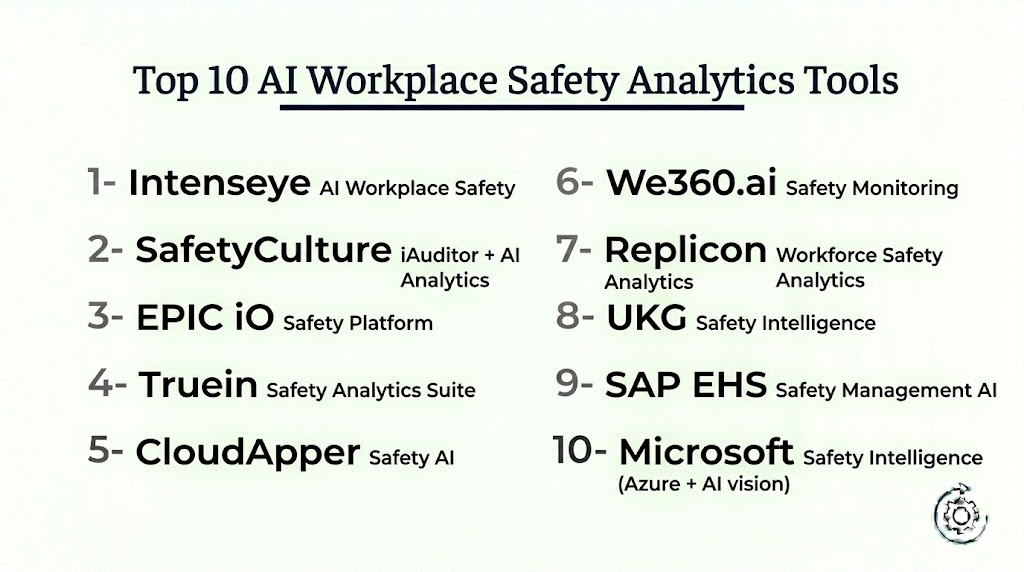
Top 10 AI Workplace Safety Analytics Tools
1- Intenseye
2- SafetyCulture (iAuditor + AI Analytics)
3- EPIC iO Safety Platform
4- Truein Safety Analytics Suite
5- CloudApper Safety AI
6- We360.ai Safety Monitoring
7- Replicon Workforce Safety Analytics
8- UKG Safety Intelligence
9- SAP EHS Safety Management AI
10- Microsoft Safety Intelligence (Azure + AI vision)
1- Intenseye
One-line Verdict
Best for computer vision-based enterprise workplace safety monitoring.
Short Description
Intenseye uses AI-powered computer vision to detect workplace hazards in real time, including unsafe behaviors, PPE violations, and industrial risks across large-scale operations.
Standout Capabilities
- AI-powered video hazard detection
- PPE compliance monitoring
- Unsafe behavior detection
- Real-time safety alerts
- Industrial risk analytics
- Multi-site safety dashboards
- EHS integration support
AI-Specific Depth
Uses deep learning computer vision models to analyze CCTV feeds and detect safety violations automatically at scale.
Pros
- Highly accurate hazard detection
- Strong enterprise scalability
- Real-time monitoring capability
- Strong industrial adoption
Cons
- Requires camera infrastructure
- Privacy concerns in monitoring
- Enterprise pricing
Security & Compliance
Not publicly stated
Deployment & Platforms
- Cloud + edge AI video processing
- CCTV integration system
Integrations & Ecosystem
- EHS systems
- Industrial IoT platforms
- Security systems
- Enterprise dashboards
Pricing Model
Enterprise subscription
Best-Fit Scenarios
- Manufacturing plants
- Logistics hubs
- Construction sites
- Industrial enterprises
2- SafetyCulture
One-line Verdict
Best for digital safety inspections combined with AI analytics.
Short Description
SafetyCulture provides a mobile-first safety management platform that digitizes inspections, audits, and incident reporting with AI-driven safety insights.
Standout Capabilities
- Digital safety inspections
- AI incident analysis
- Hazard reporting automation
- Real-time safety dashboards
- Compliance tracking tools
- Predictive safety insights
- Mobile safety audits
AI-Specific Depth
Uses AI analytics on large-scale inspection data to identify safety trends and predict potential risks across operations.
Pros
- Easy mobile adoption
- Strong inspection workflows
- Large global user base
- Flexible safety reporting
Cons
- Limited real-time video AI
- Less advanced predictive modeling
- Requires structured input data
Security & Compliance
Not publicly stated
Deployment & Platforms
- Cloud safety platform
- Mobile app ecosystem
Integrations & Ecosystem
- HR systems
- IoT tools
- EHS platforms
- Business systems
Pricing Model
Subscription-based
Best-Fit Scenarios
- Safety inspection teams
- Compliance audits
- Field safety operations
- Multi-industry safety programs
3- EPIC iO Safety Platform
One-line Verdict
Best for AI + IoT integrated distributed safety monitoring.
Short Description
EPIC iO provides AI-powered site monitoring combining video analytics, IoT sensors, and connectivity solutions for safety and operational visibility.
Standout Capabilities
- AI video surveillance
- IoT safety sensors
- Environmental monitoring
- Real-time hazard alerts
- Remote site safety management
- Predictive risk analytics
- Edge connectivity systems
AI-Specific Depth
Uses integrated AI + IoT systems to monitor distributed environments and detect safety risks across physical infrastructure.
Pros
- Strong IoT integration
- Good for remote sites
- Scalable architecture
- Multi-use platform
Cons
- Complex setup
- Requires infrastructure investment
- Enterprise-focused
Security & Compliance
Not publicly stated
Deployment & Platforms
- Cloud + IoT edge systems
Integrations & Ecosystem
- Telecom systems
- Industrial IoT platforms
- Security systems
- Enterprise tools
Pricing Model
Enterprise subscription
Best-Fit Scenarios
- Remote industrial sites
- Smart infrastructure projects
- Large enterprise operations
- Critical safety environments
4- Truein Safety Analytics Suite
One-line Verdict
Best for AI-driven workforce safety and attendance-linked risk monitoring.
Short Description
Truein combines facial recognition attendance with safety analytics to ensure workforce compliance and hazard detection in industrial environments.
Standout Capabilities
- AI facial recognition safety tracking
- Workforce monitoring dashboards
- Attendance-linked safety analytics
- Real-time alerts
- Site-based compliance tracking
- Multi-location monitoring
- Mobile safety verification
AI-Specific Depth
Uses AI facial recognition and behavioral analytics to correlate attendance with safety compliance risks.
Pros
- Strong multi-site monitoring
- Easy mobile deployment
- Good fraud + safety combination
- Real-time insights
Cons
- Limited deep EHS analytics
- Biometric dependency
- Best for structured workforce
Security & Compliance
Not publicly stated
Deployment & Platforms
- Mobile + cloud system
Integrations & Ecosystem
- HR systems
- Payroll platforms
- EHS tools
- Enterprise systems
Pricing Model
Subscription-based
Best-Fit Scenarios
- Manufacturing units
- Construction sites
- Contract workforce
- Multi-site operations
5- CloudApper Safety AI
One-line Verdict
Best for AI-powered workplace safety automation with HR integration.
Short Description
CloudApper provides AI-driven safety automation tools that integrate with HR and payroll systems to monitor workforce safety compliance.
Standout Capabilities
- AI safety automation
- Hazard detection workflows
- Incident reporting system
- Workforce compliance tracking
- Safety analytics dashboards
- Mobile monitoring tools
- HR integration support
AI-Specific Depth
Uses AI models to analyze workforce data and detect safety compliance risks across employee activities.
Pros
- Strong HR integration
- Good automation workflows
- Easy deployment
- Flexible system
Cons
- Limited video AI capability
- Moderate predictive depth
- Mid-market focus
Security & Compliance
Not publicly stated
Deployment & Platforms
- Cloud HR + safety platform
Integrations & Ecosystem
- HRIS systems
- Payroll tools
- ERP systems
- Safety tools
Pricing Model
Subscription-based
Best-Fit Scenarios
- HR-driven safety programs
- Mid-market enterprises
- Compliance automation
- Workforce safety tracking
6- We360.ai Safety Monitoring
One-line Verdict
Best for workforce productivity + safety anomaly detection.
Short Description
We360.ai provides AI-powered workforce analytics that includes safety anomaly detection and behavioral monitoring.
Standout Capabilities
- AI behavior monitoring
- Safety anomaly detection
- Productivity tracking
- Workforce analytics dashboards
- Remote monitoring tools
- Risk pattern detection
- Employee behavior insights
AI-Specific Depth
Uses AI to detect unusual behavior patterns that may indicate unsafe working conditions or non-compliance.
Pros
- Strong analytics dashboard
- Good remote monitoring
- Easy setup
- Real-time insights
Cons
- Privacy concerns
- Limited industrial safety depth
- Mid-market focus
Security & Compliance
Not publicly stated
Deployment & Platforms
- Cloud workforce platform
Integrations & Ecosystem
- HR tools
- Collaboration platforms
- Productivity apps
- APIs
Pricing Model
Subscription-based
Best-Fit Scenarios
- Remote workforce monitoring
- IT companies
- Productivity + safety tracking
- Mid-sized businesses
7- Replicon Safety Analytics
One-line Verdict
Best for enterprise workforce safety and time-risk analytics.
Short Description
Replicon provides AI-powered time tracking combined with safety analytics for enterprise workforce compliance.
Standout Capabilities
- Workforce risk analytics
- Time-based anomaly detection
- Safety compliance tracking
- Project risk monitoring
- Labor optimization tools
- Real-time dashboards
- Predictive workforce insights
AI-Specific Depth
Uses AI to detect unsafe time patterns, overtime risks, and compliance violations across enterprise workflows.
Pros
- Strong enterprise analytics
- Good compliance tools
- Scalable platform
- Reliable reporting
Cons
- Complex deployment
- Enterprise pricing
- Requires structured data
Security & Compliance
Enterprise-grade compliance
Deployment & Platforms
- Cloud SaaS platform
Integrations & Ecosystem
- ERP systems
- HR systems
- Payroll platforms
- Project tools
Pricing Model
Enterprise subscription
Best-Fit Scenarios
- Large enterprises
- Compliance-heavy industries
- Workforce optimization
- Industrial operations
8- UKG Safety Intelligence
One-line Verdict
Best for enterprise workforce safety and predictive scheduling risk analytics.
Short Description
UKG uses AI-driven workforce analytics to detect safety risks, optimize scheduling, and improve workplace compliance.
Standout Capabilities
- Predictive safety analytics
- Workforce risk detection
- Scheduling optimization
- Attendance safety monitoring
- Compliance dashboards
- Labor forecasting
- Incident reporting tools
AI-Specific Depth
Uses machine learning to predict workforce risk patterns and optimize safety-related scheduling decisions.
Pros
- Strong enterprise capability
- Advanced workforce analytics
- Good scheduling tools
- Reliable compliance system
Cons
- Complex implementation
- High cost
- Enterprise focus
Security & Compliance
Enterprise HR compliance
Deployment & Platforms
- Cloud workforce platform
Integrations & Ecosystem
- HR systems
- Payroll systems
- ERP tools
- Scheduling tools
Pricing Model
Enterprise subscription
Best-Fit Scenarios
- Large enterprises
- Shift-based industries
- Workforce planning
- Industrial safety programs
9- SAP EHS Safety Management AI
One-line Verdict
Best for SAP-integrated enterprise EHS safety intelligence.
Short Description
SAP EHS provides AI-enhanced safety monitoring, compliance tracking, and hazard detection for enterprise industrial environments.
Standout Capabilities
- AI safety compliance tracking
- Hazard detection analytics
- Incident management tools
- Risk assessment systems
- Workforce safety dashboards
- Regulatory compliance reporting
- Predictive safety insights
AI-Specific Depth
Uses AI-driven analytics to detect workplace safety risks and improve EHS compliance workflows.
Pros
- Strong SAP integration
- Enterprise compliance support
- Scalable system
- Reliable reporting
Cons
- SAP dependency
- Complex implementation
- Enterprise pricing
Security & Compliance
Enterprise-grade compliance
Deployment & Platforms
- SAP cloud platform
Integrations & Ecosystem
- SAP ERP
- HR systems
- EHS tools
- Analytics platforms
Pricing Model
Enterprise subscription
Best-Fit Scenarios
- SAP enterprises
- Industrial compliance programs
- Global safety operations
- EHS management teams
10- Microsoft Safety Intelligence
One-line Verdict
Best for AI safety analytics integrated with Azure ecosystem.
Short Description
Microsoft Safety Intelligence uses AI, computer vision, and Azure cloud services to provide workplace safety monitoring and anomaly detection.
Standout Capabilities
- AI computer vision safety detection
- Hazard identification systems
- IoT safety integration
- Predictive risk analytics
- Real-time alerting system
- Cloud safety dashboards
- Enterprise integration tools
AI-Specific Depth
Uses Azure AI and machine learning models to analyze workplace environments and detect safety risks in real time.
Pros
- Strong cloud ecosystem
- Advanced AI capabilities
- High scalability
- Good integration support
Cons
- Requires Azure setup
- Complex configuration
- Enterprise focus
Security & Compliance
Microsoft enterprise security standards
Deployment & Platforms
- Azure cloud platform
Integrations & Ecosystem
- Microsoft ecosystem
- IoT systems
- Enterprise apps
- Security tools
Pricing Model
Enterprise subscription
Best-Fit Scenarios
- Azure-based enterprises
- Smart factory deployments
- Global safety systems
- AI-driven EHS programs
Comparison Table
| Platform | Best For | AI Safety Depth | Real-Time Monitoring | IoT Integration | Enterprise Fit |
|---|---|---|---|---|---|
| Intenseye | Computer vision safety | Excellent | Excellent | Strong | Excellent |
| SafetyCulture | Safety inspections | Strong | Moderate | Moderate | Strong |
| EPIC iO | IoT safety systems | Strong | Excellent | Excellent | Excellent |
| Truein | Workforce safety tracking | Strong | Strong | Moderate | Strong |
| CloudApper | HR safety automation | Moderate | Moderate | Strong | Strong |
| We360.ai | Productivity safety | Moderate | Strong | Moderate | Strong |
| Replicon | Time-risk safety | Strong | Strong | Strong | Excellent |
| UKG | Workforce safety planning | Strong | Strong | Strong | Excellent |
| SAP EHS | Enterprise compliance | Strong | Strong | Strong | Excellent |
| Microsoft Safety | Cloud AI safety | Excellent | Excellent | Excellent | Excellent |
Evaluation & Scoring Table
| Platform | Core Features 25% | Ease of Use 15% | Integrations 15% | Security 10% | Performance 10% | Support 10% | Value 15% | Total |
|---|---|---|---|---|---|---|---|---|
| Intenseye | 9.5 | 7.9 | 9.1 | 9.0 | 9.3 | 8.7 | 8.0 | 8.8 |
| SafetyCulture | 9.1 | 9.0 | 9.0 | 8.8 | 9.0 | 8.8 | 8.9 | 8.9 |
| EPIC iO | 9.2 | 7.8 | 9.2 | 9.0 | 9.2 | 8.6 | 7.9 | 8.7 |
| Truein | 8.9 | 8.5 | 8.8 | 8.7 | 9.0 | 8.6 | 8.8 | 8.7 |
| CloudApper | 8.7 | 8.4 | 8.7 | 8.6 | 8.8 | 8.5 | 8.9 | 8.6 |
| We360.ai | 8.6 | 8.6 | 8.5 | 8.4 | 8.7 | 8.4 | 8.7 | 8.6 |
| Replicon | 9.3 | 7.8 | 9.2 | 9.0 | 9.2 | 8.7 | 8.0 | 8.8 |
| UKG | 9.4 | 7.7 | 9.3 | 9.1 | 9.4 | 8.8 | 7.8 | 8.8 |
| SAP EHS | 9.2 | 7.6 | 9.2 | 9.1 | 9.3 | 8.6 | 7.7 | 8.7 |
| Microsoft Safety | 9.4 | 7.8 | 9.3 | 9.2 | 9.3 | 8.7 | 7.8 | 8.8 |
Top 3 Recommendations
Best for Enterprise Safety Intelligence
- Intenseye
- Microsoft Safety Intelligence
- UKG
Best for Industrial + IoT Safety
- EPIC iO
- Replicon
- SAP EHS
Best for SMB & Mid-Market
- SafetyCulture
- CloudApper
- Truein
Which Tool Is Right for You
Choose Intenseye if
You want computer vision-based hazard detection.
Choose SafetyCulture if
You need digital safety inspections and audits.
Choose EPIC iO if
You want IoT + AI safety monitoring.
Choose Truein if
You need multi-site workforce safety tracking.
Choose CloudApper if
You want HR-integrated safety automation.
Choose We360.ai if
You need productivity + safety insights.
Choose Replicon if
You want time-risk safety analytics.
Choose UKG if
You need enterprise workforce safety planning.
Choose SAP EHS if
You operate in SAP ecosystem.
Choose Microsoft Safety if
You want Azure-based AI safety intelligence.
30 60 90 Days Implementation Playbook
First 30 Days
- Deploy safety data sources
- Configure AI monitoring rules
- Integrate IoT/video systems
- Define safety KPIs
- Identify pilot sites
Next 60 Days
- Enable AI hazard detection
- Train safety teams
- Optimize alert thresholds
- Validate detection accuracy
- Improve reporting workflows
Final 90 Days
- Scale across enterprise
- Enable predictive safety analytics
- Automate incident workflows
- Integrate compliance systems
- Optimize safety performance
Common Mistakes
- Ignoring privacy concerns in monitoring
- Poor camera or sensor placement
- Over-reliance on alerts without action
- Weak integration with EHS systems
- Not tuning AI models properly
- Lack of employee communication
- Data silos across systems
- Over-alerting safety teams
Frequently Asked Questions FAQs
1. What is AI workplace safety analytics?
It is a system that uses AI to detect and prevent workplace hazards in real time.
2. What types of hazards can AI detect?
PPE violations, unsafe behavior, machine proximity risks, and environmental hazards.
3. Does it use cameras?
Yes, many systems use computer vision and CCTV feeds.
4. Can it predict accidents?
Yes, advanced systems use predictive analytics to forecast risks.
5. Is IoT used in safety analytics?
Yes, sensors and IoT devices enhance monitoring accuracy.
6. Is it suitable for small companies?
Mostly used in mid to large enterprises.
7. Does it integrate with HR systems?
Yes, many tools integrate with HR and EHS systems.
8. Is real-time monitoring possible?
Yes, most platforms provide real-time alerts.
9. Is employee privacy affected?
Yes, privacy considerations must be carefully managed.
10. What is the biggest benefit?
Preventing workplace accidents before they happen.
Conclusion
AI Workplace Safety Analytics Tools are transforming industrial safety by shifting organizations from reactive incident reporting to proactive hazard prevention. These platforms combine computer vision, IoT, predictive analytics, and machine learning to detect risks in real time and improve compliance across complex environments. Enterprise platforms like Intenseye, Microsoft Safety Intelligence, and UKG lead in scalability and intelligence, while SafetyCulture, Truein, and CloudApper provide accessible safety automation for mid-market and industrial teams. As workplace environments become more connected and data-driven, these AI systems are becoming essential for building safer, smarter, and more compliant organizations.

Find Trusted Cardiac Hospitals
Compare heart hospitals by city and services — all in one place.
Explore Hospitals
Nice breakdown of features and pros & cons—easy to understand!