
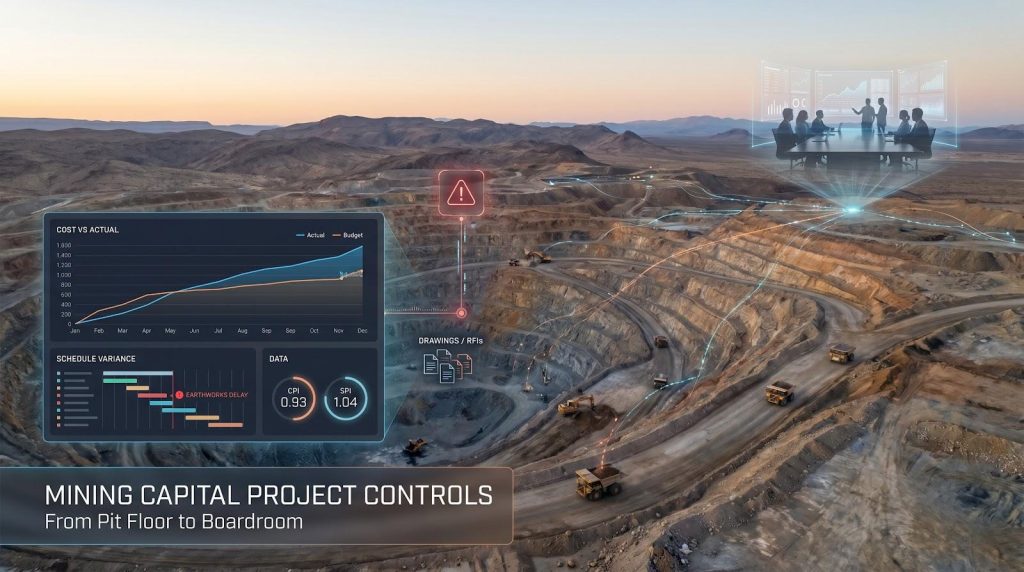
Mining projects don’t creep—they stampede. A 15 percent budget slip on a new pit can erase tens of millions. Bain & Co. reports that energy and mining builds now run 15–20 percent over budget, putting roughly US $1.5 billion of capital at risk every year for the average company.
But capital-project control platforms finally bring order—connecting schedules, costs, contractors, and compliance in one living source of truth.
This guide ranks the four software platforms that topped our 2026 mining scorecard—chosen for mining-specific depth, AI analytics, and proven vendor support. You’ll see which one solves your problem first, and why.
Key challenges in mining capital projects (and how modern platforms address them)
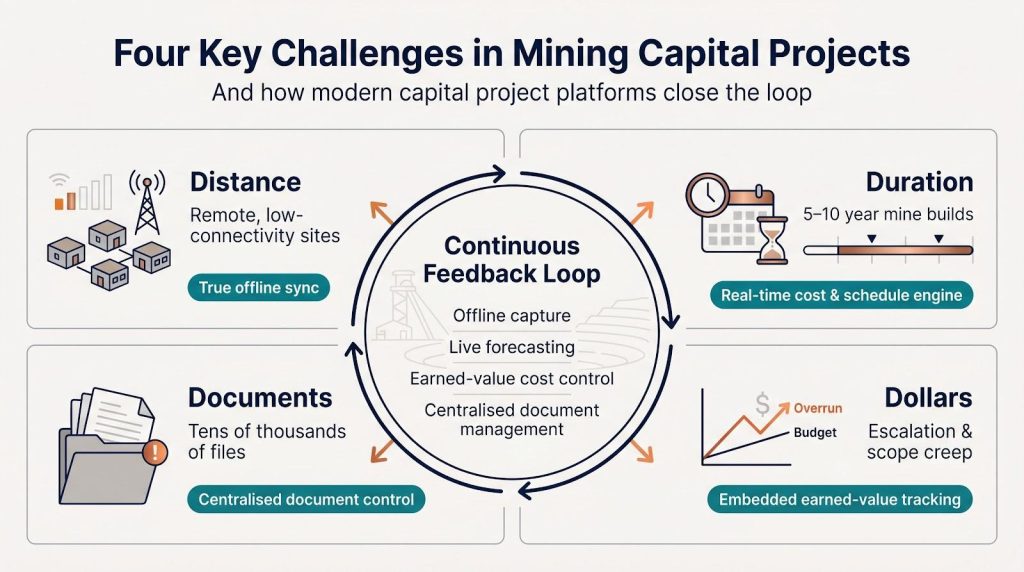
Every mine build shares four headaches: distance, duration, dollars, and documents.
First, location. New sites often sit hundreds of kilometres from the nearest fibre line. When connectivity flickers, field engineers fall back to print-outs and progress slips into the dark. A cloud platform with true offline sync keeps data moving even when the signal dies, so you never wait days for an update that should arrive in minutes.
Second, timeline. Greenfield mines stretch five, seven, sometimes ten years from shovel to ship. Over that span the schedule shifts, suppliers change, and inflation mocks early estimates. Real-time cost-and-schedule engines flag variance the moment it appears, letting you correct mid-stride instead of months later.
Third, budget. Commodity swings and scope creep can turn a billion-dollar forecast into a billion-five reality. Rigorous earned-value tracking, embedded right inside the software, reveals the burn rate against true progress so finance teams spot overruns while there is still time to act.
Finally, paperwork. A single expansion can spawn tens of thousands of drawings, RFIs, and permits. Without a controlled environment, revisions get lost, contractors build from the wrong rev, and rework spirals. Centralised document control with role-based access keeps everyone—from the survey crew to head office—working from the same source.
When you combine offline capture, live forecasting, strict cost control, and airtight document management, you create the continuous feedback loop mining projects have needed for years. The next sections show which platforms deliver that loop best.
A quick-glance comparison
Before we look at each platform in detail, it helps to see the front-runners side by side.
The table below distils the essentials: what each platform does best, where it shines for mining teams, and how the licensing typically works. Scan it now, bookmark the names that fit your short-list, then stay with us for the deeper analysis to follow.
| Software | Best for | Headline strengths | Notable mining use | Licensing snapshot |
| InEight | End-to-end project controls | Integrated cost + schedule engine, AI risk alerts, offline field app | Major gold and copper expansions; 850+ enterprise customers | Modular enterprise subscription |
| Contruent (ARES PRISM) | Precision cost forecasting | Earned-value reporting, rapid SaaS deployment, deep P6/SAP links | Large greenfield copper project rollout | Per-user SaaS or on-prem |
| Hexagon EcoSys | Portfolio governance | Capital planning, ERP integration, predictive analytics dashboards | Corporate PMOs at top-tier diversified miners | Enterprise licence; cloud or on-prem |
| Procore | Site-level collaboration | Mobile field tools, drawing/RFI control, unlimited external users | EPC contractors on process-plant builds | Annual project fee; cloud only |
Remember, every tool in this table covers the basics: schedules, budgets, and documents. The real difference lies in depth and fit—some focus on cost control, others on field productivity or portfolio oversight. The next sections unpack those differences so you can match a platform to the problem you need solved first.
1. InEight: best for integrated project controls in mining
InEight is the Swiss Army knife of capital-project software, and its mining-lifecycle tools surface subsurface conditions, safety KPIs, and real-time cost analytics in the same dashboard.
That blend of geological insight and project controls lets teams decide faster when ground conditions change.
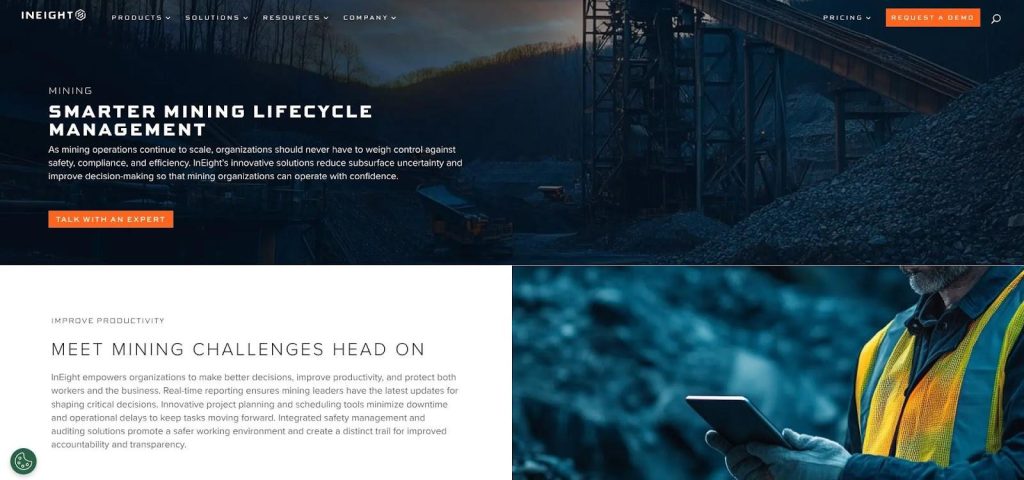
InEight mining project controls dashboard screenshot.
One login still brings together estimating, scheduling, cost control, and field reporting, so your crews stop juggling spreadsheets and work from one source of truth.
The scale speaks for itself. More than 850 enterprises rely on InEight to steer over US $1 trillion in projects across mining, energy, and heavy civil sectors. That reach is something few rivals can match.
Mining crews appreciate that breadth. An estimator in Perth can adjust a haul-road quantity and, seconds later, a cost engineer in Denver sees the change ripple through earned-value metrics. With AI-powered risk alerts, project directors receive early warnings when production drilling slips or steel prices spike.
In short, InEight does more than collect data; it connects every phase of a mine build, giving you the confidence to act in real time rather than at month-end.
2. Contruent (formerly ARES PRISM): best for laser-focused cost control
If InEight is the multitool, Contruent is the precision scalpel. Born as ARES PRISM and re-engineered for the cloud in 2023, it focuses on one job: keeping a project’s financial pulse steady from day one to hand-over.
Open the dashboard and you see a live earned-value feed: budget, actuals, and forecast in the same view. Change orders flow through an approval workflow, roll into the forecast, and instantly update CPI and SPI, so nothing hides in a side spreadsheet.
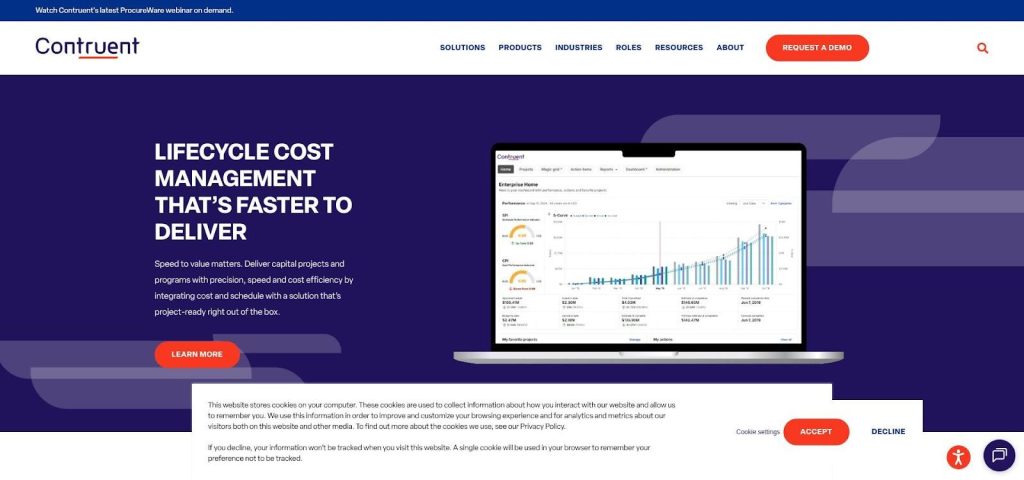
Contruent earned-value cost control dashboard screenshot.
That rigour matters in mining, where procurement swings can dwarf labour costs. Contruent links directly to Primavera P6 for dates and SAP for actual spend, then runs variance analytics every night. Controllers wake up to a ranked list of hotspots instead of a blank reconciliation sheet.
Implementation is quicker than you might expect. Contruent’s SaaS edition ships with mining-ready WBS templates and claims deployment in under four months, welcome relief if your expansion kicks off next quarter.
There is a compromise. Contruent will not manage your drawings or daily logs; it assumes you already have field tools and only want airtight cost governance. But if escalation risk keeps you up at night, this is the system you hand to your cost engineer.
One copper-project manager summed it up after switching from Excel: “We stopped arguing about the numbers and started acting on them.” That is the Contruent difference: less drama, more data, better decisions.
3. Hexagon EcoSys: best for portfolio-level governance
EcoSys speaks the language of the head office.
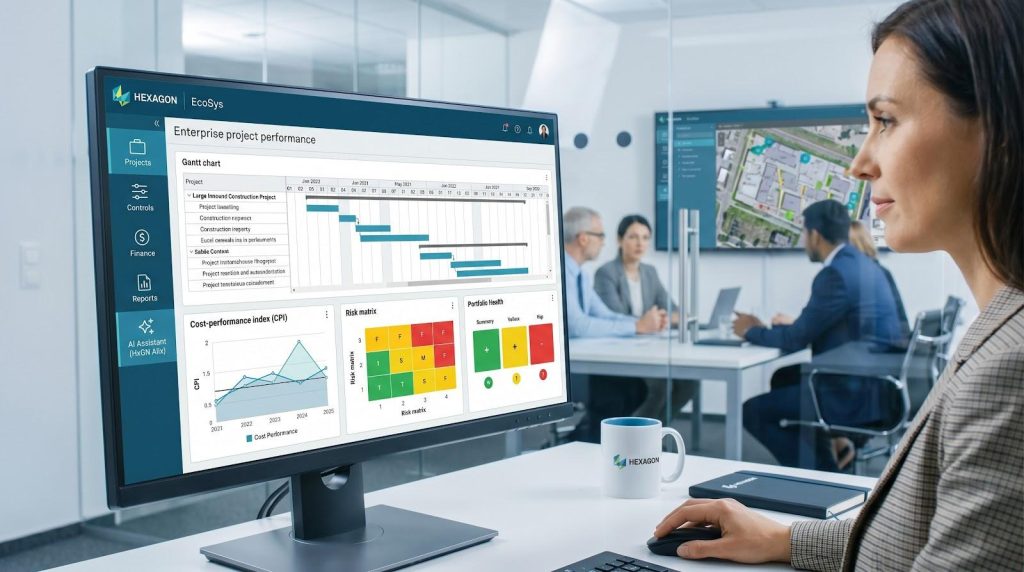
Hexagon EcoSys portfolio governance cockpit screenshot.
While most project tools live in the trenches, EcoSys rises above individual builds and tracks the entire investment portfolio. Open its home screen and you see every capital project lined up like drill cores on a rack, each coloured by stage-gate status, cost variance, and cash-flow curve. One glance tells the CFO where tomorrow’s overruns will land.
The secret is deep integration. EcoSys draws actuals from SAP or Oracle overnight, matches them with Primavera schedules, and produces a fresh forecast by sunrise. That automatic link eliminates the weekly spreadsheet round-trip that still frustrates many PMOs.
Analytics are another draw. The platform ships with dashboards for portfolio health, scenario funding, and risk heat-maps. Add your carbon KPIs, and EcoSys rolls them up for board-level ESG reporting with zero manual chasing.
There is a catch. Implementation takes effort and money. DevOpsSchool’s 2025 review praises EcoSys for high total cost of ownership and longer onboarding time. You need a mature controls team and executive patience to realise full value.
If you manage multiple mines, or expansions scattered across continents, those trade-offs pay back quickly. EcoSys gives you a single cockpit to steer billions in spend, spot systemic risks early, and prove governance to regulators and investors.
Next up: Procore, the field-first platform that keeps construction crews humming even when the pit has no cell signal.
4. Procore: best for field-first collaboration
Procore lives where the rebar bends and the concrete cures.
Site teams open the mobile app, snap a photo of a mis-aligned conveyor pedestal, and tag an RFI before the dust settles. The engineer back in town replies on the same thread, sketching the fix straight onto the drawing. No calls, no email chains, no guesswork.

Procore field collaboration and RFI mobile app screenshot.
That simplicity explains Procore’s strong following among contractors. Unlimited user licensing means you can invite every subcontractor, fabricator, and consultant without counting seats, so information flows freely instead of bottlenecking behind paywalls.
Financials are solid for day-to-day control. Budgets, commitments, and change orders sit in one register. When a piping subcontractor submits a variation, the cost impact updates instantly and the owner sees the delta before approving. Procore will not run full earned-value forecasts, but for construction spend it keeps everyone honest.
Scheduling is the weak spot; most mining builders still link a Primavera plan rather than rely on Procore’s native Gantt. DevOpsSchool also notes that licence fees rise with project volume, so multi-mine owners may feel the pinch over time.
Yet for boots-on-ground execution, speed wins. One EPCM on a South American process-plant expansion shaved two days off its RFI turnaround simply by moving from email to Procore tasks. Multiply that across thousands of field queries and the schedule gain is real.
Conclusion
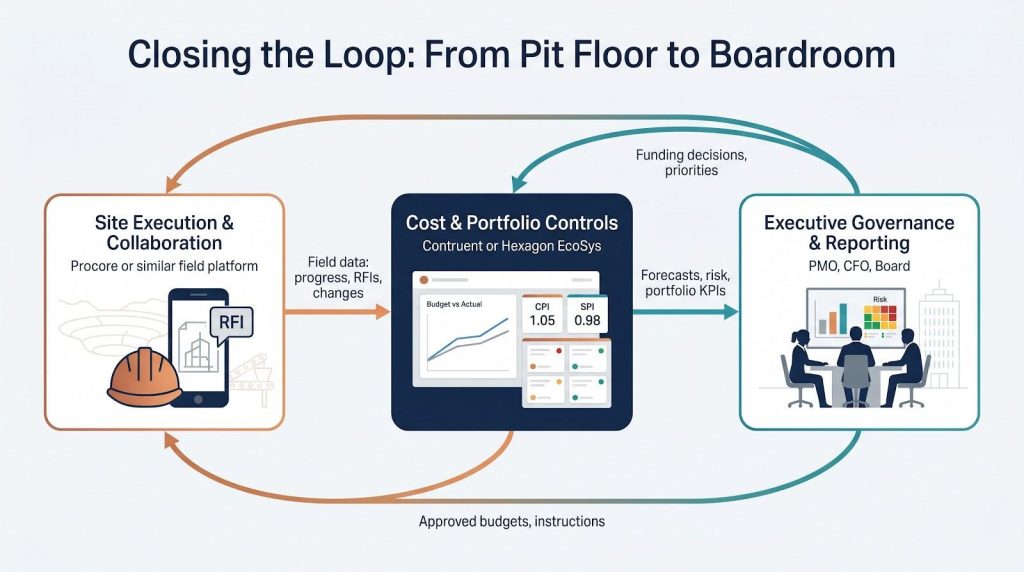
Pair Procore with a heavy-duty cost engine like Contruent or EcoSys, and you cover both ends of the control spectrum: rich site data feeding a rigorous finance backbone. That blend closes the loop between the pit floor and the boardroom, a loop many mining projects still lack.

I’m Rajesh Kumar, a DevOps, SRE, DevSecOps, Cloud, and Platform Engineering expert passionate about sharing practical knowledge, real-world experiences, and industry best practices. I have worked at Cotocus and regularly write about technology, travel, investing, health, product reviews, and digital marketing through my various platforms.
I publish technical articles at DevOps School, travel stories at Holiday Landmark, stock market insights at Stocks Mantra, health and fitness guidance at My Medic Plus, product reviews at TrueReviewNow, and SEO and digital marketing strategies at Wizbrand.
Find Trusted Cardiac Hospitals
Compare heart hospitals by city and services — all in one place.
Explore Hospitals
Very informative and practical guide for anyone in the mining industry.