
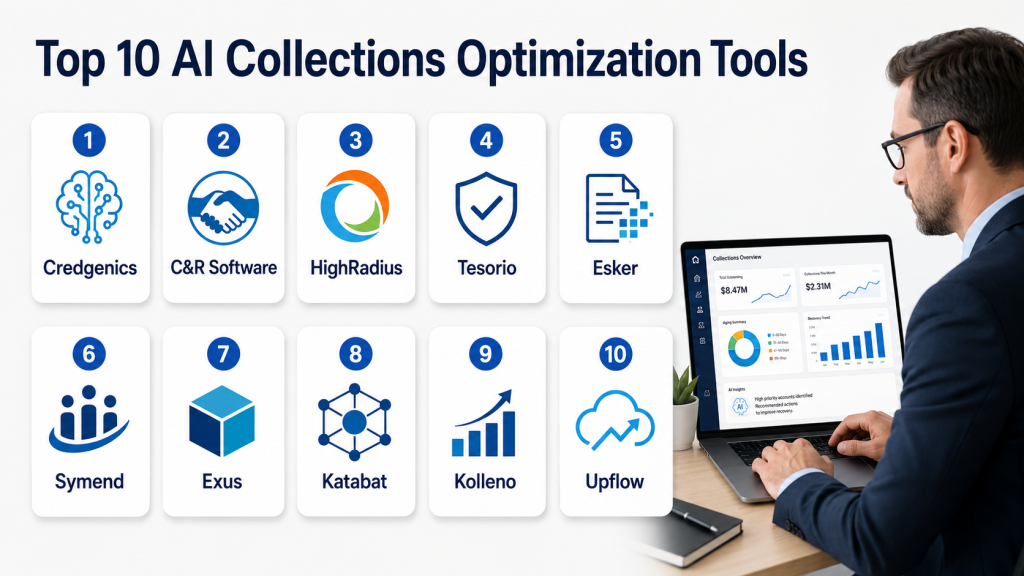
AI Collections Optimization Tools help lenders, banks, fintech companies, NBFCs, telecom providers, utility companies, subscription businesses, and accounts receivable teams improve how they recover overdue payments. These platforms use AI, machine learning, automation, behavioral analytics, digital communication, segmentation, and workflow intelligence to decide which accounts to prioritize, when to contact customers, which channel to use, what message to send, and when to escalate to a human agent.
Unlike basic debt collection software, AI collections optimization tools focus on smarter recovery strategy. They help teams reduce manual effort, improve customer engagement, lower collection costs, increase recovery rates, and maintain compliance. A good platform does not simply push more reminders. It helps organizations communicate responsibly, personalize repayment journeys, and protect customer relationships while improving cash flow.
Introduction
AI Collections Optimization Tools are software platforms that help organizations manage overdue accounts using data-driven decisioning, automation, communication workflows, and predictive analytics. They analyze customer behavior, payment history, account risk, communication response patterns, promise-to-pay behavior, delinquency stage, and repayment likelihood to recommend the best collection action.
Why It Matters
Collections is no longer only about calling customers repeatedly or sending standard payment reminders. Modern customers expect digital, respectful, personalized, and convenient repayment experiences. At the same time, lenders and finance teams need to reduce defaults, manage delinquency, improve cash flow, lower operational costs, and stay compliant with contact rules and consumer protection expectations.
AI collections optimization matters because it helps organizations decide where to focus effort. Instead of treating all overdue accounts the same, these tools can segment customers by risk, likelihood to pay, preferred channel, hardship signals, and required intervention. This makes collections more efficient, more customer-friendly, and more measurable.
Real World Use Cases
- Prioritizing overdue accounts by repayment probability
- Automating payment reminders through email, SMS, WhatsApp, voice, and digital channels
- Predicting which customers need early intervention
- Creating personalized repayment plans
- Routing high-risk cases to human collectors
- Optimizing call timing and communication frequency
- Reducing manual follow-up work for collections teams
- Managing promise-to-pay tracking and broken promises
- Supporting hardship, restructuring, and settlement workflows
- Improving accounts receivable collections for B2B teams
- Monitoring field collections and agency performance
- Reducing collection cost per recovered amount
- Supporting compliance with communication rules and audit trails
- Improving borrower experience during delinquency management
Evaluation Criteria for Buyers
- Accuracy of repayment prediction and account prioritization
- Ability to segment accounts by risk, balance, stage, and behavior
- Omnichannel communication support
- Personalization of messages, repayment plans, and workflows
- Integration with loan management, billing, CRM, ERP, and payment systems
- Support for human review, collector assignment, and escalation
- Compliance controls for contact timing, disclosures, and auditability
- Reporting on recovery rate, roll rates, cure rates, and promise-to-pay outcomes
- AI model transparency and explainability
- Workflow automation and rule configuration
- Field collections and agency management support where needed
- Data privacy, consent, and retention controls
- Ease of implementation and user adoption
- Cost scalability across account volume
- Vendor support and regional compliance fit
Best for
AI Collections Optimization Tools are best for banks, NBFCs, fintech lenders, credit unions, telecom companies, utility providers, subscription businesses, insurance companies, B2B finance teams, accounts receivable teams, and collection agencies that manage large volumes of overdue accounts. They are especially useful for collections heads, risk leaders, finance managers, operations teams, customer support teams, compliance teams, and digital transformation leaders.
Not ideal for
These tools may not be ideal for very small businesses with only a few overdue invoices, teams that only need simple payment reminders, or organizations without enough account volume to justify automation. In such cases, a basic invoicing tool, CRM reminder workflow, or manual follow-up process may be enough.
What’s Changed in AI Collections Optimization Tools
- Collections is moving from manual calling to data-driven digital engagement.
- AI is helping teams prioritize accounts based on repayment likelihood.
- More platforms now support omnichannel outreach across email, SMS, voice, WhatsApp, chat, and self-service portals.
- Personalized repayment plans are becoming more common than generic reminders.
- Compliance monitoring is becoming a major requirement for regulated lenders.
- Conversational AI and voice bots are being used for routine payment reminders and self-service.
- Human collectors are increasingly focused on complex, high-value, or hardship cases.
- Collections strategy is becoming more customer experience-driven.
- Predictive analytics is helping teams identify early delinquency risk before accounts worsen.
- Digital payment links and self-service options are improving collection convenience.
- Field collections and agency workflows are being connected to central dashboards.
- Reporting is shifting from activity tracking to recovery effectiveness and customer outcome tracking.
Quick Buyer Checklist
Use this checklist to shortlist AI Collections Optimization Tools quickly:
- Does the platform support your collection type such as loan, invoice, utility, telecom, or subscription?
- Can it prioritize accounts by repayment likelihood and delinquency risk?
- Does it support omnichannel communication?
- Can it personalize reminders, offers, and repayment plans?
- Does it integrate with your loan, billing, ERP, CRM, or payment system?
- Can it support human collector workflows and case assignment?
- Does it offer promise-to-pay tracking and broken promise alerts?
- Are audit logs and communication history available?
- Can it support compliance rules for timing, language, consent, and disclosures?
- Does it provide dashboards for recovery rate, roll rate, cure rate, and agent performance?
- Can it handle field collections or agency management if needed?
- Does it include self-service payment portals?
- Are data privacy and retention controls clearly documented?
- Can rules and workflows be configured by operations teams?
- Is pricing practical at your account volume?
Top 10 AI Collections Optimization Tools
1- Credgenics
One-line verdict: Best for lenders needing digital collections, AI prioritization, and end-to-end recovery workflows.
Short description:
Credgenics is a debt collections and resolution platform used by banks, NBFCs, fintech lenders, and financial institutions. It supports digital outreach, borrower engagement, litigation workflows, field collections, analytics, and AI-driven recovery optimization.
Standout Capabilities
- AI-driven collections strategy and account prioritization
- Digital borrower engagement across multiple channels
- End-to-end loan collections and resolution workflows
- Field collections and agency management support
- Legal and litigation workflow capabilities
- Payment tracking and settlement workflows
- Analytics for recovery performance and delinquency management
- Strong fit for lenders managing large overdue portfolios
AI-Specific Depth
- Model support: Proprietary AI and machine learning capabilities
- RAG and knowledge integration: Not applicable for standard collections optimization
- Evaluation: Recovery performance tracking and account outcome analysis vary by deployment
- Guardrails: Workflow rules, communication controls, escalation logic, and compliance workflows
- Observability: Dashboards for recovery outcomes, collector performance, account status, and workflow visibility
Pros
- Strong fit for banks, NBFCs, and fintech lenders
- Broad coverage across digital, field, and legal collections
- Useful for large-scale recovery operations
Cons
- May be more advanced than small businesses need
- Implementation may require process redesign
- Exact pricing is not publicly stated
Security & Compliance
Security and compliance details should be verified directly. Buyers should confirm SSO, RBAC, audit logs, encryption, data retention, consent management, regional compliance controls, and data residency. Certifications are not publicly stated here.
Deployment & Platforms
- Cloud-based platform
- Web-based operations dashboard
- API-based integrations
- Mobile support may be available for field workflows
- Self-hosted deployment is not publicly stated
Integrations & Ecosystem
Credgenics fits into lending, recovery, legal, payment, and customer communication workflows.
- Loan management systems
- Core banking systems
- Payment gateways
- CRM platforms
- Communication channels
- Field collections workflows
- Legal and settlement workflows
Pricing Model
Pricing is typically enterprise or contract-based. Exact pricing is not publicly stated.
Best-Fit Scenarios
- Banks and NBFCs managing high-volume delinquent portfolios
- Fintech lenders automating digital collections
- Organizations needing digital, field, and legal recovery workflows
2- C&R Software
One-line verdict: Best for enterprises needing mature collections management, strategy control, and recovery operations.
Short description:
C&R Software provides collections and recovery solutions for financial institutions, lenders, and enterprises managing complex delinquency portfolios. Its platform supports collections strategy, workflow automation, analytics, communication, and operational control.
Standout Capabilities
- Enterprise collections and recovery management
- Strategy design and workflow automation
- Support for complex account segmentation
- Collector work queues and case management
- Digital engagement and customer communication workflows
- Analytics for recovery and operations performance
- Strong fit for large financial services organizations
- Supports multi-stage delinquency management
AI-Specific Depth
- Model support: AI and analytics capabilities vary by module and implementation
- RAG and knowledge integration: Not applicable
- Evaluation: Strategy performance analytics and recovery outcome tracking vary
- Guardrails: Workflow rules, communication controls, policy checks, and auditability
- Observability: Collector dashboards, portfolio analytics, strategy performance, and workflow reporting
Pros
- Strong enterprise collections depth
- Useful for mature recovery operations
- Supports structured workflows and strategy management
Cons
- May be too complex for small teams
- Implementation can require operational planning
- Exact pricing is not publicly stated
Security & Compliance
Security controls should be verified directly. Buyers should confirm SSO, RBAC, audit logs, encryption, data retention, data residency, and industry-specific compliance requirements. Certifications are not publicly stated here.
Deployment & Platforms
- Cloud and enterprise deployment options may vary
- Web-based collections platform
- API and data integrations
- Self-hosted or hybrid availability should be verified
Integrations & Ecosystem
C&R Software connects collections teams with account data, communication systems, payment systems, and operational workflows.
- Core lending systems
- Payment systems
- CRM tools
- Contact center platforms
- Digital communication channels
- Data warehouses
- Recovery operations workflows
Pricing Model
Pricing is typically enterprise contract-based. Exact pricing is not publicly stated.
Best-Fit Scenarios
- Large lenders with complex recovery operations
- Financial institutions needing strategy-based collections
- Enterprises managing multi-stage delinquency workflows
3- HighRadius
One-line verdict: Best for B2B finance teams optimizing accounts receivable collections and cash flow.
Short description:
HighRadius provides finance automation solutions for accounts receivable, collections, cash application, credit, deductions, and treasury workflows. Its collections capabilities help finance teams prioritize overdue invoices, automate reminders, manage collector worklists, and improve cash flow visibility.
Standout Capabilities
- AI-enabled accounts receivable collections workflows
- Invoice prioritization and collector worklist automation
- Payment prediction and cash flow visibility
- Automated reminders and customer communication
- Dispute and deduction workflow support
- ERP integration for finance teams
- Strong fit for enterprise B2B collections
- Useful for reducing days sales outstanding
AI-Specific Depth
- Model support: Proprietary AI and automation capabilities across finance workflows
- RAG and knowledge integration: Not applicable for standard AR collections
- Evaluation: Collections outcome tracking and cash flow performance analytics vary
- Guardrails: Approval workflows, communication rules, and finance process controls
- Observability: Dashboards for cash flow, collector performance, invoice status, and collection effectiveness
Pros
- Strong fit for B2B accounts receivable teams
- Broad finance automation ecosystem
- Useful for invoice collections and cash forecasting
Cons
- Less focused on consumer loan collections
- May be broader than needed for simple AR follow-ups
- Exact pricing is not publicly stated
Security & Compliance
Security and compliance capabilities should be verified directly. Buyers should confirm SSO, RBAC, audit logs, encryption, retention, residency, and ERP data protection requirements. Certifications are not publicly stated here.
Deployment & Platforms
- Cloud-based platform
- Web-based finance operations interface
- API and ERP integrations
- Self-hosted deployment is not publicly stated
Integrations & Ecosystem
HighRadius integrates with enterprise finance, ERP, and accounts receivable workflows.
- ERP systems
- Accounts receivable systems
- Payment systems
- Customer portals
- Email workflows
- Credit and deduction workflows
- Cash forecasting systems
Pricing Model
Pricing is typically enterprise contract-based. Exact pricing is not publicly stated.
Best-Fit Scenarios
- Enterprise AR teams reducing overdue invoices
- Finance teams improving cash flow predictability
- B2B companies automating invoice collections
4- Tesorio
One-line verdict: Best for finance teams needing AI-assisted collections, cash forecasting, and AR prioritization.
Short description:
Tesorio helps finance and accounts receivable teams improve collections, cash flow forecasting, and customer payment follow-up. It is well suited for B2B companies that want to prioritize accounts, automate outreach, and improve visibility into expected cash.
Standout Capabilities
- Collections prioritization for accounts receivable teams
- Cash flow forecasting and payment prediction
- Automated customer reminders and follow-ups
- Collector task management and worklists
- Customer payment behavior insights
- Useful dashboards for finance leaders
- Integrations with accounting and ERP systems
- Strong fit for B2B SaaS and finance teams
AI-Specific Depth
- Model support: AI and predictive analytics capabilities vary by module
- RAG and knowledge integration: Not applicable for standard AR collections
- Evaluation: Forecast accuracy and collections performance tracking vary
- Guardrails: Workflow rules, communication templates, and approval controls
- Observability: Cash forecast dashboards, collector activity, invoice status, and account-level insights
Pros
- Strong fit for B2B accounts receivable workflows
- Helps prioritize collections work intelligently
- Useful for cash forecasting and payment visibility
Cons
- Less suited for consumer debt collection
- Depends on quality of ERP and invoice data
- Exact pricing is not publicly stated
Security & Compliance
Security controls should be verified directly. Buyers should confirm SSO, RBAC, audit logs, encryption, data retention, and finance data protection requirements. Certifications are not publicly stated here.
Deployment & Platforms
- Cloud-based platform
- Web-based finance dashboard
- API and accounting integrations
- Self-hosted deployment is not publicly stated
Integrations & Ecosystem
Tesorio fits into AR, finance operations, accounting, and cash management workflows.
- ERP systems
- Accounting platforms
- CRM systems
- Email systems
- Payment workflows
- Customer account data
- Cash forecasting workflows
Pricing Model
Pricing is typically subscription or contract-based. Exact pricing is not publicly stated.
Best-Fit Scenarios
- B2B SaaS companies managing invoice collections
- Finance teams needing better cash forecasting
- AR teams wanting smarter collector prioritization
5- Esker
One-line verdict: Best for finance teams automating collections within broader order-to-cash workflows.
Short description:
Esker provides automation solutions for finance and customer service workflows, including order-to-cash and accounts receivable processes. Its collections capabilities help businesses automate customer reminders, prioritize overdue accounts, and improve AR team productivity.
Standout Capabilities
- Accounts receivable collections automation
- Order-to-cash workflow support
- AI-assisted invoice and customer prioritization
- Automated reminders and communication workflows
- Dispute and deduction process support
- Collector task management
- ERP and finance system integrations
- Strong fit for mid-market and enterprise finance teams
AI-Specific Depth
- Model support: Proprietary AI capabilities across finance automation workflows
- RAG and knowledge integration: Not applicable for standard collections workflows
- Evaluation: Collections productivity and AR performance tracking vary
- Guardrails: Workflow controls, approval logic, and communication rules
- Observability: Dashboards for AR performance, collections status, overdue invoices, and team activity
Pros
- Strong order-to-cash automation ecosystem
- Good fit for finance process automation
- Helps reduce manual AR follow-up work
Cons
- Less focused on loan collections
- May be broader than needed for simple payment reminders
- Exact pricing is not publicly stated
Security & Compliance
Security and compliance capabilities should be verified directly. Buyers should confirm SSO, RBAC, audit logs, encryption, data retention, residency, and finance process controls. Certifications are not publicly stated here.
Deployment & Platforms
- Cloud-based platform
- Web-based finance operations interface
- API and ERP integrations
- Self-hosted deployment is not publicly stated
Integrations & Ecosystem
Esker integrates with finance, ERP, customer communication, and order-to-cash systems.
- ERP systems
- Accounts receivable workflows
- Customer communication systems
- Dispute workflows
- Payment workflows
- Document processing
- Finance dashboards
Pricing Model
Pricing is typically subscription or enterprise contract-based. Exact pricing is not publicly stated.
Best-Fit Scenarios
- Finance teams automating order-to-cash collections
- Enterprises reducing manual AR effort
- Companies needing invoice, dispute, and collections workflows together
6- Symend
One-line verdict: Best for enterprises improving customer engagement and digital collections communication.
Short description:
Symend focuses on digital customer engagement for collections and past-due customer journeys. It helps organizations use behavioral science, analytics, and personalized outreach to improve repayment engagement while reducing pressure on call centers.
Standout Capabilities
- Digital engagement for past-due customers
- Behavioral science-based communication strategies
- Personalized outreach journeys
- Customer self-service support
- Reduction of manual call center pressure
- Useful for telecom, utilities, financial services, and subscription businesses
- Supports customer-friendly collections experiences
- Focus on engagement and retention alongside recovery
AI-Specific Depth
- Model support: Analytics and personalization capabilities vary by deployment
- RAG and knowledge integration: Not applicable
- Evaluation: Engagement and repayment outcome measurement vary
- Guardrails: Communication rules, customer journey controls, and compliance workflows
- Observability: Customer engagement analytics, repayment behavior, campaign performance, and workflow reporting
Pros
- Strong focus on customer experience in collections
- Useful for reducing call center burden
- Good fit for large consumer portfolios
Cons
- Less focused on legal or field collections
- May need integration with existing billing or collections systems
- Exact pricing is not publicly stated
Security & Compliance
Security controls should be verified directly. Buyers should confirm SSO, RBAC, audit logs, encryption, consent controls, retention, data residency, and communication compliance requirements. Certifications are not publicly stated here.
Deployment & Platforms
- Cloud-based platform
- Digital engagement workflows
- Web-based operations access may vary
- Self-hosted deployment is not publicly stated
Integrations & Ecosystem
Symend fits into customer engagement, billing, collections, and contact center ecosystems.
- Billing systems
- CRM platforms
- Digital communication channels
- Payment systems
- Contact center workflows
- Customer data platforms
- Analytics dashboards
Pricing Model
Pricing is typically enterprise contract-based. Exact pricing is not publicly stated.
Best-Fit Scenarios
- Telecom and utility companies managing past-due customers
- Financial services firms reducing call center pressure
- Enterprises improving customer-friendly recovery journeys
7- Exus
One-line verdict: Best for financial institutions needing structured collections and recoveries management.
Short description:
Exus provides collections and recoveries software for banks, financial institutions, and lending organizations. Its platform supports delinquency management, recovery workflows, strategy execution, customer communication, and operational analytics.
Standout Capabilities
- Collections and recoveries lifecycle management
- Strategy execution and work queue management
- Customer communication and follow-up workflows
- Support for different delinquency stages
- Analytics for recovery and operational performance
- Useful for banks and financial institutions
- Case management and collector productivity support
- Structured approach to debt recovery operations
AI-Specific Depth
- Model support: Analytics and automation capabilities vary by module
- RAG and knowledge integration: Not applicable
- Evaluation: Recovery strategy performance tracking varies
- Guardrails: Policy rules, workflow controls, escalation logic, and audit trails
- Observability: Collections dashboards, account status, team activity, and recovery reporting
Pros
- Strong collections and recoveries domain focus
- Useful for financial institutions with structured workflows
- Supports operational control across delinquency stages
Cons
- AI depth should be verified for specific use cases
- May be more suitable for established collections teams
- Exact pricing is not publicly stated
Security & Compliance
Security and compliance features should be verified directly. Buyers should confirm SSO, RBAC, audit logs, encryption, retention, residency, and financial services compliance requirements. Certifications are not publicly stated here.
Deployment & Platforms
- Cloud and enterprise deployment options may vary
- Web-based collections platform
- API and system integrations
- Self-hosted availability should be verified
Integrations & Ecosystem
Exus connects with lending, recovery, payment, and customer communication systems.
- Core banking systems
- Loan management systems
- Payment systems
- CRM tools
- Contact center workflows
- Data reporting systems
- Recovery agency workflows
Pricing Model
Pricing is typically enterprise contract-based. Exact pricing is not publicly stated.
Best-Fit Scenarios
- Banks managing delinquency workflows
- Financial institutions needing recoveries management
- Lenders organizing collector work queues and case flows
8- Katabat
One-line verdict: Best for enterprises needing customer engagement, collections workflows, and digital recovery journeys.
Short description:
Katabat provides customer engagement and collections workflow solutions for financial services and other consumer-facing businesses. It helps organizations manage digital outreach, collections strategies, repayment workflows, and customer communication across channels.
Standout Capabilities
- Digital collections and customer engagement workflows
- Customer segmentation and campaign management
- Payment reminder and repayment journey support
- Workflow automation for delinquent accounts
- Useful for financial services and consumer businesses
- Customer communication across digital channels
- Reporting for engagement and recovery outcomes
- Supports operational efficiency in collections teams
AI-Specific Depth
- Model support: Analytics and automation capabilities vary by implementation
- RAG and knowledge integration: Not applicable
- Evaluation: Campaign performance and recovery outcome analytics vary
- Guardrails: Contact strategy controls, workflow rules, and compliance workflows
- Observability: Communication performance, repayment outcomes, and workflow reporting
Pros
- Strong digital engagement orientation
- Useful for customer-friendly repayment workflows
- Helps standardize collections communication
Cons
- AI depth should be verified during evaluation
- May need integration with core collections or billing systems
- Pricing is not publicly stated
Security & Compliance
Security controls should be verified directly. Buyers should confirm SSO, RBAC, audit logs, encryption, consent controls, retention, residency, and communication compliance support. Certifications are not publicly stated here.
Deployment & Platforms
- Cloud-based platform
- Web-based operations access
- API and system integrations
- Self-hosted deployment is not publicly stated
Integrations & Ecosystem
Katabat fits into collections, billing, CRM, payment, and customer communication workflows.
- Billing systems
- CRM platforms
- Payment gateways
- Digital messaging channels
- Contact center workflows
- Customer data systems
- Recovery workflows
Pricing Model
Pricing is typically enterprise contract-based. Exact pricing is not publicly stated.
Best-Fit Scenarios
- Financial services firms digitizing collections
- Enterprises needing repayment engagement workflows
- Teams improving customer communication during delinquency
9- Kolleno
One-line verdict: Best for businesses needing modern accounts receivable collections automation and customer follow-up.
Short description:
Kolleno is an accounts receivable and collections platform that helps businesses automate invoice follow-ups, customer communication, payment tracking, and AR workflows. It is useful for finance teams that want better visibility and automation for overdue invoices.
Standout Capabilities
- Accounts receivable collections automation
- Invoice-level and customer-level workflows
- Automated reminders and payment follow-ups
- Customer communication tracking
- Payment reconciliation support varies
- Useful dashboards for finance teams
- Helps reduce manual collection tasks
- Strong fit for growing B2B companies
AI-Specific Depth
- Model support: Automation and AI capabilities vary by product scope
- RAG and knowledge integration: Not applicable
- Evaluation: Collections workflow performance tracking varies
- Guardrails: Communication templates, workflow rules, and user permissions
- Observability: Invoice status, customer communication history, overdue account dashboards, and collection activity
Pros
- Simple fit for AR collections teams
- Useful for automating routine reminders
- Helps centralize overdue invoice follow-up
Cons
- Less suited for regulated loan collections
- AI depth should be verified for advanced optimization needs
- Exact pricing depends on package and usage
Security & Compliance
Security capabilities should be verified directly. Buyers should confirm SSO, RBAC, audit logs, encryption, data retention, and finance data controls. Certifications are not publicly stated here.
Deployment & Platforms
- Cloud-based platform
- Web-based AR interface
- API and finance integrations may vary
- Self-hosted deployment is not publicly stated
Integrations & Ecosystem
Kolleno fits into finance, AR, customer communication, and payment follow-up workflows.
- Accounting systems
- ERP platforms
- Email workflows
- Payment systems
- Customer records
- Invoice management
- Finance dashboards
Pricing Model
Pricing is typically subscription-based or tiered. Exact pricing should be verified.
Best-Fit Scenarios
- B2B companies automating invoice follow-ups
- Finance teams reducing manual AR collections work
- Growing businesses needing better overdue invoice visibility
10- Upflow
One-line verdict: Best for B2B companies managing customer collections, payment follow-up, and AR visibility.
Short description:
Upflow helps B2B companies manage accounts receivable collections, customer reminders, payment follow-up, and cash visibility. It is useful for SaaS companies, service businesses, and finance teams that want a cleaner collections workflow without building a complex internal system.
Standout Capabilities
- AR collections workflow management
- Customer payment reminders
- Overdue invoice visibility
- Team collaboration for finance operations
- Customer communication history
- Payment follow-up automation
- Useful for SaaS and B2B companies
- Helps improve cash collection discipline
AI-Specific Depth
- Model support: AI capabilities are not publicly stated in detail
- RAG and knowledge integration: Not applicable
- Evaluation: Collections performance reporting varies
- Guardrails: Communication workflows, user roles, and process controls vary
- Observability: Invoice dashboards, payment follow-up status, customer activity, and collection performance insights
Pros
- Easy fit for B2B AR workflows
- Helps organize customer payment follow-up
- Useful for finance teams seeking better cash visibility
Cons
- Not designed for consumer debt recovery
- Advanced AI optimization depth should be verified
- May not cover legal, field, or regulated collections needs
Security & Compliance
Security details should be verified directly. Buyers should confirm SSO, RBAC, audit logs, encryption, retention, and finance data protection requirements. Certifications are not publicly stated here.
Deployment & Platforms
- Cloud-based platform
- Web-based finance interface
- Accounting and finance integrations
- Self-hosted deployment is not publicly stated
Integrations & Ecosystem
Upflow fits into B2B accounts receivable, customer communication, and finance workflows.
- Accounting systems
- ERP tools
- CRM platforms
- Payment workflows
- Customer communication channels
- Invoice management systems
- Finance dashboards
Pricing Model
Pricing is typically subscription-based or tiered. Exact pricing should be verified.
Best-Fit Scenarios
- SaaS companies improving invoice collections
- B2B finance teams organizing payment follow-up
- Companies needing AR visibility and customer reminders
Comparison Table
| Tool Name | Best For | Deployment | Model Flexibility | Strength | Watch-Out | Public Rating |
|---|---|---|---|---|---|---|
| Credgenics | Lender collections and recovery | Cloud | Proprietary AI and workflows | End-to-end recovery depth | May be advanced for small teams | N/A |
| C&R Software | Enterprise collections operations | Cloud or varies | AI and analytics vary | Mature strategy management | Implementation planning needed | N/A |
| HighRadius | B2B AR collections | Cloud | Proprietary AI and automation | Order-to-cash depth | Less consumer debt focused | N/A |
| Tesorio | AR prioritization and cash forecasting | Cloud | Predictive analytics vary | Cash visibility | Depends on invoice data quality | N/A |
| Esker | Finance collections automation | Cloud | Proprietary AI capabilities | AR and O2C automation | Broader than simple collections | N/A |
| Symend | Digital customer engagement | Cloud | Analytics and personalization vary | Customer-friendly outreach | Less legal or field focus | N/A |
| Exus | Financial collections and recoveries | Cloud or varies | Analytics varies | Structured recovery workflows | AI depth should be verified | N/A |
| Katabat | Digital collections engagement | Cloud | Analytics varies | Communication workflows | Requires core system integration | N/A |
| Kolleno | AR collections automation | Cloud | Automation and AI vary | Simple AR workflow automation | Not for regulated loan recovery | N/A |
| Upflow | B2B payment follow-up | Cloud | AI depth not publicly stated | AR visibility | Limited debt recovery depth | N/A |
Scoring and Evaluation
The scoring below is a comparative editorial rubric, not a lab benchmark or public rating. Scores reflect collections optimization fit, AI and analytics depth, workflow automation, integration value, compliance support, ease of use, reporting, and practical usefulness for recovery teams. Final selection should depend on account volume, collection type, regulatory environment, customer segment, and internal operations maturity.
| Tool | Core | Reliability and Eval | Guardrails | Integrations | Ease | Performance and Cost | Security and Admin | Support | Weighted Total |
|---|---|---|---|---|---|---|---|---|---|
| Credgenics | 9 | 8 | 8 | 8 | 7 | 8 | 8 | 8 | 8.15 |
| C&R Software | 9 | 8 | 8 | 8 | 6 | 8 | 8 | 8 | 8.00 |
| HighRadius | 9 | 8 | 8 | 9 | 7 | 8 | 8 | 8 | 8.25 |
| Tesorio | 8 | 8 | 7 | 8 | 8 | 8 | 7 | 8 | 7.75 |
| Esker | 8 | 8 | 8 | 8 | 8 | 8 | 8 | 8 | 8.00 |
| Symend | 8 | 8 | 8 | 8 | 7 | 8 | 8 | 7 | 7.85 |
| Exus | 8 | 7 | 8 | 8 | 7 | 7 | 8 | 7 | 7.55 |
| Katabat | 8 | 7 | 8 | 7 | 7 | 7 | 8 | 7 | 7.40 |
| Kolleno | 7 | 7 | 7 | 7 | 8 | 8 | 7 | 7 | 7.20 |
| Upflow | 7 | 7 | 7 | 7 | 8 | 8 | 7 | 7 | 7.20 |
Top 3 for Enterprise
- HighRadius
- Credgenics
- C&R Software
Top 3 for SMB
- Tesorio
- Kolleno
- Upflow
Top 3 for Developers
- Credgenics
- Tesorio
- HighRadius
Which AI Collections Optimization Tool Is Right for You
Solo or Freelancer
Solo professionals usually do not need a dedicated AI collections optimization tool unless they manage recurring invoices or many overdue customer accounts. A basic accounting platform, reminder workflow, or payment link system may be enough. If invoice volume grows, a lightweight AR collections tool such as Upflow or Kolleno can help organize payment follow-up.
SMB
Small and mid-sized businesses should focus on ease of use, invoice visibility, automated reminders, and simple customer communication. Tesorio, Kolleno, and Upflow are good fits for B2B companies that want better cash visibility without a heavy enterprise implementation. For lending-focused SMBs, Credgenics or a similar loan collections platform may be more relevant.
Mid-Market
Mid-market organizations usually need stronger workflow control, segmentation, reporting, and integrations. HighRadius and Esker are strong for AR and order-to-cash automation. Credgenics and Exus are better suited for lenders managing delinquency portfolios. Symend and Katabat are useful when digital customer engagement and communication strategy are central.
Enterprise
Enterprise buyers should prioritize scalability, compliance, audit trails, data integrations, strategy management, role-based access, and operational reporting. HighRadius is strong for enterprise AR collections. Credgenics is strong for lender recovery workflows. C&R Software fits mature collections operations. Symend supports large-scale digital customer engagement.
Regulated Industries
Banks, NBFCs, credit unions, telecom providers, utility companies, and financial institutions should prioritize compliance controls, audit trails, consent management, contact strategy controls, escalation workflows, and data protection. Credgenics, C&R Software, Exus, Symend, and Katabat are stronger fits for regulated recovery environments than lightweight AR tools.
Budget vs Premium
Budget-conscious teams should start with invoice reminders, simple workflows, and AR visibility tools. Upflow and Kolleno are practical for smaller B2B teams. Premium buyers should evaluate HighRadius, Credgenics, C&R Software, Esker, or Symend when account volume, compliance risk, recovery complexity, and operational scale justify a larger investment.
Build vs Buy
Build internally when you have strong engineering, data science, compliance knowledge, communication infrastructure, payment systems, and collections operations expertise. Buy when you need faster deployment, proven workflows, omnichannel communication, recovery analytics, compliance controls, and vendor support. Many mature organizations use a hybrid approach by combining vendor workflows with internal models and business rules.
Implementation Playbook
First Phase: Pilot and Success Metrics
- Define the collection type such as consumer loans, business invoices, telecom bills, utility payments, or subscription dues.
- Choose one portfolio or customer segment for the pilot.
- Run the platform alongside current collections workflows before replacing existing processes.
- Capture baseline metrics such as recovery rate, roll rate, cure rate, days sales outstanding, manual effort, agent productivity, and cost per recovery.
- Map required data sources such as account balance, due date, payment history, communication history, customer profile, promise-to-pay status, and risk category.
- Define collection actions such as reminder, digital outreach, call, self-service payment, settlement, restructuring, field visit, or escalation.
- Create communication templates with approved language.
- Confirm privacy, consent, contact timing, and audit requirements before production rollout.
Second Phase: Security, Evaluation, and Rollout
- Integrate the platform with billing, loan management, ERP, CRM, payment, and communication systems.
- Add role-based access for collectors, supervisors, finance users, compliance teams, and administrators.
- Create account segmentation rules based on delinquency stage, amount due, risk level, and repayment probability.
- Set up digital outreach journeys and self-service payment options.
- Add feedback loops from payments, broken promises, disputes, settlements, and customer responses.
- Review compliance controls for contact rules, consent, disclosures, and escalation workflows.
- Train collections teams on dashboards, work queues, and recommended actions.
- Test workflows on a limited portfolio before scaling.
Third Phase: Optimization and Scale
- Monitor recovery rate, customer response rate, cure rate, roll rate, agent productivity, and cost per recovery.
- Tune outreach timing, channel selection, message personalization, and escalation triggers.
- Expand automation to more delinquency stages and customer segments.
- Add dashboards for team leaders, finance leaders, and compliance reviewers.
- Compare AI recommendations against collector outcomes.
- Review workflow performance by channel and customer segment.
- Optimize field collections, agency allocation, and legal escalation where relevant.
- Schedule regular governance reviews for templates, policies, models, and contact strategies.
Common Mistakes and How to Avoid Them
- Treating all overdue accounts the same
- Using aggressive outreach without customer segmentation
- Ignoring customer experience during collections
- Over-automating sensitive or hardship cases
- Not tracking promise-to-pay outcomes
- Forgetting compliance controls for contact timing and consent
- Sending reminders without payment links or self-service options
- Not integrating with billing, loan, or payment systems
- Measuring only recovered amount and ignoring cost per recovery
- Not monitoring broken promises and repeat delinquency
- Using outdated communication templates
- Ignoring agent performance and workload balancing
- Failing to separate early delinquency from late-stage recovery
- Not reviewing AI recommendations against real outcomes
- Choosing a platform without checking regional compliance needs
FAQs
1- What is an AI Collections Optimization Tool?
An AI Collections Optimization Tool is a platform that helps organizations prioritize overdue accounts, automate outreach, personalize repayment workflows, and improve recovery decisions using analytics, automation, and machine learning.
2- How is it different from basic debt collection software?
Basic debt collection software mainly tracks overdue accounts and follow-ups. AI collections optimization tools go further by predicting repayment likelihood, recommending next actions, personalizing communication, and improving recovery strategy.
3- Can these tools improve recovery rates?
Yes, they can improve recovery by helping teams focus on the right accounts, use better timing, personalize outreach, and reduce manual delays. Results depend on data quality, workflow design, and customer segment.
4- Are these tools only for banks and lenders?
No. They are also useful for telecom companies, utility providers, subscription businesses, B2B finance teams, insurance companies, and any organization managing overdue payments at scale.
5- Do AI collections tools replace human collectors?
No. They reduce routine manual work and help prioritize accounts, but human collectors remain important for complex cases, hardship situations, disputes, settlements, and high-value accounts.
6- What data is used for collections optimization?
Common data includes account balance, due date, payment history, communication history, customer profile, risk score, delinquency stage, promise-to-pay status, transaction history, and previous response behavior.
7- Can these tools support omnichannel communication?
Yes, many tools support email, SMS, voice, WhatsApp, chat, portals, and contact center workflows. The exact channels depend on vendor capabilities and regional regulations.
8- What is promise-to-pay tracking?
Promise-to-pay tracking records when a customer agrees to pay by a certain date. The system then monitors whether the promise is fulfilled and triggers follow-up if the payment is missed.
9- Are AI collections tools safe for regulated industries?
They can be safe when implemented with compliance controls, audit logs, approved templates, consent management, contact timing rules, role-based access, and human oversight. Buyers should verify compliance fit before deployment.
10- How do these tools improve customer experience?
They reduce unnecessary calls, use preferred channels, offer self-service payment options, personalize messages, and route sensitive cases to the right team. This can make collections less stressful and more effective.
11- Can small businesses use AI collections tools?
Yes, but small businesses should choose lightweight AR collections tools rather than complex enterprise platforms. If overdue volume is low, simple reminders and payment links may be enough.
12- How should companies measure collections performance?
Key metrics include recovery rate, cure rate, roll rate, days sales outstanding, cost per recovery, agent productivity, customer response rate, payment plan completion, and repeat delinquency.
13- What is the biggest risk in collections automation?
The biggest risk is over-automation without compliance and empathy. Poorly designed automation can annoy customers, create complaints, violate contact rules, or escalate cases too quickly.
14- Should companies build or buy collections optimization software?
Companies should build only if they have strong engineering, analytics, compliance, communication, and recovery operations expertise. Most teams benefit from buying because vendors provide ready workflows, dashboards, integrations, and compliance controls.
Conclusion
AI Collections Optimization Tools help organizations recover overdue payments more efficiently while improving customer experience, compliance, and operational control. The best platform depends on your collection type, account volume, industry, communication strategy, regulatory needs, and existing systems. Credgenics is strong for lender collections and recovery workflows, C&R Software fits enterprise collections operations, HighRadius and Esker are strong for B2B accounts receivable automation, Tesorio supports AR prioritization and cash forecasting, Symend improves digital customer engagement, Exus supports structured financial recoveries, Katabat helps with digital collections journeys, Kolleno supports modern invoice follow-up, and Upflow is useful for B2B payment visibility. Start by defining your collections goals, pilot one segment, verify compliance and data controls, then scale gradually with better segmentation, automation, human review, and performance monitoring.

Find Trusted Cardiac Hospitals
Compare heart hospitals by city and services — all in one place.
Explore Hospitals
What’s missing here is the real-world constraint of compliance in collections optimization, where strategies must balance recovery efficiency with strict regulatory and fair-debt practices. Also not covered is how customer response behavior varies across channels and segments, making static optimization less effective in live environments.