
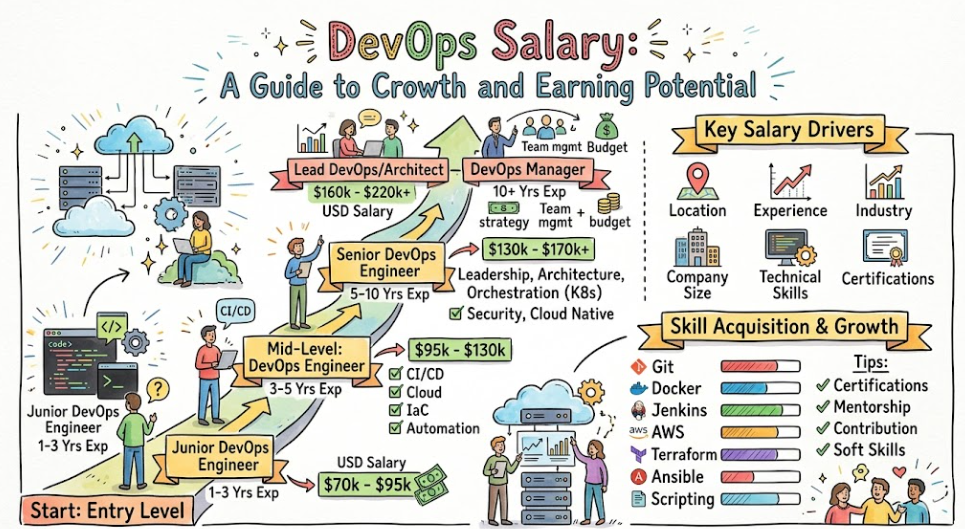
DevOps has established itself as one of the most rewarding career paths in the IT industry. As organizations shift their operations to the cloud and embrace automation, the demand for professionals who can bridge the gap between development and operations continues to rise globally. This growth is driven by the necessity for faster delivery, improved reliability, and scalable infrastructure.
Unlike many technical roles where certifications might be the primary focus, DevOps emphasizes a combination of skill, real-world application, and operational outcomes. This guide helps you navigate the landscape of DevOps salaries, understand how your technical expertise influences your compensation, and plan a career trajectory that aligns with industry demands.
Why DevOps Salaries Are High
The premium placed on DevOps professionals is a direct response to the complexity of modern digital ecosystems. Companies today are navigating massive transitions that require specialized talent. Key factors driving this salary growth include:
- Cloud Computing and Multi-Cloud Growth: As businesses move from on-premise hardware to cloud-native architectures, the need for engineers who can manage these complex landing zones is immense.
- Automation and Reliability: Organizations are prioritizing automation to reduce toil. Professionals who can build self-healing pipelines and robust monitoring systems are critical.
- Kubernetes and Containerization: The widespread adoption of container orchestration has made expertise in Kubernetes a baseline requirement for high-value engineering roles.
- Security and DevSecOps: With the increasing sophistication of cyber threats, embedding security into the CI/CD pipeline (DevSecOps) has become a top priority, often commanding a premium salary.
- Shortage of Skilled Professionals: The industry faces a gap between the number of available roles and professionals who can demonstrate proficiency in architecture, reliability, and cost engineering (FinOps).
Who Should Read This Guide
This guide is designed for individuals at various stages of their IT career who are interested in maximizing their earning potential within the DevOps domain:
- Freshers entering the job market.
- Developers looking to transition into DevOps or SRE roles.
- Linux Administrators seeking to upskill into cloud infrastructure.
- Cloud Engineers aiming to move into architecture and design.
- Automation and SRE Engineers focused on reliability and platform stability.
- DevSecOps Professionals building secure, automated pipelines.
DevOps Salary Overview
DevOps salary structures are generally divided into three main market segments: high-scale product organizations (often equity-heavy), large regulated enterprises (bonus-heavy), and service-based firms.
Compensation in this field typically tracks business risk. When your work is directly tied to revenue uptime, regulatory compliance, or cloud bill management, your earning potential increases significantly. While entry-level roles focus on executing specific tasks, the compensation ceiling rises as professionals move into ownership roles—designing systems, managing incidents, and strategizing platform adoption.
DevOps Salary by Experience Level
The career ladder in DevOps is defined by the scope of responsibility. As you move from executing tasks to designing cross-team architecture, your salary potential grows.
| Experience Level | Typical Roles | Skills Expected | Salary Growth Potential | Career Scope |
| Fresher | Junior DevOps Engineer | Linux, Git, Scripting | Baseline entry | Learning on-call and task execution |
| Mid-Level | DevOps Engineer | CI/CD, Terraform, AWS/Azure | Moderate | Independent project delivery |
| Senior | Senior DevOps Engineer | Kubernetes, Security, Architecture | High | Mentorship and complex design |
| Lead / Architect | Platform Engineer / Architect | Distributed Systems, FinOps | Very High | Org-wide technical strategy |
Highest Paying DevOps Roles
Different roles command different premiums based on the complexity and impact of the work.
| Role | Main Skills | Difficulty Level | Salary Potential | Career Demand |
| DevOps Engineer | CI/CD, Infra Automation | Moderate | Standard | High |
| SRE Engineer | SLOs, Incident Response | High | High | Very High |
| Platform Engineer | Internal Developer Platforms | High | High | Very High |
| DevSecOps Engineer | Security-as-Code | High | Very High | Growing |
| Cloud Architect | Multi-Cloud Design | Very High | Very High | High |
DevOps Salary by Skills
Your technical toolkit is a direct lever for salary negotiation. Professionals who can demonstrate “hard” skills are typically valued higher than those with general knowledge.
- Infrastructure as Code (Terraform): High demand for managing scale.
- Kubernetes: A premium skill for container orchestration and management.
- Cloud Platforms (AWS, Azure, Google Cloud): Expertise in landing zones and IAM patterns.
- DevSecOps: Knowledge of policy-as-code and pipeline security is increasingly rewarded.
- Observability: Ability to manage telemetry and logging architecture.
- FinOps: Understanding cost governance and capacity economics is becoming a valuable niche.
DevOps Salary by Certification
Certifications serve as a validation of your knowledge and can influence salary, provided they are backed by project experience.
| Certification | Best For | Career Level | Skills Covered | Salary Impact |
| Cloud Associate | Entry/Mid | Beginners | Cloud Fundamentals | Moderate |
| Kubernetes Certified | Mid/Senior | Technical | Containers/Orchestration | High |
| Security Professional | Advanced | Specialized | DevSecOps/Compliance | High |
| Platform Architect | Senior | Architecture | Systems Design | Very High |
DevOps Salary by Country or Region
Salaries vary significantly based on the local market and currency. For example, roles in the United States and Switzerland often see higher base salaries compared to other regions. It is essential to consider the cost of living and local market demands when evaluating salary data. The global market is currently bifurcating: top companies pay for high-scarcity skill profiles, while mid-market firms maintain stricter geographical pay bands.
DevOps Salary by Company Type
The type of organization you work for fundamentally changes your compensation and learning experience:
- Startups: Often offer broad learning exposure and faster career growth.
- Product Companies: Frequently provide competitive base salaries and additional equity compensation.
- MNCs/Enterprises: Usually offer stability, structured bonus programs, and standardized career ladders.
- Service-based Companies: Compensation is often determined by client rate-cards and project billability.
Factors That Affect DevOps Salary
Your base salary is rarely just about years of tenure; it is about the value you bring to the business. Key factors include:
- Operational Outcomes: Tying your work to SLOs, reliability metrics, and cost reduction.
- Ownership: Moving from simply responding to alerts to owning the reliability of a platform.
- Communication: The ability to translate technical complexity into business value.
- Multi-Cloud Expertise: Being comfortable across different cloud providers.
- Leadership: The ability to mentor others and drive technical standards across the organization.
Best Skills for High DevOps Salary
A structured approach to skill acquisition is the most reliable way to increase your market value.
- Beginner Path: Focus on mastering Linux, Git, basic networking, and shell scripting.
- Intermediate Path: Build proficiency in Docker, Jenkins, Terraform, and CI/CD pipeline construction.
- Advanced Path: Deepen expertise in Kubernetes, cloud architecture, GitOps workflows, observability, and DevSecOps.
Real-World Career Scenarios
- Fresher Starting DevOps: Focus on learning the basics of automation and infrastructure management. Your initial growth will come from proving your ability to handle tasks independently.
- Developer Moving Into DevOps: Your background in coding is a massive asset. Focus on applying your development knowledge to build robust pipelines and automated infrastructure.
- System Administrator Moving into Cloud: You have an advantage in understanding infrastructure. Upskill in cloud native tools and modern provisioning methods to bridge the gap.
- SRE/Platform Engineering: Focus on design reviews, error budgets, and platform adoption metrics. This is often where the highest compensation bands are found.
Common Mistakes That Reduce Salary Growth
Avoid these pitfalls to maintain a positive career trajectory:
- Learning tools in isolation without applying them to real-world projects.
- Ignoring the fundamentals (like Linux or Networking) in favor of flashy, high-level tools.
- Failing to connect your technical work to business outcomes (e.g., uptime, cost-efficiency).
- Neglecting to build a public portfolio (e.g., GitHub) that demonstrates your code and architecture.
- Avoiding communication and collaboration tasks, which are vital for senior roles.
Hands-On Projects to Increase Salary Opportunities
To truly stand out, you need to build things. Consider these projects:
- Build a full CI/CD pipeline from scratch.
- Deploy a high-availability application using Kubernetes.
- Automate infrastructure using Terraform.
- Implement a monitoring and alerting system for a cloud-hosted app.
- Create a secure DevSecOps pipeline with automated vulnerability scanning.
FAQs
Is DevOps a high-paying career?
Yes, DevOps is consistently ranked as a top-paying IT career due to the high demand for specialized skills in cloud and automation.
Which DevOps skill provides the highest salary?
Skills related to system architecture, security platform engineering, and reliable distributed systems (SRE) typically command the highest premiums.
Does certification increase salary?
Certifications validate your skills and can help in securing interviews, but they are most effective when coupled with hands-on experience and real-world project work.
Is Kubernetes good for salary growth?
Absolutely. Kubernetes expertise is a core requirement for many mid-to-senior level roles and is a major differentiator in compensation.
How long does it take to become a DevOps engineer?
It depends on your background, but a focused path of continuous learning and hands-on project work can prepare you for the field.
Final Recommendation
Your career in DevOps should be a journey of continuous learning. While certifications are helpful, they are not a substitute for hands-on experience. Focus on understanding the why behind the tools—how they impact reliability, cost, and developer experience. Prioritize cloud and Kubernetes skills, engage in real-world projects, and always seek to align your technical efforts with the success of the business.

Find Trusted Cardiac Hospitals
Compare heart hospitals by city and services — all in one place.
Explore Hospitals