
Introduction
AI Molecular Generation Tools are computational platforms that leverage artificial intelligence, deep learning, and graph neural networks to design novel molecules with desired chemical, biological, or pharmacological properties. These tools accelerate drug discovery, optimize compound properties, and allow exploration of chemical spaces beyond traditional methods.
This matters because conventional molecular design is slow, costly, and relies heavily on human intuition. AI molecular generation enables rapid identification of promising drug candidates, multi-objective optimization for potency, solubility, and toxicity, and prioritization for experimental validation. Pharmaceutical companies, biotech startups, and academic labs use these tools to reduce discovery timelines, improve lead quality, and integrate AI-guided predictions into experimental workflows.
Real-world use cases include:
- De novo design of small molecules for therapeutic targets
- Optimizing lead compounds for potency, solubility, and toxicity
- Exploring uncharted chemical space for rare or complex diseases
- Supporting virtual screening, docking simulations, and compound prioritization
- Retrosynthetic analysis and synthesis feasibility
- Drug repurposing and multi-target molecule design
Evaluation Criteria for Buyers:
- Accuracy of molecular property prediction
- Diversity, novelty, and drug-likeness of generated molecules
- Multi-objective optimization capabilities
- Integration with docking, virtual screening, and cheminformatics tools
- Ease of use and workflow flexibility
- Scalability for large chemical libraries
- Synthetic feasibility and retrosynthetic analysis
- Experimental validation support
- Data security and IP protection
- Deployment options: cloud, hybrid, or on-premise
- Vendor support and documentation
- Explainability and interpretability of AI models
Best for: Pharmaceutical R&D teams, biotech firms, and academic labs focused on early-stage drug discovery and compound optimization.
Not ideal for: Small-scale manual molecular design projects or teams without computational chemistry expertise.
What’s Changed in AI Molecular Generation Tools
- Deep generative models for de novo molecule design
- Graph neural networks for property prediction and molecular representation
- Multi-objective optimization incorporating potency, solubility, toxicity, and synthetic feasibility
- Explainable AI for interpretability and regulatory compliance
- Cloud-based high-throughput generation for large chemical libraries
- Integration with docking simulations, virtual screening, and cheminformatics pipelines
- AI-assisted retrosynthetic planning and synthesis feasibility scoring
- Improved observability and logging of workflows
- Multi-modal and target-specific constraints
- Collaboration features for multi-user teams
- Enhanced security, IP protection, and governance frameworks
- API-based modular pipelines for integration with existing workflows
Quick Buyer Checklist
- Verify AI model accuracy and prediction reliability
- Confirm multi-objective optimization support
- Evaluate integration with virtual screening, docking, and cheminformatics tools
- Check interpretability and explainable AI features
- Ensure scalability for high-throughput molecular generation
- Confirm synthetic feasibility scoring and retrosynthetic analysis
- Assess ease of use and workflow flexibility
- Validate data security, IP protection, and compliance
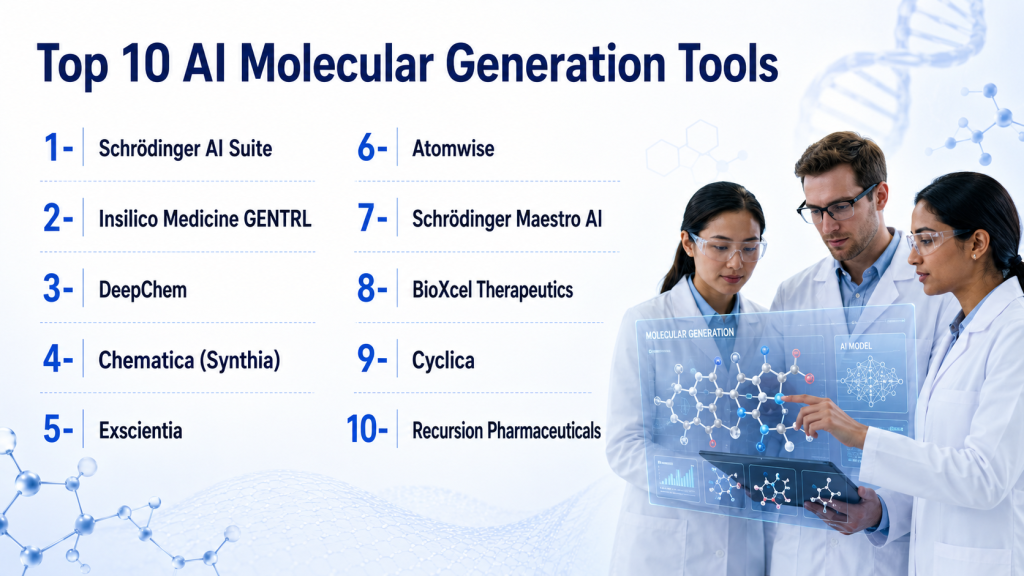
Top 10 AI Molecular Generation Tools
1- Schrödinger AI Suite
One-line verdict: Ideal for enterprise pharma teams seeking integrated AI-driven molecular design.
Short description: Schrödinger AI Suite generates and optimizes molecules with deep learning, integrates with docking and simulation pipelines, and supports multi-objective optimization for potency, solubility, and toxicity.
Standout Capabilities
- Deep learning-based molecule generation
- Multi-objective optimization
- High-throughput virtual screening
- Retrosynthetic feasibility scoring
- Docking and simulation integration
AI-Specific Depth
- Model support: Proprietary deep learning
- RAG / knowledge integration: Cheminformatics datasets
- Evaluation: Experimental benchmarking
- Guardrails: Chemical feasibility constraints
- Observability: Confidence metrics and optimization tracking
Pros
- Comprehensive chemical modeling integration
- Scalable for large libraries
- Multi-parameter optimization support
Cons
- Enterprise-focused and costly
- Requires domain expertise
- Cloud-dependent for high-throughput workflows
Security & Compliance
- Encryption, RBAC
- Certifications: Not publicly stated
Deployment & Platforms
- Cloud, Web
Integrations & Ecosystem
- APIs and SDKs for docking and chemical library workflows
Pricing Model
- Subscription-based enterprise licenses
- Not publicly stated
Best-Fit Scenarios
- Enterprise pharma R&D
- Lead optimization projects
- Multi-objective drug design
2- Insilico Medicine GENTRL
One-line verdict: Best for de novo molecule generation with multi-property optimization.
Short description: GENTRL leverages generative AI to design molecules for specific targets, predicting potency, solubility, and toxicity, enabling rapid exploration of chemical space and prioritization for experimental validation.
Standout Capabilities
- De novo molecular generation
- Multi-objective optimization
- Target-guided molecule prioritization
- Retrosynthetic feasibility scoring
- Integration with virtual screening datasets
AI-Specific Depth
- Model support: Proprietary generative AI
- RAG / knowledge integration: Bioactivity and chemical datasets
- Evaluation: Retrospective and experimental benchmarking
- Guardrails: Synthetic feasibility constraints
- Observability: Property and ranking metrics
Pros
- Explores novel chemical space
- Multi-objective optimization
- Prioritizes synthetically feasible molecules
Cons
- Requires integrated datasets
- Enterprise licensing cost
- Learning curve
Security & Compliance
- Encryption, access control
- Certifications: Not publicly stated
Deployment & Platforms
- Cloud, Web
Integrations & Ecosystem
- APIs for bioactivity and chemical datasets
- Integration with virtual screening and docking tools
Pricing Model
- Subscription-based enterprise licenses
- Not publicly stated
Best-Fit Scenarios
- Novel compound generation
- Target-specific molecule design
- Lead optimization
3- DeepChem
One-line verdict: Open-source platform for academic and small-scale molecular generation.
Short description: DeepChem provides a Python-based framework for molecular modeling, property prediction, and molecule generation. Researchers can develop custom AI models, perform virtual screening, and analyze chemical properties efficiently.
Standout Capabilities
- Graph neural network-based molecular modeling
- Property prediction and activity scoring
- Virtual screening support
- Open-source modular framework
- Python SDK support
AI-Specific Depth
- Model support: Open-source and customizable
- RAG / knowledge integration: Chemical and bioactivity datasets
- Evaluation: Retrospective validation
- Guardrails: User-configurable constraints
- Observability: Logs and training metrics
Pros
- Open-source and flexible
- Custom AI workflows
- Community-driven improvements
Cons
- Requires programming expertise
- Limited pre-built integrations
- Cloud resources may be needed for scale
Security & Compliance
- Data security varies by deployment
- Certifications: Not publicly stated
Deployment & Platforms
- Cloud, Linux, macOS, Web
Integrations & Ecosystem
- Python SDKs and pipelines
- Integration with docking software and chemical libraries
Pricing Model
- Free and open-source
- Optional enterprise support
Best-Fit Scenarios
- Academic research
- Custom AI workflows
- Small-scale drug discovery
4- Chematica (Synthia)
One-line verdict: Excellent for AI molecular generation with synthetic feasibility guidance.
Short description: Chematica generates molecules while providing retrosynthetic pathways, enabling chemists to design compounds that are novel and synthetically feasible.
Standout Capabilities
- AI-driven molecular generation
- Retrosynthetic pathway suggestions
- Multi-objective chemical optimization
- Integration with experimental datasets
- Virtual screening support
AI-Specific Depth
- Model support: Proprietary AI
- RAG / knowledge integration: Chemical reaction databases
- Evaluation: Feasibility scoring
- Guardrails: Synthesis constraints
- Observability: Molecule generation tracking
Pros
- Synthetic feasibility focus
- Generates novel compounds
- Integrates with lab workflows
Cons
- Enterprise-focused, high cost
- Limited multi-target optimization
- Learning curve
Security & Compliance
- Data encryption, access control
- Certifications: Not publicly stated
Deployment & Platforms
- Cloud, Web
Integrations & Ecosystem
- APIs for chemical libraries
- Integration with LIMS and docking pipelines
Pricing Model
- Subscription-based
- Not publicly stated
Best-Fit Scenarios
- Synthetic chemistry design
- Lead compound generation
- Lab-integrated molecular design
5- Exscientia
One-line verdict: Suited for pharma teams optimizing molecules with AI-driven target predictions.
Short description: Exscientia combines AI with chemical datasets to optimize molecules, prioritize leads, and accelerate early-stage drug discovery with multi-objective scoring and experimental validation.
Standout Capabilities
- Target identification and lead optimization
- Multi-objective molecular scoring
- Off-target effect prediction
- Integration with experimental validation
- Compound prioritization pipelines
AI-Specific Depth
- Model support: Proprietary AI
- RAG / knowledge integration: Omics and chemical datasets
- Evaluation: Experimental benchmarking
- Guardrails: Property optimization constraints
- Observability: Compound scoring metrics
Pros
- Accelerates discovery
- Supports precision medicine
- Integrates multi-source data
Cons
- Enterprise pricing
- Requires domain expertise
- Limited model transparency
Security & Compliance
- Encryption, access control
- Certifications: Not publicly stated
Deployment & Platforms
- Cloud, Web
Integrations & Ecosystem
- APIs for chemical and omics datasets
- Integration with docking and validation workflows
Pricing Model
- Subscription-based enterprise licenses
- Not publicly stated
Best-Fit Scenarios
- Lead optimization
- Multi-parameter compound design
- Target-guided molecule discovery
6‑ Atomwise
One‑line verdict: Ideal for high‑throughput virtual screening and target‑driven molecular design.
Short description: Atomwise uses deep learning to predict molecular interactions, prioritize drug targets, and optimize candidate compounds for experimental validation, helping teams quickly identify promising leads.
Standout Capabilities
- Deep learning‑based binding affinity prediction
- Virtual screening pipelines that handle large libraries
- Off‑target effect prediction to reduce risks
- Multi‑parameter scoring for candidate prioritization
- Integration with computational chemistry workflows
AI‑Specific Depth
- Model support: Proprietary deep learning
- RAG / knowledge integration: Molecular and chemical datasets
- Evaluation: Experimental benchmarking and retrospective validation
- Guardrails: Quality checks on predictions
- Observability: Confidence and prediction metrics
Pros
- Fast binding prediction for many compounds
- Supports screening of large chemical spaces
- Reduces early experimental workload
Cons
- Limited coverage for very rare targets
- Enterprise‑oriented with higher cost
- Requires curated chemical datasets
Security & Compliance
- Data encryption
- Role‑based access controls
- Certifications: Not publicly stated
Deployment & Platforms
- Cloud
- Web
Integrations & Ecosystem
- APIs for chemical and structural data
- Compatible with docking and cheminformatics systems
Pricing Model
- Subscription‑based
- Not publicly stated
Best‑Fit Scenarios
- High‑throughput screening workflows
- Early‑stage target identification
- Lead compound prioritization
7‑ Schrödinger Maestro AI
One‑line verdict: Computational chemistry platform for protein and small‑molecule generation.
Short description: Maestro AI combines molecular modeling, docking simulations, and generative AI to design novel molecules and predict interactions with biological targets, enabling integrated discovery science.
Standout Capabilities
- Protein‑ligand interaction prediction
- Molecular docking and scoring
- Multi‑objective optimization
- Structural analysis and visualization
- Generative design for small molecules
AI‑Specific Depth
- Model support: Proprietary AI
- RAG / knowledge integration: Structural and chemical databases
- Evaluation: Benchmarking against experimental datasets
- Guardrails: Property constraints and plausibility checks
- Observability: Confidence metrics and audit logs
Pros
- Deep integration of modeling and AI generation
- Strong support for structural prediction
- Well‑suited to complex biological targets
Cons
- Compute‑intensive workloads
- Enterprise pricing structure
- Steeper learning curve for new users
Security & Compliance
- Encryption, access restrictions
- Certifications: Not publicly stated
Deployment & Platforms
- Cloud
- Linux
- Web
Integrations & Ecosystem
- Molecular docking and cheminformatics pipelines
- Third‑party simulation tools
Pricing Model
- Subscription‑based
- Not publicly stated
Best‑Fit Scenarios
- Protein target identification
- Molecular docking and scoring
- Structure‑guided molecule design
8‑ BioXcel Therapeutics
One‑line verdict: Integrates AI with clinical and omics data for advanced molecular generation.
Short description: BioXcel combines clinical insights and omics datasets with AI to generate and prioritize molecule candidates, helping teams discover targets and compounds informed by patient and biological data.
Standout Capabilities
- AI‑driven molecule prioritization
- Integration of clinical, genomic, and proteomic datasets
- Prediction of drug‑target interactions
- Support for drug repurposing
- Feedback loop from validation results
AI‑Specific Depth
- Model support: Proprietary AI
- RAG / knowledge integration: Clinical and omics knowledge bases
- Evaluation: Lab and clinical dataset validation
- Guardrails: Safety and biological plausibility checks
- Observability: Output metrics and validation tracking
Pros
- Integrates multi‑modal data
- Ideal for clinical‑oriented discovery
- Supports drug repurposing use cases
Cons
- Enterprise orientation
- Requires deep biological datasets
- Limited external documentation
Security & Compliance
- Encryption, role controls
- Certifications: Not publicly stated
Deployment & Platforms
- Cloud
- Web
Integrations & Ecosystem
- APIs for omics and clinical data systems
- Interoperable with lab information systems
Pricing Model
- Subscription‑based
- Not publicly stated
Best‑Fit Scenarios
- Clinical and omics‑driven discovery
- Precision medicine initiatives
- Drug repurposing research
9‑ Cyclica
One‑line verdict: Strong for polypharmacology and multi‑target molecule optimization.
Short description: Cyclica focuses on multi‑target interaction prediction and polypharmacology, generating molecules optimized for multiple targets and reducing potential off‑target side effects.
Standout Capabilities
- Multi‑target interaction prediction
- Polypharmacology optimization
- Off‑target risk assessment
- Integration with virtual screening
- Multi‑objective molecule scoring
AI‑Specific Depth
- Model support: Proprietary AI
- RAG / knowledge integration: Chemical and proteomic datasets
- Evaluation: Experimental benchmark comparisons
- Guardrails: Safety constraint checks
- Observability: Confidence and interaction metrics
Pros
- Predicts complex biological interactions
- Focus on safety and multi‑target design
- Reduces off‑target failure risks
Cons
- Higher enterprise price points
- Specialized focus narrows general utility
- More complex data requirements
Security & Compliance
- Encryption, access control
- Certifications: Not publicly stated
Deployment & Platforms
- Cloud
- Web
Integrations & Ecosystem
- APIs for proteomic and chemical systems
- Compatible with virtual screening tools
Pricing Model
- Subscription‑based
- Not publicly stated
Best‑Fit Scenarios
- Polypharmacology research
- Multi‑target drug discovery
- Early‑stage compound optimization
10‑ Recursion Pharmaceuticals
One‑line verdict: Integrates AI with high‑throughput experimental data for molecule discovery.
Short description: Recursion combines AI predictions with large‑scale experimental datasets to generate novel molecules, accelerate target discovery, and prioritize compounds for lab validation.
Standout Capabilities
- High‑throughput experimental data integration
- AI‑driven molecule and target generation
- Disease mechanism analysis
- Retrosynthetic feasibility scoring
- Multi‑modal data interpretation
AI‑Specific Depth
- Model support: Proprietary AI
- RAG / knowledge integration: Experimental and omics datasets
- Evaluation: Lab correlation and validation
- Guardrails: Confidence and safety scoring
- Observability: Prediction tracking and audit logs
Pros
- Links AI with empirical data
- Supports broad experimental pipelines
- Strong for target discovery
Cons
- Enterprise pricing
- Complex workflows
- Limited public documentation
Security & Compliance
- Encryption, compliance controls
- Certifications: Not publicly stated
Deployment & Platforms
- Cloud
- Web
Integrations & Ecosystem
- APIs for experimental data systems
- Integration with high‑throughput lab workflows
Pricing Model
- Subscription‑based
- Not publicly stated
Best‑Fit Scenarios
- Automated lab workflows
- High‑throughput discovery
- Complex disease research
Comparison Table
| Tool | Best For | Deployment | Model Flexibility | Strength | Watch‑Out | Public Rating |
|---|---|---|---|---|---|---|
| Schrödinger AI Suite | Enterprise pharma | Cloud, Web | Proprietary | Integrated chemistry | Costly for small teams | N/A |
| GENTRL | Biotech R&D | Cloud, Web | Proprietary | Novel molecule design | Steep learning | N/A |
| DeepChem | Academic/Custom | Cloud, Linux, Web | Open‑source | Flexible toolkits | Requires expertise | N/A |
| Chematica | Synthetic design | Cloud, Web | Proprietary | Synthetic feasibility | Enterprise focus | N/A |
| Exscientia | Lead optimization | Cloud, Web | Proprietary | Multi‑objective | Cost | N/A |
| Atomwise | High‑throughput | Cloud, Web | Proprietary | Rapid binding prediction | Limited rare targets | N/A |
| Schrödinger Maestro AI | Protein modeling | Cloud, Linux, Web | Proprietary | Structural insights | Compute‑intensive | N/A |
| BioXcel Therapeutics | Clinical genomics | Cloud, Web | Proprietary | Multi‑omic integration | Data requirements | N/A |
| Cyclica | Polypharmacology | Cloud, Web | Proprietary | Multi‑target design | Enterprise pricing | N/A |
| Recursion Pharmaceuticals | Lab‑AI fusion | Cloud, Web | Proprietary | Experimental integration | Complex workflows | N/A |
Scoring & Evaluation
Weighted scoring uses: Core Features 20%, AI Reliability & Evaluation 15%, Guardrails 10%, Integrations 15%, Ease of Use 10%, Performance & Cost 15%, Security/Admin 10%, Support/Community 5%.
| Tool | Core | Reliability | Guardrails | Integrations | Ease | Perf/Cost | Security | Support | Weighted Total |
|---|---|---|---|---|---|---|---|---|---|
| Schrödinger AI Suite | 9 | 9 | 8 | 9 | 8 | 8 | 9 | 8 | 8.7 |
| GENTRL | 8 | 9 | 8 | 8 | 7 | 7 | 8 | 7 | 7.9 |
| DeepChem | 8 | 8 | 7 | 8 | 7 | 7 | 7 | 7 | 7.4 |
| Chematica | 8 | 8 | 7 | 8 | 7 | 7 | 7 | 6 | 7.3 |
| Exscientia | 8 | 8 | 7 | 8 | 7 | 7 | 8 | 6 | 7.5 |
| Atomwise | 8 | 7 | 7 | 8 | 7 | 7 | 7 | 6 | 7.2 |
| Schrödinger Maestro AI | 8 | 8 | 7 | 8 | 6 | 7 | 7 | 6 | 7.1 |
| BioXcel Therapeutics | 7 | 7 | 6 | 7 | 7 | 7 | 7 | 6 | 6.8 |
| Cyclica | 7 | 7 | 6 | 7 | 7 | 7 | 6 | 6 | 6.7 |
| Recursion Pharmaceuticals | 8 | 8 | 7 | 8 | 7 | 7 | 7 | 6 | 7.3 |
Top 3 Recommendations
- Enterprise: Schrödinger AI Suite, GENTRL, Exscientia
- SMB: DeepChem, Atomwise, Chematica
- Developers: Schrödinger Maestro AI, BioXcel Therapeutics, Cyclica
Which Tool Is Right for You
Solo / Freelancer
DeepChem and Atomwise are ideal due to flexibility and lower cost commitments.
SMB
GENTRL, Chematica, and Exscientia balance capability with usability for growing R&D teams.
Mid‑Market
Exscientia and BioXcel Therapeutics provide multi‑modal discovery workflows.
Enterprise
Schrödinger AI Suite, Maestro AI, and Recursion Pharmaceuticals deliver full‑featured, scalable solutions.
Clinical & Regulated Workflows
Prioritize tools with strong guardrails, audit logs, and compliance features.
Build vs Buy
Open‑source tools like DeepChem allow custom pipelines; enterprise platforms accelerate deployment.
Implementation Playbook
- 30 days: Pilot representative datasets, test molecule generation quality, set monitoring dashboards
- 60 days: Integrate multi‑objective workflows, validate synthetic feasibility, enforce AI guardrails
- 90 days: Scale AI generation pipelines, integrate experimental validation, optimize cost and performance
Common Mistakes & How to Avoid Them
- Ignoring prediction validation against experimental results
- Skipping multi‑objective property testing
- Using incomplete or biased chemical datasets
- Over‑reliance on AI without human oversight
- Poor integration with docking or cheminformatics systems
- Failing to secure proprietary molecule data
- Ignoring synthetic feasibility scoring
- Not tracking AI outputs for drift or errors
- Vendor lock‑in without export options
- Minimal documentation for reproducibility
- Missing retraining and model versioning checkpoints
- Lack of transparency on property scoring assumptions
FAQs
1. What is an AI Molecular Generation Tool?
These tools use AI to design and optimize molecules with targeted chemical and biological properties.
2. Are these tools suitable for small labs?
Yes, tools like DeepChem and Atomwise support smaller teams with flexible workflows.
3. How is synthetic feasibility assessed?
Platforms often include retrosynthetic scoring to guide experimental feasibility.
4. Do these tools support multi‑objective optimization?
Most enterprise tools optimize potency, solubility, toxicity, and other properties simultaneously.
5. Can they integrate with virtual screening?
Yes, integration with virtual screening and docking workflows is common.
6. Are these secure for proprietary molecule data?
Enterprise solutions provide encryption, role‑based access, and governance controls.
7. How do I validate AI predictions?
By comparing AI outputs with lab data and retrospective benchmarking.
8. Can these tools help with drug repurposing?
Yes, tools like BioXcel support multi‑modal datasets for repurposing insights.
9. Do they require programming skills?
Tools vary; open‑source solutions like DeepChem require programming, while enterprise tools have UI workflows.
10. Are they scalable for large libraries?
Cloud deployments enable high‑throughput generation for millions of candidates.
11. How to avoid vendor lock‑in?
Choose tools with APIs, export options, or open‑source pathways.
12. What datasets improve results?
Large, curated chemical, omics, and experimental datasets enhance AI prediction quality.
Conclusion
AI Molecular Generation Tools are transforming drug discovery by enabling rapid, reliable generation and optimization of novel molecules, integrating deeply with experimental and computational workflows, and reducing early‑stage research timelines. They make it possible to explore diverse chemical spaces, optimize multiple properties, and prioritize experimental candidates with confidence. Small teams and academic labs find value in flexible, open tools like DeepChem and Atomwise, while mid‑market organizations benefit from balanced options like GENTRL, Chematica, and Exscientia. Large enterprises achieve scalability and governance with Schrödinger AI Suite, Maestro AI, and Recursion Pharmaceuticals. Successful adoption requires careful evaluation using criteria such as prediction accuracy, integration flexibility, guardrails, experimental support, and cost effectiveness. By piloting representative datasets, validating predictions experimentally, and implementing governance and monitoring, teams can unlock AI‑driven innovation and efficiency in molecular discovery and therapeutic development.

Find Trusted Cardiac Hospitals
Compare heart hospitals by city and services — all in one place.
Explore Hospitals
One thing worth adding is how well these tools balance innovation with feasibility—generating novel molecules is exciting, but synthesis practicality and real-world testing matter just as much.