
Introduction
AI Virtual Screening Platforms are specialized computational ecosystems that leverage artificial intelligence, deep graph neural networks (GNNs), and geometric diffusion architectures to evaluate, rank, and predict the biological activity of massive chemical libraries. By translating molecular structures into high-dimensional data encodings, these platforms simulate drug-target interactions in silico at unprecedented scale. This fundamentally upgrades traditional computer-aided drug design (CADD)—which relied on slow, brute-force physics equations—into a rapid, deterministic, software-driven pipeline capable of evaluating billions of molecules in hours.
Why It Matters
The traditional pharmaceutical research and development loop is notoriously inefficient, taking over a decade and billions of dollars to bring a single new drug to market. A primary bottleneck is early-stage lead discovery, where researchers historically screen millions of physical compounds by hand in high-throughput screening (HTS) wet labs, resulting in low hit rates (often under 1%) and massive capital waste. AI virtual screening platforms eliminate this friction by shifting the discovery phase into the cloud. By accurately predicting binding affinities, structural docking configurations, and synthetic accessibility before any physical molecule is ordered or synthesized, these platforms slash discovery timelines from years to days and dramatically increase the optimization success rate of downstream lead candidates.
Real-World Use Cases
- De Novo Small-Molecule Design: Generating entirely novel chemical structures from scratch that match a designated protein pocket configuration without searching existing chemical catalogs.
- Ultra-Large Library Screening: Scanning massive commercial make-on-demand databases containing billions of virtual compounds to identify high-affinity binders for newly discovered disease targets.
- Repurposing Approved Therapeutics: Screening existing, clinically validated drug libraries against emergent viral or bacterial pathogens to find immediate, alternative therapeutic choices.
- Multi-Target Polypharmacology: Engineering single chemical entities engineered to modulate multiple target pathways simultaneously, which is critical for complex oncology treatments.
- In Silico ADMET Profiling: Running parallel, early-stage predictive modeling to screen out candidates with poor absorption, metabolic toxicity, or high cardiac risk factors like hERG inhibition.
Evaluation Criteria
When purchasing or deploying an AI virtual screening platform, technical buyers should evaluate options based on the following:
- Geometric Docking Accuracy: The platform’s predictive precision in finding the correct 3D pose of a ligand inside a flexible or rigid protein target pocket.
- Affinity Estimation Reliability: The capability of the machine learning scoring functions to accurately separate true active binders from inactive decoys.
- Library Parsing Throughput: The computational runtime and efficiency required to process compound libraries containing hundreds of millions or billions of entries.
- Multi-Parameter Optimization MPO: The system’s ability to balance binding strength with manufacturing visibility, solubility, and metabolic parameters simultaneously.
- Infrastructure Adaptability: Support for hybrid deployment options, allowing local computing clusters to seamlessly coordinate with scalable cloud GPU endpoints.
- Target Customization Agility: The capacity to ingest custom, non-public crystal structures, AlphaFold outputs, or cryo-EM density maps to build custom screening spaces.
- Data IP Isolation Boundaries: Strict technical guardrails ensuring that corporate therapeutic targets and screened target molecules are never exposed to public models.
- Best for: Chief Scientific Officers CSOs, Medicinal Chemists, Computational Biologists, and Lead Optimization Managers at biopharmaceutical brands, contract research organizations CROs, and agile discovery startups.
- Not ideal for: Pure clinical trial operators who focus exclusively on patient monitoring, or basic academic research labs seeking simple molecular visualizations without heavy screening or generative needs.
What’s Changed in AI Virtual Screening Platforms
The operational mechanics of computational drug discovery have moved forward fast, driven by advancements in specialized deep learning architectures and high-throughput physical lab feedback.
- Diffusion-Based Molecular Docking: Traditional force-field physics docking tools have been upgraded by generative diffusion models that frame ligand-target alignment as a gradual noise-reduction task, delivering up to 6x faster results.
- All-Atom Flexible Modeling: Software suites now account for dynamic protein pocket flexibility and induced-fit movements, shifting away from rigid, static structural representations.
- Active Learning Closed-Loop Ingestion: Leading environments feature tightly coupled pipelines that ingest physical assay hit data from automated robotic synthesis systems, continuously retraining internal binding models.
- Zero-Knowledge Compute Enclaves: Enterprise platforms utilize isolated cloud spaces to process screening pipelines, ensuring that confidential target structure assets never train external competitor models.
- Graph-Transformer Representation Vectors: Platforms leverage combined graph neural network and transformer architectures, treating molecules as biological text and 3D geometric graphs simultaneously to maximize properties accuracy.
- Simultaneous Multi-Parameter Scoring: Software runs ADMET, solubility, synthesis difficulty, and target affinity parameters concurrently, eliminating old serial filtering steps that delayed timelines.
- Pre-Optimized Multi-Billion Virtual Vaults: Platforms provide direct, indexed access to immense cloud databases like Enamine REAL, eliminating the need to download, clean, and prepare massive compound structures locally.
- Token-Based API Infrastructure Metrics: Development portals feature transparent dashboards tracking processing usage, inference calls, and active server costs during massive screening campaigns.
- Traceable Interaction Energy Lines: Interactive visualization modules map specific hydrogen bonds, hydrophobic interactions, and atomic distances step-by-step, explaining the exact logic behind deep learning affinity scores.
Quick Buyer Checklist Scan-Friendly
Use this checklist to quickly screen potential AI virtual screening platforms during initial vendor discovery:
- Data Privacy & Hosting: Does the platform offer fully containerized on-premises deployment models or single-tenant cloud configurations to secure proprietary target parameters?
- Library Compatibility: Can the engine seamlessly parse billion-scale virtual databases without requiring manual sequence splitting or extensive local structural formatting?
- Target Ingestion Flex: Does the platform natively import and prepare variable input files like PDB, mmCIF, and custom machine learning structural predictions?
- De Novo Capacity: Does the system support true generative de novo compound design alongside traditional virtual database screening?
- ADMET Profiling Range: Are predictive toxicity and metabolic stability filters embedded natively inside the core screening workflow?
- Interface Accessibility: Is there a clean graphical workbench for medicinal bench chemists, or is the software environment restricted to developer python scripts?
- Active Loop Support: Can your team input local physical assay files directly to retrain model workspaces dynamically?
- Downstream Export Integrity: Are output hits exported in standard file formats containing complete metadata tracking coordinates for synthesis ordering?
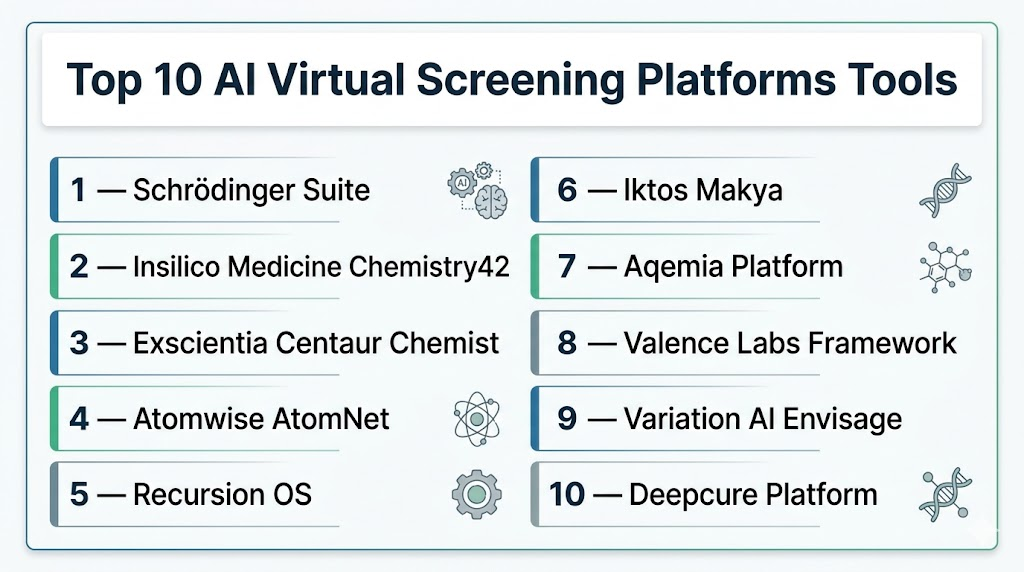
Top 10 AI Virtual Screening Platforms Tools
#1 — Schrödinger Suite
One-line verdict: Best for enterprise teams requiring a proven, elite hybrid ecosystem that perfectly blends physics-based simulations with high-performance machine learning.
Short description:
Schrödinger Suite is an industry-standard computational chemistry platform that combines rigorous quantum mechanics and molecular dynamics calculations with advanced machine learning layers to maximize screening throughput and hit reliability.
Standout Capabilities
- Ultra-high-fidelity Free Energy Perturbation FEP+ simulations predicting binding affinities.
- Machine learning-accelerated docking routines capable of screening multi-billion molecule libraries.
- Comprehensive molecular preparation modules handling complex tautomer and stereochemistry variations.
- Collaborative live-design dashboards allowing distributed research teams to iterate chemical structures concurrently.
- Native predictive models scoring a broad array of standard ADMET and physical property metrics.
AI-Specific Depth
- Model support: Proprietary active learning frameworks, deep deep-learning scoring functions, and quantum physics-informed neural loops.
- RAG / knowledge integration: Seamless cloud access to massive chemical structures archives and public biological coordinate systems.
- Evaluation: Advanced validation matrices tracking structural stability across thousands of virtual physical states.
- Guardrails: Structural constraint parameters that automatically flag molecules with reactive functional groups or structural flaws.
- Observability: Atomic-level visualization suites detailing binding interactions, ligand strains, and electrostatic surface contours.
Pros
- Unrivaled accuracy in binding free energy estimations, drastically minimizing wet-lab false positives.
- Highly mature software interface backed by decades of validation across major drug discovery programs.
- Excellent integration between traditional physics-based calculations and rapid machine learning models.
Cons
- Substantial computational infrastructure and licensing investments required to operate at scale.
- Steep onboarding curve demanding specialized computational chemistry expertise to extract maximum value.
- Heavy physics simulations generate considerable compute overhead compared to pure machine learning tools.
Security & Compliance
Maintains strict enterprise security boundaries, single-tenant private workspace options, comprehensive admin access logging, and robust local data storage protocols. Certifications are not publicly stated.
Deployment & Platforms
- On-Premises Linux Clusters, Private Cloud AWS/GCP, Managed Cloud instances.
Integrations & Ecosystem
Interfaces via native python scripting architectures, enterprise data connectors, and high-performance pipeline tools.
- Enterprise database architectures
- Commercial synthesis compound databases
- High-performance computing scheduling systems
- Laboratory information management portals
Pricing Model
Custom corporate enterprise licensing agreements based on node compute capacity, module deployment depth, and user volume counts.
Best-Fit Scenarios
- Major pharmaceutical brands scaling up massive multi-target discovery campaigns requiring high affinity precision.
- Established computational chemistry divisions needing to speed up physical asset validations through active machine learning layers.
- Advanced therapeutic research groups working on highly validated biological targets with well-resolved 3D configurations.
#2 — Insilico Medicine Chemistry42
One-line verdict: Best for biopharma operations seeking an end-to-end generative AI engine to design completely novel hits from scratch.
Short description:
Chemistry42 is a core component of Insilico Medicine’s Pharma.AI ecosystem, utilizing a collection of generative models and deep reinforcement learning systems to design, evaluate, and optimize novel drug-like molecules against custom target specifications.
Standout Capabilities
- Generative molecular synthesis driven by multi-model deep reinforcement learning loops.
- Simultaneous evaluation across over forty distinct chemical, physical, and biological properties.
- Automated identification of novel, unmapped binding pockets within tricky target proteins.
- Fast structure-based generation utilizing advanced 3D geometric generative models.
- Native synthetic accessibility analysis scoring the ease of physical compound manufacturing.
AI-Specific Depth
- Model support: Generative Adversarial Networks GANs, Variational Autoencoders VAEs, and advanced Reinforcement Learning architectures.
- RAG / knowledge integration: Direct interaction with PandaOmics data lakes tracking target definitions and multi-omics disease models.
- Evaluation: Multi-parameter score tracking ranking generated candidates by overall developability metrics.
- Guardrails: Strict toxicophore filters blocking the generation of reactive, mutagenic, or metabolic liability structures.
- Observability: Comprehensive design space maps showing the step-by-step evolutionary path of generated molecules.
Pros
- Exceptional performance at navigating structural spaces to build completely novel chemical leads.
- Fast discovery cycles, compressively demonstrated by moving candidates from target identification to clinical trials rapidly.
- Extremely user-friendly visual analytical interface customized for medicinal chemists.
Cons
- Operates optimally when connected to the wider Pharma.AI platform ecosystem, raising deployment scope.
- Requires rigorous downstream physical assay screening to validate unique generative compound predictions.
- Can occasionally build highly complex rings that challenge traditional contract synthesis parameters.
Security & Compliance
Provides isolated multi-tenant workspaces, strict cryptographic parameter protection, comprehensive audit tracking paths, and full data masking capabilities. Certifications are not publicly stated.
Deployment & Platforms
- Cloud Managed SaaS, Dedicated Private Instance, Hybrid On-Premises configurations.
Integrations & Ecosystem
Communicates through flexible RESTful API architectures and standard corporate chemical data models.
- PandaOmics target identification tools
- InClinico clinical trial forecasting platforms
- Automated laboratory synthesis robotic pipelines
- Standard structural layout data stores
Pricing Model
Tiered commercial platform subscriptions scaled by active workspace counts, processing throughput volume, or custom discovery milestones.
Best-Fit Scenarios
- Biotechnology startups trying to build unique, patent-protected molecular pipelines against difficult oncology targets.
- Discovery teams aiming to expand lead structures away from competitive patent clusters via scaffold-hopping generation.
- Enterprise drug teams requiring tight integration between multi-omics target data and automated small-molecule generation.
#3 — Exscientia Centaur Chemist
One-line verdict: Best for precision medicine ventures seeking a platform that leverages active learning loops focused on patient-tissue translation data.
Short description:
Centaur Chemist is Exscientia’s integrated automated discovery pipeline, leveraging high-throughput active learning models to design and prioritize candidate small molecules while evaluating target clinical translation metrics early in the cycle.
Standout Capabilities
- Active learning loop architectures engineered to minimize the total number of physical compound assays required.
- Automated multi-parameter optimization tracking structural affinity alongside target patient response criteria.
- Structure-agnostic ligand design tracks leveraging extensive evolutionary compound archives.
- Integrated high-throughput screen processing layers that analyze physical phenotypic cell alterations.
- Automated layout generation optimized to deliver compounds tailored for specific patient subgroups.
AI-Specific Depth
- Model support: Custom evolutionary deep learning models, advanced graph neural encoders, and bayesian active optimization loops.
- RAG / knowledge integration: Private data bridges linking screened molecule performance to real-world patient tissue database profiles.
- Evaluation: Advanced translation metrics scoring prospective chemical options by predicted clinical utility.
- Guardrails: Safety filtering scripts dropping compounds with a high propensity for off-target receptor interaction.
- Observability: Dynamic performance charts plotting active design improvement increments relative to compute spending footprints.
Pros
- Highly effective active learning loops that substantially lower physical laboratory testing overhead.
- Strong focus on clinical developability parameters, reducing downstream efficacy attrition risks.
- Proven ability to discover clinic-ready molecules across highly short project durations.
Cons
- Access parameters are primarily restricted to large-scale enterprise co-development arrangements.
- Requires deep structural or functional data reference matrices to jump-start active optimization cycles.
- Platform workflows are intensely integrated with proprietary automated screening facilities.
Security & Compliance
Implements rigorous pharma-tier data boundaries, end-to-end system event recording, multi-layered data encryption keys, and single-tenant hosting spaces. Certifications are not publicly stated.
Deployment & Platforms
- Dedicated Managed Cloud, Secure Private Environments.
Integrations & Ecosystem
Interacts via enterprise programmatic structures to feed candidate information directly into internal target evaluation engines.
- Automated wet-lab robotic execution sites
- Patient multi-omics data repositories
- Downstream pharmacokinetics modeling tools
- Corporate laboratory database archives
Pricing Model
Custom enterprise co-development agreements structured around specific disease pipelines, corporate milestones, or shared commercial assets.
Best-Fit Scenarios
- Precision oncology groups needing to design molecules optimized against specific, patient-derived genomic variations.
- Enterprise therapeutic networks aiming to minimize chemical synthesis rounds through hyper-efficient active learning tracks.
- Translational medicine operations wanting to align virtual screening filters directly with target clinical indicators.
#4 — Atomwise AtomNet
One-line verdict: Best for high-volume discovery teams requiring deep convolutional neural networks to run structure-based screens across massive compound vaults.
Short description:
AtomNet is a virtual screening framework that treats protein-ligand interactions like 3D spatial images, applying advanced deep convolutional neural networks to evaluate structural parameters and predict bioactivity.
Standout Capabilities
- 3D convolutional neural networks trained to evaluate spatial atomic configurations without manual descriptor inputs.
- Scalable structure-based parsing capable of scanning billion-compound compound vaults in parallel.
- Agnostic target handling across highly diverse protein classifications, including complex GPCRs.
- Automated structural pocket mapping identifying non-obvious allosteric binding locations.
- Integrated data preparation tools that clean, parse, and process raw protein coordinate variations.
AI-Specific Depth
- Model support: Deep 3D Convolutional Neural Networks CNNs, geometric graph layers, and fast affinity scoring algorithms.
- RAG / knowledge integration: Access to massive internal structural databases tracking millions of historical screening models.
- Evaluation: Spatial alignment validation matrices tracking binding contact distances across target pocket vectors.
- Guardrails: Automated pan-assay interference compounds PAINS screens that filter out non-specific false positives.
- Observability: Structural visualizers showing exactly which spatial coordinate nodes contributed most to the overall score.
Pros
- Exceptional processing throughput when evaluating immense, multi-billion item make-on-demand molecule libraries.
- Strong predictive accuracy across novel targets that lack close natural evolutionary structural analogs.
- Highly automated setup that abstracts away tedious manual computational chemistry steps.
Cons
- Heavy reliance on structural target accuracy; poorly resolved raw crystal configurations degrade scoring metrics.
- Can feel less customizable for teams wanting to adjust the underlying machine learning layer code settings manually.
- Primarily focused on structure-based tracks, offering less utility for ligand-blind screening pipelines.
Security & Compliance
Features isolated single-tenant compute spaces, comprehensive user event path histories, enterprise credential control compatibility, and secure data transit paths. Certifications are not publicly stated.
Deployment & Platforms
- Cloud Native Architecture GCP/AWS, Private API environments.
Integrations & Ecosystem
Communicates through standard secure REST services and high-volume file loading configurations.
- Enamine REAL virtual database engines
- Standard PDB structure platforms
- Automated synthesis procurement channels
- Corporate compound library trackers
Pricing Model
Usage-tiered subscription models based on library screening volume metrics, target processing depth, or structural generation runs.
Best-Fit Scenarios
- Discovery teams needing to rapidly screen multi-billion molecule libraries to discover initial hits against emergent disease targets.
- Research units shifting to structure-based deep learning workflows that do not require complex manual descriptor setups.
- Ecosystem developers building automated high-volume small-molecule generation and procurement operations.
#5 — Recursion OS
One-line verdict: Best for enterprise teams prioritizing phenotypic drug discovery driven by computer vision analysis of massive cellular image datasets.
Short description:
Recursion OS combines high-scale automated wet-lab biology with deep learning computer vision architectures, screening thousands of compounds by analyzing structural morphology changes in cells rather than utilizing traditional molecular docking.
Standout Capabilities
- Phenotypic screening driven by computer vision classification algorithms.
- Automated multi-million well cellular assay generation running in continuous physical loops.
- Deep machine learning feature extraction mapping subtle changes in cellular structure post-drug application.
- Target-agnostic discovery pipelines focused on real cellular rescue indicators rather than pocket docking.
- Massive, internal image database capturing biological disease states across millions of cellular models.
AI-Specific Depth
- Model support: Deep Convolutional Neural Networks, self-supervised image embedders, and automated anomaly classification loops.
- RAG / knowledge integration: Direct interaction with a proprietary, petabyte-scale data vault of biological images.
- Evaluation: Automated morphological profiling scoring how effectively a compound shifts a diseased cell model back toward a healthy state.
- Guardrails: Integrated cellular toxicity screens flagging compounds that cause cellular degradation or death.
- Observability: Visual feature-space dashboards mapping chemical performance relative to known control compounds.
Pros
- Discovers functional therapeutic hits without requiring a pre-resolved or understood 3D target protein structure.
- Captures complex, unexpected biological responses that pure virtual pocket-docking tools overlook completely.
- Highly scalable automated physical layout infrastructure ensures data inputs are highly consistent.
Cons
- Requires heavy collaboration with or deployment through the vendor’s physical laboratory infrastructure.
- Not suitable for computational chemistry groups focused strictly on structure-based virtual docking or target engineering.
- Substantial initial resource requirements tailored for enterprise therapeutic discovery pipelines.
Security & Compliance
Provides comprehensive workspace isolation, advanced physical and digital asset access logs, enterprise single sign-on parameters, and data protection structures optimized for major commercial biopharma discovery tracks. Certifications are not publicly stated.
Deployment & Platforms
- Managed Enterprise Cloud Workspace, Co-Development Laboratory Pipeline.
Integrations & Ecosystem
Interfaces via specialized high-volume cloud data connectors to synchronize imaging and compound profiles with internal systems.
- High-throughput screening imaging modules
- Internal clinical candidate tracking dashboards
- Genomic alteration mapping engines
- Private chemical repository trackers
Pricing Model
Custom enterprise partnerships structured around target therapeutic sectors, discovery milestones, or shared intellectual pipeline rights.
Best-Fit Scenarios
- Oncology or rare disease research teams seeking to identify functional drug leads for targets that lack known structural pocket definitions.
- Enterprise therapeutic groups wanting to augment structure-based programs with massive real-world cell morphology screening.
- Discovery operations aiming to find unique biological mechanisms of action by tracking visible cellular phenotype shifts.
#6 — Iktos Makya
One-line verdict: Best for medicinal chemistry divisions seeking an accessible generative design platform focused on optimizing lead compounds.
Short description:
Makya is Iktos’s web-native generative design platform, engineered to help medicinal chemists design and optimize small-molecule candidates across multi-parametric constraint profiles via deep learning models.
Standout Capabilities
- Generative structure alteration optimized for multi-parameter lead optimization tasks.
- Structure-based and ligand-based de novo generation modes operating inside a single interface.
- Integrated synthetic accessibility analytics driven by proprietary retro-synthesis planning layers.
- Automated match-molecular pair analyses identifying effective point alterations across chemical scaffolds.
- Intuitive compound grouping and tracking menus designed for distributed discovery teams.
AI-Specific Depth
- Model support: Deep generative autoencoders, reinforcement learning optimization networks, and retro-synthetic pathway algorithms.
- RAG / knowledge integration: Built-in connection to extensive reaction archives and commercial precursor catalogs.
- Evaluation: Custom scoring profiles ranking compound structures by alignment with target multi-property profiles.
- Guardrails: Filter arrays flagging problematic structures, reactive groups, and unviable metabolic scaffolds.
- Observability: Comprehensive synthetic route trees detailing exactly how to construct a generated molecule from raw materials.
Pros
- Outstanding balance between powerful generative chemical AI models and practical synthetic production execution steps.
- Intuitive web workbench interface that requires minimal coding experience from traditional lab chemistry staff.
- Highly effective at taking an existing hit compound and optimizing it into an advanced lead candidate.
Cons
- Less optimized for massive, target-blind multi-billion compound library screening passes.
- Demands clear baseline structural criteria to maximize generative optimization efficiency.
- Customizing the deep neural network layer code structures is locked down to protect interface stability.
Security & Compliance
Features secure multi-tenant account parameters, isolated workspace dataset environments, user permission control configurations, and complete audit activity logging. Certifications are not publicly stated.
Deployment & Platforms
- Cloud Managed SaaS, Private Cloud Cloud deployments AWS/GCP.
Integrations & Ecosystem
Interfaces via modern secure web services and standard text/file chemical structure exchange layers.
- Iktos Spaya retro-synthesis planning engines
- Corporate electronic lab notebooks ELN
- Standard corporate chemical inventory management spaces
- Molecular drawing workbench modules
Pricing Model
Tiered user seat subscription packages scaling into project-based generation volume frameworks.
Best-Fit Scenarios
- Medicinal chemistry units needing to optimize lead molecules to reduce toxic parameters without losing binding strength.
- Biotech teams seeking an easy-to-use platform to accelerate chemical generation runs without hiring custom data developers.
- Discovery projects looking to quickly evaluate the production costs and synthetic paths of prospective small molecules.
#7 — Aqemia Platform
One-line verdict: Best for discovery operations aiming to replace massive training data dependencies with physics-informed generative AI and quantum calculations.
Short description:
Aqemia combines advanced quantum-inspired statistical physics simulations with generative AI architectures to design small molecules, navigating chemical space without requiring historical target training data.
Standout Capabilities
- Physics-informed generative chemistry tracks operating independently from historical screening data.
- Ultra-fast quantum mechanical calculation matrices evaluating binding free energy.
- De novo structure generation optimized to explore structural options outside standard chemical catalog bounds.
- Simultaneous multi-property filtering checking binding affinity alongside manufacturing criteria.
- Automated structural iteration adjusting compound traits relative to pocket physics conditions.
AI-Specific Depth
- Model support: Custom generative AI autoencoders, physics-informed reinforcement networks, and quantum-mechanical simulation layers.
- RAG / knowledge integration: Native connectivity with structural coordinate indexes and physical atomic property charts.
- Evaluation: Energetic calculations scoring binding state stability inside target structural pockets.
- Guardrails: Structural filter checks that prevent the assembly of unstable, chemically impossible atomic rings.
- Observability: Real-time generation progress trackers showing property score improvements across design iterations.
Pros
- Succeeds at discovering unique binders for completely novel targets that possess zero historical screening data.
- Extremely high accuracy in predicting binding stability driven by physics calculations.
- Accelerates early-stage structure discovery steps by removing traditional dataset preparation blocks.
Cons
- Demands highly precise 3D structural representations of the target protein pocket to run calculations.
- Requires substantial initial computing capacity to run advanced quantum simulations.
- Ecosystem access is typically managed via long-term, structured corporate pipeline partnerships.
Security & Compliance
Enforces robust single-tenant platform environments, end-to-end data transaction protection, user access authentication layers, and absolute isolation of proprietary target records. Certifications are not publicly stated.
Deployment & Platforms
- High-Performance Compute Environments, Secure Private Clouds.
Integrations & Ecosystem
Communicates through enterprise file frameworks and encrypted API models to connect with chemical development pipelines.
- High-performance server scheduling packages
- Structural prediction visualization files
- Corporate candidate pipeline databases
- Automated chemical ordering tools
Pricing Model
Custom corporate enterprise agreements tailored to discovery milestones, pipeline targets, or computational processing scale.
Best-Fit Scenarios
- Therapeutic research ventures targeting newly discovered disease proteins with zero existing small-molecule literature.
- Computational discovery divisions wanting to integrate quantum physics calculations directly into generative AI loops.
- Enterprise drug teams aiming to identify high-affinity small-molecule binders within short project timelines.
#8 — Valence Labs Framework
One-line verdict: Best for enterprise teams seeking advanced graph neural network architectures and low-resource data modeling setups.
Short description:
Valence Labs, backed by Recursion, develops advanced geometric deep learning frameworks and low-resource machine learning models to predict compound attributes and run virtual screens using minimal baseline biological metrics.
Standout Capabilities
- Geometric graph neural networks built to interpret complex spatial molecular topologies.
- Low-resource deep learning models optimized to predict chemical activity from tiny initial datasets.
- Structure-based and ligand-based hybrid property prediction modeling grids.
- Advanced cross-validation scripts measuring model certainty and prediction accuracy parameters.
- Automated molecular embedding generation mapping compounds across uniform latent spaces.
AI-Specific Depth
- Model support: Geometric Graph Neural Networks GNNs, Equivariant Graph Transformers, and low-resource meta-learning architectures.
- RAG / knowledge integration: Native connectivity with open and private macromolecular data stores and structural repositories.
- Evaluation: Out-of-distribution tracking metrics checking if predictive scores remain reliable across unmapped chemical families.
- Guardrails: Multi-property safety filtering dropping designs with high chemical toxicity profile estimations.
- Observability: Fine-grained feature attribution maps showing exactly which atoms drive specific property predictions.
Pros
- Outstanding capability at predicting properties when working with extremely small, low-resource biological datasets.
- Elite geometric deep learning architectures that capture molecular shape rules with high fidelity.
- Open-source friendly framework construction built to match cutting-edge academic AI advancements.
Cons
- Command-line heavy environment requires significant developer and bioinformatics coding experience to run.
- Lacks the pre-packaged web interface menus found in platforms tailored for traditional lab staff.
- Requires thoughtful computational environment setup to coordinate graph networks with local data frameworks.
Security & Compliance
Implements secure data repository boundaries, comprehensive programmatic access logs, cryptographic code execution checking, and role-based workspace credential splits. Certifications are not publicly stated.
Deployment & Platforms
- Private Docker Containers, Kubernetes Cluster spaces, Cloud Managed APIs.
Integrations & Ecosystem
Interfaces via modular Python SDK kits, developer API tools, and containerized deployment frameworks.
- Recursion OS enterprise data networks
- Open-source machine learning libraries PyTorch Geometric
- Bioinformatics file processors
- Automated cloud compute environments
Pricing Model
Tiered developer infrastructure access models scaling into custom corporate enterprise development agreements.
Best-Fit Scenarios
- Advanced bioinformatics divisions building custom, in-house graph-based virtual screening pipelines.
- Discovery projects targeting highly rare diseases where only a handful of active compound data points exist in literature.
- Data engineering groups needing to run fast property prediction models across massive structural files.
#9 — Variation AI Envisage
One-line verdict: Best for discovery pipelines requiring highly specific, target-tailored generative chemistry models to cross off-target liabilities early.
Short description:
Envisage is Variation AI’s generative platform, leveraging advanced variational autoencoders to generate drug-like small molecules optimized across multiple specific target parameters simultaneously.
Standout Capabilities
- Generative structure design focused on multi-property target optimization matrices.
- Automated generation of scaffold-hopping compound variations to bypass competitor patents.
- In silico screening of off-target kinase selectivity profiles to ensure high binding specificity.
- Integrated physical property calculators checking lead asset solubility and polar surface areas.
- Automated tracking logs saving chemical optimization adjustments inside a centralized space.
AI-Specific Depth
- Model support: Variational Autoencoders VAEs, custom property predictor classifiers, and deep reinforcement scoring loops.
- RAG / knowledge integration: Direct access to curated kinase affinity archives and small-molecule property datasets.
- Evaluation: Multi-parameter optimization scoring verifying that candidates satisfy all baseline drug criteria.
- Guardrails: Structural filtering loops dropping reactive groups or structural assets prone to rapid liver metabolism.
- Observability: Graphic affinity vs property dashboards display compound scores across uniform distribution charts.
Pros
- Succeeds at building highly selective compounds that minimize unwanted off-target biological cross-reactions.
- Fast generative turnarounds, returning hundreds of optimized candidates within short compute passes.
- Clean file exporting parameters optimized for direct delivery to contract chemical printers.
Cons
- Primary technological strength is focused on kinase or well-mapped target families, offering less scope for rare structural types.
- Requires deliberate initial property definition setups to prevent generative model drift.
- The system lacks built-in comprehensive 3D physics-based molecular dynamic modeling modules.
Security & Compliance
Provides strict tenant database separation boundaries, single-tenant private workspace options, admin access logs, and encryption frameworks optimized for commercial discovery projects. Certifications are not publicly stated.
Deployment & Platforms
- Cloud Managed Workspaces, Private Cloud Dedicated Tenants.
Integrations & Ecosystem
Interfaces via standard web pipelines and secure document upload structures to pass molecular targets down the line.
- Corporate electronic notebook apps
- Chemical supply chain ordering tools
- Downstream property tracking suites
- Private chemical registry databases
Pricing Model
Tiered structural generation subscription structures paired with custom commercial milestones for target candidate nominations.
Best-Fit Scenarios
- Oncology drug projects requiring a highly selective kinase inhibitor to minimize patient side effects.
- Discovery squads needing to navigate around existing competitor small-molecule patent locks via scaffold-hopping design.
- Biotech teams seeking an automated approach to rapidly build a target family of lead molecules.
#10 — Deepcure Platform
One-line verdict: Best for enterprise operations seeking an automated cloud platform that uses deep learning to screen massive, asymmetric combinatorial chemistry spaces.
Short description:
Deepcure leverages advanced multi-modal deep learning architectures and high-performance cloud processing to run virtual screens across massive custom combinatorial chemical vaults, optimizing both target docking and synthesis viability.
Standout Capabilities
- Virtual screening of multi-billion asset custom combinatorial chemical vaults.
- Automated deep learning generation mapping molecule structural configurations against dynamic targets.
- Integrated synthesis route planning verifying that generated compounds can be manufactured reliably.
- Multi-parameter optimization frameworks evaluating target binding alongside ADMET profiles.
- Automated cloud scaling tools that adjust active cluster sizes based on raw pipeline size.
AI-Specific Depth
- Model support: Multi-modal deep transformers, advanced geometric graph neural layers, and active optimization scripts.
- RAG / knowledge integration: Integrated data access to extensive global precursor catalogs and validated reaction rulesets.
- Evaluation: Multi-tier virtual screens tracking target pocket interactions and structural alignment scores.
- Guardrails: In silico filtering tools dropping structures containing known toxic sub-structures or metabolic risks.
- Observability: Comprehensive pipeline analytics dashboards tracking molecule performance across serial filtering phases.
Pros
- Exceptional at processing complex chemical structures within ultra-large, customizable libraries.
- Strong alignment between virtual screening results and actual chemical manufacturing options.
- Highly scalable architecture optimized for parallel execution across multiple cloud environments.
Cons
- Requires deep familiarity with combinatorial building block definitions to maximize search parameters.
- The platform infrastructure generates significant compute overhead during ultra-large library evaluations.
- Access parameters require formal corporate enterprise subscription agreements.
Security & Compliance
Enforces multi-layer database isolation systems, strict administrative audit tracking histories, secure identity validation controls, and complete encryption protocols for data in transit and at rest. Certifications are not publicly stated.
Deployment & Platforms
- High-Volume Cloud SaaS, Dedicated Private Instances, Secure Multi-Cloud setups.
Integrations & Ecosystem
Communicates through modern secure programmatic REST models and advanced automated data loading pipelines.
- Commercial chemical building block systems
- Automated robotic laboratory interfaces
- Molecular modeling analysis engines
- Private institutional candidate databases
Pricing Model
Custom enterprise pricing models based on total library screening sizes, target deployment counts, or collaborative project parameters.
Best-Fit Scenarios
- Biopharma organizations aiming to evaluate vast, custom combinatorial chemistry libraries against novel disease proteins.
- Discovery groups needing to guarantee high manufacturing viability metrics during generative AI lead tracking.
- High-volume drug projects requiring parallel virtual screening runs across multiple targets concurrently.
Comparison Table
| Tool Name | Best For | Deployment | Model Flexibility | Strength | Watch-Out | Public Rating |
| Schrödinger Suite | Physics + ML Hybrid | On-Prem / Cloud | Physics-Informed ML | Exceptional free energy affinity prediction | High compute overhead costs | N/A |
| Chemistry42 | Generative De Novo | Cloud / Private | Multi-Model GAN/VAE | Fast generation of novel patentable leads | Can generate complex structures | N/A |
| Centaur Chemist | Active Learning loops | Dedicated Cloud | Bayesian Active ML | Lowers total physical wet-lab assay rounds | Restricted to enterprise deals | N/A |
| AtomNet | Billion-Scale Screening | Cloud Native | 3D Convolutional CNN | Fast parsing of ultra-large databases | Dependent on structural accuracy | N/A |
| Recursion OS | Phenotypic Discovery | Co-Dev / Cloud | Computer Vision CNN | Finds leads without resolved target pockets | Tied to specific physical labs | N/A |
| Iktos Makya | Lead Optimization | Cloud / SaaS | Autoencoder / Reinforce | Practical interface with retro-synthesis | Not built for large initial scans | N/A |
| Aqemia Platform | Data-Blind Targets | HPC / Private | Quantum Simulation | Operates without prior dataset training | Needs precise target structure | N/A |
| Valence Framework | Geometric Graph Neural | Container / Cloud | Geometric GNN / Meta | Elite results from tiny baseline datasets | Command-line heavy workspace | N/A |
| Envisage | Kinase Selectivity | Cloud / Private | Variational Autoencoders | Minimizes toxic off-target side effects | Kinase/Target family focused | N/A |
| Deepcure Platform | Combinatorial Vaults | Cloud / Multi-Cloud | Multi-Modal Transformer | Screens custom combinatorial libraries | High compute platform costs | N/A |
Scoring & Evaluation Transparent Rubric
The analysis below uses a comparative scoring methodology to evaluate platforms relative to category-specific requirements. Scores reflect a tool’s capability within specialized computer-aided drug design and generative discovery frameworks.
The overall weighted score is calculated using the following criteria:
- Core features 20%: Docking precision, virtual library tracking capacity, and property prediction accuracy.
- AI reliability & evaluation 15%: Active model retraining, assay feedback integration, and out-of-distribution validity.
- Guardrails & safety 10%: PAINS screening, toxicophore filtration blocks, and structural validation checks.
- Integrations & ecosystem 15%: Support for standard chemical file formats, inventory databases, and synthesis pathways.
- Ease of use 10%: Graphical user interface design, visual analytic tools, and onboarding complexity.
- Performance & cost controls 15%: GPU parallel scaling efficiency, infrastructure deployment models, and routing logic.
- Security & admin 10%: Dedicated tenant isolation boundaries, administrative audit trails, and IP encryption protocols.
- Support & community 5%: Validation literature depth, computational assistance access, and configuration training materials.
| Tool | Core | Reliability/Eval | Guardrails | Integrations | Ease | Perf/Cost | Security/Admin | Support | Weighted Total |
| Schrödinger Suite | 10 | 9 | 9 | 9 | 6 | 7 | 9 | 9 | 8.50 |
| Chemistry42 | 9 | 8 | 9 | 8 | 8 | 8 | 9 | 7 | 8.25 |
| Centaur Chemist | 9 | 9 | 8 | 8 | 5 | 8 | 9 | 7 | 7.95 |
| AtomNet | 8 | 8 | 8 | 8 | 7 | 9 | 9 | 7 | 8.05 |
| Recursion OS | 9 | 9 | 8 | 7 | 5 | 7 | 9 | 7 | 7.75 |
| Iktos Makya | 8 | 8 | 9 | 8 | 9 | 8 | 8 | 8 | 8.15 |
| Aqemia Platform | 9 | 8 | 8 | 8 | 5 | 8 | 9 | 7 | 7.85 |
| Valence Framework | 9 | 8 | 8 | 8 | 4 | 8 | 9 | 7 | 7.65 |
| Envisage | 8 | 8 | 9 | 8 | 7 | 8 | 9 | 7 | 8.00 |
| Deepcure Platform | 9 | 8 | 8 | 8 | 6 | 8 | 9 | 7 | 7.85 |
- Top 3 for Enterprise: Schrödinger Suite, Insilico Medicine Chemistry42, Exscientia Centaur Chemist
- Top 3 for SMB: Iktos Makya, Variation AI Envisage, Schrödinger Suite
- Top 3 for Developers: Valence Labs Framework, Schrödinger Suite, Atomwise AtomNet
Which AI Virtual Screening Platforms Tool Is Right for You
Solo / Freelancer
Independent medicinal chemistry consultants or standalone bioinformatics developers rarely require heavy enterprise active learning platforms that link directly to physical robotic infrastructure. Focus on flexible, self-service software models or script-friendly frameworks like Valence Labs Framework or Iktos Makya. These tools allow you to construct property prediction scripts or run small lead optimization checks via standard developer interfaces without massive up-front cost structures.
SMB
Growing biotechnology operations and local discovery research labs require software that simplifies screening execution steps without demanding an immense internal data engineering team. Platforms like Iktos Makya or Variation AI Envisage provide intuitive, web-native visual dashboards that allow chemistry teams to run multi-parameter generative design cycles or selectivity filters smoothly, keeping internal IT overhead low.
Mid-Market
Expanding therapeutic developers and contract research entities require an optimal balance of structural modeling depth and predictable cloud computing metrics. Platforms like Atomwise AtomNet or deep module variations of Schrödinger Suite match this operational scope perfectly. They deliver high-throughput, structure-based screening configurations capable of parsing vast libraries while integrating natively into commercial synthesis procurement networks.
Enterprise
Global pharmaceutical networks and multi-site therapeutic institutions require industrial-scale processing, uncompromised structural docking precision, and comprehensive wet-lab pipeline integrations. Environments like Schrödinger Suite, Chemistry42, or Centaur Chemist are engineered explicitly for this scale. They evaluate multi-billion item catalogs, run highly precise free-energy dynamics simulations, and manage end-to-end multi-parameter optimizations seamlessly across global research teams.
Regulated Industries
Discovery divisions developing high-stakes therapeutics, genetic components, or proprietary defense molecules must keep data protection above all else. Select private, containerized cloud environments or secure on-premises deployments through software like Schrödinger Suite, Valence Labs Framework, or Aqemia. These configurations prevent sensitive target protein structures and unique molecular hit candidates from leaking to external public datasets, satisfying international data compliance and patent security rules.
Budget vs Premium
When early-stage project funding is restricted, utilization of pay-as-you-go cloud architectures or developer-centric environments like Valence Labs Framework or Iktos Makya minimizes capital exposure risks. Conversely, premium integrated frameworks like Schrödinger Suite, Chemistry42, or Deepcure demand substantial, long-term enterprise investments. However, these premium systems justify their cost tiers by embedding advanced quantum physics modeling, automating compound preparation pipelines, and providing legally clean intellectual property frameworks.
Build vs Buy When to DIY
Constructing an in-house virtual screening pipeline from scratch can be an effective approach if your organization maintains massive, proprietary chemical activity databases and employs an internal division of geometric machine learning engineers. For standard discovery workflows, however, buying or partnering with an established platform provider is vastly more efficient. Pre-built systems include optimized molecular graph encoders, verified retro-synthesis planning layers, and direct cloud links to billion-scale compound archives, saving your organization from spending years trying to replicate foundational computational chemistry infrastructure.
Implementation Playbook 30 / 60 / 90 Days
Day 1–30: Pilot Setup & Target Ingestion
- Establish an isolated, secure instance space or container layout completely separated from external training vectors.
- Configure explicit user role permissions, set up corporate single sign-on parameters, and confirm tenant data isolation boundaries.
- Ingest a selection of highly validated, public target crystal files to establish clean baseline processing benchmarks.
- Measure primary success metrics checking geometric docking accuracy, library parsing speed, and structural alignment verification.
Day 31–60: Workflows Setup & Chemist Training
- Connect the active virtual screening engine to internal compound inventories and molecular drawing modules.
- Launch the platform’s visual dashboards, training medicinal chemists to build property optimization queries and screen target libraries.
- Deploy internal PAINS filters and toxicophore screening scripts to automatically drop reactive false positives early in the loop.
- Integrate open-source or custom property prediction models alongside core platform frameworks to establish hybrid evaluation tracks.
Day 61–90+: Automated Scaling & Synthesis Loops
- Implement hybrid computing rules, utilizing local clusters for fast ligand preparation while offloading heavy docking steps to scalable cloud GPU pools.
- Link the platform’s output hit candidate dashboards directly to commercial make-on-demand synthesis vendors via structured APIs.
- Deploy interactive operational cost tracking screens to display active token usage, compute hour spending, and pipeline latency metrics.
- Configure automated data ingestion filters to import physical assay results back into the system to retrain local workspace models dynamically.
Common Mistakes & How to Avoid Them
- Relying on Public Server Desktops Without IP Masking: Uploading proprietary target protein files or custom lead structures to open web tools can accidentally expose institutional assets to public training pools. Always enforce strict private instance boundaries or on-premises code spaces.
- Equating Virtual Docking Confidences With Physical Assay Success: Assuming a high machine learning binding affinity score translates directly to biological activity inside a wet lab is a common pitfall. Always pass virtual hits through multi-parameter filters checking solubility, cell permeability, and structural stability.
- Running Screening Passes on Dirty Target Files: Attempting to screen molecules against raw protein crystal files that contain missing loops, incorrect protonation states, or trapped water molecules causes corrupted outputs. Enforce rigorous structural optimization steps before running screens.
- Ignoring Synthetic Accessibility Layout Paths: Allowing a generative AI model to build an exceptionally high-scoring binder that traditional chemistry parameters cannot physically synthesize. Always apply retro-synthesis planning screens to verify chemical viability.
- Using Rigid Structural Filters for Dynamic Targets: Treating highly mobile or flexible protein pockets as fixed, rigid objects causes models to miss potent induced-fit binding options. Select platforms that support flexible pocket or ensemble-based modeling.
- Failing to Check for Non-Specific PAINS Liabilities: Allowing compounds that indiscriminately interfere with assay equipment to pass screening loops creates extensive downstream wet-lab false positives. Apply automated pan-assay interference filters early.
- Over-Optimizing a Single Trait to the Detriment of Overall Developability: Focusing exclusively on maximizing pocket binding strength while overlooking critical ADMET attributes produces high-affinity molecules with toxic profiles. Enforce balanced, multi-parameter optimization scoring from step one.
- Creating Static Hardcoded Dependencies on One Specific AI Architecture: Restricting your workflow pipelines to a single model prevents your division from utilizing newer biological advancements. Maintain model-agnostic software layouts that allow you to upgrade components easily.
- Neglecting Downstream Metabolic Transformation Liabilities: Designing a compound that fits perfectly in silico but is instantly destroyed by liver enzymes upon entering an organism. Run predictive metabolic stability modeling concurrently with docking steps.
- Launching Large Screening Batches Without Spend Ceiling Controls: Triggering immense multi-billion virtual library scans across extensive target variations without setting budget constraints can generate unexpected cloud compute bills. Run mini-pilot screens first and enforce strict infrastructure spending boundaries.
FAQs
1. What exactly is an AI Virtual Screening Platform?
In the context of modern drug discovery, these platforms utilize advanced deep learning, graph neural networks, and geometric diffusion models to automatically evaluate, score, and rank the binding affinities and developability profiles of vast chemical libraries against target proteins in silico.
2. How do these tools prevent data leaks and maintain core asset privacy?
Enterprise platforms protect institutional intellectual property by deploying within fully isolated, single-tenant private cloud spaces or containerized on-premises environments. They enforce strict zero-knowledge data rules, ensuring your proprietary targets and screened structures are never exposed to external models.
3. Can I use open-source AI models with these mapping platforms?
Yes. Many leading virtual screening platforms utilize model-agnostic infrastructure configurations. This allows discovery teams to seamlessly run popular open-source models like DiffDock or specialized academic property predictors alongside proprietary platform architectures inside a single user interface.
4. What is the purpose of an automated validation loop in a screening pipeline?
An automated validation loop automatically pipes high-scoring virtual hit candidates through an independent property verification layer. If this layer flags problematic attributes like poor solubility or hERG cardiac toxicity risk, the platform logs the error and updates the screening filter constraints automatically.
5. How do these tools map text descriptions to precise biological designs?
Generative variations of these engines interpret functional parameters like cross the blood-brain barrier and target receptor X using high-dimensional chemical embedding spaces, guiding reinforcement learning models to synthesize molecules matching those text parameters from scratch.
6. What happens if the platform generates an unstable structural conformation?
When a screening pass constructs a conformation with unviable atomic strains or impossible bond angles, the platform flags the design and routes it to a human-in-the-loop review workbench, allowing computational chemists to manually tweak coordinates or adjust atom constraints.
7. Can these platforms handle real-time biological screening pipelines?
Managing continuous high-throughput virtual scanning across billion-scale libraries requires running initial passes through fast, lightweight molecular language models or graph neural networks. This approach weeds out massive percentages of inactive molecules in seconds, saving heavy geometric calculations for the final selection rounds.
8. What are the main risks of total vendor lock-in in this software category?
The primary risk is having your target optimization workflows, custom-trained model parameters, and chemical data sets locked inside a closed system. To prevent this, ensure your chosen platform exports all screening hits and molecular coordinates in standard, open formats like PDB, mmCIF, or SDF files.
9. How do hybrid routing configurations help control cloud compute costs?
Hybrid routing routes fast property calculations, ligand cleaning routines, and basic similarity screening steps to small local compute servers. The system automatically reserves expensive, scalable cloud GPU clusters exclusively for intensive de novo generation passes and quantum molecular dynamics runs.
10. Do these screening engines support modern molecular file definitions?
Yes. Top-tier design environments natively support varied molecular data layouts, parsing legacy PDB protein formats alongside modern, detail-rich mmCIF coordinate definitions and chemical structure SDF matrices to guarantee clean data transit across external biological tools.
11. Why is tracking structural data lineage important for therapeutic approval tracks?
Data lineage tracking captures an unalterable history of every property calculation, structural modification, and scoring adjustment applied during a screening campaign. This verifiable record is crucial for satisfying regulatory compliance tracking and proving structural selection logic during patent and clinical licensing steps.
12. Can these mapping engines parse scanned paperwork or unstructured lab files?
Advanced multi-modal deep learning models can ingest unstructured assay spreadsheets, scanned experimental plates, and published research articles, translating raw historical findings into clean, formatted input parameters for active virtual screening databases.
Conclusion
AI virtual screening platforms have fundamentally transformed early-stage drug discovery from an inefficient, trial-and-error wet-lab process into an agile, engineering discipline. By replacing legacy, brute-force physics equations with advanced geometric deep learning, graph neural networks, and generative reinforcement loops, these tools allow research teams to screen billions of molecules, optimize lead candidates, and map complex target interactions with unprecedented speed and accuracy.Selecting the right platform depends on your operational scale, computational experience, and pipeline targets. Enterprise institutions require mature, multi-model networks like Schrödinger Suite or Chemistry42 to manage global discovery tracks, while mid-market and SMB chemistry teams can accelerate timelines using accessible, lead-optimization workbenches like Iktos Makya.As you deploy your computational discovery pipeline, follow a clear implementation strategy: shortlist target-compatible environments, launch a secure private sandbox instance using verified reference targets, integrate multi-parameter screening filters early, and scale up physical compound synthesis orders only after validating synthetic accessibility and cost metrics in silico.

Find Trusted Cardiac Hospitals
Compare heart hospitals by city and services — all in one place.
Explore Hospitals
A useful point to consider is how these platforms balance speed with accuracy—fast screening is valuable, but reliable predictions and fewer false positives matter just as much in real research.