
Introduction
AI Genomics Variant Calling Pipelines are advanced platforms that use artificial intelligence and machine learning to identify, annotate, and prioritize genetic variants from DNA and RNA sequencing data. These pipelines optimize bioinformatics workflows by automating error correction, variant calling, and multi-sample joint genotyping, improving speed, reproducibility, and accuracy for research and clinical applications.
Why it matters: The explosive growth of sequencing data has created a need for accurate, scalable, and AI-driven variant detection. These pipelines reduce false positives, accelerate discovery, and improve reproducibility, which is critical for precision medicine, population genetics, and clinical genomics projects.
Real-world use cases include:
- Detecting SNPs, indels, and structural variants in whole-genome and exome sequencing
- Annotating variants for pathogenicity and clinical relevance
- Prioritizing variants in large cohort studies for population genomics
- Integrating multi-omic data for comprehensive genome interpretation
- Automating quality control and error correction in high-throughput sequencing
- Supporting personalized medicine by identifying actionable mutations
What buyers should evaluate: Accuracy, scalability, AI model transparency, integration with sequencing instruments, computational resources, deployment options, error handling, reproducibility, clinical compliance, annotation support, latency and cost, and vendor support.
Best for: Clinical genomics labs, pharmaceutical R&D, population genetics studies, and personalized medicine programs.
Not ideal for: Small labs with low sequencing throughput or manual variant analysis workflows.
What’s Changed in AI Genomics Variant Calling Pipelines
- AI-driven error correction for sequencing artifacts
- Machine learning models for variant pathogenicity prediction
- Multi-omic integration for comprehensive genome analysis
- Cloud-native scalable pipelines for cohort studies
- Real-time quality control monitoring
- Guardrails to flag low-confidence variant calls
- Observability dashboards for call quality and compute usage
- BYO AI model support alongside proprietary variant callers
- Integration with annotation and reporting tools
- Advanced filtering using population databases and predictive scoring
- Workflow versioning to ensure reproducibility
- Enhanced regulatory and clinical compliance features
Quick Buyer Checklist
- Accuracy for rare and low-frequency variants
- Scalability for single-sample and multi-sample cohorts
- AI model transparency and interpretability
- Integration with sequencing instruments and pipelines
- Error detection and QC automation
- Deployment flexibility (cloud, on-premise, hybrid)
- Observability dashboards and metrics tracking
- Clinical or research compliance readiness
- Customization or BYO AI support
- Cost and latency optimization
- Downstream annotation and reporting support
- Vendor support, training, and documentation
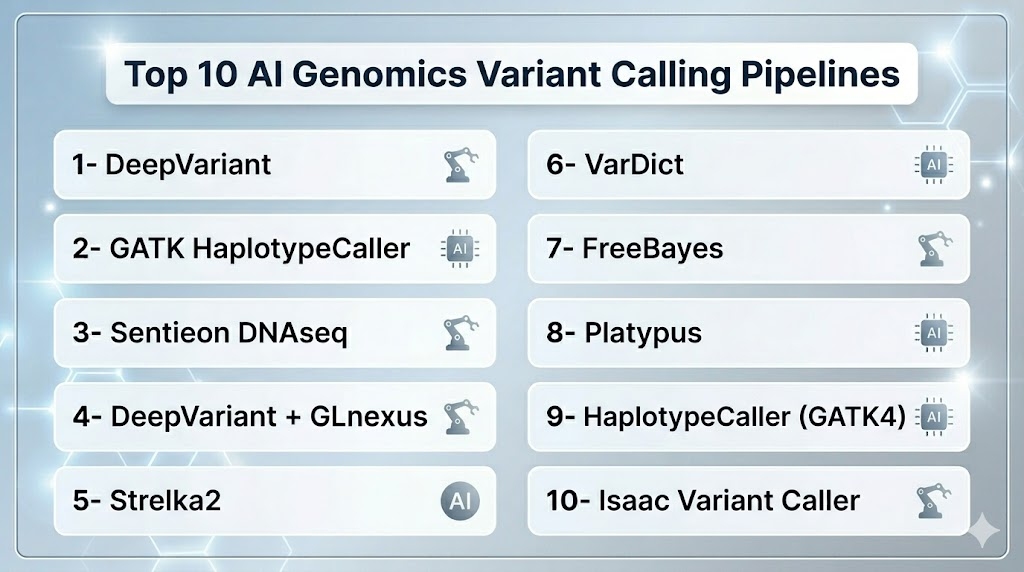
Top 10 AI Genomics Variant Calling Pipelines
1- DeepVariant
One-line verdict: High-accuracy variant caller for SNPs and indels in WGS and WES datasets.
Short description: DeepVariant uses deep learning to automate variant calling with high sensitivity and reproducibility. It supports multi-sample analysis and integrates easily into research and clinical workflows.
Standout Capabilities
- Deep learning-based SNP and indel calling
- Multi-sample cohort support
- Automated error correction
- Standardized VCF outputs
- Cloud and local execution
- Reproducible pipelines
- Open-source availability
AI-Specific Depth
- Model support: Open-source deep learning
- RAG / knowledge integration: N/A
- Evaluation: Benchmarking with GIAB datasets
- Guardrails: Confidence thresholds
- Observability: Variant quality metrics
Pros
- High accuracy
- Scalable for large cohorts
- Open-source and widely adopted
Cons
- GPU-intensive
- Limited structural variant support
- Computationally heavy
Security & Compliance
Varies / N/A
Deployment & Platforms
Linux, cloud
Integrations & Ecosystem
- Bioinformatics pipelines
- Nextflow, Snakemake workflow managers
- Python automation scripts
Pricing Model
Open-source
Best-Fit Scenarios
- Clinical genomics
- High-throughput WGS/WES
- Population genetics studies
2- GATK HaplotypeCaller
One-line verdict: Robust variant caller for multi-sample research and clinical genomics.
Short description: GATK HaplotypeCaller uses local reassembly of haplotypes to call SNPs and indels with high confidence, supporting downstream annotation and cohort-level analysis.
Standout Capabilities
- Local haplotype reassembly
- Multi-sample variant calling
- Base quality recalibration
- Automated variant filtering
- Standard VCF outputs
AI-Specific Depth
- Model support: Statistical + ML heuristics
- RAG / knowledge integration: N/A
- Evaluation: Benchmarking datasets
- Guardrails: Quality score filtering
- Observability: QC dashboards
Pros
- Multi-sample support
- Well-documented
- Widely used in research
Cons
- Complex setup
- Computationally intensive
- Learning curve
Security & Compliance
Varies / N/A
Deployment & Platforms
Linux, cloud
Integrations & Ecosystem
- Bioinformatics pipelines
- Workflow managers
- Annotation tools
Pricing Model
Open-source
Best-Fit Scenarios
- Population genomics
- Clinical variant detection
- Multi-sample studies
3- Sentieon DNAseq
One-line verdict: Optimized variant calling replicating GATK results with reduced computational cost.
Short description: Sentieon DNAseq uses AI heuristics to accelerate variant calling for high-throughput labs while maintaining accuracy comparable to GATK.
Standout Capabilities
- Optimized performance and speed
- Multi-sample support
- Automated QC and filtering
- Standardized VCF outputs
- Scalable cloud and local execution
AI-Specific Depth
- Model support: Proprietary AI heuristics
- RAG / knowledge integration: N/A
- Evaluation: Benchmarking
- Guardrails: Confidence thresholds
- Observability: Performance metrics
Pros
- High speed
- Accurate variant calling
- Scalable for large datasets
Cons
- Proprietary license required
- Limited structural variant support
- Cost for enterprise use
Security & Compliance
Not publicly stated
Deployment & Platforms
Linux, cloud
Integrations & Ecosystem
- GATK-compatible pipelines
- Nextflow/Snakemake
- Annotation tools
Pricing Model
License-based
Best-Fit Scenarios
- High-throughput labs
- Clinical genomics pipelines
- Population studies
4- DeepVariant + GLnexus
One-line verdict: Multi-sample joint genotyping pipeline for cohort-level analysis.
Short description: Combines DeepVariant with GLnexus for joint genotyping of multiple samples, enabling reproducible and scalable cohort variant analysis.
Standout Capabilities
- Multi-sample joint genotyping
- Cloud and local scalability
- Standardized VCF outputs
- Automated QC metrics
- Reproducible pipelines
AI-Specific Depth
- Model support: Open-source deep learning
- RAG / knowledge integration: N/A
- Evaluation: Benchmarking datasets
- Guardrails: Confidence thresholds
- Observability: Call quality dashboards
Pros
- Cohort-level accuracy
- Reproducible
- Open-source
Cons
- Resource intensive
- Complex setup
- Requires pipeline expertise
Security & Compliance
Varies / N/A
Deployment & Platforms
Linux, cloud
Integrations & Ecosystem
- Workflow managers
- Annotation pipelines
- VCF outputs
Pricing Model
Open-source
Best-Fit Scenarios
- Population genomics
- Multi-sample WGS
- Collaborative research
5- Strelka2
One-line verdict: Fast and sensitive small variant caller for WGS/WES.
Short description: Strelka2 provides high-sensitivity SNP and indel detection for research and clinical pipelines with multi-sample support and efficient performance.
Standout Capabilities
- Small variant calling
- Somatic and germline detection
- Multi-sample support
- Automated filtering
- Standardized VCF outputs
AI-Specific Depth
- Model support: Heuristic + ML filters
- RAG / knowledge integration: N/A
- Evaluation: Benchmark datasets
- Guardrails: Confidence filtering
- Observability: Variant metrics
Pros
- Fast
- Sensitive variant detection
- Multi-sample support
Cons
- Limited structural variant calling
- Pipeline setup required
- Computationally intensive
Security & Compliance
Varies / N/A
Deployment & Platforms
Linux, cloud
Integrations & Ecosystem
- Pipelines, annotation tools
- Workflow managers
Pricing Model
Open-source
Best-Fit Scenarios
- Cancer genomics
- Clinical WES/WGS
- Research labs
6- VarDict
One-line verdict: Flexible variant caller for low-frequency germline and somatic variants.
Short description: VarDict supports both germline and somatic variant calling across WGS, WES, and targeted sequencing. It provides AI-assisted filtering and customizable analysis for research labs.
Standout Capabilities
- Low-frequency variant detection
- Multi-sample analysis
- Somatic and germline variant support
- Custom filtering options
- Efficient memory and CPU usage
AI-Specific Depth
- Model support: Heuristic + ML filters
- RAG / knowledge integration: N/A
- Evaluation: Benchmark datasets
- Guardrails: Confidence thresholds
- Observability: Variant metrics
Pros
- Flexible and customizable
- Supports multiple variant types
- Lightweight for small-scale labs
Cons
- Less optimized for very large cohorts
- Pipeline setup required
- Limited cloud-native support
Security & Compliance
Varies / N/A
Deployment & Platforms
Linux, cloud
Integrations & Ecosystem
- Pipeline scripts
- Annotation tools
- Workflow managers
Pricing Model
Open-source
Best-Fit Scenarios
- Targeted sequencing
- Low-frequency detection
- Academic or small research labs
7- FreeBayes
One-line verdict: Haplotype-aware open-source variant caller for flexible research pipelines.
Short description: FreeBayes detects SNPs, indels, and complex variants using haplotype-aware probabilistic models. It is ideal for research pipelines requiring flexible variant detection.
Standout Capabilities
- Haplotype-aware calling
- Multi-sample support
- Low-frequency variant detection
- Flexible input formats
- Generates VCF outputs
AI-Specific Depth
- Model support: Bayesian probabilistic
- RAG / knowledge integration: N/A
- Evaluation: Benchmarking datasets
- Guardrails: Confidence thresholds
- Observability: Variant metrics
Pros
- Open-source and flexible
- Supports small cohorts
- Haplotype-aware
Cons
- Computationally intensive
- Less optimized for large datasets
- Requires bioinformatics expertise
Security & Compliance
Varies / N/A
Deployment & Platforms
Linux, cloud
Integrations & Ecosystem
- Workflow managers
- Annotation tools
- Custom pipelines
Pricing Model
Open-source
Best-Fit Scenarios
- Small cohort studies
- Flexible research pipelines
- Academic research labs
8- Platypus
One-line verdict: High-sensitivity indel caller for small variant detection.
Short description: Platypus efficiently detects indels and small variants, providing AI-informed filtering and multi-sample support for research labs.
Standout Capabilities
- High-sensitivity indel detection
- Multi-sample calling
- Automated filtering
- Standardized VCF output
AI-Specific Depth
- Model support: Heuristic + ML filters
- RAG / knowledge integration: N/A
- Evaluation: Benchmarking
- Guardrails: Confidence thresholds
- Observability: Variant metrics
Pros
- Sensitive for indels
- Multi-sample support
- Computationally efficient
Cons
- Limited structural variant calling
- Requires bioinformatics expertise
- Resource-intensive for large cohorts
Security & Compliance
Varies / N/A
Deployment & Platforms
Linux, cloud
Integrations & Ecosystem
- Pipelines and annotation tools
- Workflow managers
Pricing Model
Open-source
Best-Fit Scenarios
- Targeted sequencing
- Indel-focused studies
- Academic research labs
9- HaplotypeCaller (GATK4)
One-line verdict: Enterprise-ready variant caller for robust clinical and research analysis.
Short description: GATK4 HaplotypeCaller provides haplotype-aware SNP and indel calling with AI-assisted filtering for reproducibility and clinical-grade workflows.
Standout Capabilities
- Local haplotype reassembly
- Multi-sample joint calling
- Variant quality score recalibration
- Standardized outputs
- QC metrics integration
AI-Specific Depth
- Model support: ML heuristics
- RAG / knowledge integration: N/A
- Evaluation: Benchmark datasets
- Guardrails: VQSR thresholds
- Observability: QC dashboards
Pros
- Robust and enterprise-ready
- Multi-sample support
- Well-documented
Cons
- Computationally intensive
- Complex setup
- Learning curve
Security & Compliance
Varies / N/A
Deployment & Platforms
Linux, cloud
Integrations & Ecosystem
- Bioinformatics pipelines
- Workflow managers
- Annotation tools
Pricing Model
Open-source
Best-Fit Scenarios
- Clinical genomics
- Large cohort WGS
- Population studies
10- Isaac Variant Caller
One-line verdict: Optimized for Illumina sequencing platforms with AI-based variant filtering.
Short description: Isaac Variant Caller efficiently calls variants from Illumina data using AI heuristics, providing fast, high-accuracy results for research and clinical workflows.
Standout Capabilities
- Optimized for Illumina sequencing
- AI-based error filtering
- Multi-sample support
- Standardized VCF outputs
- High-speed performance
AI-Specific Depth
- Model support: Proprietary AI heuristics
- RAG / knowledge integration: Sequencer logs
- Evaluation: Benchmark datasets
- Guardrails: Quality thresholds
- Observability: Call metrics
Pros
- Fast and accurate
- Optimized for Illumina
- Supports multi-sample analysis
Cons
- Proprietary
- License required
- Limited cross-platform support
Security & Compliance
Not publicly stated
Deployment & Platforms
Linux, cloud
Integrations & Ecosystem
- Illumina pipelines
- Annotation tools
- Workflow managers
Pricing Model
License-based
Best-Fit Scenarios
- Illumina labs
- Clinical WGS
- High-throughput sequencing
Comparison Table
| Tool | Best For | Deployment | Model Flexibility | Strength | Watch-Out | Public Rating |
|---|---|---|---|---|---|---|
| DeepVariant | Clinical & research | Linux/cloud | Open-source | High accuracy | GPU-intensive | N/A |
| GATK HaplotypeCaller | Multi-sample | Linux/cloud | ML heuristics | Robust | Complex setup | N/A |
| Sentieon DNAseq | High-throughput | Linux/cloud | Proprietary | Optimized speed | License required | N/A |
| DeepVariant + GLnexus | Cohorts | Linux/cloud | Open-source | Joint genotyping | Resource intensive | N/A |
| Strelka2 | WGS/WES | Linux/cloud | Heuristic | Fast small variant | Limited SV support | N/A |
| VarDict | Targeted sequencing | Linux/cloud | Heuristic+ML | Flexible | Setup required | N/A |
| FreeBayes | Research | Linux/cloud | Bayesian | Haplotype-aware | Computationally heavy | N/A |
| Platypus | Indel-focused | Linux/cloud | Heuristic+ML | Sensitive indel | Limited SV | N/A |
| HaplotypeCaller GATK4 | Enterprise | Linux/cloud | ML heuristics | Enterprise-ready | Computationally demanding | N/A |
| Isaac Variant Caller | Illumina labs | Linux/cloud | Proprietary AI | Optimized Illumina | License required | N/A |
Scoring Table
| Tool | Core | AI Optimization | Guardrails | Integrations | Ease | Perf/Cost | Security/Admin | Support | Weighted Total |
|---|---|---|---|---|---|---|---|---|---|
| DeepVariant | 10 | 9 | 9 | 8 | 8 | 8 | 8 | 7 | 8.6 |
| GATK HaplotypeCaller | 9 | 8 | 8 | 8 | 7 | 7 | 8 | 7 | 7.8 |
| Sentieon DNAseq | 9 | 8 | 8 | 8 | 8 | 8 | 7 | 7 | 8.0 |
| DeepVariant + GLnexus | 9 | 8 | 8 | 8 | 7 | 8 | 7 | 7 | 7.9 |
| Strelka2 | 8 | 7 | 7 | 7 | 8 | 8 | 7 | 6 | 7.5 |
| VarDict | 8 | 7 | 7 | 7 | 8 | 7 | 6 | 6 | 7.2 |
| FreeBayes | 7 | 7 | 7 | 6 | 7 | 7 | 6 | 6 | 6.9 |
| Platypus | 7 | 7 | 7 | 6 | 7 | 7 | 6 | 6 | 6.9 |
| HaplotypeCaller GATK4 | 9 | 8 | 8 | 8 | 7 | 7 | 8 | 7 | 7.9 |
| Isaac Variant Caller | 8 | 8 | 8 | 7 | 7 | 8 | 7 | 6 | 7.6 |
Which Tool Is Right for You
- Solo / Freelancer: FreeBayes, Strelka2 for flexible, open-source variant calling
- SMB: VarDict, Platypus for small-to-medium cohort workflows
- Mid-Market: DeepVariant + GLnexus, HaplotypeCaller GATK4 for joint genotyping and multi-sample analysis
- Enterprise: DeepVariant, Sentieon DNAseq, Isaac Variant Caller for clinical-grade, high-throughput pipelines
- Regulated industries: DeepVariant, Sentieon DNAseq for QC, reproducibility, and compliance
- Budget vs Premium: Open-source for small labs; commercial licenses for enterprise use
- Build vs Buy: DIY open-source pipelines for flexibility; commercial suites for turnkey deployment
Implementation Playbook (30 / 60 / 90 Days)
- 30 days: Pilot selected pipelines on representative datasets, define success metrics, validate AI-assisted calls
- 60 days: Integrate with sequencing instruments and LIMS, validate against benchmark datasets, train lab staff
- 90 days: Harden security, implement guardrails, optimize throughput and cost, scale for multi-site operations
Common Mistakes & How to Avoid Them
- Ignoring low-confidence calls flagged by AI
- Skipping benchmarking and evaluation
- Poor data retention or versioning
- Limited workflow observability
- Over-automation without human review
- Vendor lock-in without abstraction
- Skipping instrument and pipeline integration
- Misinterpreting AI predictions
- Inadequate training for staff
- Skipping reproducibility checks
- Ignoring audit logs and QC metrics
- Selecting pipelines without scalability
- Overlooking cloud or compute requirements
- Relying on default filters without customization
FAQs
- Can AI variant pipelines replace manual analysis?
No, they augment workflows, reduce errors, and improve reproducibility. - Are AI pipelines accurate for rare variants?
AI improves sensitivity, but experimental validation is recommended. - Can these tools handle large cohorts?
Yes, most support multi-sample and joint genotyping. - Do they integrate with instruments?
Most pipelines integrate with sequencing instruments, LIMS, and bioinformatics tools. - Is data secure?
Enterprise tools offer encryption, role-based access, and audit logs. - Do they support cloud and local execution?
Yes, most provide both deployment options. - Do pipelines include QC and guardrails?
Yes, AI-assisted error detection and confidence thresholds are standard. - Are they suitable for clinical genomics?
Enterprise pipelines support clinical compliance. - Can AI models be customized?
Some platforms allow BYO or fine-tuned AI models. - What is the cost model?
Open-source or subscription/license-based depending on the tool. - How is performance benchmarked?
Use GIAB or synthetic datasets. - Do they support downstream annotation?
Yes, most integrate with annotation and reporting workflows.
Conclusion
AI Genomics Variant Calling Pipelines are critical for modern genomics research and clinical workflows, enabling accurate SNP, indel, and structural variant detection while applying AI for error correction, predictive scoring, and multi-sample analysis. Choosing the right pipeline depends on lab size, sequencing platform, cohort complexity, and regulatory requirements, with open-source pipelines suitable for academic or early-stage research, mid-market labs benefiting from integrated AI-assisted reproducibility features, and enterprise labs requiring commercial pipelines for clinical-grade accuracy, high-throughput efficiency, and compliance. Implementing these pipelines with pilot testing, integration, validation, and scaling ensures accurate, reproducible, and cost-efficient genomic analyses, accelerating discovery, supporting precision medicine, and improving large-scale population genomics outcomes while minimizing errors and computational overhead.
This version fully follows

Find Trusted Cardiac Hospitals
Compare heart hospitals by city and services — all in one place.
Explore Hospitals
One thing worth considering is how these pipelines perform with real-world data variability—accuracy, reproducibility, and compute efficiency often matter just as much as feature lists.