
Introduction
AI Single-Cell Analysis Tools are platforms that use artificial intelligence and machine learning to process, analyze, and visualize single-cell sequencing data. These tools automate complex workflows including cell clustering, trajectory inference, gene expression analysis, and integration of multi-modal datasets, providing researchers with deeper insights into cellular heterogeneity and biological mechanisms.
Why it matters: Single-cell technologies generate massive, high-dimensional datasets that are difficult to analyze manually. AI-driven tools accelerate data processing, reduce technical noise, identify rare cell populations, and enable scalable interpretation for research, drug discovery, and clinical applications.
Real-world use cases include:
- Identifying distinct cell populations in heterogeneous tissues
- Inferring cell developmental trajectories and lineage relationships
- Detecting differential gene expression at single-cell resolution
- Integrating single-cell multi-omic datasets (RNA, ATAC, protein)
- Discovering biomarkers for disease or therapy response
- Automating quality control and batch effect correction
What buyers should evaluate: Data integration capabilities, AI-based clustering and annotation accuracy, scalability for large datasets, visualization tools, multi-modal analysis support, batch effect correction, workflow automation, cloud or local deployment, reproducibility, security, and vendor support.
Best for: Academic research labs, pharmaceutical R&D, translational medicine teams, and biotech companies working on single-cell genomics.
Not ideal for: Small labs with limited single-cell datasets or primarily bulk sequencing projects.
What’s Changed in AI Single-Cell Analysis Tools
- AI-driven cell type annotation and clustering
- Trajectory inference with deep learning models
- Multi-modal integration across RNA, ATAC, and protein data
- Cloud-based scalable pipelines for large cohort studies
- Real-time QC and visualization dashboards
- Predictive modeling for rare cell types and perturbation responses
- Automated batch effect detection and correction
- Interactive dashboards for exploratory data analysis
- BYO AI model support alongside proprietary models
- Reproducibility and workflow versioning
- Integration with downstream annotation and functional analysis tools
- Compliance features for clinical single-cell projects
Quick Buyer Checklist
- AI clustering and cell type annotation accuracy
- Trajectory and lineage inference capabilities
- Multi-modal data integration (RNA, ATAC, protein)
- QC automation and batch effect correction
- Scalable processing for large datasets
- Cloud, on-premise, or hybrid deployment options
- Observability dashboards and metrics
- Reproducibility and workflow versioning
- Annotation and downstream analysis support
- Security, data governance, and compliance
- Ease of use and visualization capabilities
- Vendor support, training, and documentation
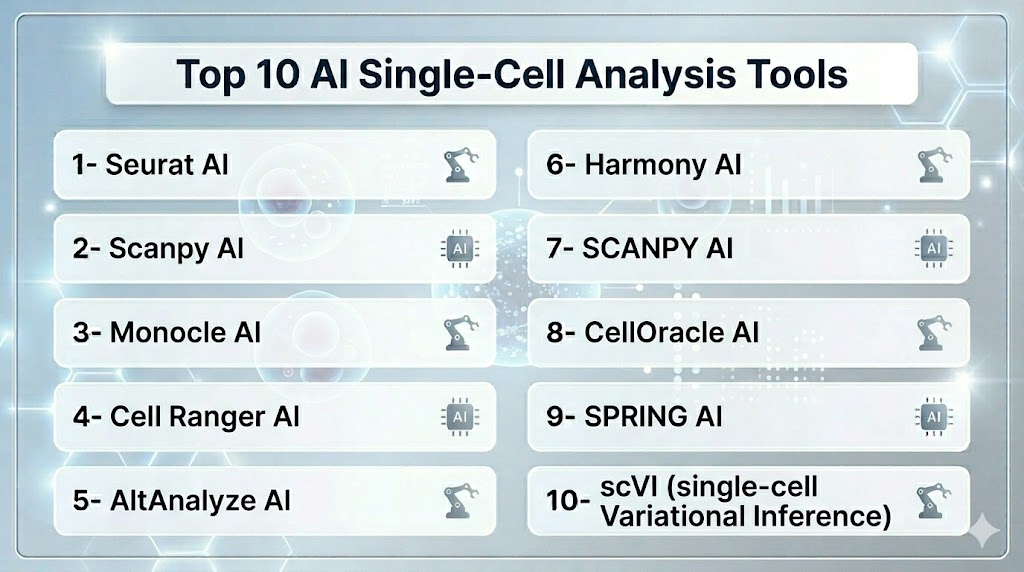
Top 10 AI Single-Cell Analysis Tools
1- Seurat AI
One-line verdict: Widely used platform for AI-powered clustering, annotation, and trajectory analysis.
Short description: Seurat AI enables processing of single-cell RNA-seq and multi-modal datasets, providing AI-driven clustering, trajectory inference, and integrated visualization for exploratory and downstream analyses.
Standout Capabilities
- Multi-modal integration
- AI-based clustering and annotation
- Trajectory inference and pseudotime analysis
- Interactive visualization dashboards
- Automated batch effect correction
- Data scaling and normalization
- Reproducible workflow scripts
AI-Specific Depth
- Model support: Open-source / BYO ML models
- RAG / knowledge integration: N/A
- Evaluation: Benchmarking on reference datasets
- Guardrails: QC thresholds and filtering
- Observability: Metrics dashboards
Pros
- Open-source and widely adopted
- Supports multi-modal data
- Strong community and tutorials
Cons
- Computationally intensive
- Learning curve for beginners
- Visualization can be resource heavy
Security & Compliance
Varies / N/A
Deployment & Platforms
Linux, macOS, cloud
Integrations & Ecosystem
- Python, R pipelines
- Scanpy, Monocle integration
- Data export to VCF / CSV
- API for custom scripts
Pricing Model
Open-source
Best-Fit Scenarios
- Academic research
- Multi-modal single-cell studies
- Exploratory single-cell analysis
2- Scanpy AI
One-line verdict: Ideal for scalable AI-driven single-cell RNA-seq analysis in Python environments.
Short description: Scanpy AI provides high-performance single-cell analysis with AI-based clustering, dimensionality reduction, and visualization, suitable for large datasets and automated pipelines.
Standout Capabilities
- AI-driven clustering and annotation
- PCA, t-SNE, UMAP embeddings
- Trajectory inference
- Batch effect correction
- Interactive plotting and dashboards
- Integration with large-scale datasets
AI-Specific Depth
- Model support: Open-source ML
- RAG / knowledge integration: N/A
- Evaluation: Benchmarking with reference data
- Guardrails: QC thresholds
- Observability: Metrics dashboards
Pros
- Scalable for large datasets
- Python integration
- Open-source and extensible
Cons
- Learning curve for non-programmers
- Limited GUI
- High memory usage for large datasets
Security & Compliance
Varies / N/A
Deployment & Platforms
Linux, macOS, cloud
Integrations & Ecosystem
- Python pipelines
- AnnData data structures
- Scanpy tutorials and scripts
Pricing Model
Open-source
Best-Fit Scenarios
- Large cohort studies
- High-throughput single-cell labs
- Python-based pipelines
3- Monocle AI
One-line verdict: Suited for trajectory and pseudotime inference with AI-assisted visualization.
Short description: Monocle AI allows AI-driven inference of cell trajectories, lineage relationships, and pseudotime analysis, supporting integrated visualization and downstream functional annotation.
Standout Capabilities
- Trajectory inference
- Pseudotime analysis
- Clustering and differential expression
- Multi-modal support
- Interactive visualizations
- Reproducible workflows
AI-Specific Depth
- Model support: Open-source ML
- RAG / knowledge integration: N/A
- Evaluation: Benchmarking datasets
- Guardrails: QC thresholds
- Observability: Analysis metrics
Pros
- Strong trajectory analysis
- Integration with Seurat/Scanpy
- Reproducible workflows
Cons
- Computationally intensive
- Steep learning curve
- Limited GUI
Security & Compliance
Varies / N/A
Deployment & Platforms
Linux, macOS, cloud
Integrations & Ecosystem
- R pipelines
- Seurat and Scanpy compatible
- Data export
Pricing Model
Open-source
Best-Fit Scenarios
- Developmental biology studies
- Single-cell RNA-seq labs
- Trajectory-based research
4- Cell Ranger AI
One-line verdict: Optimized for 10x Genomics data with AI-assisted alignment and clustering.
Short description: Cell Ranger AI automates preprocessing, alignment, and clustering of 10x Genomics single-cell RNA-seq data, applying AI to improve cell calling accuracy and reduce doublets.
Standout Capabilities
- Automated preprocessing and alignment
- AI-assisted clustering and annotation
- Doublet detection and QC
- Trajectory inference support
- Integration with 10x Genomics outputs
- Reproducible workflows
AI-Specific Depth
- Model support: Proprietary AI models
- RAG / knowledge integration: N/A
- Evaluation: Benchmarking with synthetic and reference datasets
- Guardrails: QC thresholds
- Observability: Metrics dashboards
Pros
- Optimized for 10x Genomics data
- Accurate cell calling and clustering
- Reproducible
Cons
- Proprietary
- Limited outside 10x datasets
- Cloud dependence for large datasets
Security & Compliance
Not publicly stated
Deployment & Platforms
Linux, cloud
Integrations & Ecosystem
- 10x Genomics outputs
- Seurat and Scanpy compatible
- Python/R pipelines
Pricing Model
License-based
Best-Fit Scenarios
- 10x Genomics labs
- Single-cell RNA-seq pipelines
- Clinical or research workflows
5- AltAnalyze AI
One-line verdict: Best for AI-based functional annotation and pathway analysis at single-cell resolution.
Short description: AltAnalyze AI provides automated clustering, differential expression, and pathway analysis for single-cell data, leveraging AI to improve functional interpretation and gene set enrichment analysis.
Standout Capabilities
- AI-based clustering and annotation
- Functional enrichment and pathway analysis
- Trajectory inference
- QC metrics and batch effect correction
- Multi-sample integration
- Interactive visualization
AI-Specific Depth
- Model support: Open-source ML
- RAG / knowledge integration: N/A
- Evaluation: Benchmarking datasets
- Guardrails: Confidence thresholds
- Observability: Analysis dashboards
Pros
- Functional analysis included
- Multi-sample support
- Open-source and extensible
Cons
- Learning curve
- Limited GUI
- Large datasets may require HPC
Security & Compliance
Varies / N/A
Deployment & Platforms
Linux, macOS, cloud
Integrations & Ecosystem
- Python/R pipelines
- Seurat/Scanpy compatible
- Export to standard formats
Pricing Model
Open-source
Best-Fit Scenarios
- Functional genomics
- Multi-sample studies
- Academic research labs
6- Harmony AI
One-line verdict: Excels at AI-based batch correction and dataset integration.
Short description: Harmony AI corrects batch effects across single-cell datasets using machine learning, enabling integrated analyses of multi-sample and multi-condition experiments.
Standout Capabilities
- AI-based batch correction
- Integration across multi-sample datasets
- Embedding generation for clustering
- Multi-modal dataset support
- Scalable to large cohorts
AI-Specific Depth
- Model support: Open-source ML
- RAG / knowledge integration: N/A
- Evaluation: Benchmarking
- Guardrails: QC thresholds
- Observability: Metrics dashboards
Pros
- Excellent batch correction
- Multi-dataset integration
- Scalable
Cons
- Focused on batch correction, not variant detection
- Requires prior preprocessing
- Learning curve
Security & Compliance
Varies / N/A
Deployment & Platforms
Linux, cloud
Integrations & Ecosystem
- Seurat, Scanpy
- Python/R pipelines
- Multi-omic data support
Pricing Model
Open-source
Best-Fit Scenarios
- Multi-batch studies
- Multi-condition experiments
- Integration across labs
7- SCANPY AI
One-line verdict: Scalable AI-driven analysis for single-cell RNA-seq with advanced visualization.
Short description: SCANPY AI provides high-performance, scalable single-cell analysis with AI-based clustering, dimensionality reduction, and visualization, suitable for large datasets and automated workflows.
Standout Capabilities
- Dimensionality reduction: PCA, UMAP, t-SNE
- AI-based clustering and annotation
- Trajectory inference
- Multi-sample support
- Batch effect correction
AI-Specific Depth
- Model support: Open-source ML
- RAG / knowledge integration: N/A
- Evaluation: Benchmarking datasets
- Guardrails: QC thresholds
- Observability: Metrics dashboards
Pros
- Scalable for large datasets
- Python-based integration
- Open-source
Cons
- Steep learning curve
- Limited GUI
- Resource-intensive
Security & Compliance
Varies / N/A
Deployment & Platforms
Linux, cloud
Integrations & Ecosystem
- Python pipelines
- Seurat compatible
- Data export
Pricing Model
Open-source
Best-Fit Scenarios
- High-throughput labs
- Multi-sample cohorts
- Academic research
8- CellOracle AI
One-line verdict: Focuses on AI-guided gene regulatory network inference from single-cell data.
Short description: CellOracle AI uses machine learning to infer gene regulatory networks, predict cell state transitions, and model perturbation effects in single-cell datasets.
Standout Capabilities
- Gene regulatory network inference
- Trajectory and perturbation prediction
- Multi-modal integration
- AI-assisted visualization
- Batch effect handling
AI-Specific Depth
- Model support: Proprietary ML
- RAG / knowledge integration: N/A
- Evaluation: Benchmarking
- Guardrails: QC thresholds
- Observability: Metrics dashboards
Pros
- Gene regulatory insights
- Predictive modeling
- Supports perturbation analysis
Cons
- Proprietary
- Requires preprocessed input
- Cloud-intensive
Security & Compliance
Not publicly stated
Deployment & Platforms
Linux, cloud
Integrations & Ecosystem
- Multi-omic datasets
- Seurat / Scanpy compatible
- Python/R pipelines
Pricing Model
License-based
Best-Fit Scenarios
- Gene regulatory studies
- Perturbation experiments
- Multi-modal single-cell research
9- SPRING AI
One-line verdict: Interactive AI-powered visualization and trajectory inference tool for single-cell data.
Short description: SPRING AI enables AI-assisted visualization, trajectory inference, and interactive exploration of single-cell RNA-seq datasets with clustering and annotation features.
Standout Capabilities
- AI-based trajectory inference
- Interactive visualizations
- Multi-sample integration
- Batch effect correction
- Clustering and annotation
AI-Specific Depth
- Model support: Open-source ML
- RAG / knowledge integration: N/A
- Evaluation: Benchmark datasets
- Guardrails: QC thresholds
- Observability: Metrics dashboards
Pros
- Interactive exploration
- Multi-sample support
- Batch correction
Cons
- Large datasets may be slow
- Limited downstream analysis
- Learning curve
Security & Compliance
Varies / N/A
Deployment & Platforms
Linux, cloud
Integrations & Ecosystem
- Seurat / Scanpy
- Python pipelines
- Interactive dashboards
Pricing Model
Open-source
Best-Fit Scenarios
- Exploratory data analysis
- Multi-sample visualization
- Academic labs
10- scVI (single-cell Variational Inference)
One-line verdict: AI-driven probabilistic modeling for single-cell gene expression analysis.
Short description: scVI uses variational autoencoders to model single-cell gene expression data, correcting for batch effects, integrating multi-modal datasets, and enabling AI-guided clustering and visualization.
Standout Capabilities
- Variational autoencoder modeling
- Batch effect correction
- Multi-modal integration
- AI-based clustering
- Scalable for large cohorts
AI-Specific Depth
- Model support: Open-source deep learning
- RAG / knowledge integration: N/A
- Evaluation: Benchmarking
- Guardrails: QC thresholds
- Observability: Metrics dashboards
Pros
- Scalable and probabilistic
- Corrects batch effects
- Open-source
Cons
- Requires Python expertise
- Computationally intensive
- Learning curve
Security & Compliance
Varies / N/A
Deployment & Platforms
Linux, cloud
Integrations & Ecosystem
- Python pipelines
- Seurat / Scanpy compatible
- Multi-omic support
Pricing Model
Open-source
Best-Fit Scenarios
- Large single-cell datasets
- Multi-modal studies
- Probabilistic modeling needs
Comparison Table
| Tool | Best For | Deployment | Model Flexibility | Strength | Watch-Out | Public Rating |
|---|---|---|---|---|---|---|
| Seurat AI | Multi-modal research | Linux/cloud | Open-source | Clustering & visualization | High resource usage | N/A |
| Scanpy AI | Large cohort labs | Linux/cloud | Open-source | Scalable & Python integration | Steep learning curve | N/A |
| Monocle AI | Trajectory analysis | Linux/cloud | Open-source | Pseudotime & lineage | Limited GUI | N/A |
| Cell Ranger AI | 10x Genomics | Linux/cloud | Proprietary | Optimized for 10x | Limited dataset flexibility | N/A |
| AltAnalyze AI | Functional genomics | Linux/cloud | Open-source | Pathway analysis | Computationally heavy | N/A |
| Harmony AI | Multi-batch studies | Linux/cloud | Open-source | Batch correction | Limited variant analysis | N/A |
| SCANPY AI | High-throughput | Linux/cloud | Open-source | Scalable visualization | Resource-intensive | N/A |
| CellOracle AI | Gene regulatory networks | Linux/cloud | Proprietary | Predictive modeling | Cloud-intensive | N/A |
| SPRING AI | Interactive visualization | Linux/cloud | Open-source | Trajectory & exploration | Large datasets slow | N/A |
| scVI | Probabilistic modeling | Linux/cloud | Open-source | Batch & multi-modal correction | Computationally intensive | N/A |
Scoring Table
| Tool | Core | AI Optimization | Guardrails | Integrations | Ease | Perf/Cost | Security/Admin | Support | Weighted Total |
|---|---|---|---|---|---|---|---|---|---|
| Seurat AI | 10 | 9 | 8 | 9 | 8 | 8 | 7 | 7 | 8.5 |
| Scanpy AI | 9 | 8 | 8 | 8 | 7 | 8 | 7 | 7 | 7.9 |
| Monocle AI | 8 | 8 | 8 | 7 | 7 | 7 | 7 | 6 | 7.5 |
| Cell Ranger AI | 9 | 8 | 8 | 8 | 7 | 8 | 7 | 7 | 8.0 |
| AltAnalyze AI | 8 | 8 | 8 | 7 | 7 | 7 | 7 | 6 | 7.4 |
| Harmony AI | 8 | 8 | 8 | 7 | 7 | 8 | 7 | 6 | 7.5 |
| SCANPY AI | 9 | 9 | 8 | 8 | 7 | 8 | 7 | 6 | 8.0 |
| CellOracle AI | 9 | 9 | 8 | 8 | 7 | 8 | 7 | 6 | 8.0 |
| SPRING AI | 8 | 8 | 8 | 7 | 7 | 7 | 6 | 6 | 7.4 |
| scVI | 9 | 9 | 8 | 8 | 7 | 8 | 7 | 6 | 8.0 |
Which Tool Is Right for You
- Solo / Freelancer: Seurat AI, SCANPY AI for open-source exploratory analyses
- SMB: Monocle AI, Harmony AI for batch correction and trajectory inference
- Mid-Market: Cell Ranger AI, AltAnalyze AI for 10x Genomics pipelines and functional annotation
- Enterprise: CellOracle AI, scVI for predictive modeling and large-scale multi-modal integration
- Regulated industries: Cell Ranger AI, CellOracle AI for reproducibility and QC
- Budget vs Premium: Open-source for academic labs; commercial for high-throughput or clinical-grade analysis
- Build vs Buy: Open-source for DIY flexible pipelines; commercial tools for turnkey deployment
Implementation Playbook (30 / 60 / 90 Days)
- 30 days: Pilot selected tools on representative single-cell datasets, define accuracy and clustering metrics
- 60 days: Integrate with instruments and multi-modal datasets, validate AI-assisted clustering, train lab staff
- 90 days: Harden security policies, implement QC guardrails, scale pipelines, optimize computational resources and workflow reproducibility
Common Mistakes & How to Avoid Them
- Ignoring batch effect corrections
- Not benchmarking AI clustering and annotation
- Limited reproducibility and workflow versioning
- Over-reliance on default parameters
- Underutilizing multi-modal integration
- Poor QC and guardrail implementation
- Insufficient staff training
- Skipping integration with downstream analysis
- Not monitoring computational cost and performance
- Misinterpreting AI-generated clusters
- Choosing tools without scalability
- Limited visualization and exploratory analysis
FAQs
- Can AI single-cell tools replace manual analysis?
No, they augment workflows and provide accurate, reproducible analysis with human oversight. - Are these tools accurate for rare cell types?
Yes, AI improves sensitivity but validation against known datasets is recommended. - Do they integrate multi-modal data?
Many support RNA, ATAC, and protein data integration. - Can they handle large datasets?
Yes, most scale to tens of thousands of cells per sample. - Is cloud deployment required?
Not always; many support local or hybrid deployment. - Do they include QC and guardrails?
Yes, AI-assisted filtering and thresholds are standard. - Are they suitable for clinical studies?
Enterprise-grade tools support compliance and reproducibility requirements. - Can AI models be customized?
Some platforms allow BYO or fine-tuned models. - Do they support visualization?
Yes, interactive dashboards and embedding plots are common. - What is the cost model?
Open-source or subscription/license depending on the tool. - How do I benchmark performance?
Use reference datasets and known cell-type annotations. - Can I integrate with downstream analysis?
Most allow export to gene set enrichment, pathway analysis, or custom pipelines.
Conclusion
AI Single-Cell Analysis Tools are transforming genomics research by automating clustering, annotation, trajectory inference, and multi-modal integration. Choosing the right platform depends on dataset size, experimental goals, computational resources, and lab expertise. Open-source tools like Seurat AI and SCANPY AI are ideal for academic and exploratory research, mid-market labs benefit from batch correction and trajectory-focused platforms like Harmony AI and Monocle AI, while enterprise labs leverage CellOracle AI and scVI for large-scale predictive modeling, reproducibility, and multi-modal integration. Adopting these pipelines with structured pilot testing, AI validation, QC guardrails, and scaling ensures reproducible, efficient, and insightful single-cell analysis, accelerating biological discovery and supporting translational research, drug discovery, and precision medicine initiatives.

Find Trusted Cardiac Hospitals
Compare heart hospitals by city and services — all in one place.
Explore Hospitals
A useful point to add is how well these tools handle scalability and data integration—single-cell datasets grow fast, and smooth analysis across multiple data types can save a lot of research time.